Adventures in Contacting the Russian FSB

KrebsOnSecurity recently had occasion to contact the Russian Federal Security Service (FSB), the Russian equivalent of the U.S. Federal Bureau of Investigation (FBI). In the process of doing so, I encountered a small snag: The FSB’s website said in order to communicate with them securely, I needed to download and install an encryption and virtual private networking (VPN) appliance that is flagged by at least 20 antivirus products as malware.

The FSB headquarters at Lubyanka Square, Moscow. Image: Wikipedia.

The reason I contacted the FSB — one of the successor agencies to the Russian KGB — ironically enough had to do with security concerns raised by an infamous Russian hacker about the FSB’s own preferred method of being contacted.

KrebsOnSecurity was seeking comment from the FSB about a blog post published by Vladislav “BadB” Horohorin, a former international stolen credit card trafficker who served seven years in U.S. federal prison for his role in the theft of $9 million from RBS WorldPay in 2009. Horohorin, a citizen of Russia, Israel and Ukraine, is now back where he grew up in Ukraine, running a cybersecurity consulting business.
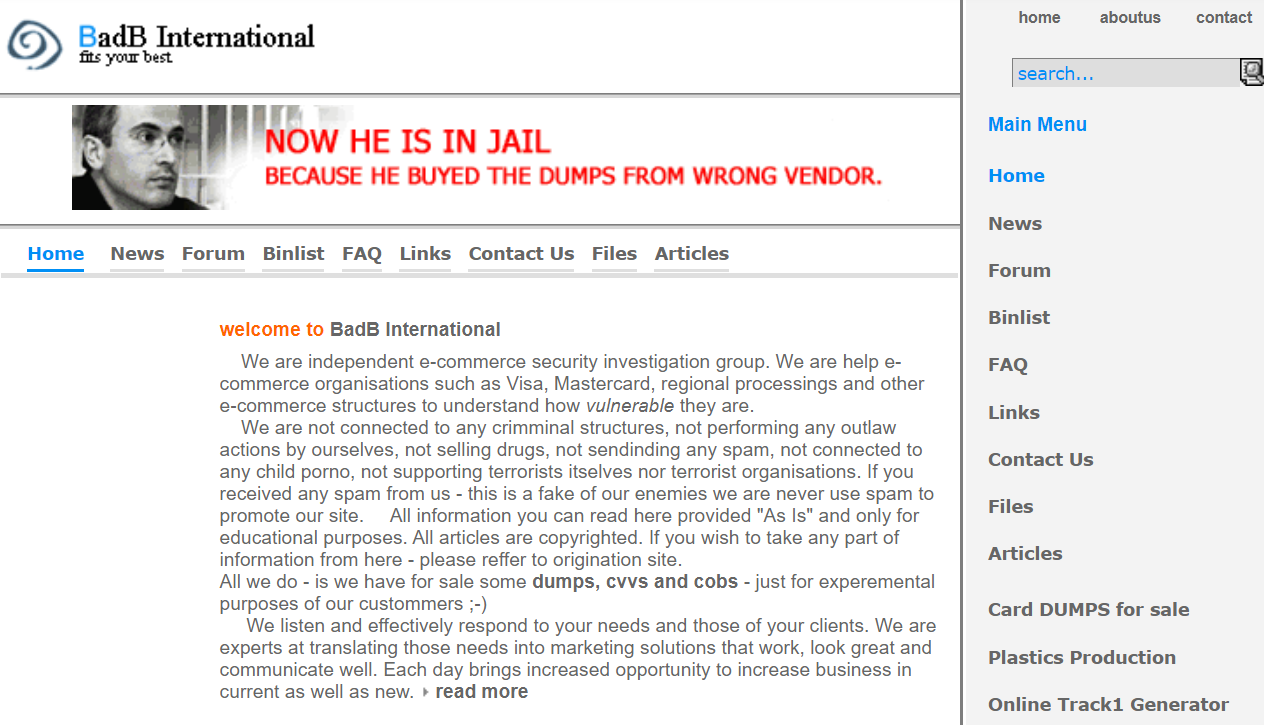
Horohorin’s BadB carding store, badb[.]biz, circa 2007. Image: Archive.org.

Visit the FSB’s website and you might notice its web address starts with http:// instead of https://, meaning the site is not using an encryption certificate. In practical terms, any information shared between the visitor and the website is sent in plain text and will be visible to anyone who has access to that traffic.

This appears to be the case regardless of which Russian government site you visit. According to Russian search giant Yandex, the laws of the Russian federation demand that encrypted connections be installed according to the Russian GOST cryptographic algorithm.

That means those who have a reason to send encrypted communications to a Russian government organization — including ordinary things like making a payment for a government license or fine, or filing legal documents — need to first install CryptoPro, a Windows-only application that loads the GOST encryption libraries on a user’s computer.

But if you want to talk directly to the FSB over an encrypted connection, you can just install their own client, which bundles the CryptoPro code. Visit the FSB’s site and select the option to “transfer meaningful information to operational units,” and you’ll see a prompt to install a “random number generation” application that is needed before a specific contact form on the FSB’s website will load properly.

Mind you, I’m not suggesting anyone go do that: Horohorin pointed out that this random number generator was flagged by 20 different antivirus and security products as malicious.

“Think well before contacting the FSB for any questions or dealing with them, and if you nevertheless decide to do this, it is better to use a virtual machine,” Horohorin wrote. “And a spacesuit. And, preferably, while in another country.”
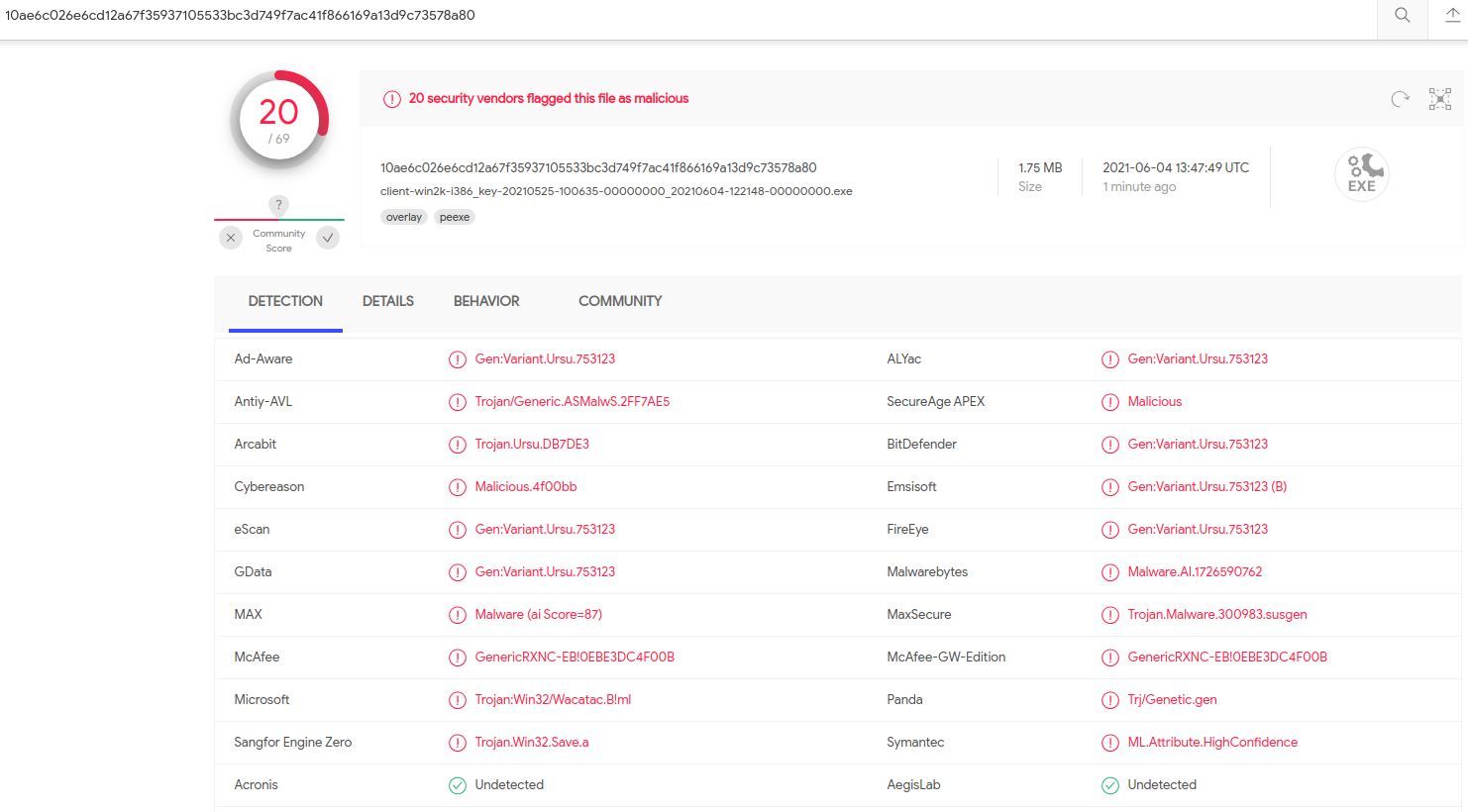
Antivirus product detections on the FSB’s VPN software. Image: VirusTotal.

It’s probably worth mentioning that the FSB is the same agency that’s been sanctioned for malicious cyber activity by the U.S. government on multiple occasions over the past five years. According to the most recent sanctions by the U.S. Treasury Department, the FSB is known for recruiting criminal hackers from underground forums and offering them legal cover for their actions.

“To bolster its malicious cyber operations, the FSB cultivates and co-opts criminal hackers, including the previously designated Evil Corp., enabling them to engage in disruptive ransomware attacks and phishing campaigns,” reads a Treasury assessment from April 2021.

While Horohorin seems convinced the FSB is disseminating malware, it is not unusual for a large number of security tools used by VirusTotal or other similar malware “sandbox” services to incorrectly flag safe files as bad or suspicious — an all-too-common condition known as a “false positive.”

Late last year I warned my followers on Twitter to put off installing updates for their Dell products until the company could explain why a bunch of its software drivers were being detected as malware by two dozen antivirus tools. Those all turned out to be false positives.

To really figure out what this FSB software was doing, I turned to Lance James, the founder of Unit221B, a New York City based cybersecurity firm. James said each download request generates a new executable program. That is because the uniqueness of the file itself is part of what makes the one-to-one encrypted connection possible.

“Essentially it is like a temporary, one-time-use VPN, using a separate key for each download” James said. “The executable is the handshake with you to exchange keys, as it stores the key for that session in the exe. It’s a terrible approach. But it’s what it is.”

James said the FSB’s program does not appear to be malware, at least in terms of the actions it takes on a user’s computer.

“There’s no sign of actual trojan activity here except the fact it self deletes,” James said. “It uses GOST encryption, and [the antivirus products] may be thinking that those properties look like ransomware.”

James says he suspects the antivirus false-positives were triggered by certain behaviors which could be construed as malware-like. The screenshot below — from VirusTotal — says some of the file’s contents align with detection rules made to find instances of ransomware.
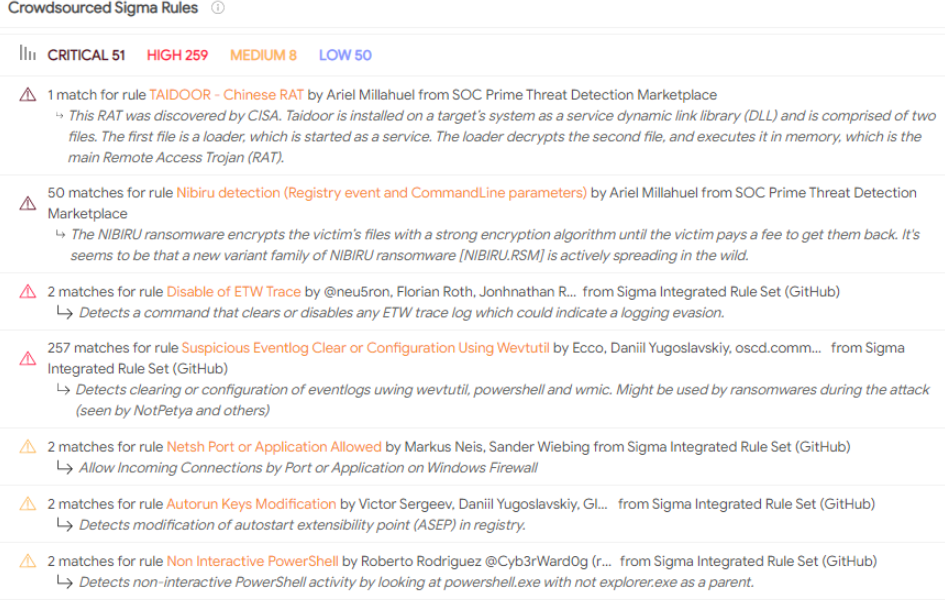
Some of the malware detection rules triggered by the FSB’s software. Source: VirusTotal.

Other detection rules tripped by this file include program routines that erase event logs from the user’s system — a behavior often seen in malware that is trying to hide its tracks.

On a hunch that just including the GOST encryption routine in a test program might be enough to trigger false positives in VirusTotal, James wrote and compiled a short program in C++ that invoked the GOST cipher but otherwise had no networking components. He then uploaded the file for scanning at VirusTotal.

Even though James’ test program did nothing untoward or malicious, it was flagged by six antivirus engines as potentially hostile. Symantec’s machine learning engine seemed particularly certain that James’ file might be bad, awarding it the threat name “ML.Attribute.HighConfidence” — the same designation it assigned to the FSB’s program.

KrebsOnSecurity installed the FSB’s software on a test computer using a separate VPN, and straight away it connected to an Internet address currently assigned to the FSB (213.24.76.xxx).

The program prompted me to click on various parts of the screen to generate randomness for an encryption key, and when that was done it left a small window which explained in Russian that the connection was established and that I should visit a specific link on the FSB’s site.
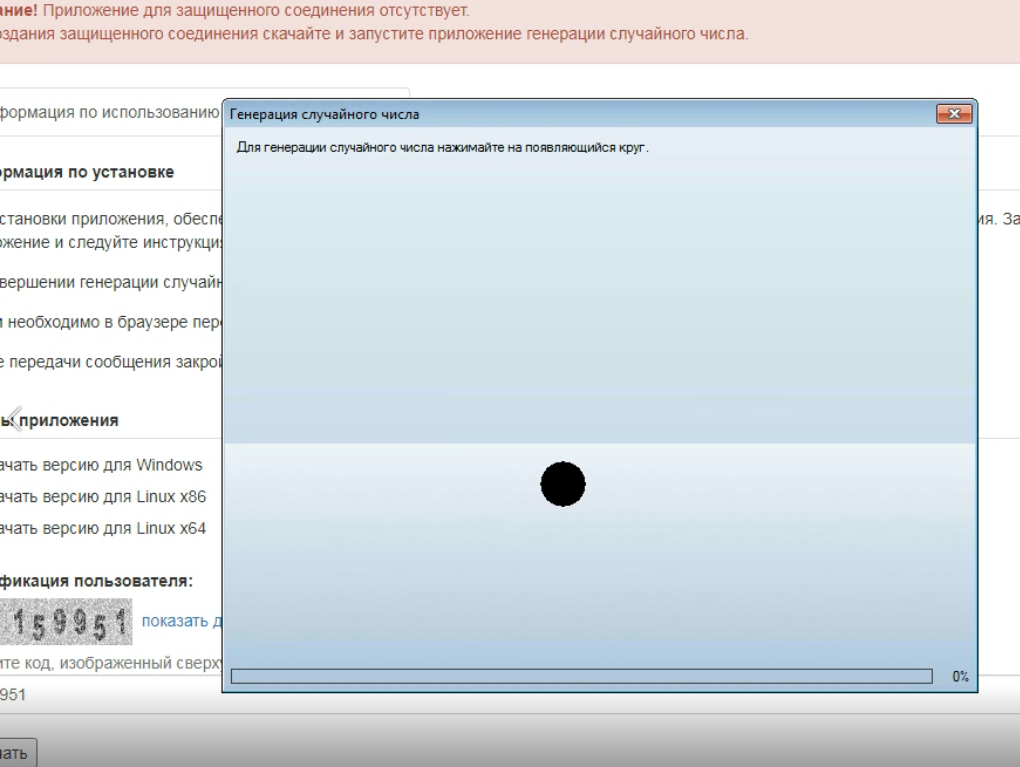
The FSB’s random number generator in action.

Doing so opened up a page where I could leave a message for the FSB. I asked them if they had any response to their program being broadly flagged as malware.
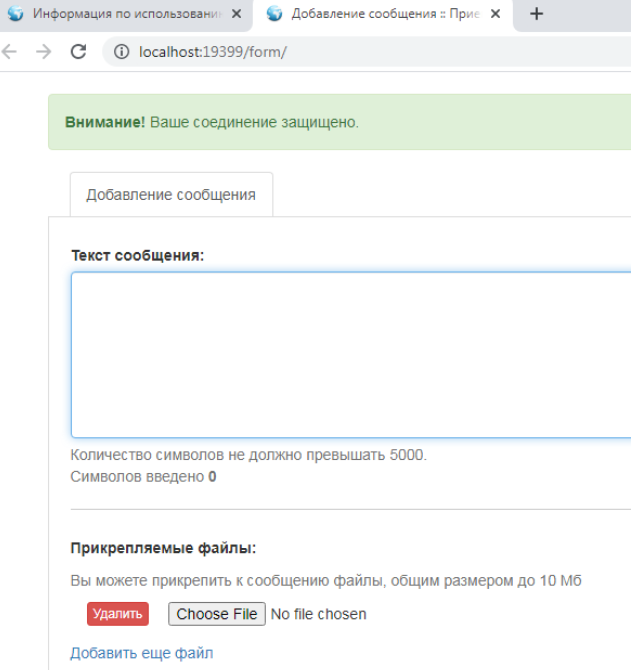
The contact form that ultimately appeared after installing the FSB’s software and clicking a specific link at fsb[.]ru.

After all the effort, I’m disappointed to report that I have not yet received a reply. Nor did I hear back from S-Terra CSP, the company that makes the VPN software offered by the FSB.

James said that given their position, he could see why many antivirus products might think it’s malware.

“Since they won’t use our crypto and we won’t use theirs,” James said. “It’s a great explanation on political weirdness with crypto.”

Still, James said, a number of things just don’t make sense about the way the FSB has chosen to deploy its one-time VPN software.

“The way they have set this up to suddenly trust a dynamically changing exe is still very concerning. Also, why would you send me a 256 random number generator seed in an exe when the computer has a perfectly valid and tested random number generator built in? You’re sending an exe to me with a key you decide over a non-secure environment. Why the fuck if you’re a top intelligence agency would you do that?”

Why indeed. I wonder how many people would share information about federal crimes with the FBI if the agency required everyone to install an executable file first — to say nothing of one that looks a lot like ransomware to antivirus firms?

“The application is running for a limited time to ensure your safety,” the FSB’s instructions assure, with just a gentle nudge of urgency. “Do not forget to close the application when finished.”

Yes, don’t forget that. Also, do not forget to incinerate your computer when finished.

source https://krebsonsecurity.com/2021/06/adventures-in-contacting-the-russian-fsb/
Using Fake Reviews to Find Dangerous Extensions

Fake, positive reviews have infiltrated nearly every corner of life online these days, confusing consumers while offering an unwelcome advantage to fraudsters and sub-par products everywhere. Happily, identifying and tracking these fake reviewer accounts is often the easiest way to spot scams. Here’s the story of how bogus reviews on a counterfeit Microsoft Authenticator browser extension exposed dozens of other extensions that siphoned personal and financial data.

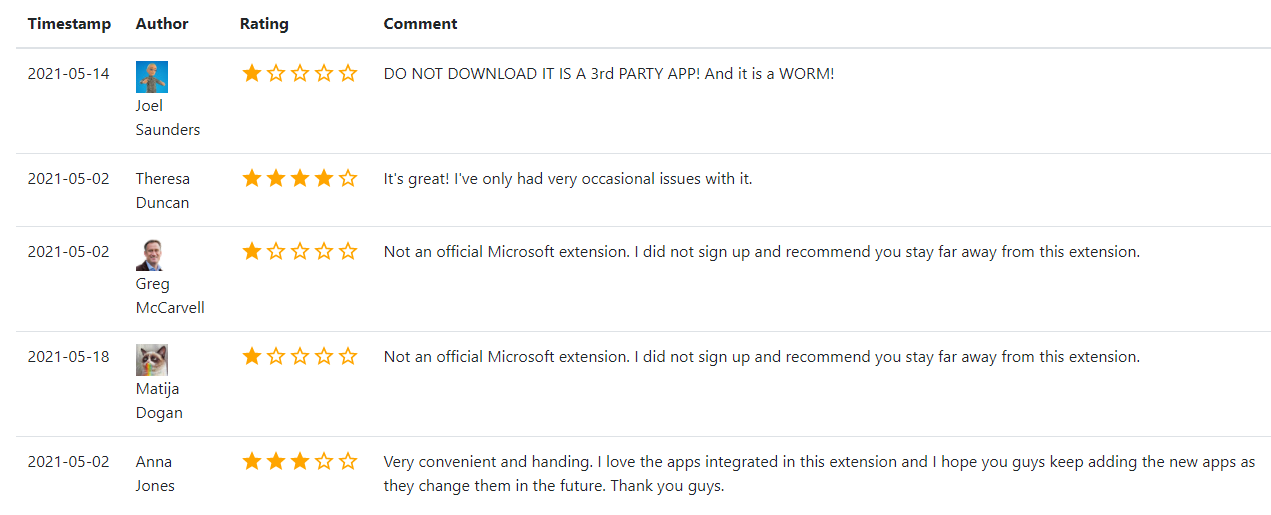
Comments on the fake Microsoft Authenticator browser extension show the reviews for these applications are either positive or very negative — basically calling it out as a scam. Image: chrome-stats.com.

After hearing from a reader about a phony Microsoft Authenticator extension that appeared on the Google Chrome Store, KrebsOnSecurity began looking at the profile of the account that created it. There were a total of five reviews on the extension before it was removed: Three Google users gave it one star, warning people to stay far away from it; but two of the reviewers awarded it between three and four stars.

“It’s great!,” the Google account Theresa Duncan enthused, improbably. “I’ve only had very occasional issues with it.”

“Very convenient and handing,” assessed Anna Jones, incomprehensibly.

Google’s Chrome Store said the email address tied to the account that published the knockoff Microsoft extension also was responsible for one called “iArtbook Digital Painting.” Before it was removed from the Chrome Store, iArtbook had garnered just 22 users and three reviews. As with the knockoff Microsoft extension, all three reviews were positive, and all were authored by accounts with first and last names, like Megan Vance, Olivia Knox, and Alison Graham.

Google’s Chrome Store doesn’t make it easy to search by reviewer. For that I turned to Hao Nguyen, the developer behind chrome-stats.com, which indexes and makes searchable a broad array of attributes about extensions available from Google.

Looking at the Google accounts that left positive reviews on both the now-defunct Microsoft Authenticator and iArtbook extensions, KrebsOnSecurity noticed that each left positive reviews on a handful of other extensions that have since been removed.

Reviews on the iArtbook extension were all from apparently fake Google accounts that each reviewed two other extensions, one of which was published by the same developer. This same pattern was observed across 45 now-defunct extensions.

Like an ever-expanding venn diagram, a review of the extensions commented on by each new fake reviewer found led to the discovery of even more phony reviewers and extensions. In total, roughly 24 hours worth of digging through chrome-stats.com unearthed more than 100 positive reviews on a network of patently fraudulent extensions.

Those reviews in turn lead to the relatively straightforward identification of:

-39 reviewers who were happy with extensions that spoofed major brands and requested financial data
-45 malicious extensions that collectively had close to 100,000 downloads
-25 developer accounts tied to multiple banned applications

The extensions spoofed a range of consumer brands, including Adobe, Amazon, Facebook, HBO, Microsoft, Roku and Verizon. Scouring the manifests for each of these other extensions in turn revealed that many of the same developers were tied to multiple apps being promoted by the same phony Google accounts.

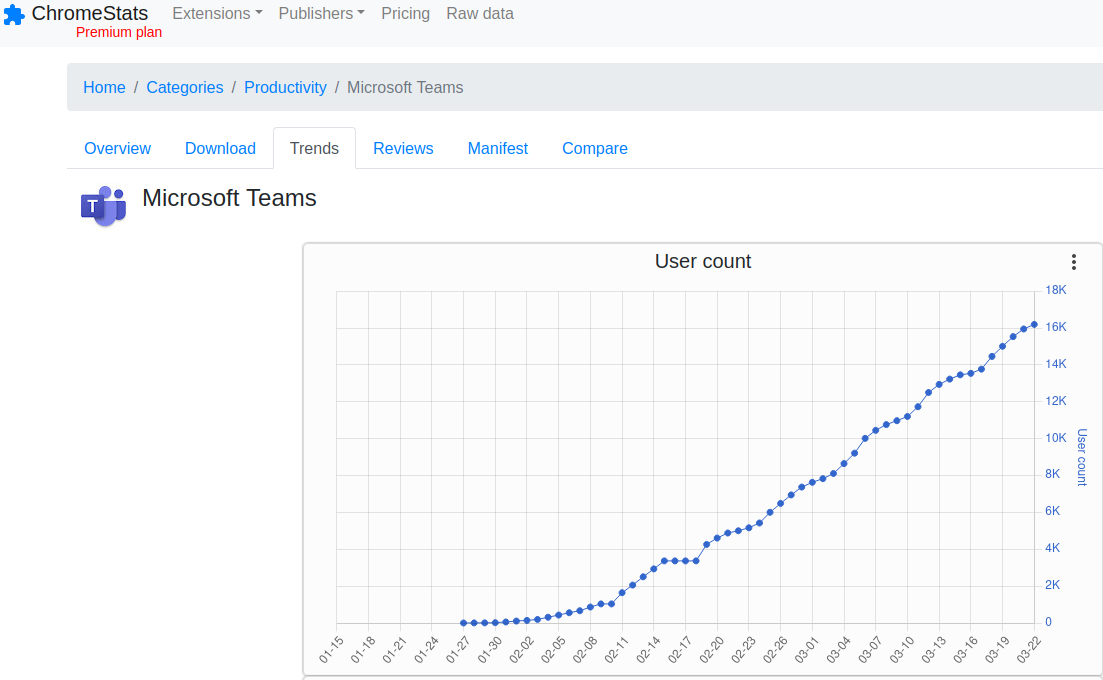
Some of the fake extensions have only a handful of downloads, but most have hundreds or thousands. A fake Microsoft Teams extension attracted 16,200 downloads in the roughly two months it was available from the Google store. A counterfeit version of CapCut, a professional video editing software suite, claimed nearly 24,000 downloads over a similar time period.

More than 16,000 people downloaded a fake Microsoft Teams browser extension over the roughly two months it was available for download from the Google Chrome store.

Unlike malicious browser extensions that can turn your PC into a botnet or harvest your cookies, none of the extensions examined here request any special permissions from users. Once installed, however, they invariably prompt the user to provide personal and financial data — all the while pretending to be associated with major brand names.

In some cases, the fake reviewers and phony extension developers used in this scheme share names, such as the case with “brook ice,” the Google account that positively reviewed the malicious Adobe and Microsoft Teams extensions. The email address brookice100@gmail.com was used to register the developer account responsible for producing two of the phony extensions examined in this review (PhotoMath and Dollify).

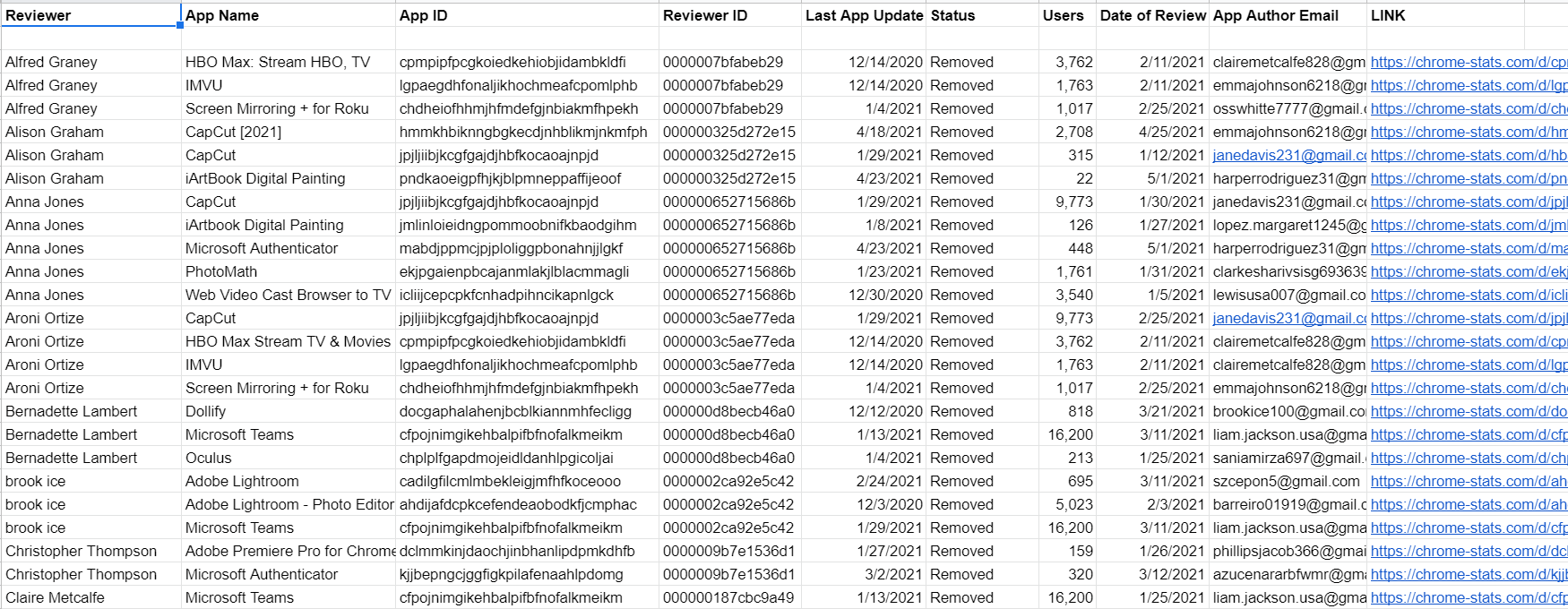
Some of the data that informed this report. The full spreadsheet is available as a link at the end of the story.

As we can see from the spreadsheet snippet above, many of the Google accounts that penned positive reviews on patently bogus extensions left comments on multiple apps on the same day.

Additionally, Google’s account recovery tools indicate many different developer email addresses tied to extensions reviewed here share the same recovery email — suggesting a relatively few number of anonymous users are controlling the entire scheme. When the spreadsheet data shown above is sorted by email address of the extension developer, the grouping of the reviews by date becomes even clearer.

KrebsOnSecurity shared these findings with Google and will update this story in the event they respond. Either way, Google somehow already detected all of these extensions as fraudulent and removed them from its store.

However, there may be a future post here about how long that bad extension identification and removal process has taken over time. Overall, most of these extensions were available for two to three months before being taken down.

As for the “so what?” here? I performed this research mainly because I could, and I thought it was interesting enough to share. Also, I got fascinated with the idea that finding fake applications might be as simple as identifying and following the likely fake reviewers. I’m positive there is more to this network of fraudulent extensions than is documented here.

As this story illustrates, it pays to be judicious about installing extensions. Leaving aside these extensions which are outright fraudulent, so many legitimate extensions get abandoned or sold each year to shady marketers that it’s wise to only trust extensions that are actively maintained (and perhaps have a critical mass of users that would make noise if anything untoward happened with the software).

According to chrome-stats.com, the majority of extensions — more than 100,000 of them — are effectively abandoned by their authors, or haven’t been updated in more than two years. In other words, there a great many developers who are likely to be open to someone else buying up their creation along with their user base.

The data that informed this report is searchable in this Google spreadsheet.

source https://krebsonsecurity.com/2021/05/using-fake-reviews-to-find-dangerous-extensions/

Boss of ATM Skimming Syndicate Arrested in Mexico

Florian “The Shark” Tudor, the alleged ringleader of a prolific ATM skimming gang that siphoned hundreds of millions of dollars from bank accounts of tourists visiting Mexico over the last eight years, was arrested in Mexico City on Thursday in response to an extradition warrant from a Romanian court.

Florian Tudor, at a 2020 press conference in Mexico in which he asserted he was a legitimate businessman and not a mafia boss. Image: OCCRP.

Tudor, a native of Craiova, Romania, moved to Mexico to set up Top Life Servicios, an ATM servicing company which managed a fleet of relatively new ATMs based in Mexico branded as Intacash.

Intacash was the central focus of a threepart investigation KrebsOnSecurity published in September 2015. That series tracked the activities of a crime gang working with Intacash that was bribing and otherwise coercing ATM technicians to install sophisticated Bluetooth-based skimmers inside cash machines throughout popular tourist destinations in and around Mexico’s Yucatan Peninsula — including Cancun, Cozumel, Playa del Carmen and Tulum.

Follow-up reporting last year by the Organized Crime and Corruption Reporting Project (OCCRP) found Tudor and his associates compromised more than 100 ATMs across Mexico using skimmers that were able to remain in place undetected for years. The OCCRP, which dubbed Tudor’s group “The Riviera Maya Gang,” estimates the crime syndicate used cloned card data and stolen PINs to steal more than $1.2 billion from bank accounts of tourists visiting the region.

Last year, a Romanian court ordered Tudor’s capture following his conviction in absentia for attempted murder, blackmail and the creation of an organized crime network that specialized in human trafficking.

Mexican authorities have been examining bank accounts tied to Tudor and his companies, and investigators believe Tudor and his associates paid protection and hush money to various Mexican politicians and officials over the years. In February, the leader of Mexico’s Green Party stepped down after it emerged that he received funds from Tudor’s group.

This is the second time Mexican authorities have detained Tudor. In April 2019, Tudor and his deputy were arrested for illegal firearms possession. That arrest came just months after Tudor allegedly ordered the execution of a former bodyguard who was trying to help U.S. authorities bring down the group’s lucrative skimming operations.

Tudor’s arrest this week inside the premises of the Mexican Attorney General’s Office did not go smoothly, according to Mexican news outlets. El Universal reports that a brawl broke out between Tudor’s lawyers and officials at the Mexican AG’s office, and a video released by the news outlet on Twitter shows Tudor resisting arrest as he is being hauled out of the building hand and foot.

A Mexican judge will decide on Tudor’s extradition to Romania in the coming weeks.

source https://krebsonsecurity.com/2021/05/boss-of-atm-skimming-syndicate-arrested-in-mexico/

How to Tell a Job Offer from an ID Theft Trap

One of the oldest scams around — the fake job interview that seeks only to harvest your personal and financial data — is on the rise, the FBI warns. Here’s the story of a recent LinkedIn impersonation scam that led to more than 100 people getting duped, and one almost-victim who decided the job offer was too-good-to-be-true.

Last week, someone began began posting classified notices on LinkedIn for different design consulting jobs at Geosyntec Consultants, an environmental engineering firm based in the Washington, D.C. area. Those who responded were told their application for employment was being reviewed and that they should email Troy Gwin — Geosyntec’s senior recruiter — immediately to arrange a screening interview.

Gwin contacted KrebsOnSecurity after hearing from job seekers trying to verify the ad, which urged respondents to email Gwin at a Gmail address that was not his. Gwin said LinkedIn told him roughly 100 people applied before the phony ads were removed for abusing the company’s terms of service.

“The endgame was to offer a job based on successful completion of background check which obviously requires entering personal information,” Gwin said. “Almost 100 people applied. I feel horrible about this. These people were really excited about this ‘opportunity’.”

Erica Siegel was particularly excited about the possibility of working in a creative director role she interviewed for at the fake Geosyntec. Siegel said her specialty — helping wealthy people develop their own personal brands — has been in low demand throughout the pandemic, so she’s applied to dozens of jobs and freelance gigs over the past few months.

On Monday, someone claiming to work with Gwin contacted Siegel and asked her to set up an online interview with Geosyntec. Siegel said the “recruiter” sent her a list of screening questions that all seemed relevant to the position being advertised.

Siegel said that within about an hour of submitting her answers, she received a reply saying the company’s board had unanimously approved her as a new hire, with an incredibly generous salary considering she had to do next to no work to get a job she could do from home.

Worried that her potential new dream job might be too-good-to-be-true, she sent the recruiter a list of her own questions that she had about the role and its position within the company.

But the recruiter completely ignored Siegel’s follow-up questions, instead sending a reply that urged her to get in touch with a contact in human resources to immediately begin the process of formalizing her employment. Which of course involves handing over one’s personal (driver’s license info) and financial details for direct deposit.

Multiple things about this job offer didn’t smell right to Siegel.

“I usually have six or seven interviews before getting a job,” Siegel said. “Hardly ever in my lifetime have I seen a role that flexible, completely remote and paid the kind of money I would ask for. You never get all three of those things.”

So she called her dad, an environmental attorney who happens to know and have worked with people at the real Geosyntec Consultants. Then she got in touch with the real Troy Gwin, who confirmed her suspicions that the whole thing was a scam.

“Even after the real Troy said they’d gotten these [LinkedIn] ads shut down, this guy was still emailing me asking for my HR information,” Siegel said. “So my dad said, ‘Troll him back, and tell him you want a signing bonus via money order.’ I was like, okay, what’s the worst that could happen? I never heard from him again.”

HOW TO SPOT A JOB SCAM

In late April, the FBI warned that technology is making these scams easier and more lucrative for fraudsters, who are particularly fond of impersonating recruiters.

“Fake Job or Employment Scams occur when criminal actors deceive victims into believing they have a job or a potential job,” the FBI warned. “Criminals leverage their position as “employers” to persuade victims to provide them with personally identifiable information (PII), become unwitting money mules, or to send them money.”

Last year, some 16,012 people reported being victims of employment scams with losses totaling more than $59 million, according to the FBI’s Internet Crime Complaint Center (IC3). But the real losses each year from employment scams are likely far higher; as the Justice Department often points out, relatively few victims of these crimes report the matter to the IC3.

LinkedIn said its platform uses automated and manual defenses to detect and address fake accounts or fraudulent payments.

“Any accounts or job posts that violate our policies are blocked from the site,” LinkedIn said in response to a request for comment. “The majority of fake job postings are stopped before going live on our site, and for those job postings that aren’t, whenever we find fake posts, we work to remove it quickly.”

LinkedIn’s most recent transparency report says these automated defenses block or automatically remove 98.4% of the fake accounts. But the scam that ensnared Gwin and Siegel is more of a hybrid, in that the majority of it operates outside of LinkedIn’s control via email services like Gmail and Yahoo.

This, by the way, should be a major red flag for anyone searching for a job, says the FBI: “Potential employers contact victims through non-company email domains and teleconference applications.”

Here are some other telltale signs of a job scam, as per the FBI:

-Interviews are not conducted in-person or through a secure video call.
-Potential employers contact victims through non-company email domains and teleconference applications.
-Potential employers require employees to purchase start-up equipment from the company.
-Potential employers require employees to pay upfront for background investigations or screenings.
-Potential employers request credit card information.
-Potential employers send an employment contract to physically sign asking for PII.
-Job postings appear on job boards, but not on the companies’ websites.
-Recruiters or managers do not have profiles on the job board, or the profiles do not seem to fit their roles.

source https://krebsonsecurity.com/2021/05/how-to-tell-a-job-offer-from-an-id-theft-trap/

Recycle Your Phone, Sure, But Maybe Not Your Number

Many online services allow users to reset their passwords by clicking a link sent via SMS, and this unfortunately widespread practice has turned mobile phone numbers into de facto identity documents. Which means losing control over one thanks to a divorce, job termination or financial crisis can be devastating.

Even so, plenty of people willingly abandon a mobile number without considering the potential fallout to their digital identities when those digits invariably get reassigned to someone else. New research shows how fraudsters can abuse wireless provider websites to identify available, recycled mobile numbers that allow password resets at a range of email providers and financial services online.

Researchers in the computer science department at Princeton University say they sampled 259 phone numbers at two major wireless carriers, and found 171 of them were tied to existing accounts at popular websites, potentially allowing those accounts to be hijacked.

The Princeton team further found 100 of those 259 numbers were linked to leaked login credentials on the web, which could enable account hijackings that defeat SMS-based multi-factor authentication.

“Our key finding is that attackers can feasibly leverage number recycling to target previous owners and their accounts,” the researchers wrote. “The moderate to high hit rates of our testing methods indicate that most recycled numbers are vulnerable to these attacks. Furthermore, by focusing on blocks of Likely recycled numbers, an attacker can easily discover available recycled numbers, each of which then becomes a potential target.”

The researchers located newly-recycled mobile numbers by browsing numbers made available to customers interested in signing up for a prepaid account at T-Mobile or Verizon (apparently AT&T doesn’t provide a similar interface). They said they were able to identify and ignore large blocks of new, unused numbers, as these blocks tend to be made available consecutively — much like newly printed money is consecutively numbered in stacks.

The Princeton team has a number of recommendations for T-Mobile and Verizon, noting that both carriers allow unlimited inquiries on their prepaid customer platforms online — meaning there is nothing to stop attackers from automating this type of number reconnaissance.

“On postpaid interfaces, Verizon already has safeguards and T-Mobile does not even support changing numbers online,” the researchers wrote. “However, the number pool is shared between postpaid and prepaid, rendering all subscribers vulnerable to attacks.”

They also recommend the carriers teach their support employees to remind customers about the risks of relinquishing a mobile number without first disconnecting it from other identities and sites online, advice they generally did not find was offered when interacting with customer support regarding number changes.

In addition, the carriers could offer their own “number parking” service for customers who know they will not require phone service for an extended period of time, or for those who just aren’t sure what they want to do with a number. Such services are already offered by companies like NumberBarn and Park My Phone, and they generally cost between $2-5 per month.

The Princeton study recommends consumers who are considering a number change instead either store the digits at an existing number parking service, or “port” the number to something like Google Voice. For a one-time $20 fee, Google Voice will let you port the number, and then you can continue to receive texts and calls to that number via Google Voice, or you can forward them to another number.

Porting seems like less of a hassle and potentially safer considering the average user has something like 150 accounts online, and a significant number of those accounts are going to be tied to one’s mobile number.

While you’re at it, consider removing your phone number as a primary or secondary authentication mechanism wherever possible. Many online services require you to provide a phone number upon registering an account, but in many cases that number can be removed from your profile afterwards.

It’s also important for people to use something other than text messages for two-factor authentication on their email accounts when stronger authentication options are available. Consider instead using a mobile app like AuthyDuo, or Google Authenticator to generate the one-time code. Or better yet, a physical security key if that’s an option.

The full Princeton study is available here (PDF).

source https://krebsonsecurity.com/2021/05/recycle-your-phone-sure-but-maybe-not-your-number/

Try This One Weird Trick Russian Hackers Hate

In a Twitter discussion last week on ransomware attacks, KrebsOnSecurity noted that virtually all ransomware strains have a built-in failsafe designed to cover the backsides of the malware purveyors: They simply will not install on a Microsoft Windows computer that already has one of many types of virtual keyboards installed — such as Russian or Ukrainian. So many readers had questions in response to the tweet that I thought it was worth a blog post exploring this one weird cyber defense trick.

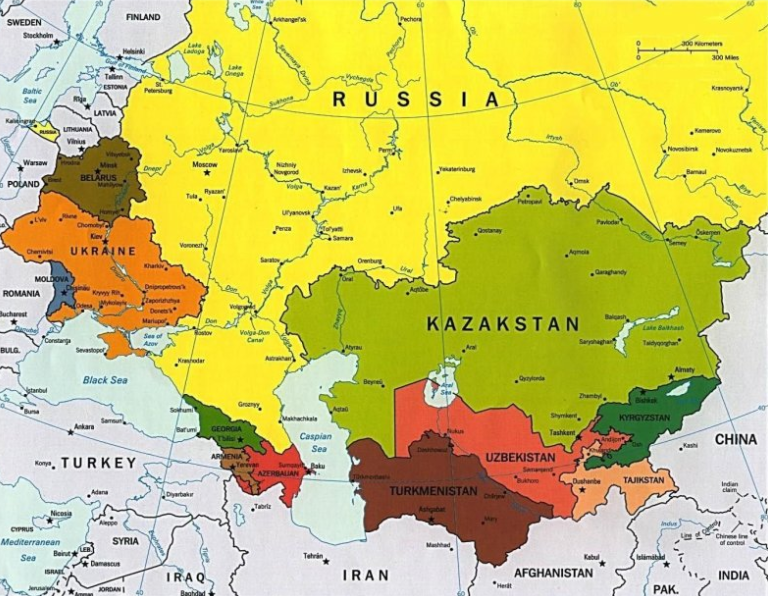
The Commonwealth of Independent States (CIS) more or less matches the exclusion list on an awful lot of malware coming out of Eastern Europe.

The Twitter thread came up in a discussion on the ransomware attack against Colonial Pipeline, which earlier this month shut down 5,500 miles of fuel pipe for nearly a week, causing fuel station supply shortages throughout the country and driving up prices. The FBI said the attack was the work of DarkSide, a new-ish ransomware-as-a-service offering that says it targets only large corporations.

DarkSide and other Russian-language affiliate moneymaking programs have long barred their criminal associates from installing malicious software on computers in a host of Eastern European countries, including Ukraine and Russia. This prohibition dates back to the earliest days of organized cybercrime, and it is intended to minimize scrutiny and interference from local authorities.

In Russia, for example, authorities there generally will not initiate a cybercrime investigation against one of their own unless a company or individual within the country’s borders files an official complaint as a victim. Ensuring that no affiliates can produce victims in their own countries is the easiest way for these criminals to stay off the radar of domestic law enforcement agencies.

Possibly feeling the heat from being referenced in President Biden’s Executive Order on cybersecurity this past week, the DarkSide group sought to distance itself from their attack against Colonial Pipeline. In a message posted to its victim shaming blog, DarkSide tried to say it was “apolitical” and that it didn’t wish to participate in geopolitics.

“Our goal is to make money, and not creating problems for society,” the DarkSide criminals wrote last week. “From today we introduce moderation and check each company that our partners want to encrypt to avoid social consequences in the future.”

But here’s the thing: Digital extortion gangs like DarkSide take great care to make their entire platforms geopolitical, because their malware is engineered to work only in certain parts of the world.

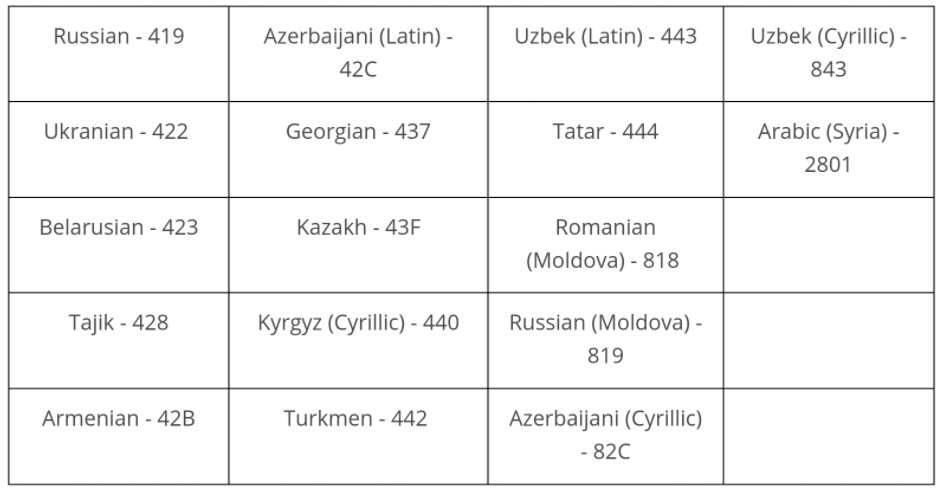
DarkSide, like a great many other malware strains, has a hard-coded do-not-install list of countries which are the principal members of the Commonwealth of Independent States (CIS) — former Soviet satellites that all currently have favorable relations with the Kremlin, including Azerbaijan, Belarus, Georgia, Romania, Turkmenistan, Ukraine and Uzbekistan. The full exclusion list in DarkSide (published by Cybereason) is below:

Image: Cybereason.

Simply put, countless malware strains will check for the presence of one of these languages on the system, and if they’re detected the malware will exit and fail to install.

[Side note. Many security experts have pointed to connections between the DarkSide and REvil (a.k.a. “Sodinokibi”) ransomware groups. REvil was previously known as GandCrab, and one of the many things GandCrab had in common with REvil was that both programs barred affiliates from infecting victims in Syria. As we can see from the chart above, Syria is also exempted from infections by DarkSide ransomware. And DarkSide itself proved their connection to REvil this past week when it announced it was closing up shop after its servers and bitcoin funds were seized.]

CAVEAT EMPTOR

Will installing one of these languages keep your Windows computer safe from all malware? Absolutely not. There is plenty of malware that doesn’t care where in the world you are. And there is no substitute for adopting a defense-in-depth posture, and avoiding risky behaviors online.

But is there really a downside to taking this simple, free, prophylactic approach? None that I can see, other than perhaps a sinking feeling of capitulation. The worst that could happen is that you accidentally toggle the language settings and all your menu options are in Russian.

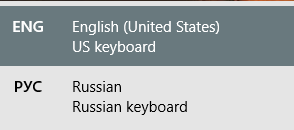
If this happens (and the first time it does the experience may be a bit jarring) hit the Windows key and the space bar at the same time; if you have more than one language installed you will see the ability to quickly toggle from one to the other. The little box that pops up when one hits that keyboard combo looks like this:

Cybercriminals are notoriously responsive to defenses which cut into their profitability, so why wouldn’t the bad guys just change things up start ignoring the language check? Well, they certainly can and maybe even will do that (a recent version of DarkSide analyzed by Mandiant did not perform the system language check).

But doing so increases the risk to their personal safety and fortunes by some non-trivial amount, said Allison Nixon, chief research officer at New York City-based cyber investigations firm Unit221B.

Nixon said because of Russia’s unique legal culture, criminal hackers in that country employ these checks to ensure they are only attacking victims outside of the country.

“This is for their legal protection,” Nixon said. “Installing a Cyrillic keyboard, or changing a specific registry entry to say ‘RU’, and so forth, might be enough to convince malware that you are Russian and off limits. This can technically be used as a ‘vaccine’ against Russian malware.”

Nixon said if enough people do this in large numbers, it may in the short term protect some people, but more importantly in the long term it forces Russian hackers to make a choice: Risk losing legal protections, or risk losing income.

“Essentially, Russian hackers will end up facing the same difficulty that defenders in the West must face — the fact that it is very difficult to tell the difference between a domestic machine and a foreign machine masquerading as a domestic one,” she said.

KrebsOnSecurity asked Nixon’s colleague at Unit221B — founder Lance James — what he thought about the efficacy of another anti-malware approach suggested by Twitter followers who chimed in on last week’s discussion: Adding entries to the Windows registry that specify the system is running as a virtual machine (VM). In a bid to stymie analysis by antivirus and security firms, some malware authors have traditionally configured their malware to quit installing if it detects it is running in a virtual environment.

But James said this prohibition is no longer quite so common, particularly since so many organizations have transitioned to virtual environments for everyday use.

“Being a virtual machine doesn’t stop malware like it used to,” James said. “In fact, a lot of the ransomware we’re seeing now is running on VMs.”

But James says he loves the idea of everyone adding a language from the CIS country list so much he’s produced his own clickable two-line Windows batch script that adds a Russian language reference in the specific Windows registry keys that are checked by malware. The script effectively allows one’s Windows PC to look like it has a Russian keyboard installed without actually downloading the added script libraries from Microsoft.

To install a different keyboard language on a Windows 10 computer the old fashioned way, hit the Windows key and X at the same time, then select Settings, and then select “Time and Language.” Select Language, and then scroll down and you should see an option to install another character set. Pick one, and the language should be installed the next time you reboot. Again, if for some reason you need to toggle between languages, Windows+Spacebar is your friend.

source https://krebsonsecurity.com/2021/05/try-this-one-weird-trick-russian-hackers-hate/

DarkSide Ransomware Gang Quits After Servers, Bitcoin Stash Seized

The DarkSide ransomware affiliate program responsible for the six-day outage at Colonial Pipeline this week that led to fuel shortages and price spikes across the country is running for the hills. The crime gang announced it was closing up shop after its servers were seized and someone drained the cryptocurrency from an account the group uses to pay affiliates.

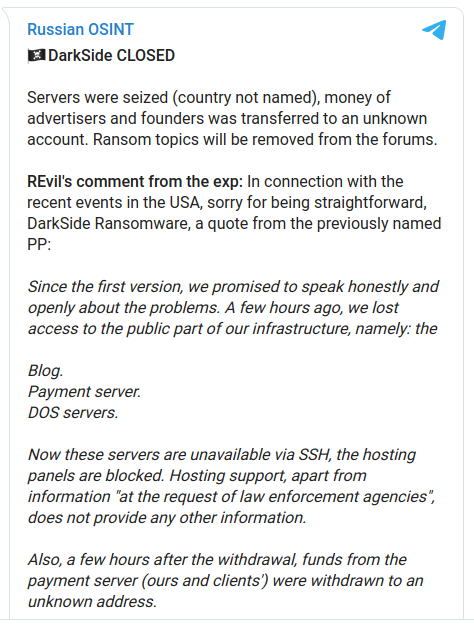
“Servers were seized (country not named), money of advertisers and founders was transferred to an unknown account,” reads a message from a cybercrime forum reposted to the Russian OSINT Telegram channel.

“A few hours ago, we lost access to the public part of our infrastructure,” the message continues, explaining the outage affected its victim shaming blog where stolen data is published from victims who refuse to pay a ransom. The outage also took down its payment server and those that supply its distributed denial-of-service feature, which is used to turn up the heat on victims who balk at paying.

“Also, a few hours after the withdrawal, funds from the payment server (ours and clients’) were withdrawn to an unknown address,” the DarkSide admin says.

DarkSide organizers also said they were releasing decryption tools for all of the companies that have been ransomed but which haven’t yet paid.

“After that, you will be free to communicate with them wherever you want in any way you want,” the instructions read.

The DarkSide message includes passages apparently penned by a leader of the REvil ransomware-as-a-service platform. This is interesting because security experts have posited that many of DarkSide’s core members are closely tied to the REvil gang.

The REvil representative said its program was introducing new restrictions on the kinds of organizations that affiliates could hold for ransom, and that henceforth it would be forbidden to attack those in the “social sector” (defined as healthcare and educational institutions) and organizations in the “gov-sector” (state) of any country. Affiliates also will be required to get approval before infecting victims.

The new restrictions came as some Russian cybercrime forums began distancing themselves from ransomware operations altogether. On Thursday, the administrator of the popular Russian forum XSS announced the forum would no longer allow discussion threads about ransomware moneymaking programs.

“There’s too much publicity,” the XSS administrator explained. “Ransomware has gathered a critical mass of nonsense, bullshit, hype, and fuss around it. The word ‘ransomware’ has been put on a par with a number of unpleasant phenomena, such as geopolitical tensions, extortion, and government-backed hacks. This word has become dangerous and toxic.”

In a blog post on the DarkSide closure, cyber intelligence firm Intel 471 said it believes all of these actions can be tied directly to the reaction related to the high-profile ransomware attacks covered by the media this week.

“However, a strong caveat should be applied to these developments: it’s likely that these ransomware operators are trying to retreat from the spotlight more than suddenly discovering the error of their ways,” Intel 471 wrote. “A number of the operators will most likely operate in their own closed-knit groups, resurfacing under new names and updated ransomware variants. Additionally, the operators will have to find a new way to ‘wash’ the cryptocurrency they earn from ransoms. Intel 471 has observed that BitMix, a popular cryptocurrency mixing service used by Avaddon, DarkSide and REvil has allegedly ceased operations. Several apparent customers of the service reported they were unable to access BitMix in the last week.”

source https://krebsonsecurity.com/2021/05/darkside-ransomware-gang-quits-after-servers-bitcoin-stash-seized/

Microsoft Patch Tuesday, May 2021 Edition

Microsoft today released fixes to plug at least 55 security holes in its Windows operating systems and other software. Four of these weaknesses can be exploited by malware and malcontents to seize complete, remote control over vulnerable systems without any help from users. On deck this month are patches to quash a wormable flaw, a creepy wireless bug, and yet another reason to call for the death of Microsoft’s Internet Explorer (IE) web browser.

While May brings about half the normal volume of updates from Microsoft, there are some notable weaknesses that deserve prompt attention, particularly from enterprises. By all accounts, the most pressing priority this month is CVE-2021-31166, a Windows 10 and Windows Server flaw which allows an unauthenticated attacker to remotely execute malicious code at the operating system level. With this weakness, an attacker could compromise a host simply by sending it a specially-crafted packet of data.

“That makes this bug wormable, with even Microsoft calling that out in their write-up,” said Dustin Childs, with Trend Micro’s ZDI program. “Before you pass this aside, Windows 10 can also be configured as a web server, so it is impacted as well. Definitely put this on the top of your test-and-deploy list.”

Kevin Breen from Immersive Labs said the fact that this one is just 0.2 points away from a perfect 10 CVSS score should be enough to identify just how important it is to patch.

“For ransomware operators, this kind of vulnerability is a prime target for exploitation,” Breen said. “Wormable exploits should always be a high priority, especially if they are for services that are designed to be public facing. As this specific exploit would not require any form of authentication, it’s even more appealing for attackers, and any organization using HTTP.sys protocol stack should prioritize this patch.”

Breen also called attention to CVE-2021-26419 — a vulnerability in Internet Explorer 11 — to make the case for why IE needs to stand for “Internet Exploder.” To trigger this vulnerability, a user would have to visit a site that is controlled by the attacker, although Microsoft also recognizes that it could be triggered by embedding ActiveX controls in Office Documents.

“IE needs to die – and I’m not the only one that thinks so,” Breen said. “If you are an organization that has to provide IE11 to support legacy applications, consider enforcing a policy on the users that restricts the domains that can be accessed by IE11 to only those legacy applications. All other web browsing should be performed with a supported browser.”

Another curious bug fixed this month is CVE-2020-24587, described as a “Windows Wireless Networking Information Disclosure Vulnerability.” ZDI’s Childs said this one has the potential to be pretty damaging.

“This patch fixes a vulnerability that could allow an attacker to disclose the contents of encrypted wireless packets on an affected system,” he said. “It’s not clear what the range on such an attack would be, but you should assume some proximity is needed. You’ll also note this CVE is from 2020, which could indicate Microsoft has been working on this fix for some time.”

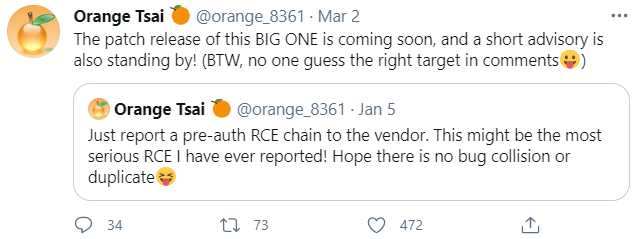
Microsoft also patched four more security holes its Exchange Server corporate email platform, which recently was besieged by attacks on four other zero-day Exchange flaws that resulted in hundreds of thousands of servers worldwide getting hacked. One of the bugs is credited to Orange Tsai of the DEVCORE research team, who was responsible for disclosing the ProxyLogon Exchange Server vulnerability that was patched in an out-of-band release back in March.

Researcher Orange Tsai commenting that nobody guessed the remote zero-day he reported on Jan. 5, 2021 to Microsoft was in Exchange Server.

“While none of these flaws are deemed critical in nature, it is a reminder that researchers and attackers are still looking closely at Exchange Server for additional vulnerabilities, so organizations that have yet to update their systems should do so as soon as possible,” said Satnam Narang, staff research engineer at Tenable.

As always, it’s a good idea for Windows users to get in the habit of updating at least once a month, but for regular users (read: not enterprises) it’s usually safe to wait a few days until after the patches are released, so that Microsoft has time to iron out any kinks in the new armor.

But before you update, please make sure you have backed up your system and/or important files. It’s not uncommon for a Windows update package to hose one’s system or prevent it from booting properly, and some updates have been known to erase or corrupt files.

So do yourself a favor and backup before installing any patches. Windows 10 even has some built-in tools to help you do that, either on a per-file/folder basis or by making a complete and bootable copy of your hard drive all at once.

And if you wish to ensure Windows has been set to pause updating so you can back up your files and/or system before the operating system decides to reboot and install patches on its own schedule, see this guide.

If you experience glitches or problems installing any of these patches this month, please consider leaving a comment about it below; there’s a better-than-even chance other readers have experienced the same and may chime in here with some helpful tips.

source https://krebsonsecurity.com/2021/05/microsoft-patch-tuesday-may-2021-edition/

A Closer Look at the DarkSide Ransomware Gang

The FBI confirmed this week that a relatively new ransomware group known as DarkSide is responsible for an attack that caused Colonial Pipeline to shut down 5,550 miles of pipe, stranding countless barrels of gasoline, diesel and jet fuel on the Gulf Coast. Here’s a closer look at the DarkSide cybercrime gang, as seen through their negotiations with a recent U.S. victim that earns $15 billion in annual revenue.

Colonial Pipeline has shut down 5,500 miles of fuel pipe in response to a ransomware incident. Image: colpipe.com

New York City-based cyber intelligence firm Flashpoint said its analysts assess with a moderate-strong degree of confidence that the attack was not intended to damage national infrastructure and was simply associated with a target which had the finances to support a large payment.

“This would be consistent with DarkSide’s earlier activities, which included several ‘big game hunting’ attacks, whereby attackers target an organization that likely possesses the financial means to pay the ransom demanded by the attackers,” Flashpoint observed.

In response to public attention to the Colonial Pipeline attack, the DarkSide group sought to play down fears about widespread infrastructure attacks going forward.

“We are apolitical, we do not participate in geopolitics, do not need to tie us with a defined government and look for other our motives [sic],” reads an update to the DarkSide Leaks blog. “Our goal is to make money, and not creating problems for society. From today we introduce moderation and check each company that our partners want to encrypt to avoid social consequences in the future.”

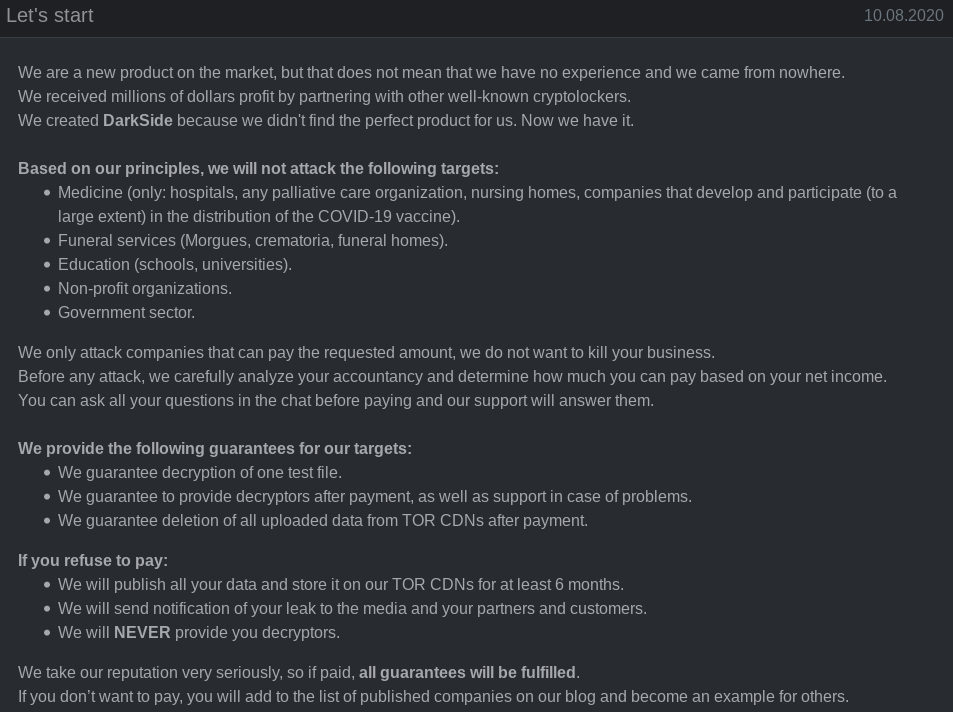
First surfacing on Russian language hacking forums in August 2020, DarkSide is a ransomware-as-a-service platform that vetted cybercriminals can use to infect companies with ransomware and carry out negotiations and payments with victims. DarkSide says it targets only big companies, and forbids affiliates from dropping ransomware on organizations in several industries, including healthcare, funeral services, education, public sector and non-profits.

Like other ransomware platforms, DarkSide adheres to the current badguy best practice of double extortion, which involves demanding separate sums for both a digital key needed to unlock any files and servers, and a separate ransom in exchange for promise to destroy any data stolen from the victim.

At its launch, DarkSide sought to woo affiliates from competing ransomware programs by advertising a victim data leak site that gets “stable visits and media coverage,” as well as the ability to publish victim data by stages. Under the “Why choose us?” heading of the ransomware program thread, the admin answers:

An advertisement for the DarkSide ransomware group.

“High trust level of our targets. They pay us and know that they’re going to receive decryption tools. They also know that we download data. A lot of data. That’s why the percent of our victims who pay the ransom is so high and it takes so little time to negotiate.”

In late March, DarkSide introduced a “call service” innovation that was integrated into the affiliate’s management panel, which enabled the affiliates to arrange calls pressuring victims into paying ransoms directly from the management panel.

In mid-April the ransomware program announced new capability for affiliates to launch distributed denial-of-service (DDoS) attacks against targets whenever added pressure is needed during ransom negotiations.

DarkSide also has advertised a willingness to sell information about upcoming victims before their stolen information is published on the DarkSide victim shaming blog, so that enterprising investment scammers can short the company’s stock in advance of the news.

“Now our team and partners encrypt many companies that are trading on NASDAQ and other stock exchanges,” DarkSide explains. “If the company refuses to pay, we are ready to provide information before the publication, so that it would be possible to earn in the reduction price of shares. Write to us in ‘Contact Us’ and we will provide you with detailed information.”

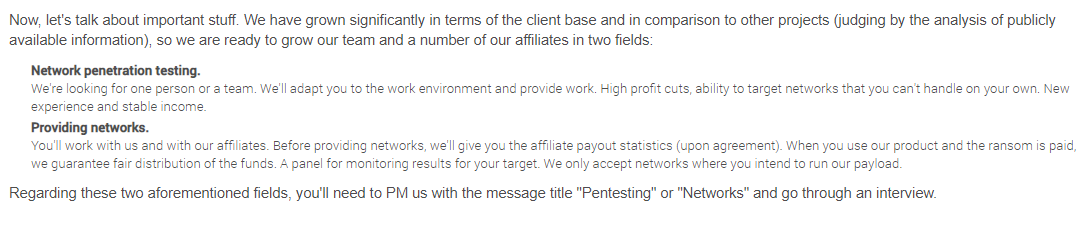
DarkSide also started recruiting new affiliates again last month — mainly seeking network penetration testers who can help turn a single compromised computer into a full-on data breach and ransomware incident.

Portions of a DarkSide recruitment message, translated from Russian. Image: Intel 471.

“We have grown significantly in terms of the client base and in comparison to other projects (judging by the analysis of publicly available information), so we are ready to grow our team and a number of our affiliates in two fields,” DarkSide explained. The advertisement continued:

“Network penetration testing. We’re looking for one person or a team. We’ll adapt you to the work environment and provide work. High profit cuts, ability to target networks that you can’t handle on your own. New experience and stable income. When you use our product and the ransom is paid, we guarantee fair distribution of the funds. A panel for monitoring results for your target. We only accept networks where you intend to run our payload.”

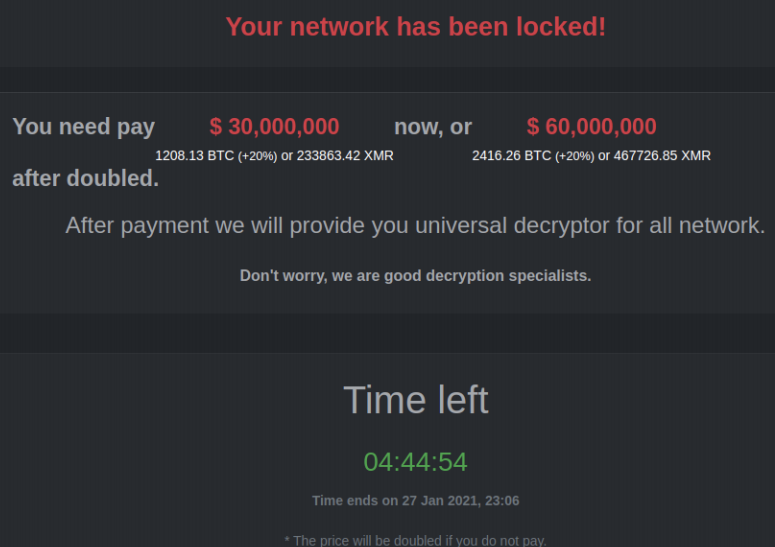
DarkSide has shown itself to be fairly ruthless with victim companies that have deep pockets, but they can be reasoned with. Cybersecurity intelligence firm Intel 471 observed a negotiation between the DarkSide crew and a $15 billion U.S. victim company that was hit with a $30 million ransom demand in January 2021, and in this incident the victim’s efforts at negotiating a lower payment ultimately reduce the ransom demand by almost two-thirds.

The DarkSide ransomware note.

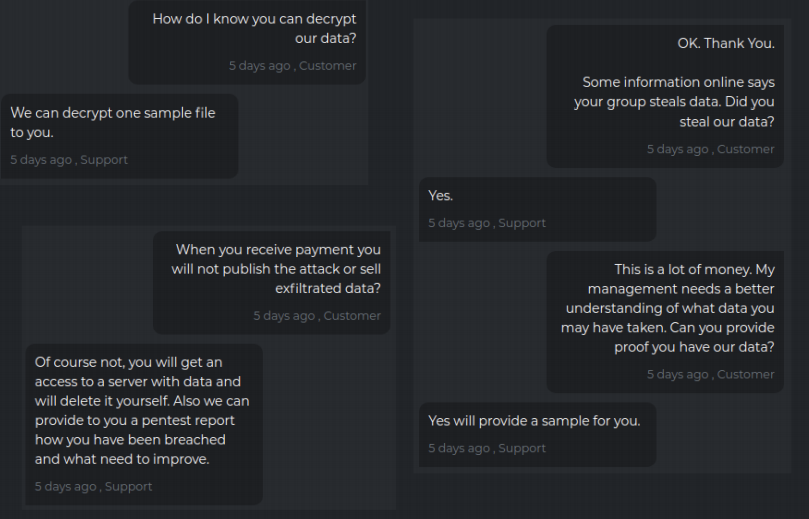
The first exchange between DarkSide and the victim involved the usual back-and-forth establishing of trust, wherein the victim asks for assurances that stolen data will be deleted after payment.

Image: Intel 471.

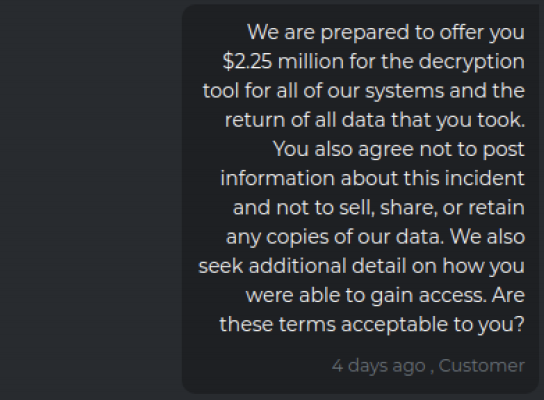
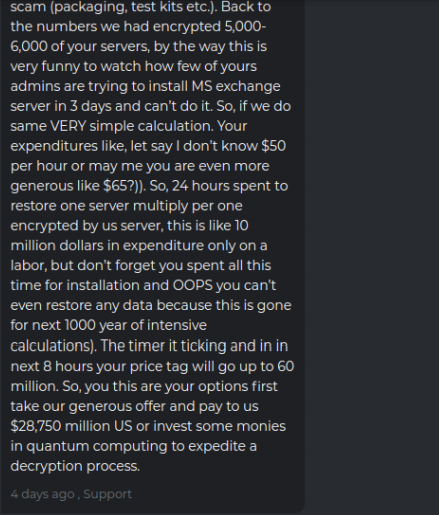
When the victim counter-offered to pay just $2.25 million, DarkSide responded with a lengthy, derisive reply, ultimately agreeing to lower the ransom demand to $28.7 million.

“The timer it [sic] ticking and in in next 8 hours your price tag will go up to $60 million,” the crooks replied. “So, you this are your options first take our generous offer and pay to us $28,750 million US or invest some monies in quantum computing to expedite a decryption process.”

Image: Intel 471.

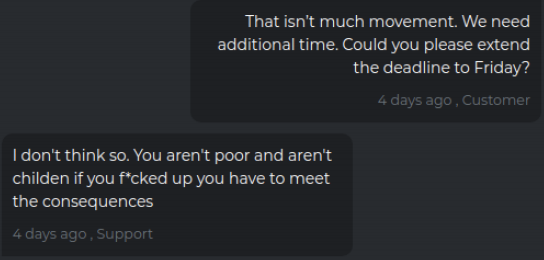
The victim complains that negotiations haven’t moved the price much, but DarkSide countered that the company can easily afford the payout. “I don’t think so,” they wrote. “You aren’t poor and aren’t children if you f*cked up you have to meet the consequences.”

Image: Intel 471.

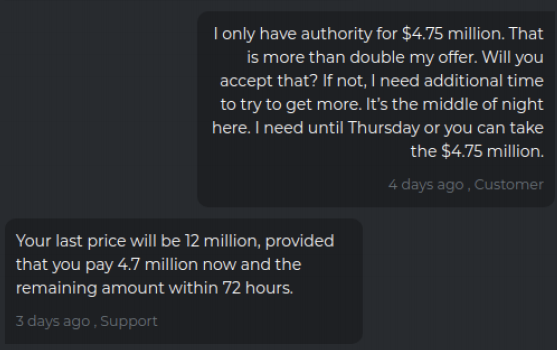
The victim firm replies a day later saying they’ve gotten authority to pay $4.75 million, and their tormentors agree to lower the demand significantly to $12 million.

Image: Intel 471.

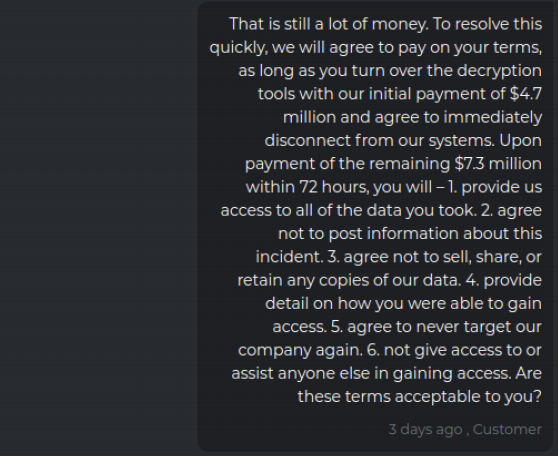
The victim replies that this is still a huge amount, and it tries to secure additional assurances from the ransomware group if it agrees to pay the $12 million, such as an agreement not to target the company ever again, or give anyone access to its stolen data. The victim also tried to get the attackers to hand over a decryption key before paying the full ransom demand.

Image: Intel 471.

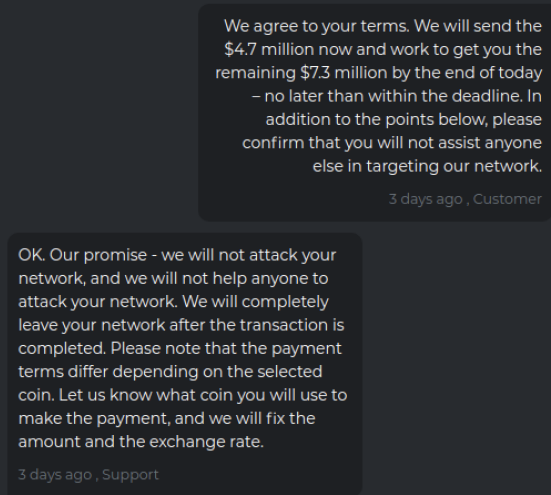
The crime gang responded that its own rules prohibit it from giving away a decryption key before full payment is made, but they agree to the rest of the terms.

Image: Intel 471.

The victim firm agrees to pay an $11 million ransom, and their extortionists concur and promise not to attack or help anyone else attack the company’s network going forward.

Image: Intel 471

Flashpoint assesses that at least some of the criminals behind DarkSide hail from another ransomware outfit called “REvil,” a.k.a. “Sodinokibi” (although Flashpoint rates this finding at only “moderate” confidence). REvil is widely considered to be the newer name for GandCrab, a ransomware-as-a-service offering that closed up shop in 2019 after bragging that it had extorted more than $2 billion.

Experts say ransomware attacks will continue to grow in sophistication, frequency and cost unless something is done to disrupt the ability of crooks to get paid for such crimes. According to a report late last year from Coveware, the average ransomware payment in the third quarter of 2020 was $233,817, up 31 percent from the second quarter of last year. Security firm Emsisoft found that almost 2,400 U.S.-based governments, healthcare facilities and schools were victims of ransomware in 2020.

Last month, a group of tech industry heavyweights lent their imprimatur to a task force that delivered an 81-page report to the Biden administration on ways to stymie the ransomware industry. Among many other recommendations, the report urged the White House to make finding, frustrating and apprehending ransomware crooks a priority within the U.S. intelligence community, and to designate the current scourge of digital extortion as a national security threat.

source https://krebsonsecurity.com/2021/05/a-closer-look-at-the-darkside-ransomware-gang/

Fintech Startup Offers $500 for Payroll Passwords

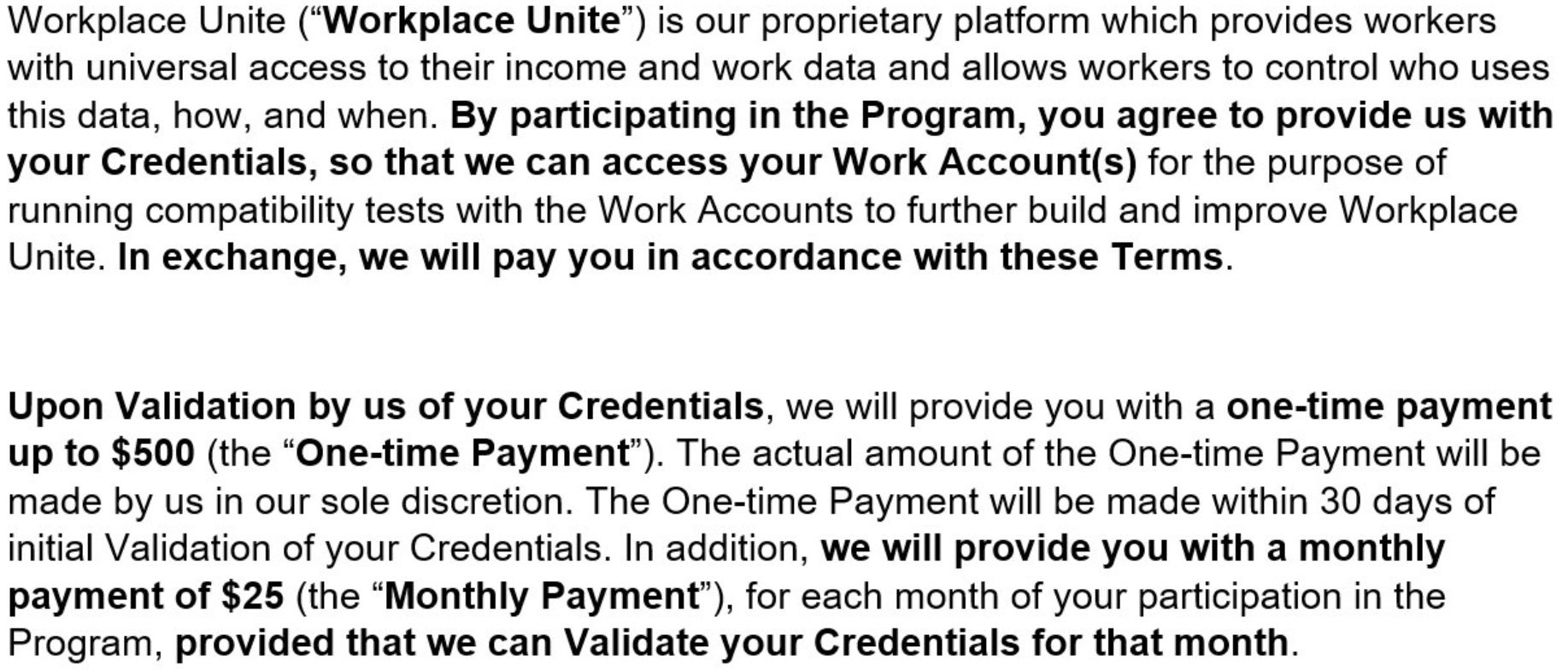
How much is your payroll data worth? Probably a lot more than you think. One financial startup that’s targeting the gig worker market is offering up to $500 to anyone willing to hand over the payroll account username and password given to them by their employer, plus a regular payment for each month afterwards in which those credentials still work.

This ad, from workplaceunited[.]com, promised up to $500 for people who provided their payroll passwords, plus $25 a month for each month those credentials kept working.

New York-based Argyle.com says it’s building a platform where people who work multiple jobs and/or side hustles can improve their credit and employment options by pooling all of their gig work data in one place.

“Consumers’ access to financial security and upward mobility is dependent on their access to and control over their own employment records and how easily they can share those records with financial institutions,” Argyle explained in a May 3 blog post. “We enable access to a dataset that, for too long, has gone unstandardized, unregulated, and controlled by corporations instead of consumers, contributing to system-wide inequalities.”

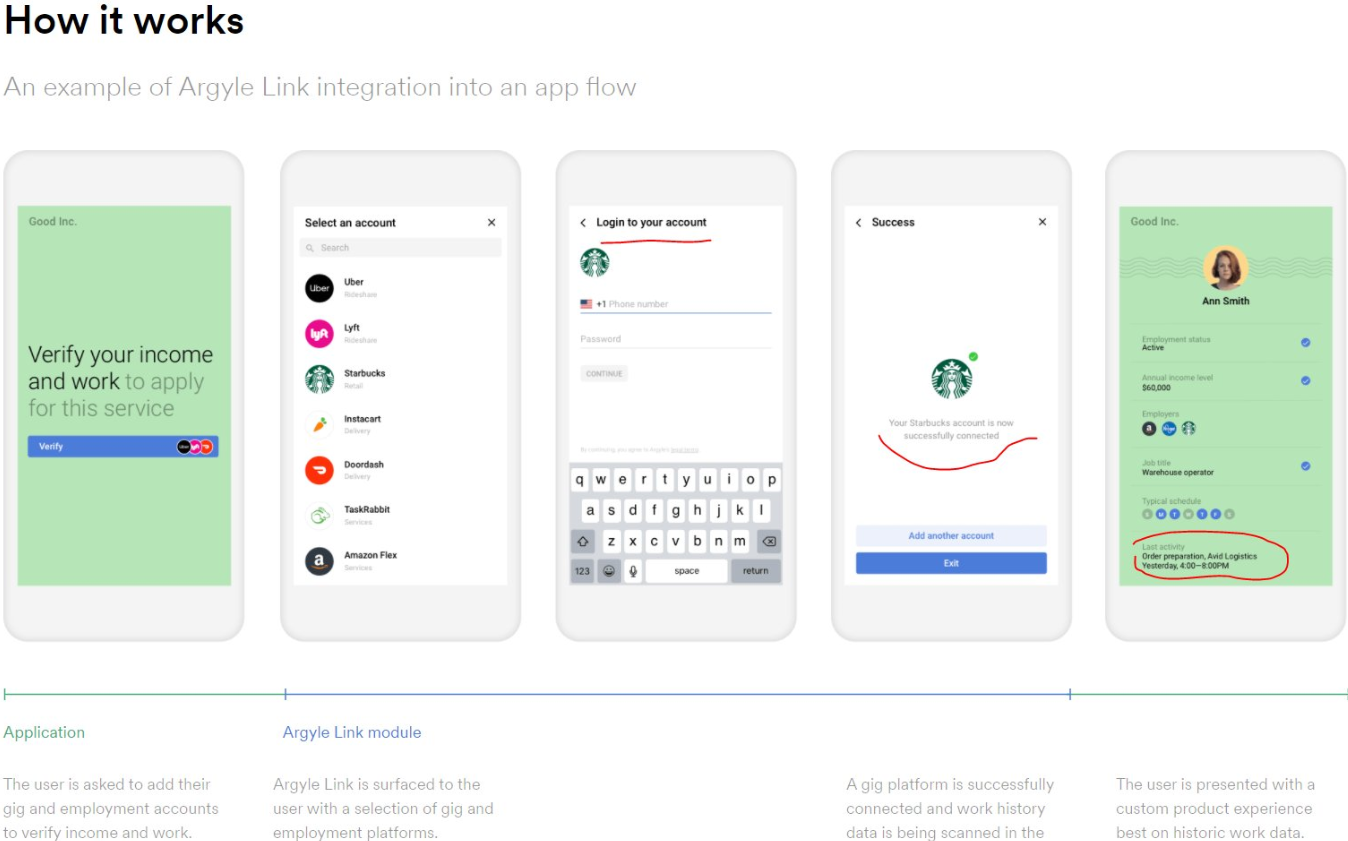
Argyle’s app flow. Image: Argyle.com.

In that sense, Argyle is making a play for a discrete chunk of a much larger employment data market dominated by the major credit bureaus, which have been hoovering up and selling access to employment data for years.

The 800-lb. gorilla there is Equifax, whose The Work Number product has for years purchased employment data flows from some of the world’s largest companies (employees consent to this sharing as part of their employment contract, and The Work Number makes it fairly easy for anyone to learn how much you earn).

The Work Number is designed to provide automated employment and income verification for prospective employers, and tens of thousands of companies report employee salary data to it. It also allows anyone whose employer uses the service to provide proof of their income when purchasing a home or applying for a loan.

On its blog, Argyle imagines a world in which companies choose to integrate its application platform interface (API) and share their employee payroll data. At the same time, the company appears to be part of an effort in which non-salaried workers are prompted to repay their erstwhile employers’ trust by selling payroll credentials.

If Argyle is worried these two goals might somehow conflict, that is not obvious by looking at some of its direct-to-consumer efforts.

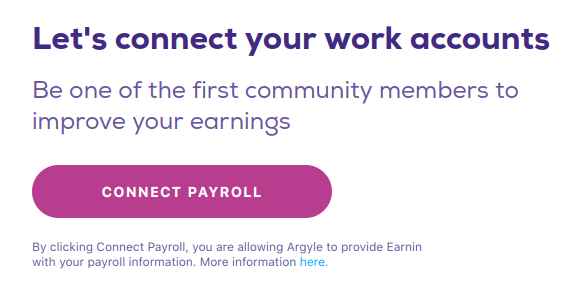
The website pictured below prompts visitors to “connect payroll,” and those who proceed agree to have their payroll data shared with a company called Earnin, a mobile payday loan app that lets users get an advance on their upcoming paycheck.

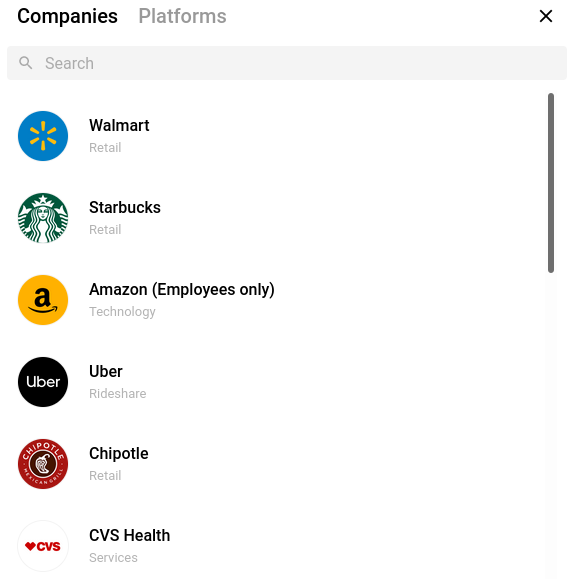
Clicking “Connect Payroll” brings up a list of payroll login pages for brand name companies, including Walmart, Starbucks, Amazon, Uber, Chipotle, etc., with a search feature that reveals login pages for everyone from the Federal Bureau of Investigation (FBI) to the Federal Reserve and Federal Trade Commission (FTC).

The default Argyle list of payroll login pages for major companies.

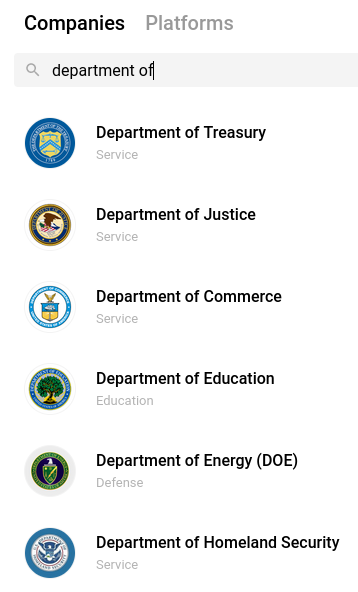
Here’s what comes up when you search by “Department of” at this site:

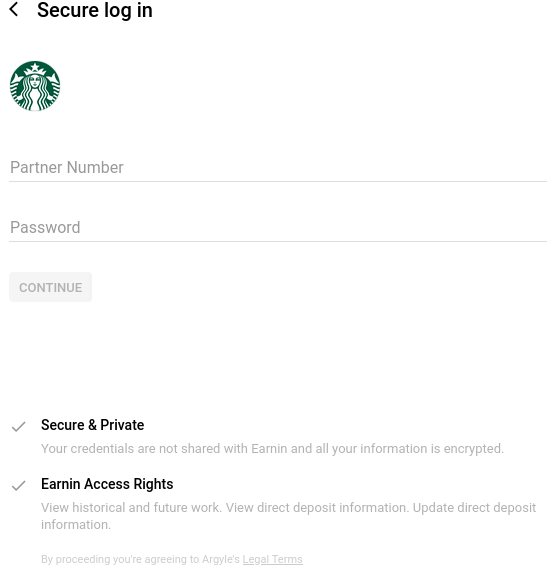
Drilling down into individual companies listed here produces a username and password form that in some cases is modified to request an employee identifier other than a username, such as a employee ID, associate or partner number instead. Here’s the login page for Starbucks employees:

The site pictured above actively checks if any submitted credentials are working, by submitting them directly to the employer in question. This Argyle status page indicates the system’s “data connection status” to countless employers.

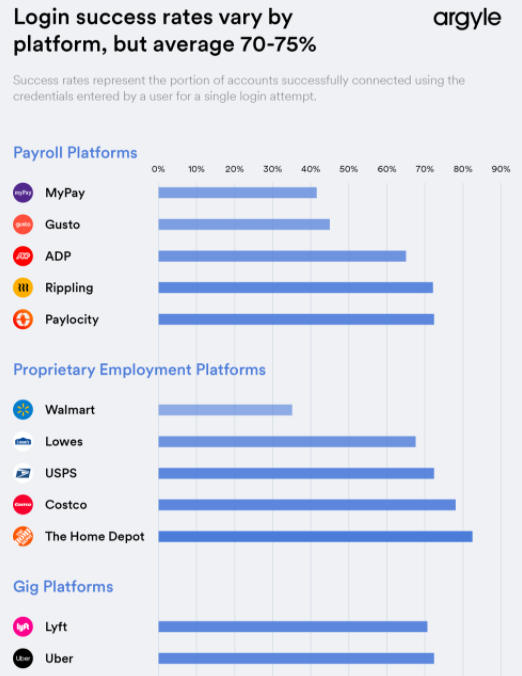
Some of you may be thinking, “How many of us actually know or have our payroll passwords?” According to Argyle, plenty of people do.

“At Argyle, we are intimately familiar with how likely someone is to know the password for their employment account or payroll system, because we’ve seen hundreds of thousands of users successfully (and unsuccessfully) provide their credentials,” Argyle’s Billy Mardsen wrote on Apr. 1. “We closely monitor their success rate—what we call conversion—because it drives the performance of the products and applications that our clients build on top of Argyle.”

Argyle’s “conversion” numbers by employer. Image: Argyle.com

UNCOMMON GROUNDS

KrebsOnSecurity first heard about this company via Twitter from security researcher Kevin Beaumont, who pointed to a nest of domains associated with Argyle’s API — nearly all of which are offline now. At the time, Beaumont and others digging into this suspected the sites were part of an elaborate phishing scam.

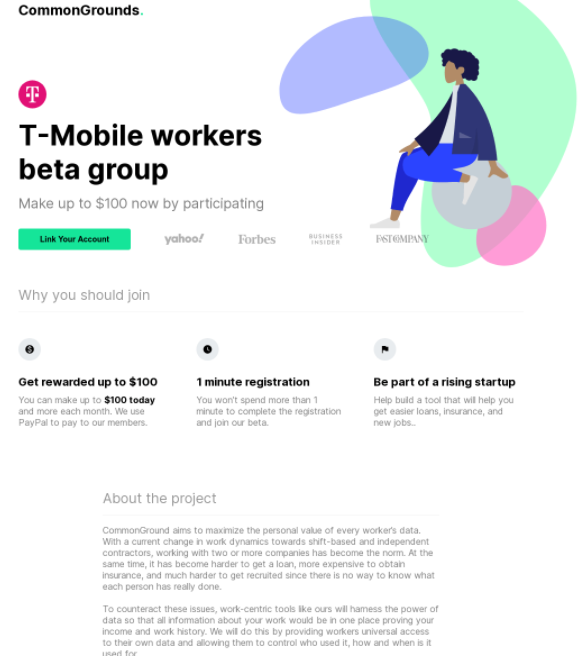
These sites, which seemed to be grouped around a recent recruitment effort variously called “Workers United,” “UniteAtWork,” “WageCompete” and “CommonGrounds,” indicate that Argyle’s platform has been pivotal in a slew of campaigns paying employees at specific companies up to $100 for their payroll account passwords. Here’s one seeking T-Mobile employees:

A promotion offering T-Mobile employees $100 to give up their T-Mobile payroll account passwords.

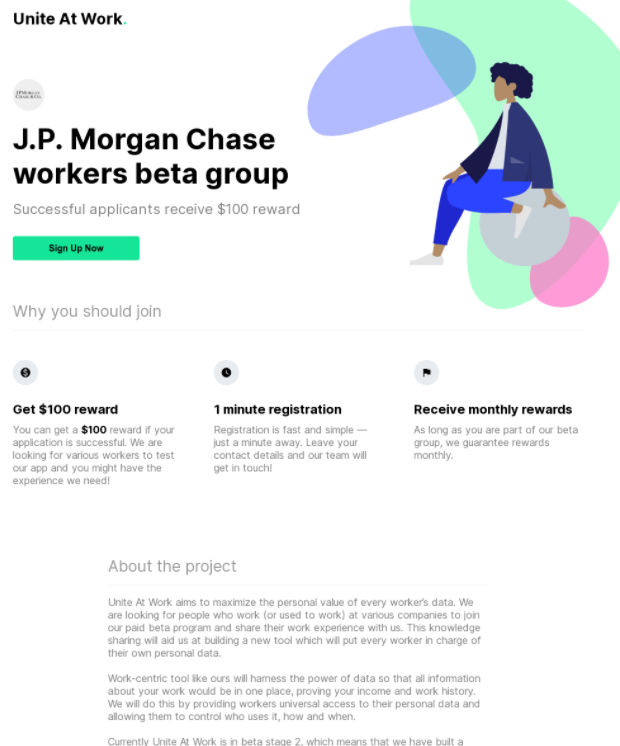
Another recent promotion targeted employees at J.P. Morgan Chase, the largest financial institution in the United States:

Argyle declined multiple interview requests for this story, so it’s not clear how much of a role — if any — the company may have played in these various sites. But code prebuilds and instructions published in the company’s name on Github strongly suggest Argyle was instrumental in the WageCompete initiative.

Also, this page over at Scopeinc.com says the WageCompete program is provided by Argyle Expert Services.

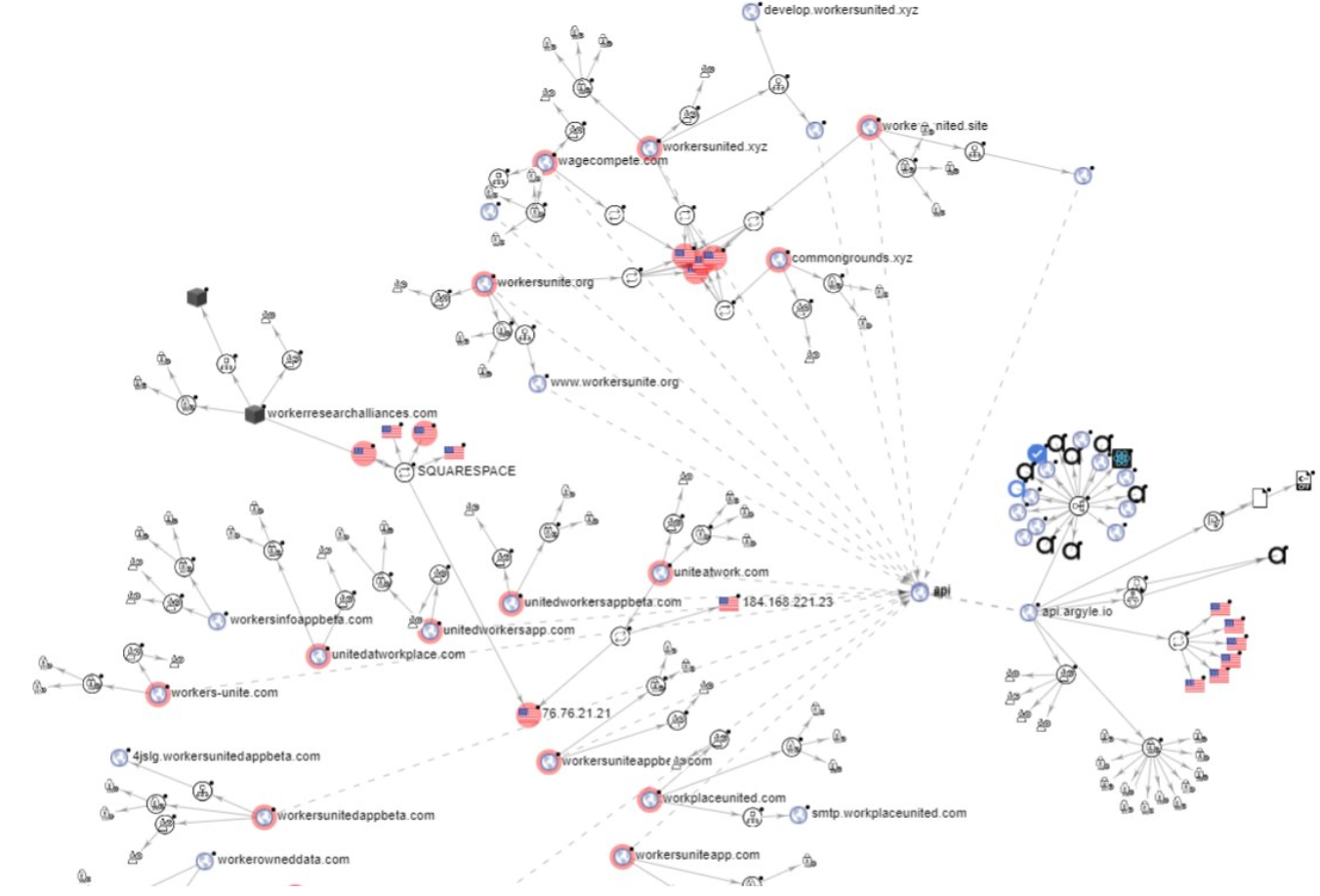
Here’s a graphical look at the various websites mentioned here and their ties to Argyle’s API (click to enlarge):

The network of sites paying people for payroll passwords and their connections to Argyle’s API. Click to enlarge. Image: Virustotal

One of the sites in that graphic above that’s connected to Argyle’s API — workerresearchalliances[.]com — is currently live and includes the same verbiage about participants getting paid for their payroll credentials. The terms and conditions of the “WorkersApp beta program” were set by a company called Workers Research Alliances LLC, incorporated in February. The address for Workers Research Alliances is just a few blocks from Argyle’s office in New York City.

‘WE DO THINGS OTHERS DARE NOT DO’

Steve Friedl, an IT consultant in the payroll service bureau industry, said it appears Argyle has been paying people to help them refine their API and data scraping technology.

“They are not paying this money just to be able to sell people services, they are doing so to maintain their screen-scraping software API,” Friedl said. “This is essentially paying employees to help Argyle hack their payroll provider.”

Last fall Argyle announced it had landed a $20 million investment from Bain Capital, among others. The company’s co-founder, Shmulik Fishman, is described as a “disruptor” who says he wants to make credit scores obsolete.

“We’re fearless,” Fishman told Authority Magazine. “We do things other people dare not do.”

That much is clear. Hey, I can get behind almost anything that disintermediates the creaky old credit bureaus in a straightforward and consumer-friendly way. And the last time I checked, it’s not against the law to give someone your password, or to induce someone to do so willingly in exchange for something else (unless maybe you work for a federal agency).

But I wonder how many of the companies listed on all these payroll connect sites will respond to knowing their brands and logos are associated with a site that asks their employees to give away passwords.

KrebsOnSecurity contacted multiple high-level sources at major companies whose login pages are shown in these payroll connect programs running on Argyle’s platform. None of those sources were authorized to talk to the media, but all seemed fairly horrified at what they were seeing, and each said their employer’s legal departments were launching their own investigations.

Beaumont said he’s worried that in some companies, an employee’s payroll credentials may work to gain access to other parts of the organization — meaning some employees may be giving away more than they realize.

“My concern is some companies use single sign-on for payroll,” Beaumont said. “That’s a lot of access for a data harvesting company.”

source https://krebsonsecurity.com/2021/05/fintech-startup-offers-500-for-payroll-passwords/