SEO Expert Hired and Fired By Ashley Madison Turned on Company, Promising Revenge

[This is Part II of a story published here last week on reporting that went into a new Hulu documentary series on the 2015 Ashley Madison hack.]

It was around 9 p.m. on Sunday, July 19, when I received a message through the contact form on KrebsOnSecurity.com that the marital infidelity website AshleyMadison.com had been hacked. The message contained links to confidential Ashley Madison documents, and included a manifesto that said a hacker group calling itself the Impact Team was prepared to leak data on all 37 million users unless Ashley Madison and a sister property voluntarily closed down within 30 days.
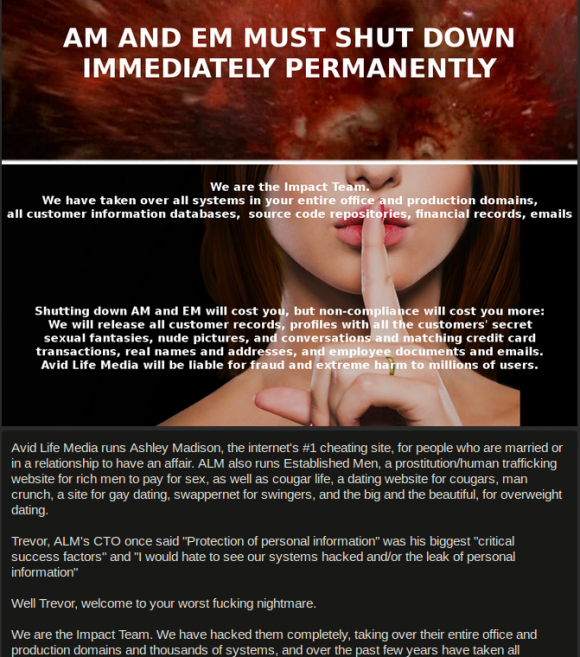
A snippet of the message left behind by the Impact Team.

The message included links to files containing highly sensitive information, including snippets of leaked user account data, maps of internal AshleyMadison company servers, employee network account information, company bank account data and salary information.

A master employee contact list was among the documents leaked that evening. Helpfully, it included the cell phone number for Noel Biderman, then the CEO of Ashley Madison parent firm Avid Life Media (ALM). To my everlasting surprise, Biderman answered on the first ring and acknowledged they’d been hacked without even waiting to be asked.

“We’re on the doorstep of [confirming] who we believe is the culprit, and unfortunately that may have triggered this mass publication,” Biderman told me on July 19, just minutes before I published the first known public report about the breach. “I’ve got their profile right in front of me, all their work credentials. It was definitely a person here that was not an employee but certainly had touched our technical services.”

On Aug 18, 2015, the Impact Team posted a “Time’s up!” message online, along with links to 60 gigabytes of Ashley Madison user data. The data leak led to the public shaming and extortion of many Ashley Madison users, and to at least two suicides. Many other users lost their jobs or their marriages. To this day, nobody has been charged in the hack, and incredibly Ashley Madison remains a thriving company.

THE CHAOS MAKER

The former employee that Biderman undoubtedly had in mind on July 19, 2015 was William Brewster Harrison, a self-described expert in search engine optimization (SEO) tricks that are designed to help websites increase their rankings for various keywords in Google and other search engines.

It is evident that Harrison was Biderman’s top suspect immediately after the breach became public because — in addition to releasing data on 37 million users a month later in August 2015 — the hackers also dumped three years worth of email they stole from Biderman. And Biderman’s inbox is full of messages about hate-filled personal attacks from Harrison.

A Native of Northern Virginia, Harrison eventually settled in North Carolina, had a son with his then-wife, and started a fence-building business. ALM hired Harrison in March 2010 to promote its various adult brands online, and it is clear that one of his roles was creating and maintaining female profiles on Ashley Madison, and creating blogs that were made to look like they were written by women who’d just joined Ashley Madison.
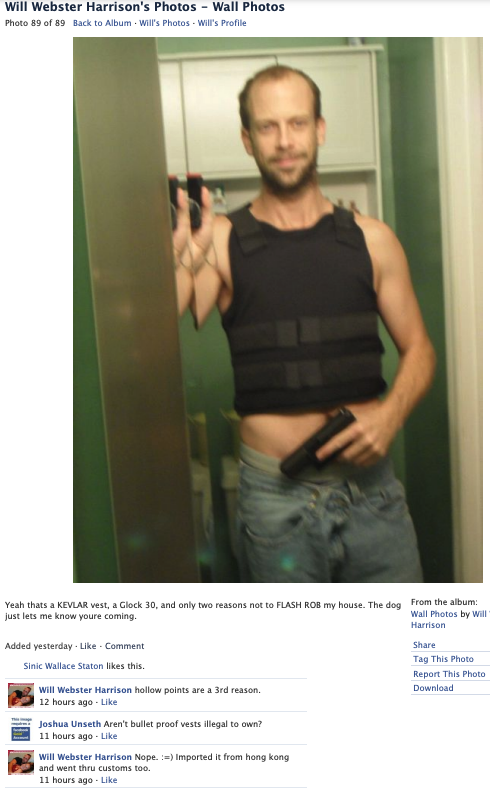
A selfie that William B. Harrison posted to his Facebook page in 2013 shows him holding a handgun and wearing a bulletproof vest.

It appears Harrison was working as an affiliate of Ashley Madison prior to his official employment with the company, which suggests that Harrison had already demonstrated he could drive signups to the service and help improve its standing in the search engine rankings.

What is less clear is whether anyone at ALM ever performed a basic background check on Harrison before hiring him. Because if they had, the results almost certainly would have given them pause. Virginia prosecutors charged the young 20-something Harrison with a series of misdemeanors, including trespassing, unlawful entry, drunk in public, and making obscene phone calls.

In 2008, North Carolina authorities charged Harrison with criminal extortion, a case that was transferred to South Carolina before ultimately being dismissed. In December 2009, Harrison faced charges of false imprisonment, charges that were also dropped by the local district attorney.

By the time Ashley Madison officially hired him, Harrison’s life was falling apart. His fence business had failed, and he’d just filed for bankruptcy. Also, his marriage had soured, and after a new arrest for driving under the influence, he was in danger of getting divorced, losing access to his son, and/or going to jail.

It also seems likely that nobody at ALM bothered to look at the dozens of domain names registered to Harrison’s various Vistomail.com email addresses, because had they done so they likely would have noticed two things.

One is that Harrison had a history of creating websites to lambaste companies he didn’t like, or that he believed had slighted him or his family in some way. Some of these websites included content that defamed and doxed executives, such as bash-a-business[.]com, google-your-business[.]com, contact-a-ceo[.]com, lowes-is-a-cancer[.]com (according to Harrison, the home improvement chain once employed his wife).

A background check on Harrison’s online footprint also would have revealed he was a self-styled rapper who claimed to be an active menace to corporate America. Harrison’s website lyrical-gangsta[.]com included a number of works, such as “Slim Thug — I Run — Remix Spoof,” which are replete with menacing words for unnamed corporate executives:

[HOOK]
I surf the net all night n day (the web love thug)
cuz I still surf the net all night n day
yuhh I type for my mind, got smart for my ego
still running circles round them, what’s good?
cuz I still surf, the net all night n day,
I cant stay away.

They don’t make to [sic] many hackers like me
bonafide hustler certified G
still pumpin’ the TOP 10 results
if you got the right dough!
think the results are fake? sucka Google ME
smarter than executives, bigger then Wal-Mart
Nelly strugglin’ with the fact that I’m #1 NOW
street boys know me, ain’t nuttin’ new
about to make my mill, with an all new crew
I-95 execs don’t know what to do, or where to go
watchin them stocks evaporate all their dough
I already left the hood, got up off the streets
its in my blood im a gangsta till Im deceased

moving lumber for money or typin’ in a zone
all night hackin’ till 6 in the mornin
that shit im focusin’ on, stronger then cologne
you can prolly smell the jealousy
through your LCD screen
if you still broke– better work for some green
called them Fortune execs on that legal bluff
cuz the Feds busy raidin other stuff
Imma run the Net til im six feet under
I’m a leave my mark — no reason to wonder
(Yea Yea)
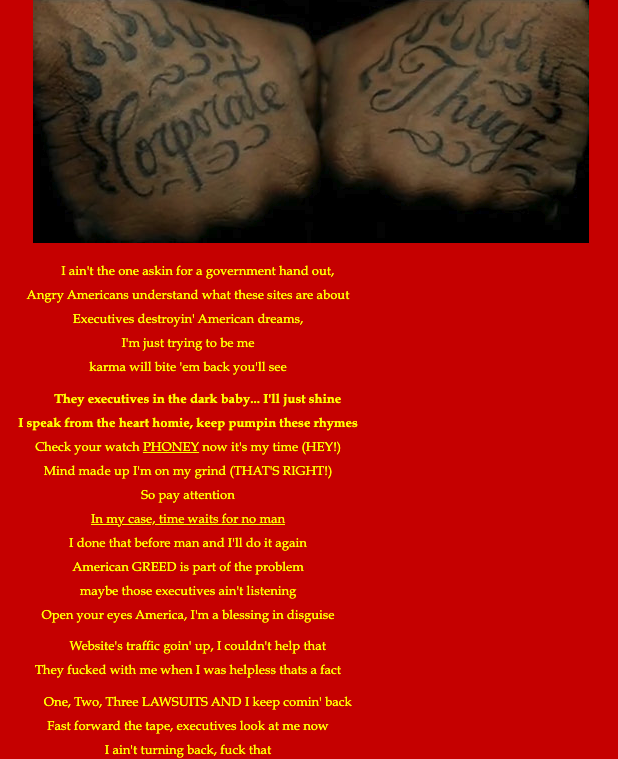
Some of the anti-corporate rhymes busted by Harrison’s hacker/rapper alter ego “Chaos Dog.” Image: Archive.org.

The same theme appears in another rap (“The Hacker Backstage”) penned by Harrison’s rapper alter ego — “Chaos Dog:”

…this hacker was born to write
bust off the rhymes and watch em take flight
you know all about them corporate jets
and handing out pinkslips without regrets
oversized companies are the problem

well, I’ve got a solution
It’s called good ol’ fashioned retribution
file bankruptcy, boycott you like Boston colonists
Corporate America cant stop this Eminem style columnist
2pac would have honored my style
Im the next generation of hacker inspiration
Americans don’t want a corporate nation
All that DOW Jones shit is a dying sensation

In addition to pimping Ashley Madison with fake profiles and phony user blogs, it appears Harrison also went after the company’s enemies during the brief time he was an employee. As noted in Part I of this story, Harrison used multiple pseudonymous Vistomail.com email addresses to harass the owners of AshleyMadisonSucks[.]com into selling or shutting down the site.

When the owner of AshleyMadisonSucks[.]com refused to sell the domain, he and his then-girlfriend were subject to an unrelenting campaign of online harassment and blackmail. It now appears those attacks were perpetrated by Harrison, who sent emails from different accounts at the free email service Vistomail pretending to be the domain owner, his then-girlfriend and their friends. Harrison even went after the domain owner’s lawyer and wife, listing them both on his Contact-A-CEO[.]com website.

TURNABOUT IS FAIR PLAY

Things started going sideways for Ashley Madison when Harrison’s employment contract was terminated in November 2011. The leaked emails do not explain why Harrison was fired, but his mercurial temperament likely played a major role. According to Harrison, it was because he had expressed some moral reservations with certain aspects of his duties, although he was not specific on that point and none of this could be confirmed.

Shortly after Harrison was fired, the company’s executives began noticing that Google was auto-completing the words “Jew” and “Jewish” whenever someone searched for Biderman’s name. The results returned when one accepted Google’s recommended search at the time filled the first page with links to Stormfront, a far-right, neo-Nazi hate group. The company strongly suspected someone was using underhanded SEO techniques to slander and attack its CEO.

In July 2022, KrebsOnSecurity published a retrospective on the 2015 Ashley Madison breach which found that Biderman had become the subject of increasing ire from members of Stormfront and other extremists groups in the years leading up to the hack. According to the neo-Nazi groups, Biderman was a worthy target of their harassment not just because he was a successful Jewish CEO, but also because his company was hellbent on destroying Christian morals and families.

Biderman’s leaked emails show that in February 2021 he hired Brian Cuban — the attorney brother of Mark Cuban, the owner of the Dallas Mavericks and one the main “sharks” on the ABC reality television series Shark Tank. Through Cuban, Ashley Madison appealed their case to both Google and to the Anti-Defamation League, but neither was apparently able or willing to help.

Also in early January 2012, Biderman and other Ashley Madison executives found themselves inundated with anonymous Vistomail.com emails that were replete with profanity and slurs against Jews. Although he used fake names and email addresses, Harrison made little effort to hide his identity in several of these nastygrams.

One particularly ugly message from Harrison even included a link to a Youtube video he’d put online of his young son playing basketball for a school team. That Youtube video was included in an email wherein Harrison – then separated from his wife — lamented all the hours he spent working for Ashley Madison up in Canada instead of spending time with his son.

Harrison then turned to making threatening phone calls to Ashley Madison executives. In one incident in March 2012, Harrison called the company’s former director of Human Resources using a caller ID spoofing service to make it look like he was calling from inside the building.

ALM’s lawyers contacted the Toronto police in response to Harrison’s harassment.

“For Will to have disguised his phone number as Mark’s strongly suggest he has hacked my email, legal counsel for the opposing side in a perceived legal dispute,” ALM VP and general counsel Mike Dacks wrote in a letter to a detective at the Toronto Police. “Over the months of his many hundreds of emails he alluded a number of times to undertaking cyberattacks against us and this was noted in my original report to police.”

Based on the exchanges in Bidernman’s inbox it appears those appeals to the Toronto authorities were successful in having Harrison barred from being able to enter Canada.

ALM also contacted a detective in Harrison’s home county in North Carolina. But when the local police paid a visit to Harrison’s home to follow up on the harassment complaints, Harrison fled out his back porch, injuring himself after jumping off the second-story deck.

It is unclear if the police ever succeeded in interviewing Harrison in response to the harassment complaints from ALM. The Raleigh police officer contacted by ALM did not respond to requests for information. But the visit from the local cops only seemed to embolden and anger Harrison even more, and Biderman’s emails indicate the harassment continued after this incident.

HUMAN DECOYS

Then in August 2012, the former sex worker turned blogger and activist Maggie McNeill published screenshots from an internal system that Ashley Madison used called the “Human Decoy Interface,” which was a fancy way of describing a system built to manage phony female accounts on the service.

The screenshots appeared to show that a great many female accounts were in fact bots designed to bring in paying customers. Ashley Madison was always free to join, but users had to pay if they wished to chat directly with other users.

Although Harrison had been fired nearly a year earlier, Biderman’s leaked emails show that Harrison’s access to Ashley Madison’s internal tools wasn’t revoked until after the screenshots were posted online and the company began reviewing which employee accounts had access to the Human Decoy Interface.

“Who or what is asdfdfsda@asdf.com?,” Biderman asked, after being sent a list of nine email addresses.

“It appears to be the email address Will used for his profiles,” the IT director replied.

“And his access was never shut off until today?,” asked the company’s general counsel Mike Dacks.

TRUTH BOMBS

Biderman’s leaked emails suggest that Harrison stopped his harassment campaign sometime after 2012. A decade later, KrebsOnSecurity sought to track down and interview Harrison. Finding nobody at his former addresses and phone numbers in North Carolina, KrebsOnSecurity wound up speaking with Will’s stepmother, Tena Nauheim, who lives with Will’s dad in Northern Virginia.

Nauheim quickly dropped two big truth bombs after patiently listening to my spiel about why I was calling and looking for Mr. Harrison. The first was that Will was brought up Jewish, although he did not practice the faith: A local rabbi and friend of the family gave the service at Will’s funeral in 2014.

Nauheim also shared that her stepson had killed himself in 2014, shooting himself in the head with a handgun. Will’s mother discovered his body.

“Will committed suicide in March 2014,” Nauheim shared. “I’ve heard all those stories you just mentioned. Will was severely mentally ill. He was probably as close to a sociopath as I can imagine anyone being. He was also a paranoid schizophrenic who wouldn’t take his medication.”

William B. Harrison died on March 5, 2014, nearly 16 months before The Impact Team announced they’d hacked Ashley Madison.

Nauheim said she constantly felt physically threatened when Will was around. But she had trouble believing that her stepson was a raging anti-Semite. She also said she thought the timing of Will’s suicide effectively ruled him out as a suspect in the 2015 Ashley Madison hack.

“Considering the date of death, I’m not sure if he’s your guy,” Nauheim offered toward the end of our conversation.

[There is one silver lining to Will Harrison’s otherwise sad tale: His widow has since remarried, and her new husband agreed to adopt their son as his own.]

ANALYSIS

Does Harrison’s untimely death rule him out as a suspect, as his stepmom suggested? This remains an open question. In a parting email to Biderman in late 2012, Harrison signed his real name and said he was leaving, but not going away.

“So good luck, I’m sure we’ll talk again soon, but for now, I’ve got better things in the oven,” Harrison wrote. “Just remember I outsmarted you last time and I will outsmart you and out maneuver you this time too, by keeping myself far far away from the action and just enjoying the sideline view, cheering for the opposition.”

Nothing in the leaked Biderman emails suggests that Ashley Madison did much to revamp the security of its computer systems in the wake of Harrison’s departure and subsequent campaign of harassment — apart from removing an administrator account of his a year after he’d already left the company.

KrebsOnSecurity found nothing in Harrison’s extensive domain history suggesting he had any real malicious hacking skills. But given the clientele that typically employed his skills — the adult entertainment industry — it seems likely Harrison was at least conversant in the dark arts of “Black SEO,” which involves using underhanded or else downright illegal methods to game search engine results.

Armed with such experience, it would not have been difficult for Harrison to have worked out a way to maintain access to working administrator accounts at Ashley Madison. If that in fact did happen, it would have been trivial for him to sell or give those credentials to someone else.

Or to something else. Like Nazi groups. As KrebsOnSecurity reported last year, in the six months leading up to the July 2015 hack, Ashley Madison and Biderman became a frequent subject of derision across multiple neo-Nazi websites.

On Jan. 14, 2015, a member of the neo-Nazi forum Stormfront posted a lively thread about Ashley Madison in the general discussion area titled, “Jewish owned dating website promoting adultery.”

On July 3, 2015, Andrew Anglin, the editor of the alt-right publication Daily Stormer, posted excerpts about Biderman from a story titled, “Jewish Hyper-Sexualization of Western Culture,” which referred to Biderman as the “Jewish King of Infidelity.”

On July 10, a mocking montage of Biderman photos with racist captions was posted to the extremist website Vanguard News Network, as part of a thread called “Jews normalize sexual perversion.”

Some readers have suggested that the data leaked by the Impact Team could have originally been stolen by Harrison. But that timeline does not add up given what we know about the hack. For one thing, the financial transaction records leaked from Ashley Madison show charges up until mid-2015. Also, the final message in the archive of Biderman’s stolen emails was dated July 7, 2015 — almost two weeks before the Impact Team would announce their hack.

Whoever hacked Ashley Madison clearly wanted to disrupt the company as a business, and disgrace its CEO as the endgame. The Impact Team’s intrusion struck just as Ashley Madison’s parent was preparing go public with an initial public offering (IPO) for investors. Also, the hackers stated that while they stole all emplyee emails, they were only interested in leaking Biderman’s.

Also, the Impact Team had to know that ALM would never comply with their demands to dismantle Ashley Madison and Established Men. In 2014, ALM reported revenues of $115 million. There was little chance the company was going to shut down some of its biggest money machines.

Hence, it appears the Impact Team’s goal all along was to create prodigious amounts of drama and tension by announcing the hack of a major cheating website, and then let that drama play out over the next few months as millions of exposed Ashley Madison users freaked out and became the targets of extortion attacks and public shaming.

After the Impact Team released Biderman’s email archives, several media outlets pounced on salacious exchanges in those messages as supposed proof he had carried on multiple affairs. Biderman resigned as CEO of Ashley Madison on Aug. 28, 2015.

Complicating things further, it appears more than one malicious party may have gained access to Ashley’s Madison’s network in 2015 or possibly earlier. Cyber intelligence firm Intel 471 recorded a series of posts by a user with the handle “Brutium” on the Russian-language cybercrime forum Antichat between 2014 and 2016.

Brutium routinely advertised the sale of large, hacked databases, and on Jan. 24, 2015, this user posted a thread offering to sell data on 32 million Ashley Madison users. However, there is no indication whether anyone purchased the information. Brutium’s profile has since been removed from the Antichat forum.

I realize this ending may be unsatisfying for many readers, as it is for me. The story I wrote in 2015 about the Ashley Madison hack is still the biggest scoop I’ve published here (in terms of traffic), yet it remains perhaps the single most frustrating investigation I’ve ever pursued. But my hunch is that there is still more to this story that has yet to unfold.
source https://krebsonsecurity.com/2023/07/seo-expert-hired-and-fired-by-ashley-madison-turned-on-company-promising-revenge/

Apple & Microsoft Patch Tuesday, July 2023 Edition

Microsoft Corp. today released software updates to quash 130 security bugs in its Windows operating systems and related software, including at least five flaws that are already seeing active exploitation. Meanwhile, Apple customers have their own zero-day woes again this month: On Monday, Apple issued (and then quickly pulled) an emergency update to fix a zero-day vulnerability that is being exploited on MacOS and iOS devices.

On July 10, Apple pushed a “Rapid Security Response” update to fix a code execution flaw in the Webkit browser component built into iOS, iPadOS, and macOS Ventura. Almost as soon as the patch went out, Apple pulled the software because it was reportedly causing problems loading certain websites. MacRumors says Apple will likely re-release the patches when the glitches have been addressed.

Launched in May, Apple’s Rapid Security Response updates are designed to address time-sensitive vulnerabilities, and this is the second month Apple has used it. July marks the sixth month this year that Apple has released updates for zero-day vulnerabilities — those that get exploited by malware or malcontents before there is an official patch available.

If you rely on Apple devices and don’t have automatic updates enabled, please take a moment to check the patch status of your various iDevices. The latest security update that includes the fix for the zero-day bug should be available in iOS/iPadOS 16.5.1, macOS 13.4.1, and Safari 16.5.2.

On the Windows side, there are at least four vulnerabilities patched this month that earned high CVSS (badness) scores and that are already being exploited in active attacks, according to Microsoft. They include CVE-2023-32049, which is a hole in Windows SmartScreen that lets malware bypass security warning prompts; and CVE-2023-35311 allows attackers to bypass security features in Microsoft Outlook.

The two other zero-day threats this month for Windows are both privilege escalation flaws. CVE-2023-32046 affects a core Windows component called MSHTML, which is used by Windows and other applications, like Office, Outlook and Skype. CVE-2023-36874 is an elevation of privilege bug in the Windows Error Reporting Service.

Many security experts expected Microsoft to address a fifth zero-day flaw — CVE-2023-36884 — a remote code execution weakness in Office and Windows.

“Surprisingly, there is no patch yet for one of the five zero-day vulnerabilities,” said Adam Barnett, lead software engineer at Rapid7. “Microsoft is actively investigating publicly disclosed vulnerability, and promises to update the advisory as soon as further guidance is available.”

Barnett notes that Microsoft links exploitation of this vulnerability with Storm-0978, the software giant’s name for a cybercriminal group based out of Russia that is identified by the broader security community as RomCom.

“Exploitation of CVE-2023-36884 may lead to installation of the eponymous RomCom trojan or other malware,” Barnett said. “[Microsoft] suggests that RomCom / Storm-0978 is operating in support of Russian intelligence operations. The same threat actor has also been associated with ransomware attacks targeting a wide array of victims.”

Microsoft’s advisory on CVE-2023-36884 is pretty sparse, but it does include a Windows registry hack that should help mitigate attacks on this vulnerability. Microsoft has also published a blog post about phishing campaigns tied to Storm-0978 and to the exploitation of this flaw.

Barnett said it’s while it’s possible that a patch will be issued as part of next month’s Patch Tuesday, Microsoft Office is deployed just about everywhere, and this threat actor is making waves.

“Admins should be ready for an out-of-cycle security update for CVE-2023-36884,” he said.

Microsoft also today released new details about how it plans to address the existential threat of malware that is cryptographically signed by…wait for it….Microsoft.

In late 2022, security experts at Sophos, Trend Micro and Cisco warned that ransomware criminals were using signed, malicious drivers in an attempt to evade antivirus and endpoint detection and response (EDR) tools.

In a blog post today, Sophos’s Andrew Brandt wrote that Sophos identified 133 malicious Windows driver files that were digitally signed since April 2021, and found 100 of those were actually signed by Microsoft. Microsoft said today it is taking steps to ensure those malicious driver files can no longer run on Windows computers.

As KrebsOnSecurity noted in last month’s story on malware signing-as-a-service, code-signing certificates are supposed to help authenticate the identity of software publishers, and provide cryptographic assurance that a signed piece of software has not been altered or tampered with. Both of these qualities make stolen or ill-gotten code-signing certificates attractive to cybercriminal groups, who prize their ability to add stealth and longevity to malicious software.

For a closer look at the patches released by Microsoft today, check out the always-thorough Patch Tuesday roundup from the SANS Internet Storm Center. And it’s not a bad idea to hold off updating for a few days until Microsoft works out any kinks in the updates: AskWoody.com usually has the lowdown on any patches that may be causing problems for Windows users.

And as ever, please consider backing up your system or at least your important documents and data before applying system updates. If you encounter any problems with these updates, please drop a note about it here in the comments.

source https://krebsonsecurity.com/2023/07/apple-microsoft-patch-tuesday-july-2023-edition/

Top Suspect in 2015 Ashley Madison Hack Committed Suicide in 2014

When the marital infidelity website AshleyMadison.com learned in July 2015 that hackers were threatening to publish data stolen from 37 million users, the company’s then-CEO Noel Biderman was quick to point the finger at an unnamed former contractor. But as a new documentary series on Hulu reveals [SPOILER ALERT!], there was just one problem with that theory: Their top suspect had killed himself more than a year before the hackers began publishing stolen user data.

The new documentary, The Ashley Madison Affair, begins airing today on Hulu in the United States and on Disney+ in the United Kingdom. The series features interviews with security experts and journalists, Ashley Madison executives, victims of the breach and jilted spouses.

The series also touches on shocking new details unearthed by KrebsOnSecurity and Jeremy Bullock, a data scientist who worked with the show’s producers at the Warner Bros. production company Wall to Wall Media. Bullock had spent many hours poring over the hundreds of thousands of emails that the Ashley Madison hackers stole from Biderman and published online in 2015.

Wall to Wall reached out in July 2022 about collaborating with Bullock after KrebsOnSecurity published A Retrospective on the 2015 Ashley Madison Breach. That piece explored how Biderman — who is Jewish — had become the target of concerted harassment campaigns by anti-Semitic and far-right groups online in the months leading up to the hack.

Whoever hacked Ashley Madison had access to all employee emails, but they only released Biderman’s messages — three years worth. Apropos of my retrospective report, Bullock found that a great many messages in Biderman’s inbox were belligerent and anti-Semitic screeds from a former Ashley Madison employee named William Brewster Harrison.

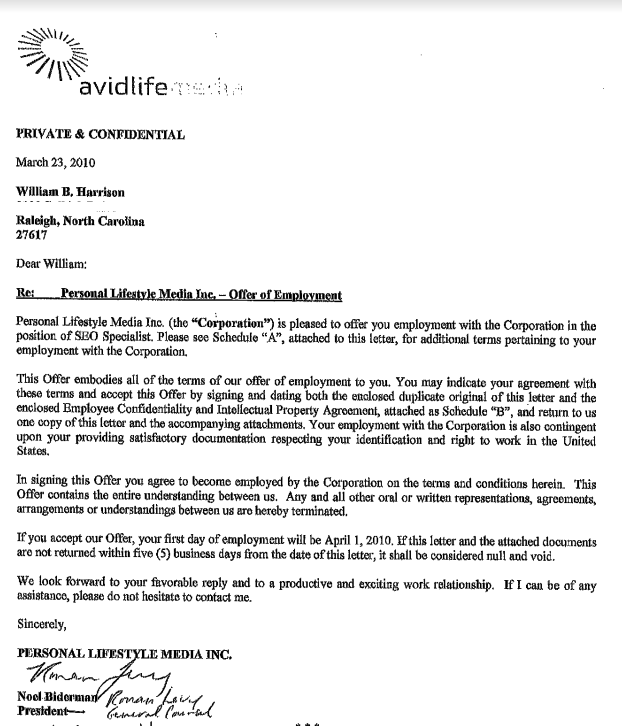
William Harrison’s employment contract with Ashley Madison parent Avid Life Media.

The messages show that Harrison was hired in March 2010 to help promote Ashley Madison online, but the messages also reveal Harrison was heavily involved in helping to create and cultivate phony female accounts on the service.

There is evidence to suggest that in 2010 Harrison was directed to harass the owner of Ashleymadisonsucks.com into closing the site or selling the domain to Ashley Madison.

Ashley Madison’s parent company — Toronto-based Avid Life Media — filed a trademark infringement complaint in 2010 that succeeded in revealing a man named Dennis Bradshaw as the owner. But after being informed that Bradshaw was not subject to Canadian trademark laws, Avid Life offered to buy AshleyMadisonSucks.com for $10,000.

When Bradshaw refused to sell the domain, he and his then-girlfriend were subject to an unrelenting campaign of online harassment and blackmail. It now appears those attacks were perpetrated by Harrison, who sent emails from different accounts at the free email service Vistomail pretending to be Bradshaw, his then-girlfriend and their friends.

[As the documentary points out, the domain AshleyMadisonSucks.com was eventually transferred to Ashley Madison, which then shrewdly used it for advertising and to help debunk theories about why its service was supposedly untrustworthy].

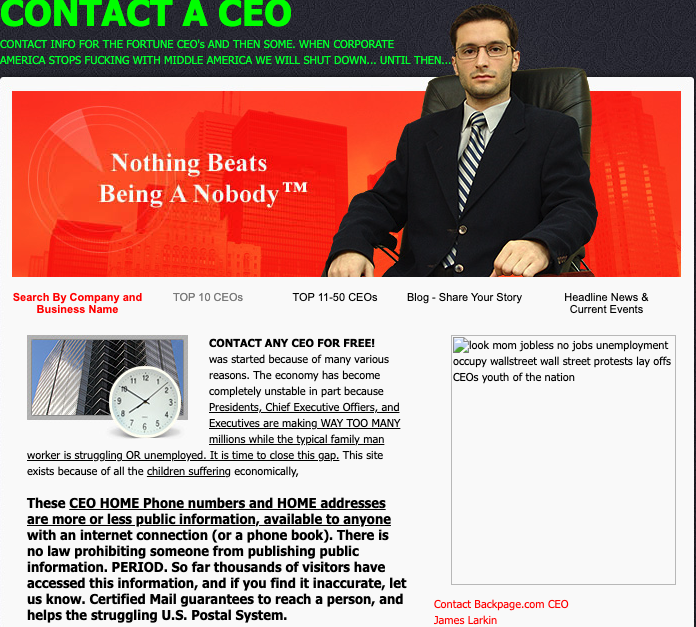
Harrison even went after Bradshaw’s lawyer and wife, listing them both on a website he created called Contact-a-CEO[.]com, which Harrison used to besmirch the name of major companies — including several past employers — all entities he believed had slighted him or his family in some way. The site also claimed to include the names, addresses and phone numbers of top CEOs.

A cached copy of Harrison’s website, contact-the-ceo.com.

An exhaustive analysis of domains registered to the various Vistomail pseudonyms used by Harrison shows he also ran Bash-a-Business[.]com, which Harrison dedicated to “all those sorry ass corporate executives out there profiting from your hard work, organs, lives, ideas, intelligence, and wallets.” Copies of the site at archive.org show it was the work of someone calling themselves “The Chaos Creator.”

Will Harrison was terminated as an Ashley Madison employee in November 2011, and by early 2012 he’d turned his considerable harassment skills squarely against the company. Ashley Madison’s long-suspected army of fake female accounts came to the fore in August 2012 after the former sex worker turned activist and blogger Maggie McNeill published screenshots apparently taken from Ashley Madison’s internal systems suggesting that a large percentage of the female accounts on the service were computer-operated bots.

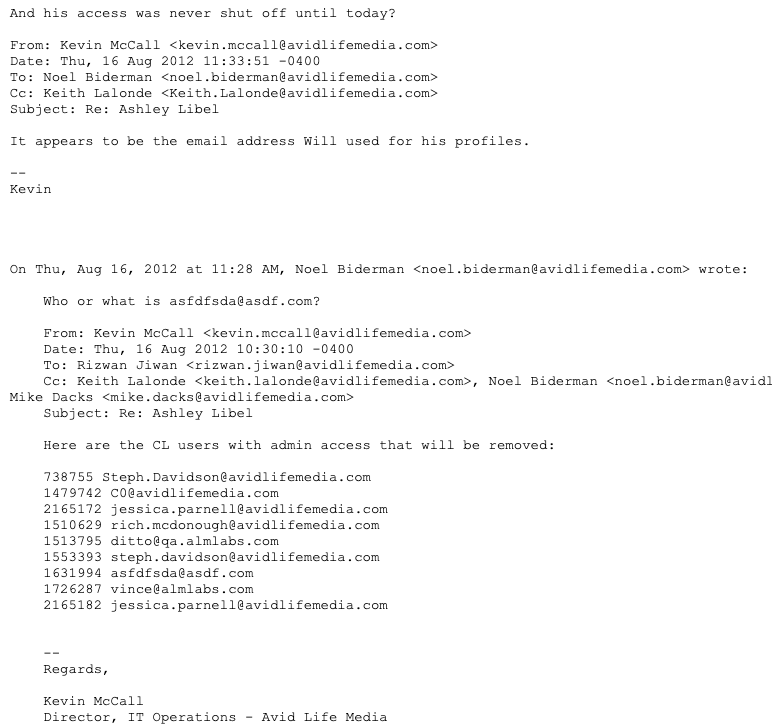
Ashley Madison’s executives understood that only a handful of employees at the time would have had access to the systems needed to produce the screenshots McNeill published online. In one exchange on Aug. 16, 2012, Ashley Madison’s director of IT was asked to produce a list of all company employees with all-powerful administrator access.

“Who or what is asdfdfsda@asdf.com?,” Biderman asked, after being sent a list of nine email addresses.

“It appears to be the email address Will used for his profiles,” the IT director replied.

“And his access was never shut off until today?,” asked the company’s general counsel Mike Daks.

A Biderman email from 2012.

What prompted the data scientist Bullock to reach out were gobs of anti-Semitic diatribes from Harrison, who had taken to labeling Biderman and others “greedy Jew bastards.”

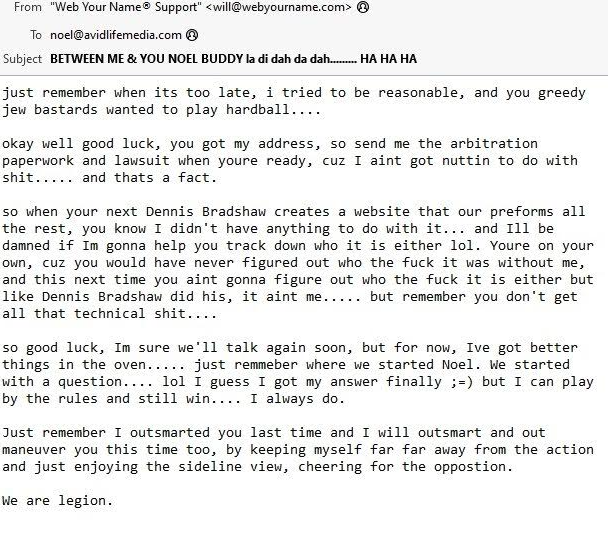
“So good luck, I’m sure we’ll talk again soon, but for now, Ive got better things in the oven,” Harrison wrote to Biderman after his employment contract with Ashley Madison was terminated. “Just remember I outsmarted you last time and I will outsmart and out maneuver you this time too, by keeping myself far far away from the action and just enjoying the sideline view, cheering for the opposition.”

A 2012 email from William Harrison to former Ashley Madison CEO Noel Biderman.

Harrison signed his threatening missive with the salutation, “We are legion,” suggesting that whatever comeuppance he had in store for Ashley Madison would come from a variety of directions and anonymous hackers.

The leaked Biderman emails show that Harrison made good on his threats, and that in the months that followed Harrison began targeting Biderman and other Ashley Madison executives with menacing anonymous emails and spoofed phone calls laced with profanity and anti-Semitic language.

But on Mar. 5, 2014, Harrison committed suicide by shooting himself in the head with a handgun. This fact was apparently unknown to Biderman and other Ashley Madison executives more than a year later when their July 2015 hack was first revealed.

Does Harrison’s untimely suicide rule him out as a suspect in the 2015 hack? Who is The Chaos Creator, and what else transpired between Harrison and Ashley Madison prior to his death? We’ll explore these questions in Part II of this story, to be published early next week.

source https://krebsonsecurity.com/2023/07/top-suspect-in-2015-ashley-madison-hack-committed-suicide-in-2014/

Whos Behind the DomainNetworks Snail Mail Scam?

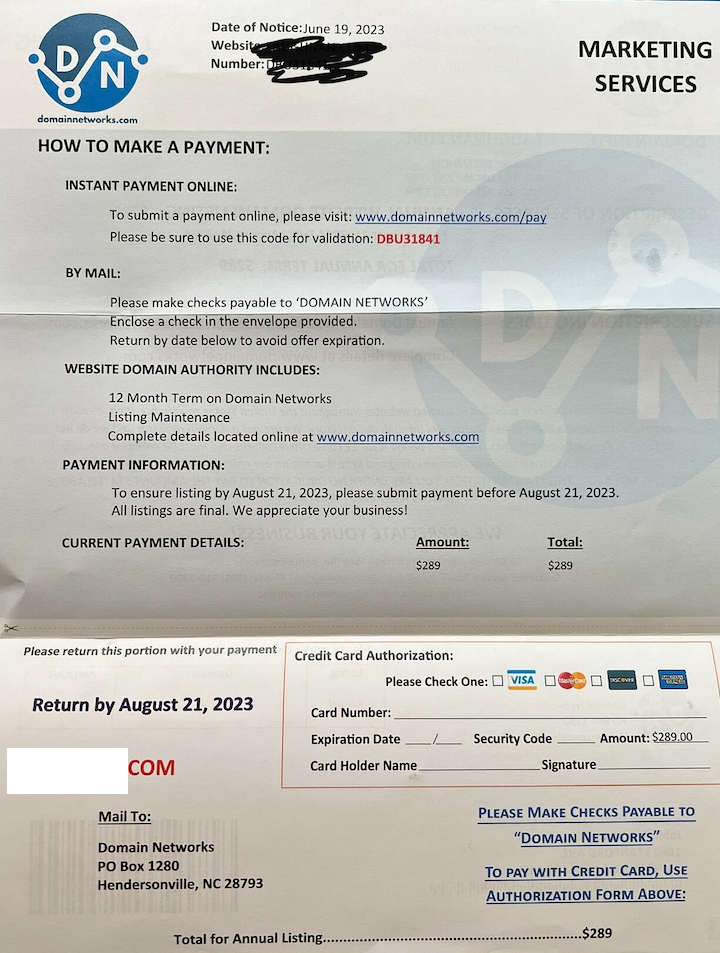
If you’ve ever owned a domain name, the chances are good that at some point you’ve received a snail mail letter which appears to be a bill for a domain or website-related services. In reality, these misleading missives try to trick people into paying for useless services they never ordered, don’t need, and probably will never receive. Here’s a look at the most recent incarnation of this scam — DomainNetworks — and some clues about who may be behind it.

The DomainNetworks mailer may reference a domain that is or was at one point registered to your name and address. Although the letter includes the words “marketing services” in the upper right corner, the rest of the missive is deceptively designed to look like a bill for services already rendered.

DomainNetworks claims that listing your domain with their promotion services will result in increased traffic to your site. This is a dubious claim for a company that appears to be a complete fabrication, as we’ll see in a moment.  But happily, the proprietors of this enterprise were not so difficult to track down.

The website Domainnetworks[.]com says it is a business with a post office box in Hendersonville, N.C., and another address in Santa Fe, N.M. There are a few random, non-technology businesses tied to the phone number listed for the Hendersonville address, and the New Mexico address was used by several no-name web hosting companies.

However, there is little connected to these addresses and phone numbers that get us any closer to finding out who’s running Domainnetworks[.]com. And neither entity appears to be an active, official company in their supposed state of residence, at least according to each state’s Secretary of State database.

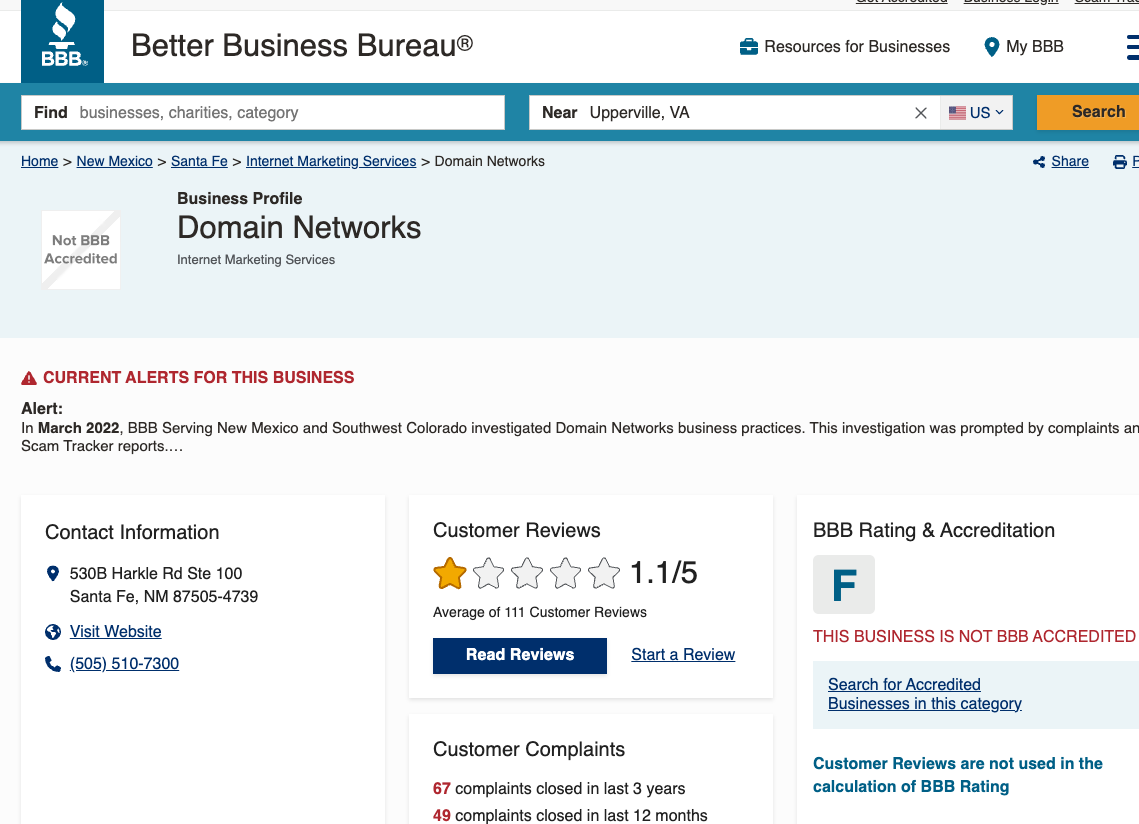
The Better Business Bureau listing for DomainNetworks gives it an “F” rating, and includes more than 100 reviews by people angry at receiving one of these scams via snail mail. Helpfully, the BBB says DomainNetworks previously operated under a different name: US Domain Authority LLC.

DomainNetworks has an “F” reputation with the Better Business Bureau.

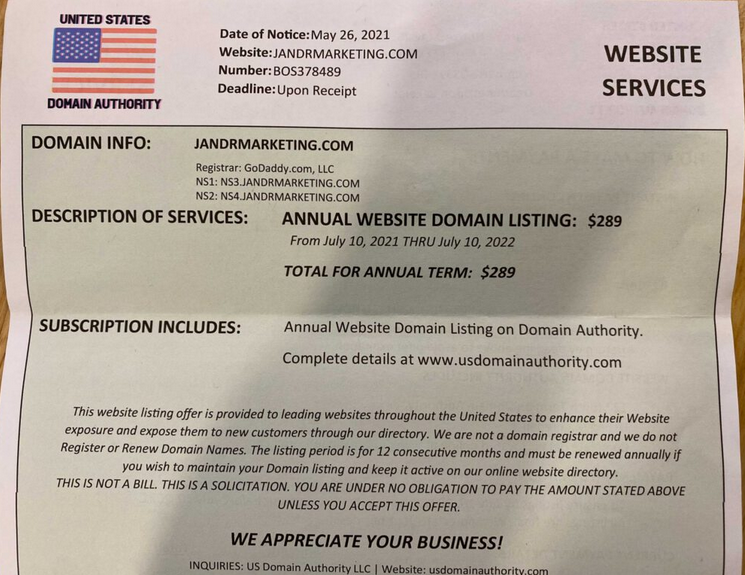
Copies of snail mail scam letters from US Domain Authority posted online show that this entity used the domain usdomainauthority[.]com, registered in May 2022. The Usdomainauthority mailer also featured a Henderson, NC address, albeit at a different post office box.

Usdomainauthority[.]com is no longer online, and the site seems to have blocked its pages from being indexed by the Wayback Machine at archive.org. But searching on a long snippet of text from DomainNetworks[.]com about refund requests shows that this text was found on just one other active website, according to publicwww.com, a service that indexes the HTML code of existing websites and makes it searchable.

A deceptive snail mail solicitation from DomainNetwork’s previous iteration — US Domain Authority. Image: Joerussori.com

That other website is a domain registered in January 2023 called thedomainsvault[.]com, and its registration details are likewise hidden behind privacy services. Thedomainsvault’s “Frequently Asked Questions” page is quite similar to the one on the DomainNetworks website; both begin with the question of why the company is sending a mailer that looks like a bill for domain services.

Thedomainsvault[.]com includes no useful information about the entity or people who operate it; clicking the “Contact-us” link on the site brings up a page with placeholder Lorem Ipsum text, a contact form, and a phone number of 123456789.

However, searching passive DNS records at DomainTools.com for thedomainsvault[.]com shows that at some point whoever owns the domain instructed incoming email to be sent to ubsagency@gmail.com.

The first result that currently pops up when searching for “ubsagency” in Google is ubsagency[.]com, which says it belongs to a Las Vegas-based Search Engine Optimization (SEO) and digital marketing concern generically named both United Business Service and United Business Services. UBSagency’s website is hosted at the same Ann Arbor, Mich. based hosting firm (A2 Hosting Inc) as thedomainsvault[.]com.

UBSagency’s LinkedIn page says the company has offices in Vegas, Half Moon Bay, Calif., and Renton, Wash. But once again, none of the addresses listed for these offices reveal any obvious clues about who runs UBSagency. And once again, none of these entities appear to exist as official businesses in their claimed state of residence.

Searching on ubsagency@gmail.com in Constella Intelligence shows the address was used sometime before February 2019 to create an account under the name “Sammy\Sam_Alon” at the interior decorating site Houzz.com. In January 2019, Houzz acknowledged that a data breach exposed account information on an undisclosed number of customers, including user IDs, one-way encrypted passwords, IP addresses, city and ZIP codes, as well as Facebook information.

Sammy\Sam_Alon registered at Houzz using an Internet address in Huntsville, Ala. (68.35.149.206). Constella says this address was associated with the email tropicglobal@gmail.com, which also is tied to several other “Sammy” accounts at different stores online.

Constella also says a highly unique password re-used by tropicglobal@gmail.com across numerous sites was used in connection with just a few other email accounts, including shenhavgroup@gmail.com, and distributorinvoice@mail.com.

The shenhavgroup@gmail.com address was used to register a Twitter account for a Sam Orit Alon in 2013, whose account says they are affiliated with the Shenhav Group. According to DomainTools, shenhavgroup@gmail.com was responsible for registering roughly two dozen domains, including the now-defunct unitedbusinessservice[.]com.

Constella further finds that the address distributorinvoice@mail.com was used to register an account at whmcs.com, a web hosting platform that suffered a breach of its user database several years back. The name on the WHMCS account was Shmuel Orit Alon, from Kidron, Israel.

UBSagency also has a Facebook page, or maybe “had” is the operative word because someone appears to have defaced it. Loading the Facebook page for UBSagency shows several of the images have been overlaid or replaced with a message from someone who is really disappointed with Sam Alon.

“Sam Alon is a LIAR, THIEF, COWARD AND HAS A VERY SMALL D*CK,” reads one of the messages:

The current Facebook profile page for UBSagency includes a logo that is similar to the DomainNetworks logo.

The logo in the UBSagency profile photo includes a graphic of what appears to be a magnifying glass with a line that zig-zags through bullet points inside and outside the circle, a unique pattern that is remarkably similar to the logo for DomainNetworks:

The logos for DomainNetworks (left) and UBSagency.

Constella also found that the same Huntsville IP address used by Sam Alon at Houzz was associated with yet another Houzz account, this one for someone named “Eliran.”

The UBSagency Facebook page features several messages from an Eliran “Dani” Benz, who is referred to by commenters as an employee or partner with UBSagency. The last check-in on Benz’s profile is from a beach at Rishon Letziyon in Israel earlier this year.

Neither Mr. Alon nor Mr. Benz responded to multiple requests for comment.

It may be difficult to believe that anyone would pay an invoice for a domain name or SEO service they never ordered. However, there is plenty of evidence that these phony bills often get processed by administrative personnel at organizations that end up paying the requested amount because they assume it was owed for some services already provided.

In 2018, KrebsOnSecurity published How Internet Savvy are Your Leaders?, which examined public records to show that dozens of cities, towns, school districts and even political campaigns across the United States got snookered into paying these scam domain invoices from a similar scam company called WebListings Inc.

In 2020, KrebsOnSecurity featured a deep dive into who was likely behind the WebListings scam, which had been sending out these snail mail scam letters for over a decade. That investigation revealed the scam’s connection to a multi-level marketing operation run out of the U.K., and to two brothers living in Scotland.

source https://krebsonsecurity.com/2023/07/whos-behind-the-domainnetworks-snail-mail-scam/

Russian Cybersecurity Executive Arrested for Alleged Role in 2012 Megahacks

Nikita Kislitsin, formerly the head of network security for one of Russia’s top cybersecurity firms, was arrested last week in Kazakhstan in response to 10-year-old hacking charges from the U.S. Department of Justice. Experts say Kislitsin’s prosecution could soon put the Kazakhstan government in a sticky diplomatic position, as the Kremlin is already signaling that it intends to block his extradition to the United States.

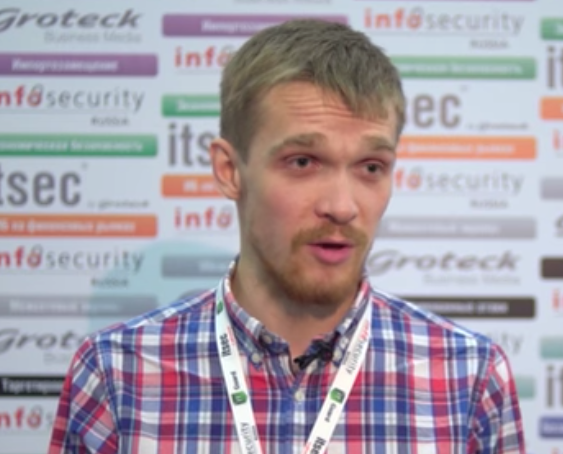
Nikita Kislitsin, at a security conference in Russia.

Kislitsin is accused of hacking into the now-defunct social networking site Formspring in 2012, and conspiring with another Russian man convicted of stealing tens of millions of usernames and passwords from LinkedIn and Dropbox that same year.

In March 2020, the DOJ unsealed two criminal hacking indictments against Kislitsin, who was then head of security at Group-IB, a cybersecurity company that was founded in Russia in 2003 and operated there for more than a decade before relocating to Singapore.

Prosecutors in Northern California indicted Kislitsin in 2014 for his alleged role in stealing account data from Formspring. Kislitsin also was indicted in Nevada in 2013, but the Nevada indictment does not name his alleged victim(s) in that case.

However, documents unsealed in the California case indicate Kislitsin allegedly conspired with Yevgeniy Nikulin, a Russian man convicted in 2020 of stealing 117 million usernames and passwords from Dropbox, Formspring and LinkedIn in 2012. Nikulin is currently serving a seven-year sentence in the U.S. prison system.

As first reported by Cyberscoop in 2020, a trial brief in the California investigation identified Nikulin, Kislitsin and two alleged cybercriminals — Oleg Tolstikh and Oleksandr Vitalyevich Ieremenko — as being present during a 2012 meeting at a Moscow hotel, where participants allegedly discussed starting an internet café business.

A 2010 indictment out of New Jersey accuses Ieremenko and six others with siphoning nonpublic information from the U.S. Securities & Exchange Commission (SEC) and public relations firms, and making $30 million in illegal stock trades based on the proprietary information they stole.

[The U.S. Secret Service has an outstanding $1 million reward for information leading to the arrest of Ieremenko (Александр Витальевич Еременко), who allegedly went by the hacker handles “Zl0m” and “Lamarez.”]

Kislitsin was hired by Group-IB in January 2013, nearly six months after the Formspring hack. Group-IB has since moved its headquarters to Singapore, and in April 2023 the company announced it had fully exited the Russian market.

In a statement provided to KrebsOnSecurity, Group-IB said Mr. Kislitsin is no longer an employee, and that he now works for a Russian organization called FACCT, which stands for “Fight Against Cybercrime Technologies.”

“Dmitry Volkov, co-founder and CEO, sold his stake in Group-IB’s Russia-based business to the company’s local management,” the statement reads. “The stand-alone business in Russia has been operating under the new brand FACCT ever since and will continue to operate as a separate company with no connection to Group-IB.”

FACCT says on its website that it is a “Russian developer of technologies for combating cybercrime,” and that it works with clients to fight targeted attacks, data leaks, fraud, phishing and brand abuse. In a statement published online, FACCT said Kislitsin is responsible for developing its network security business, and that he remains under temporary detention in Kazakhstan “to study the basis for extradition arrest at the request of the United States.”

“According to the information we have, the claims against Kislitsin are not related to his work at FACCT, but are related to a case more than 10 years ago when Nikita worked as a journalist and independent researcher,” FACCT wrote.

From 2006 to 2012, Kislitsin was editor-in-chief of “Hacker,” a popular Russian-language monthly magazine that includes articles on information and network security, programming, and frequently features interviews with and articles penned by notable or wanted Russian hackers.

“We are convinced that there are no legal grounds for detention on the territory of Kazakhstan,” the FACCT statement continued. “The company has hired lawyers who have been providing Nikita with all the necessary assistance since last week, and we have also sent an appeal to the Consulate General of the Russian Federation in Kazakhstan to assist in protecting our employee.”

FACCT indicated that the Kremlin has already intervened in the case, and the Russian government claims Kislitsin is wanted on criminal charges in Russia and must instead be repatriated to his homeland.

“The FACCT emphasizes that the announcement of Nikita Kislitsin on the wanted list in the territory of the Russian Federation became known only today, June 28, 6 days after the arrest in Kazakhstan,” FACCT wrote. “The company is monitoring developments.”

The Kremlin followed a similar playbook in the case of Aleksei Burkov, a cybercriminal who long operated two of Russia’s most exclusive underground hacking forums. Burkov was arrested in 2015 by Israeli authorities, and the Russian government fought Burkov’s extradition to the U.S. for four years — even arresting and jailing an Israeli woman on phony drug charges to force a prisoner swap.

That effort ultimately failed: Burkov was sent to America, pleaded guilty, and was sentenced to nine years in prison.

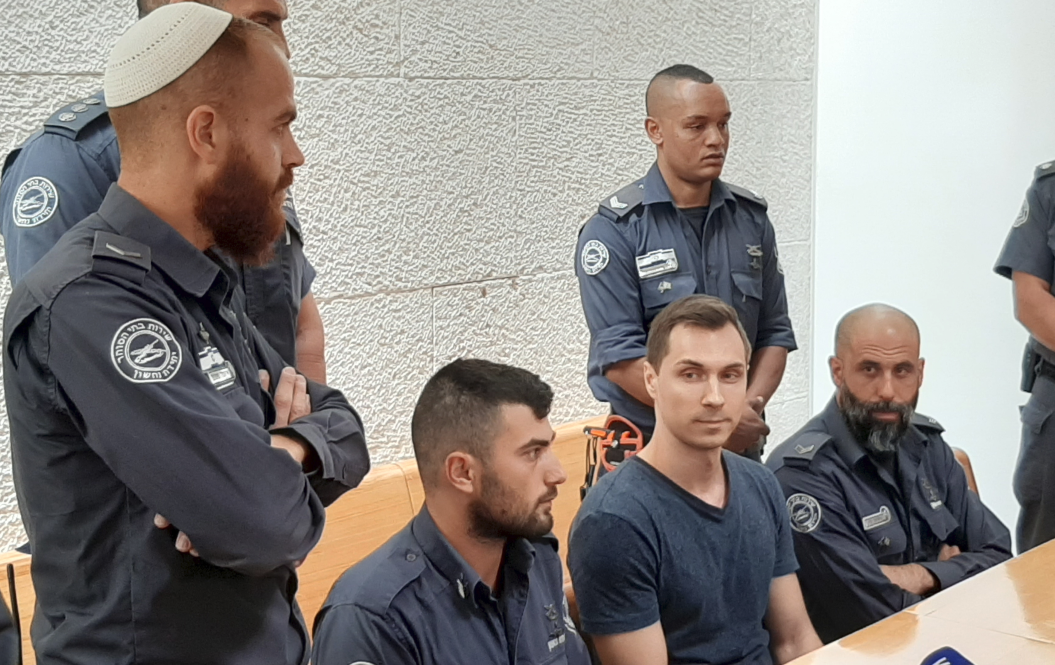
Alexei Burkov, seated second from right, attends a hearing in Jerusalem in 2015. Image: Andrei Shirokov / Tass via Getty Images.

Arkady Bukh is a U.S. attorney who has represented dozens of accused hackers from Russia and Eastern Europe who were extradited to the United States over the years. Bukh said Moscow is likely to turn the Kislitsin case into a diplomatic time bomb for Kazakhstan, which shares an enormous border and a great deal of cultural ties with Russia. A 2009 census found that Russians make up about 24 percent of the population of Kazakhstan.

“That would put Kazakhstan at a crossroads to choose between unity with Russia or going with the West,” Bukh said. “If that happens, Kazakhstan may have to make some very unpleasant decisions.”

Group-IB’s exodus from Russia comes as its former founder and CEO Ilya Sachkov remains languishing in a Russian prison, awaiting a farcical trial and an inevitable conviction on charges of treason. In September 2021, the Kremlin issued treason charges against Sachkov, although it has so far refused to disclose any details about the allegations.

Sachkov’s pending treason trial has been the subject of much speculation among denizens of Russian cybercrime forums, and the consensus seems to be that Sachkov and Group-IB were seen as a little too helpful to the DOJ in its various investigations involving top Russian hackers.

Indeed, since its inception in 2003, Group-IB’s researchers have helped to identify, disrupt and even catch a number of high-profile Russian hackers, most of whom got busted after years of criminal hacking because they made the unforgivable mistake of stealing from their own citizens.

When the indictments against Kislitsin were unsealed in 2020, Group-IB issued a lengthy statement attesting to his character and saying they would help him with his legal defense. As part of that statement, Group-IB noted that “representatives of the Group-IB company and, in particular, Kislitsin, in 2013, on their own initiative, met with employees of the US Department of Justice to inform them about the research work related to the underground, which was carried out by Kislitsin in 2012.”

source https://krebsonsecurity.com/2023/06/russian-cybersecurity-executive-arrested-for-alleged-role-in-2012-megahacks/

U.K. Cyber Thug PlugwalkJoe Gets 5 Years in Prison

Joseph James “PlugwalkJoe” O’Connor, a 24-year-old from the United Kingdom who earned his 15 minutes of fame by participating in the July 2020 hack of Twitter, has been sentenced to five years in a U.S. prison. That may seem like harsh punishment for a brief and very public cyber joy ride. But O’Connor also pleaded guilty in a separate investigation involving a years-long spree of cyberstalking and cryptocurrency theft enabled by “SIM swapping,” a crime wherein fraudsters trick a mobile provider into diverting a customer’s phone calls and text messages to a device they control.

Joseph “PlugwalkJoe” O’Connor, in a photo from a Globe Newswire press release Sept. 02, 2020, pitching O’Connor as a cryptocurrency expert and advisor.

On July 16, 2020 — the day after some of Twitter’s most recognizable and popular users had their accounts hacked and used to tweet out a bitcoin scam —  KrebsOnSecurity observed that several social media accounts tied to O’Connor appeared to have inside knowledge of the intrusion. That story also noted that thanks to COVID-19 lockdowns at the time, O’Connor was stuck on an indefinite vacation at a popular resort in Spain.

Not long after the Twitter hack, O’Connor was quoted in The New York Times denying any involvement. “I don’t care,” O’Connor told The Times. “They can come arrest me. I would laugh at them. I haven’t done anything.”

Speaking with KrebsOnSecurity via Instagram instant message just days after the Twitter hack, PlugwalkJoe demanded that his real name be kept out of future blog posts here. After he was told that couldn’t be promised, he remarked that some people in his circle of friends had been known to hire others to deliver physical beatings on people they didn’t like.

O’Connor was still in Spain a year later when prosecutors in the Northern District of California charged him with conspiring to hack Twitter. At the same time, prosecutors in the Southern District of New York charged O’Connor with an impressive array of cyber offenses involving the exploitation of social media accounts, online extortion, and cyberstalking, and the theft of cryptocurrency then valued at nearly USD $800,000.

In late April 2023, O’Connor was extradited from Spain to face charges in the United States. Two weeks later, he entered guilty pleas in both California and New York, admitting to all ten criminal charges levied against him. On June 23, O’Connor was sentenced to five years in prison.

PlugwalkJoe was part of a community that specialized in SIM-swapping victims to take over their online identities. Unauthorized SIM swapping is a scheme in which fraudsters trick or bribe employees at wireless phone companies into redirecting the target’s text messages and phone calls to a device they control.

From there, the attackers can reset the password for any of the victim’s online accounts that allow password resets via SMS. SIM swapping also lets attackers intercept one-time passwords needed for SMS-based multi-factor authentication (MFA).

O’Connor admitted to conducting SIM swapping attacks to take control over financial accounts tied to several cryptocurrency executives in May 2019, and to stealing digital currency currently valued at more than $1.6 million.

PlugwalkJoe also copped to SIM-swapping his way into the Snapchat accounts of several female celebrities and threatening to release nude photos found on their phones.

Victims who refused to give up social media accounts or submit to extortion demands were often visited with “swatting attacks,” wherein O’Connor and others would falsely report a shooting or hostage situation in the hopes of tricking police into visiting potentially lethal force on a target’s address.

Prosecutors said O’Connor even swatted and cyberstalked a 16-year-old girl, sending her nude photos and threatening to rape and/or murder her and her family.

In the case of the Twitter hack, O’Connor pleaded guilty to conspiracy to commit computer intrusions, conspiracy to commit wire fraud, and conspiracy to commit money laundering.

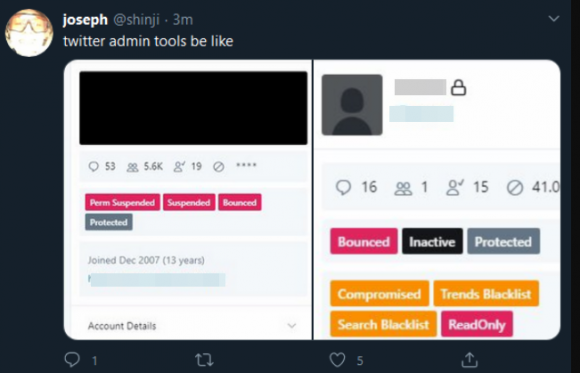
The account “@shinji,” a.k.a. “PlugWalkJoe,” tweeting a screenshot of Twitter’s internal tools interface, on July 15, 2020.

To resolve the case against him in New York, O’Connor pleaded guilty to conspiracy to commit computer intrusion, two counts of committing computer intrusions, making extortive communications, two counts of stalking, and making threatening communications.

In addition to the prison term, O’Connor was sentenced to three years of supervised release, and ordered to pay $794,012.64 in forfeiture.

To be clear, the Twitter hack of July 2020 did not involve SIM-swapping. Rather, Twitter said the intruders tricked a Twitter employee over the phone into providing access to internal tools.

Three others were charged along with O’Connor in the Twitter compromise. The alleged mastermind of the hack, then 17-year-old Graham Ivan Clarke from Tampa, Fla., pleaded guilty in 2021 and agreed to serve three years in prison, followed by three years probation.

This story is good reminder about the need to minimize your reliance on the mobile phone companies for securing your online identity. This means reducing the number of ways your life could be turned upside down if someone were to hijack your mobile phone number.

Most online services require users to validate a mobile phone number as part of setting up an account, but some services will let you remove your phone number after the fact. Those services that do you let you remove your phone number or disable SMS/phone calls for account recovery probably also offer more secure multi-factor authentication options, such as app-based one-time passwords and security keys. Check out 2fa.directory for a list of multi-factor options available across hundreds of popular sites and services.

source https://krebsonsecurity.com/2023/06/u-k-cyber-thug-plugwalkjoe-gets-5-years-in-prison/

Follow-up to prior post pertaining to SMS Phishers Harvesting contact info from UPS in Canada…

As a follow-up to the prior post regarding phishers obtaining personal data from UPS tracking software in Canada…I can personally testify that it also happened (happening) in the US; not long ago I received a similar phishing attack after ordering some item online from a reputable website and awaiting delivery via UPS—the delivery took longer than expected and I received some mysterious email saying something along the lines that there was a problem with delivery of an item. Soooo…consider yourselves forewarned—this is not just happening in Canada and the attempt on me was fairly recent.

SMS Phishers Harvested Phone Numbers Shipment Data from UPS Tracking Tool

The United Parcel Service (UPS) says fraudsters have been harvesting phone numbers and other information from its online shipment tracking tool in Canada to send highly targeted SMS phishing (a.k.a. “smishing”) messages that spoofed UPS and other top brands. The missives addressed recipients by name, included details about recent orders, and warned that those orders wouldn’t be shipped unless the customer paid an added delivery fee.

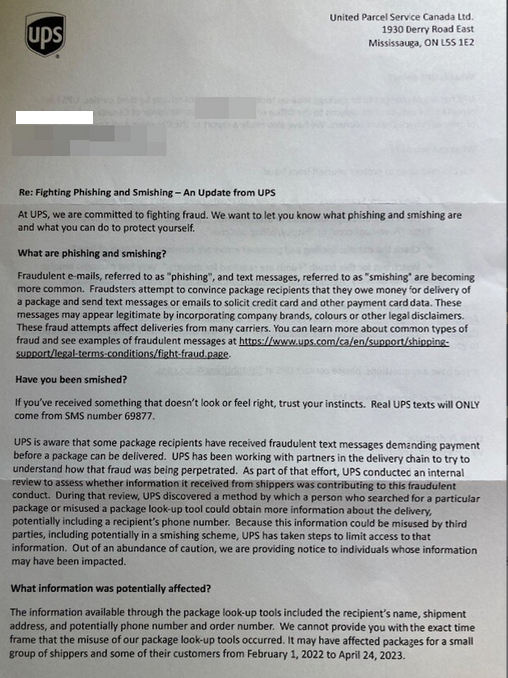
In a snail mail letter sent this month to Canadian customers, UPS Canada Ltd. said it is aware that some package recipients have received fraudulent text messages demanding payment before a package can be delivered, and that it has been working with partners in its delivery chain to try to understand how the fraud was occurring.

The recent letter from UPS about SMS phishers harvesting shipment details and phone numbers from its website.

“During that review, UPS discovered a method by which a person who searched for a particular package or misused a package look-up tool could obtain more information about the delivery, potentially including a recipient’s phone number,” the letter reads. “Because this information could be misused by third parties, including potentially in a smishing scheme, UPS has taken steps to limit access to that information.”

The written notice goes on to say UPS believes the data exposure “affected packages for a small group of shippers and some of their customers from February 1, 2022 to April 24, 2023.”

As early as April 2022, KrebsOnSecurity began receiving tips from Canadian readers who were puzzling over why they’d just received one of these SMS phishing messages that referenced information from a recent order they’d legitimately placed at an online retailer.

In March, 2023, a reader named Dylan from British Columbia wrote in to say he’d received one of these shipping fee scam messages not long after placing an order to buy gobs of building blocks directly from Lego.com. The message included his full name, phone number, and postal code, and urged him to click a link to mydeliveryfee-ups[.]info and pay a $1.55 delivery fee that was supposedly required to deliver his Legos.

“From searching the text of this phishing message, I can see that a lot of people have experienced this scam, which is more convincing because of the information the phishing text contains,” Dylan wrote. “It seems likely to me that UPS is leaking information somehow about upcoming deliveries.”

Josh is a reader who works for a company that ships products to Canada, and in early January 2023 he inquired whether there was any information about a breach at UPS Canada.

“We’ve seen many of our customers targeted with a fraudulent UPS text message scheme after placing an order,” Josh said. “A link is provided (often only after the customer responds to the text) which takes you to a captcha page, followed by a fraudulent payment collection page.”

Pivoting on the domain in the smishing message sent to Dylan shows the phishing domain shared an Internet host in Russia [91.215.85-166] with nearly two dozen other smishing related domains, including upsdelivery[.]info, legodelivery[.]info, adidascanadaltd[.]com, crocscanadafee[.]info, refw0234apple[.]info, vista-printcanada[.]info and telus-ca[.]info.

The inclusion of big-name brands in the domains of these UPS smishing campaigns suggests the perpetrators had the ability to focus their lookups on UPS customers who had recently ordered items from specific companies.

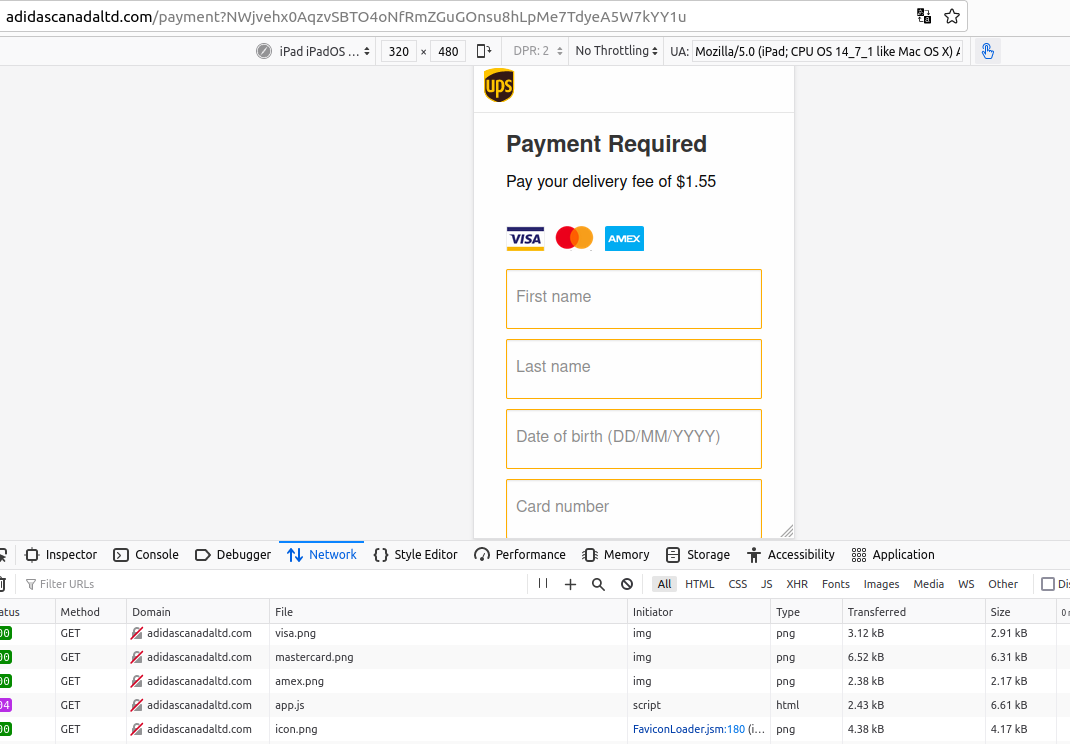
Attempts to visit these domains with a web browser failed, but loading them in a mobile device (or in my case, emulating a mobile device using a virtual machine and Developer Tools in Firefox) revealed the first stage of this smishing attack. As Josh mentioned, what first popped up was a CAPTCHA; after the visitor solved the CAPTCHA, they were taken through several more pages that requested the user’s full name, date of birth, credit card number, address, email and phone number.

A smishing website targeting Canadians who recently purchased from Adidas online. The site would only load in a mobile browser.

In April 2022, KrebsOnSecurity heard from Alex, the CEO of a technology company in Canada who asked to leave his last name out of this story. Alex reached out when he began receiving the smishing messages almost immediately after ordering two sets of Airpods directly from Apple’s website.

What puzzled Alex most was that he’d instructed Apple to send the Airpods as a gift to two different people, and less than 24 hours later the phone number he uses for his Apple account received two of the phishing messages, both of which contained salutations that included the names of the people for whom he’d bought Airpods.

“I’d put the recipient as different people on my team, but because it was my phone number on both orders I was the one getting the texts,” Alex explained. “That same day, I got text messages referring to me as two different people, neither of whom were me.”

Alex said he believes UPS Canada either doesn’t fully understand what happened yet, or it is being coy about what it knows. He said the wording of UPS’s response misleadingly suggests the smishing attacks were somehow the result of hackers randomly looking up package information via the company’s tracking website.

Alex said it’s likely that whoever is responsible figured out how to query the UPS Canada website for only pending orders from specific brands, perhaps by exploiting some type of application programming interface (API) that UPS Canada makes or made available to its biggest retail partners.

“It wasn’t like I put the order through [on Apple.ca] and some days or weeks later I got a targeted smishing attack,” he said. “It was more or less the same day. And it was as if [the phishers] were being notified the order existed.”

The letter to UPS Canada customers does not mention whether any other customers in North America were affected, and it remains unclear whether any UPS customers outside of Canada may have been targeted.

In a statement provided to KrebsOnSecurity, Sandy Springs, Ga. based UPS [NYSE:UPS] said the company has been working with partners in the delivery chain to understand how that fraud was being perpetrated, as well as with law enforcement and third-party experts to identify the cause of this scheme and to put a stop to it.

“Law enforcement has indicated that there has been an increase in smishing impacting a number of shippers and many different industries,” reads an email from Brian Hughes, director of financial and strategy communications at UPS.

“Out of an abundance of caution, UPS is sending privacy incident notification letters to individuals in Canada whose information may have been impacted,” Hughes said. “We encourage our customers and general consumers to learn about the ways they can stay protected against attempts like this by visiting the UPS Fight Fraud website.”

source https://krebsonsecurity.com/2023/06/sms-phishers-harvested-phone-numbers-shipment-data-from-ups-tracking-tool/

Why Malware Crypting Services Deserve More Scrutiny

If you operate a cybercrime business that relies on disseminating malicious software, you probably also spend a good deal of time trying to disguise or “crypt” your malware so that it appears benign to antivirus and security products. In fact, the process of “crypting” malware is sufficiently complex and time-consuming that most serious cybercrooks will outsource this critical function to a handful of trusted third parties. This story explores the history and identity behind Cryptor[.]biz, a long-running crypting service that is trusted by some of the biggest names in cybercrime.

Virtually all malware that is deployed for use in data stealing at some point needs to be crypted. This highly technical, laborious process involves iteratively altering the appearance and behavior of a malicious file until it no longer sets off alarm bells when scanned by different antivirus tools.

Experienced malware purveyors understand that if they’re not continuously crypting their malware before sending it out, then a lot more of whatever digital disease they are trying to spread is going to get flagged by security tools. In short, if you are running a cybercrime enterprise and you’re not equipped to handle this crypting process yourself, you probably need to pay someone else to do it for you.

Thanks to the high demand for reliable crypting services, there are countless cybercriminals who’ve hung out their shingles as crypting service providers. However, most of these people do not appear to be very good at what they do, because most are soon out of business.

One standout is Cryptor[.]biz. This service is actually recommended by the purveyors of the RedLine information stealer malware, which is a popular and powerful malware kit that specializes in stealing victim data and is often used to lay the groundwork for ransomware attacks. Cryptor[.]biz also has been recommended to customers of the Predator information stealer malware family (via the malware’s Telegram support channels).

WHO RUNS CRYPTOR[.]BIZ?

As good as Cryptor[.]biz may be at obfuscating malware, its proprietor does not appear to have done a great job covering his own tracks. The registration records for the website Cryptor[.]biz are hidden behind privacy protection services, but the site’s homepage says potential customers should register by visiting the domain crypt[.]guru, or by sending a Jabber instant message to the address “masscrypt@exploit.im.”

Crypt[.]guru’s registration records also are hidden, yet passive domain name system (DNS) records for both cryptor[.]biz and crypt[.]guru show that in 2018 the domains were forwarding incoming email to the address obelisk57@gmail.com.

Cyber intelligence firm Intel 471 reports that obelisk57@gmail.com was used to register an account on the forum Blacksoftware under the nickname “Kerens.” Meanwhile, the Jabber address masscrypt@exploit.im has been associated with the user Kerens on the Russian hacking forum Exploit from 2011 to the present day.

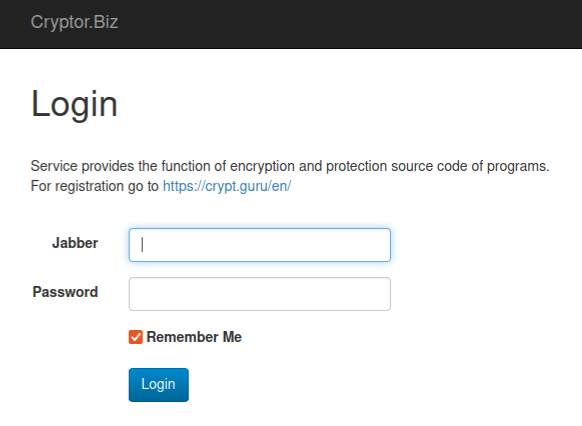
The login page for Cryptor dot biz contains several clues about who runs the service.

The very first post by Kerens on Exploit in 2011 was a negative review of a popular crypting service that predated Cryptor[.]biz called VIP Crypt, which Kerens accused of being “shitty” and unreliable. But Intel 471 finds that after his critical review of VIP Crypt, Kerens did not post publicly on Exploit again for another four years until October 2016, when they suddenly began advertising Cryptor[.]biz.

Intel 471 found that Kerens used the email address pepyak@gmail.com, which also was used to register Kerens accounts on the Russian language hacking forums Verified and Damagelab.

Ironically, Verified has itself been hacked multiple times over the years, with its private messages and user registration details leaked online. Those records indicate the user Kerens registered on Verified in March 2009 from an Internet address in Novosibirsk, a city in the southern Siberian region of Russia.

In 2010, someone with the username Pepyak on the Russian language affiliate forum GoFuckBiz[.]com shared that they typically split their time during the year between living in Siberia (during the milder months) and Thailand (when Novosibirsk is typically -15 °C/°5F).

For example, in one conversation about the best car to buy for navigating shoddy roads, Pepyak declared, “We have shitty roads in Siberia.” In January 2010, Pepyak asked the GoFuckBiz community where one might find a good USB-based modem in Phuket, Thailand.

DomainTools.com says the email address pepyak@gmail.com was used to register 28 domain names over the years, including a now-defunct Russian automobile sales website called “autodoska[.]biz.” DomainTools shows this website was registered in 2008 to a Yuri Churnov from Sevastpol, Crimea (prior to Russia’s annexation of Crimea in 2014, the peninsula was part of Ukraine).

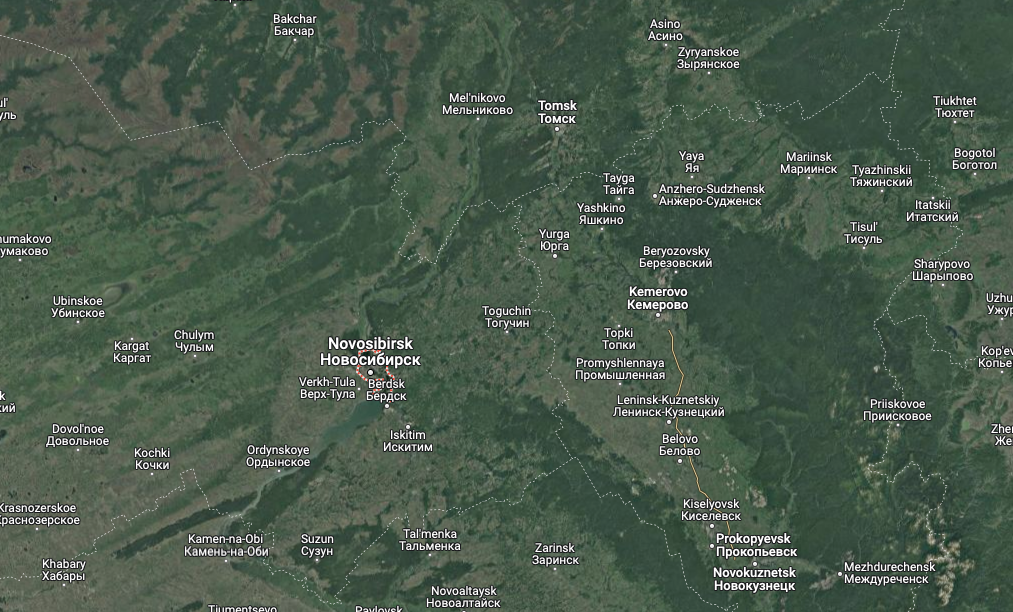
The WHOIS records for autodoska[.]biz were changed in 2010 to Sergey Purtov (pepyak@gmail.com) from Yurga, a town in Russia’s Kemerovo Oblast, which is a relatively populous area in Western Siberia that is adjacent to Novosibirsk.

A satellite view of the region including Novosibirsk, Yurga and Kemerovo Oblast. Image: Google Maps.

Many of the 28 domains registered to pepyak@gmail.com have another email address in their registration records: unforgiven57@mail.ru. According to DomainTools, the Unforgiven email address was used to register roughly a dozen domains, including three that were originally registered to Keren’s email address — pepyak@gmail.com (e.g., antivirusxp09[.]com).

One of the domains registered in 2006 to the address unforgiven57@mail.ru was thelib[.]ru, which for many years was a place to download pirated e-books. DomainTools says thelib[.]ru was originally registered to a Sergey U Purtov.

Most of the two-dozen domains registered to pepyak@gmail.com shared a server at one point with a small number of other domains, including mobile-soft[.]su, which was registered to the email address spurtov@gmail.com.

CDEK, an express delivery company based in Novosibirsk, was apparently hacked at some point because cyber intelligence firm Constella Intelligence found that its database shows the email address spurtov@gmail.com was assigned to a Sergey Yurievich Purtov (Сергей Юрьевич Пуртов).

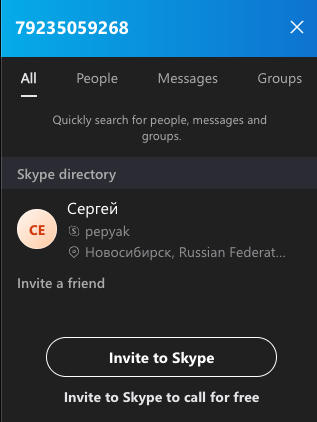
DomainTools says the same phone number in the registration records for autodoska[.]biz (+7.9235059268) was used to secure two other domains — bile[.]ru and thelibrary[.]ru, both of which were registered to a Sergey Y Purtov.

A search on the phone number 79235059268 in Skype reveals these digits belong to a “Sergey” from Novosibirsk with the now-familiar username  — Pepyak.

Bringing things full circle, Constella Intelligence shows that various online accounts tied to the email address unforgiven57@mail.ru frequently relied on the somewhat unique password, “plk139t51z.” Constella says that same password was used for just a handful of other email addresses, including gumboldt@gmail.com.

Hacked customer records from CDEK show gumboldt@gmail.com was tied to a customer named Sergey Yurievich Purtov. DomainTools found that virtually all of the 15 domain names registered to gumboldt@gmail.com (including the aforementioned mobile-soft[.]su) were at one point registered to spurtov@gmail.com.

Intel 471 reports that gumboldt@gmail.com was used in 2009 to register a user by the nickname “Kolumb” on the Russian hacking forum Antichat. From Kolumb’s posts on Antichat, it seems this user was mostly interested in buying access to compromised computers inside of Russia.

Then in December 2009, Kolumb said they were in desperate need of a reliable crypting service or full-time cryptor.

“We need a person who will crypt software every day, sometimes even a couple of times a day,” Kolumb wrote on Antichat.

Mr. Purtov did not respond to requests for comment sent to any of the email addresses referenced in this report. Mail.ru responded that the email address spurtov@mail.ru is no longer active.

ANALYSIS

As KrebsOnSecurity opined on Mastodon earlier this week, it makes a lot of sense for cybersecurity researchers and law enforcement alike to focus attention on the top players in the crypting space — for several reasons. Most critically, the cybercriminals offering time-tested crypting services also tend to be among the most experienced and connected malicious coders on the planet.

Think of it this way: By definition, a crypting service scans and examines all types of malware before those new nasties are first set loose in the wild. This fact alone should make these criminal enterprises a primary target of cybersecurity firms looking to gain more timely intelligence about new malware.

Also, a review of countless posts and private messages from Pepyak and other crypting providers shows that a successful crypting service will have direct and frequent contact with some of the world’s most advanced malware authors.

In short, infiltrating or disrupting a trusted crypting service can be an excellent way to slow down or even sideline a large number of cybercrime operations all at once.

Further reading on the crypting industry:

This Service Helps Malware Authors Fix Flaws in Their Code
Antivirus is Dead: Long Live Antivirus!

source https://krebsonsecurity.com/2023/06/why-malware-crypting-services-deserve-more-scrutiny/