Nuclear Bot Author Arrested in Sextortion Case

Last summer, a wave of sextortion emails began flooding inboxes around the world. The spammers behind this scheme claimed they’d hacked your computer and recorded videos of you watching porn, and promised to release the embarrassing footage to all your contacts unless a bitcoin demand was paid. Now, French authorities say they’ve charged two men they believe are responsible for masterminding this scam. One of them is a 21-year-old hacker interviewed by KrebsOnSecurity in 2017 who openly admitted to authoring a banking trojan called “Nuclear Bot.”

On Dec. 15, the French news daily Le Parisien published a report stating that French authorities had arrested and charged two men in the sextortion scheme. The story doesn’t name either individual, but rather refers to one of the accused only by the pseudonym “Antoine I.,” noting that his first had been changed (presumably to protect his identity because he hasn’t yet been convicted of a crime).

“According to sources close to the investigation, Antoine I. surrendered to the French authorities at the beginning of the month, after being hunted down all over Europe,” the story notes. “The young Frenchman, who lived between Ukraine, Poland and the Baltic countries, was indicted on 6 December for ‘extortion by organized gang, fraudulent access to a data processing system and money laundering.’ He was placed in pre-trial detention.”

According to Le Parisien, Antoine I. admitted to being the inventor of the initial 2018 sextortion scam, which was subsequently imitated by countless other ne’er-do-wells. The story says the two men deployed malware to compromise at least 2,000 computers that were used to blast out the sextortion emails.

While that story is light on details about the identities of the accused, an earlier version of it published Dec. 14 includes more helpful clues. The Dec. 14 piece said Antoine I. had been interviewed by KrebsOnSecurity in April 2017, where he boasted about having created Nuclear Bot, a malware strain designed to steal banking credentials from victims.

My April 2017 exposé featured an interview with Augustin Inzirillo, a young man who came across as deeply conflicted about his chosen career path. That path became traceable after he released the computer code for Nuclear Bot on GitHub. Inzirillo outed himself by defending the sophistication of his malware after it was ridiculed by both security researchers and denizens of the cybercrime underground, where copies of the code wound up for sale. From that story:

“It was a big mistake, because now I know people will reuse my code to steal money from other people,” Inzirillo told KrebsOnSecurity in an online chat.

Inzirillo released the code on GitHub with a short note explaining his motivations, and included a contact email address at a domain (inzirillo.com) set up long ago by his father, Daniel Inzirillo.

KrebsOnSecurity also reached out to Daniel, and heard back from him roughly an hour before Augustin replied to requests for an interview. Inzirillo the elder said his son used the family domain name in his source code release as part of a misguided attempt to impress him.

“He didn’t do it for money,” said Daniel Inzirillo, whose CV shows he has built an impressive career in computer programming and working for various financial institutions. “He did it to spite all the cyber shitheads. The idea was that they wouldn’t be able to sell his software anymore because it was now free for grabs.”

If Augustin Inzirillo ever did truly desire to change his ways, it wasn’t clear from his apparent actions last summer: The Le Parisien story says the sextortion scams netted the Frenchman and his co-conspirator at least a million Euros.

In August 2018, KrebsOnSecurity was contacted by a researcher working with French authorities on the investigation who said he suspected the young man was bragging on Twitter that he used a custom version of Nuclear Bot dubbed “TinyNuke” to steal funds from customers of French and Polish banks.

The source said this individual used the now-defunct Twitter account @tiny_gang1 to taunt French authorities, while showing off a fan of 100-Euro notes allegedly gained from his illicit activities (see image above). It seemed to the source that Inzirillo wanted to get caught, because at one point @tiny_gang1 even privately shared a copy of Inzirillo’s French passport to prove his identity and accomplishments to the researcher.

“He modified the Tinynuke’s config several times, and we saw numerous modifications in the malware code too,” the source said. “We tried to compare his samples with the leaked code available on GitHub and we noticed that the guy actually was using a more advanced version with features that don’t exist in the publicly available repositories. As an example, custom samples have video recording functionality, socks proxy and other features. So the guy clearly improved the source code and recompiled a new version for every new campaign.”

The source said the person behind the @tiny_gang Twitter account attacked French targets with custom versions of TinyNuke in one to three campaigns per week earlier this year, harvesting French bank accounts and laundering the stolen funds via a money mule network based mostly in the United Kingdom.

“If the guy behind this campaign is the malware author, it could easily explain the modifications happening with the malware, and his French is pretty good,” the researcher told KrebsOnSecurity. “He’s really provocative and I think he wants to be arrested in France because it could be a good way to become famous and maybe prove that his malware works (to resell it after?).”

The source said the TinyNuke author threatened him with physical harm after the researcher insulted his intelligence while trying to goad him into disclosing more details about his cybercrime activities.

“The guy has a serious ego problem,” the researcher said. “He likes when we talk about him and he hates when we mock him. He got really angry as time went by and started personally threatening me. In the last [TinyNuke malware configuration file] targeting Poland we found a long message dedicated to me with clear physical threats.”

All of the above is consistent with the findings detailed in the Le Parisien report, which quoted French investigators saying Antoine I. in October 2019 used a now-deleted Twitter account to taunt the authorities into looking for him. In one such post, he included a picture of himself holding a beer, saying: “On the train to Naples. You should send me a registered letter instead of threatening guys informally.”

The Le Parisien story also said Antoine I. threatened a researcher working with French authorities on the investigation (the researcher is referred to pseudonymously as “Marc”).

“I make a lot more money than you, I am younger, more intelligent,” Antoine I. reportedly wrote in July 2018 to Marc. “If you do not stop playing with me, I will put a bullet in your head. ”

French authorities say the defendant managed his extortion operations while traveling throughout Ukraine and other parts of Eastern Europe. But at some point he decided to return home to France, despite knowing investigators there were hunting him. According to Le Parisien, he told the French authorities he wanted to cooperate in the investigation and that he no longer wished to live like a fugitive.

source https://krebsonsecurity.com/2019/12/nuclear-bot-author-arrested-in-sextortion-case/

Ransomware Gangs Now Outing Victim Businesses That Don’t Pay Up

As if the scourge of ransomware wasn’t bad enough already: Several prominent purveyors of ransomware have signaled they plan to start publishing data stolen from victims who refuse to pay up. To make matters worse, one ransomware gang has now created a public Web site identifying recent victim companies that have chosen to rebuild their operations instead of quietly acquiescing to their tormentors.

The message displayed at the top of the Maze Ransomware public shaming site.

Less than 48 hours ago, the cybercriminals behind the Maze Ransomware strain erected a Web site on the public Internet, and it currently lists the company names and corresponding Web sites for eight victims of their malware that have declined to pay a ransom demand.

“Represented here companies dont wish to cooperate with us, and trying to hide our successful attack on their resources,” the site explains in broken English. “Wait for their databases and private papers here. Follow the news!”

KrebsOnSecurity was able to verify that at least one of the companies listed on the site indeed recently suffered from a Maze ransomware infestation that has not yet been reported in the news media.

The information disclosed for each Maze victim includes the initial date of infection, several stolen Microsoft Office, text and PDF files, the total volume of files allegedly exfiltrated from victims (measured in Gigabytes), as well as the IP addresses and machine names of the servers infected by Maze.

As shocking as this new development may be to some, it’s not like the bad guys haven’t warned us this was coming.

“For years, ransomware developers and affiliates have been telling victims that they must pay the ransom or stolen data would be publicly released,” said Lawrence Abrams, founder of the computer security blog and victim assistance site BleepingComputer.com. “While it has been a well-known secret that ransomware actors snoop through victim’s data, and in many cases steal it before the data is encrypted, they never actually carried out their threats of releasing it.”

Abrams said that changed at the end of last month, when the crooks behind Maze Ransomware threatened Allied Universal that if they did not pay the ransom, they would release their files. When they did not receive a payment, they released 700MB worth of data on a hacking forum.

“Ransomware attacks are now data breaches,” Abrams said. “During ransomware attacks, some threat actors have told companies that they are familiar with internal company secrets after reading the company’s files. Even though this should be considered a data breach, many ransomware victims simply swept it under the rug in the hopes that nobody would ever find out. Now that ransomware operators are releasing victim’s data, this will need to change and companies will have to treat these attacks like data breaches.”

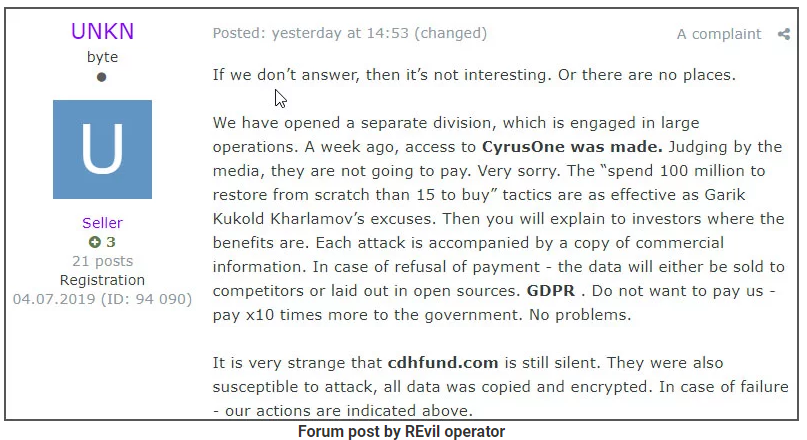
The move by Maze Ransomware comes just days after the cybercriminals responsible for managing the “Sodinokibi/rEvil” ransomware empire posted on a popular dark Web forum that they also plan to start using stolen files and data as public leverage to get victims to pay ransoms.

The leader of the Sodinokibi/rEvil ransomware gang promising to name and shame victims publicly in a recent cybercrime forum post. Image: BleepingComputer.

This is especially ghastly news for companies that may already face steep fines and other penalties for failing to report breaches and safeguard their customers’ data. For example, healthcare providers are required to report ransomware incidents to the U.S. Department of Health and Human Services, which often documents breaches involving lost or stolen healthcare data on its own site.

While these victims may be able to avoid reporting ransomware incidents if they can show forensic evidence demonstrating that patient data was never taken or accessed, sites like the one that Maze Ransomware has now erected could soon dramatically complicate these incidents.

source https://krebsonsecurity.com/2019/12/ransomware-gangs-now-outing-victim-businesses-that-dont-pay-up/

Inside ‘Evil Corp,’ a $100M Cybercrime Menace

The U.S. Justice Department this month offered a $5 million bounty for information leading to the arrest and conviction of a Russian man indicted for allegedly orchestrating a vast, international cybercrime network that called itself “Evil Corp” and stole roughly $100 million from businesses and consumers. As it happens, for several years KrebsOnSecurity closely monitored the day-to-day communications and activities of the accused and his accomplices. What follows is an insider’s look at the back-end operations of this gang.
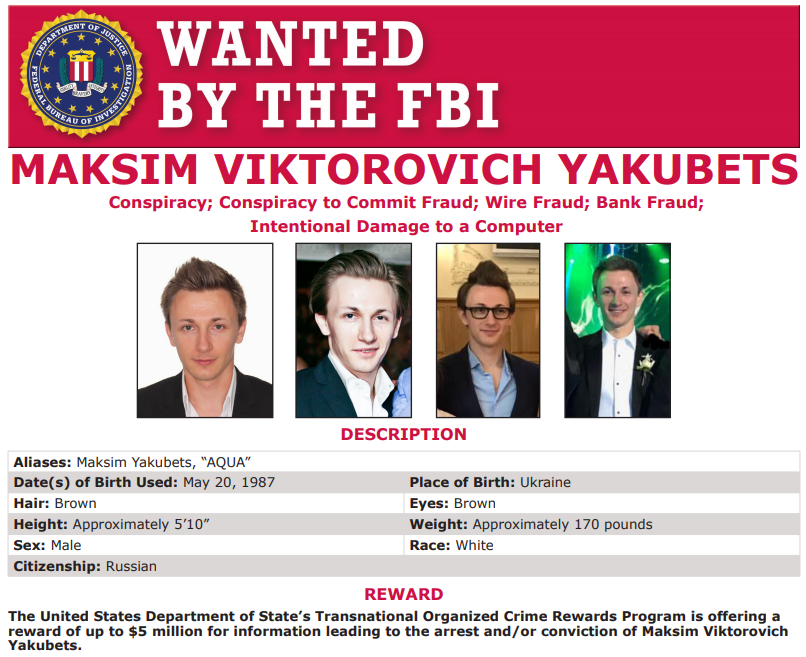
Image: FBI

The $5 million reward is being offered for 32 year-old Maksim V. Yakubets, who the government says went by the nicknames “aqua,” and “aquamo,” among others. The feds allege Aqua led an elite cybercrime ring with at least 16 others who used advanced, custom-made strains of malware known as “JabberZeus” and “Bugat” (a.k.a. “Dridex“) to steal banking credentials from employees at hundreds of small- to mid-sized companies in the United States and Europe.

From 2009 to the present, Aqua’s primary role in the conspiracy was recruiting and managing a continuous supply of unwitting or complicit accomplices to help Evil Corp. launder money stolen from their victims and transfer funds to members of the conspiracy based in Russia, Ukraine and other parts of Eastern Europe. These accomplices, known as “money mules,” are typically recruited via work-at-home job solicitations sent out by email and to people who have submitted their resumes to job search Web sites.

Money mule recruiters tend to target people looking for part-time, remote employment, and the jobs usually involve little work other than receiving and forwarding bank transfers. People who bite on these offers sometimes receive small commissions for each successful transfer, but just as often end up getting stiffed out of a promised payday, and/or receiving a visit or threatening letter from law enforcement agencies that track such crime (more on that in a moment).

HITCHED TO A MULE

KrebsOnSecurity first encountered Aqua’s work in 2008 as a reporter for The Washington Post. A source said they’d stumbled upon a way to intercept and read the daily online chats between Aqua and several other mule recruiters and malware purveyors who were stealing hundreds of thousands of dollars weekly from hacked businesses.

The source also discovered a pattern in the naming convention and appearance of several money mule recruitment Web sites being operated by Aqua. People who responded to recruitment messages were invited to create an account at one of these sites, enter personal and bank account data (mules were told they would be processing payments for their employer’s “programmers” based in Eastern Europe) and then log in each day to check for new messages.

Each mule was given busy work or menial tasks for a few days or weeks prior to being asked to handle money transfers. I believe this was an effort to weed out unreliable money mules. After all, those who showed up late for work tended to cost the crooks a lot of money, as the victim’s bank would usually try to reverse any transfers that hadn’t already been withdrawn by the mules.
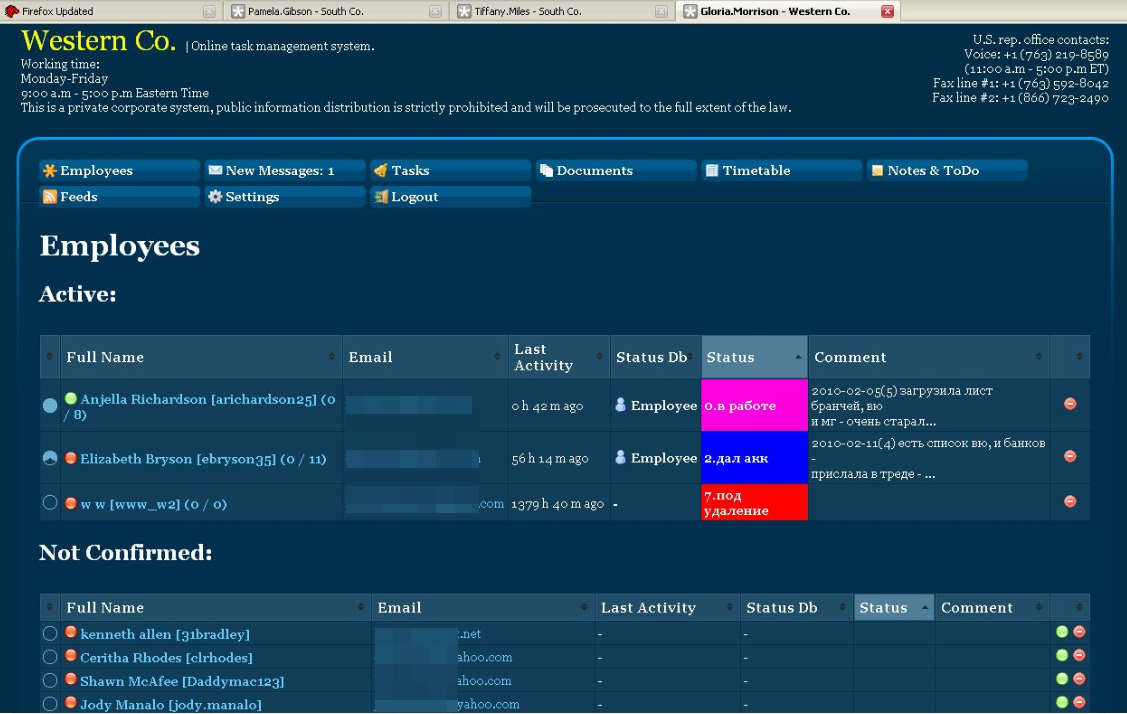
One of several sites set up by Aqua and others to recruit and manage money mules.

When it came time to transfer stolen funds, the recruiters would send a message through the mule site saying something like: “Good morning [mule name here]. Our client — XYZ Corp. — is sending you some money today. Please visit your bank now and withdraw this payment in cash, and then wire the funds in equal payments — minus your commission — to these three individuals in Eastern Europe.”

Only, in every case the company mentioned as the “client” was in fact a small business whose payroll accounts they’d already hacked into.

Here’s where it got interesting. Each of these mule recruitment sites had the same security weakness: Anyone could register, and after logging in any user could view messages sent to and from all other users simply by changing a number in the browser’s address bar. As a result, it was trivial to automate the retrieval of messages sent to every money mule registered across dozens of these fake company sites.

So, each day for several years my morning routine went as follows: Make a pot of coffee; shuffle over to the computer and view the messages Aqua and his co-conspirators had sent to their money mules over the previous 12-24 hours; look up the victim company names in Google; pick up the phone to warn each that they were in the process of being robbed by the Russian Cyber Mob.

My spiel on all of these calls was more or less the same: “You probably have no idea who I am, but here’s all my contact info and what I do. Your payroll accounts have been hacked, and you’re about to lose a great deal of money. You should contact your bank immediately and have them put a hold on any pending transfers before it’s too late. Feel free to call me back afterwards if you want more information about how I know all this, but for now please just call or visit your bank.”
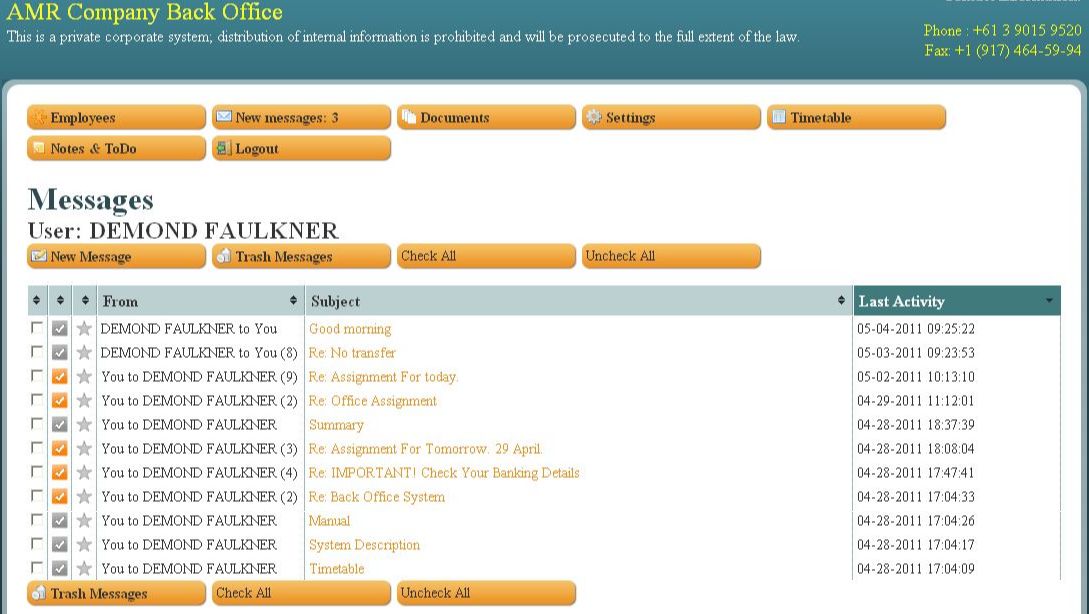
Messages to and from a money mule working for Aqua’s crew, circa May 2011.

In many instances, my call would come in just minutes or hours before an unauthorized payroll batch was processed by the victim company’s bank, and some of those notifications prevented what otherwise would have been enormous losses — often several times the amount of the organization’s normal weekly payroll. At some point I stopped counting how many tens of thousands of dollars those calls saved victims, but over several years it was probably in the millions.

Just as often, the victim company would suspect that I was somehow involved in the robbery, and soon after alerting them I would receive a call from an FBI agent or from a police officer in the victim’s hometown. Those were always interesting conversations. Needless to say, the victims that spun their wheels chasing after me usually suffered far more substantial financial losses (mainly because they delayed calling their financial institution until it was too late).

Collectively, these notifications to Evil Corp.’s victims led to dozens of stories over several years about small businesses battling their financial institutions to recover their losses. I don’t believe I ever wrote about a single victim that wasn’t okay with my calling attention to their plight and to the sophistication of the threat facing other companies.

LOW FRIENDS IN HIGH PLACES

According to the U.S. Justice Department, Yakubets/Aqua served as leader of Evil Corp. and was responsible for managing and supervising the group’s cybercrime activities in deploying and using the Jabberzeus and Dridex banking malware. The DOJ notes that prior to serving in this leadership role for Evil Corp, Yakubets was also directly associated with Evgeniy “Slavik” Bogachev, a previously designated Russian cybercriminal responsible for the distribution of the Zeus, Jabber Zeus, and GameOver Zeus malware schemes who currently has a $3 million FBI bounty on his head.

Evgeniy M. Bogachev, in undated photos.

As noted in previous stories here, during times of conflict with Russia’s neighbors, Slavik was known to retool his crime machines to search for classified information on victim systems in regions of the world that were of strategic interest to the Russian government – particularly in Turkey and Ukraine.

“Cybercriminals are recruited to Russia’s national cause through a mix of coercion, payments and appeals to patriotic sentiment,” reads a 2017 story from The Register on security firm Cybereason’s analysis of the Russian cybercrime scene. “Russia’s use of private contractors also has other benefits in helping to decrease overall operational costs, mitigating the risk of detection and gaining technical expertise that they cannot recruit directly into the government. Combining a cyber-militia with official state-sponsored hacking teams has created the most technically advanced and bold cybercriminal community in the world.”

This is interesting because the U.S. Treasury Department says Yukabets as of 2017 was working for the Russian FSB, one of Russia’s leading intelligence organizations.

“As of April 2018, Yakubets was in the process of obtaining a license to work with Russian classified information from the FSB,” notes a statement from the Treasury.

The Treasury Department’s role in this action is key because it means the United States has now imposed economic sanctions on Yukabets and 16 accused associates, effectively freezing all property and interests of these persons (subject to U.S. jurisdiction) and making it a crime to transact with these individuals.

The Justice Department’s criminal complaint against Yukabets (PDF) mentions several intercepted chat communications between Aqua and his alleged associates in which they puzzle over why KrebsOnSecurity seemed to know so much about their internal operations and victims. In the following chat conversations (translated from Russian), Aqua and others discuss a story I wrote for The Washington Post in 2009 about their theft of hundreds of thousands of dollars from the payroll accounts of Bullitt County, Ky:

tank: [Are you] there?
indep: Yeah.
indep: Greetings.
tank: https://ift.tt/2Pq2WXv
tank: This is still about me.
tank: Originator: BULLITT COUNTY FISCAL Company: Bullitt County Fiscal Court
tank: He is the account from which we cashed.
tank: Today someone else send this news.
tank: I’m reading and thinking: Let me take a look at history. For some reason this name is familiar.
tank: I’m on line and I’ll look. Ah, here is this shit.
indep: How are you?
tank: Did you get my announcements?
indep: Well, I congratulate [you].
indep: This is just fuck when they write about you in the news.
tank: Whose [What]?
tank: 😀
indep: Too much publicity is not needed.
tank: Well, so nobody knows who they are talking about.

tank: Well, nevertheless, they were writing about us.
aqua: So because of whom did they lock Western Union for Ukraine?
aqua: Tough shit.
tank: *************Originator: BULLITT COUNTY FISCAL Company: Bullitt
County Fiscal Court
aqua: So?
aqua: This is the court system.
tank: Shit.
tank: Yes
aqua: This is why they fucked [nailed?] several drops.
tank: Yes, indeed.
aqua: Well, fuck. Hackers: It’s true they stole a lot of money.

At roughly the same time, one of Aqua’s crew had a chat with Slavik, who used the nickname “lucky12345” at the time:

tank: Are you there?
tank: This is what they damn wrote about me.
tank: https://ift.tt/2Pq2WXv
tank: I’ll take a quick look at history
tank: Originator: BULLITT COUNTY FISCAL Company: Bullitt County Fiscal Court
tank: Well, you got [it] from that cash-in.
lucky12345: From 200K?
tank: Well, they are not the right amounts and the cash out from that account was shitty.
tank: Levak was written there.
tank: Because now the entire USA knows about Zeus.
tank: 😀
lucky12345: It’s fucked.

On Dec. 13, 2009, one of the Jabberzeus gang’s money mule recruiters –- a crook who used the pseudonym “Jim Rogers” — somehow learned about something I hadn’t shared beyond a few trusted friends at that point: That The Washington Post had eliminated my job in the process of merging the newspaper’s Web site (where I worked at the time) with the dead tree edition. The following is an exchange between Jim Rogers and the above-quoted “tank”:

jim_rogers: There is a rumor that our favorite (Brian) didn’t get his contract extension at Washington Post. We are giddily awaiting confirmation 🙂 Good news expected exactly by the New Year! Besides us no one reads his column 🙂

tank: Mr. Fucking Brian Fucking Kerbs!

In March 2010, Aqua would divulge in an encrypted chat that his crew was working directly with the Zeus author (Slavik/Lucky12345), but that they found him abrasive and difficult to tolerate:

dimka: I read about the king of seas, was it your handy work?
aqua: what are you talking about? show me
dimka: zeus
aqua: 🙂
aqua: yes, we are using it right now
aqua: its developer sits with us on the system
dimka: it’s a popular thing
aqua: but, he, fucker, annoyed the hell out of everyone, doesn’t want to write bypass of interactives (scans) and trojan penetration 35-40%, bitch
aqua: yeah, shit
aqua: we need better
aqua: https://ift.tt/1DTU3sC read it 🙂 here you find almost everything about us 🙂
dimka: I think everything will be slightly different, if you think so
aqua: we, in this system, the big dog, the rest on the system are doing small crap

Later that month, Aqua bemoaned even more publicity about their work, pointing to a KrebsOnSecurity story about a sophisticated attack in which their malware not only intercepted a one-time password needed to log in to the victim’s bank account, but even modified the bank’s own Web site as displayed in the victim’s browser to point to a phony customer support number.

Ironically, the fake bank phone number was what tipped off the victim company employee. In this instance, the victim’s bank — Fifth Third Bank (referred to as “53” in the chat below) was able to claw back the money stolen by Aqua’s money mules, but not funds that were taken via fraudulent international wire transfers. The cybercriminals in this chat also complain they will need a newly-obfuscated version of their malware due to public exposure:

aqua: tomorrow, everything should work.
aqua: fuck, we need to find more socks for spam.
aqua: okay, so tomorrow Petro [another conspirator who went by the nickname Petr0vich] will give us a [new] .exe
jtk: ok
jim_rogers: this one doesn’t work
jim_rogers: https://ift.tt/35v55H2
jim_rogers: here it’s written about my transfer from 53. How I made a number of wires like it said there. And a woman burnt the deal because of a fake phone number.

ANTI-MULE INITIATIVE

In tandem with the indictments against Evil Corp, the Justice Department joined with officials from Europol to execute a law enforcement action and public awareness campaign to combat money mule activity.

“More than 90% of money mule transactions identified through the European Money Mule Actions are linked to cybercrime,” Europol wrote in a statement about the action. “The illegal money often comes from criminal activities like phishing, malware attacks, online auction fraud, e-commerce fraud, business e-mail compromise (BEC) and CEO fraud, romance scams, holiday fraud (booking fraud) and many others.”

The DOJ said U.S. law enforcement disrupted mule networks that spanned from Hawaii to Florida and from Alaska to Maine. Actions were taken to halt the conduct of over 600 domestic money mules, including 30 individuals who were criminally charged for their roles in receiving victim payments and providing the fraud proceeds to accomplices.
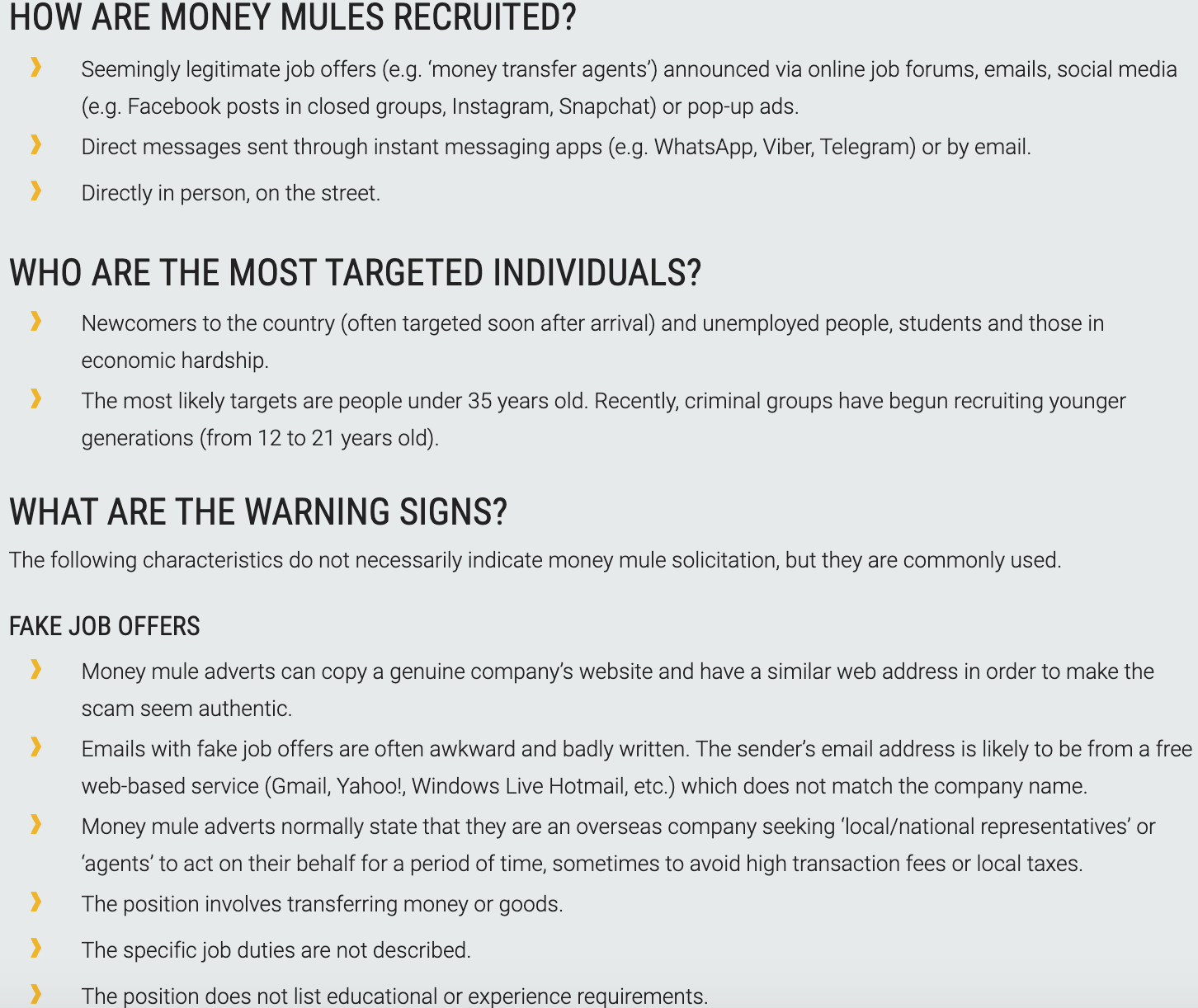
Some tips from Europol on how to spot money mule recruitment scams dressed up as legitimate job offers.

It’s good to see more public education about the damage that money mules inflict, because without them most of these criminal schemes simply fall apart. Aside from helping to launder funds from banking trojan victims, money mules often are instrumental in fleecing elderly people taken in by various online confidence scams.

It’s also great to see the U.S. government finally wielding its most powerful weapon against cybercriminals based in Russia and other safe havens for such activity: Economic sanctions that severely restrict cybercriminals’ access to ill-gotten gains and the ability to launder the proceeds of their crimes by investing in overseas assets.

Further reading:

DOJ press conference remarks on Yakubets
FBI charges announced in malware conspiracy
2019 indictment of Yakubets, Turashev. et al.
2010 Criminal complaint vs. Yukabets, et. al.
FBI “wanted” alert on Igor “Enki” Turashev
US-CERT alert on Dridex

source https://krebsonsecurity.com/2019/12/inside-evil-corp-a-100m-cybercrime-menace/

The Great $50M African IP Address Heist

A top executive at the nonprofit entity responsible for doling out chunks of Internet addresses to businesses and other organizations in Africa has resigned his post following accusations that he secretly operated several companies which sold tens of millions of dollars worth of the increasingly scarce resource to online marketers. The allegations stemmed from a three-year investigation by a U.S.-based researcher whose findings shed light on a murky area of Internet governance that is all too often exploited by spammers and scammers alike.

There are fewer than four billion so-called “Internet Protocol version 4” or IPv4 addresses available for use, but the vast majority of them have already been allocated. The global dearth of available IP addresses has turned them into a commodity wherein each IP can fetch between $15-$25 on the open market. This has led to boom times for those engaged in the acquisition and sale of IP address blocks, but it has likewise emboldened those who specialize in absconding with and spamming from dormant IP address blocks without permission from the rightful owners.

Perhaps the most dogged chronicler of this trend is California-based freelance researcher Ron Guilmette, who since 2016 has been tracking several large swaths of IP address blocks set aside for use by African entities that somehow found their way into the hands of Internet marketing firms based in other continents.

Over the course of his investigation, Guilmette unearthed records showing many of these IP addresses were quietly commandeered from African businesses that are no longer in existence or that were years ago acquired by other firms. Guilmette estimates the current market value of the purloined IPs he’s documented in this case exceeds USD $50 million.

In collaboration with journalists based in South Africa, Guilmette discovered tens of thousands of these wayward IP addresses that appear to have been sold off by a handful of companies founded by the policy coordinator for The African Network Information Centre (AFRINIC), one of the world’s five regional Internet registries which handles IP address allocations for Africa and the Indian Ocean region.

That individual — Ernest Byaruhanga — was only the second person hired at AFRINIC back in 2014. Byaruhanga did not respond to requests for comment. However, he abruptly resigned from his position in October 2019 shortly after news of the IP address scheme was first detailed by Jan Vermeulen, a reporter for the South African tech news publication Mybroadband.co.za who assisted Guilmette in his research.

KrebsOnSecurity sought comment from AFRINIC’s new CEO Eddy Kayihura, who said the organization was aware of the allegations and is currently conducting an investigation into the matter.

“Since the investigation is ongoing, you will understand that we prefer to complete it before we make a public statement,” Kayihura said. “Mr. Byauhanga’s resignation letter did not mention specific reasons, though no one would be blamed to think the two events are related.”

Guilmette said the first clue he found suggesting someone at AFRINIC may have been involved came after he located records suggesting that official AFRINIC documents had been altered to change the ownership of IP address blocks once assigned to Infoplan (now Network and Information Technology Ltd), a South African company that was folded into the State IT Agency in 1998.

“This guy was shoveling IP addresses out the backdoor and selling them on the streets,” said Guilmette, who’s been posting evidence of his findings for years to public discussion lists on Internet governance. “To say that he had an evident conflict of interest would be a gross understatement.”

For example, documents obtained from the government of Uganda by Guilmette and others show Byaruhanga registered a private company called ipv4leasing just a year after joining AFRINIC. Historic WHOIS records from domaintools.com [a former advertiser on this site] indicate Byaruhanga was the registrant of two domain names tied to this company — ipv4leasing.org and .net — back in 2013.

Guilmette and his journalist contacts in South Africa uncovered many instances of other companies tied to Byaruhanga and his immediate family members that appear to have been secretly selling AFRINIC IP address blocks to just about anyone willing to pay the asking price. But the activities of ipv4leasing are worth a closer look because they demonstrate how this type of shadowy commerce is critical to operations of spammers and scammers, who are constantly sullying swaths of IP addresses and seeking new ones to keep their operations afloat.

Historic AFRINIC record lookups show ipv4leasing.org tied to at least six sizable blocks of IP addresses that once belonged to a now defunct company from Cameroon called ITC that also did business as “Afriq*Access.”

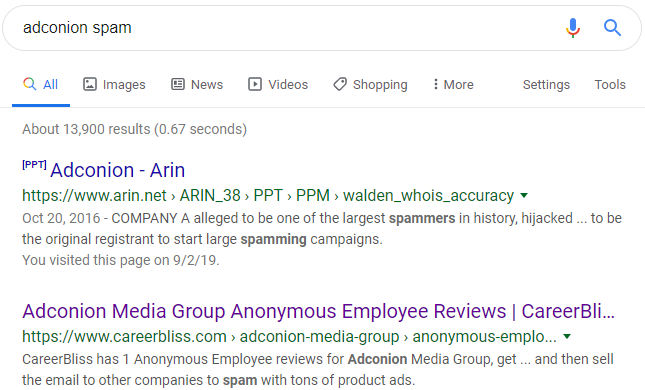
In 2013, Anti-spam group Spamhaus.org began tracking floods of junk email originating from this block of IPs that once belonged to Afriq*Access. Spamhaus says it ultimately traced the domains advertised in those spam emails back to Adconion Direct, a U.S. based email marketing company that employs several executives who are now facing federal criminal charges for allegedly paying others to hijack large ranges of IP addresses used in wide-ranging spam campaigns.

Bill Woodcock is executive director of Packet Clearing House, a non-profit research institute dedicated to understanding and supporting Internet traffic exchange technology, policy, and economics. Woodcock said it’s not unheard of for employees at regional Internet registries (RIRs) to get caught selling off IP addresses as a side hustle, but that this case is by far the longest-running alleged scheme to date.

“It’s not unprecedented in the sense that there have been insider deals in the past done illicitly by employees of other RIRs,” he said. “But typically they’ve been one-off or short-lived before getting caught or fired.”

Anyone interested in a deeper dive on Guilmette’s years-long investigation — including the various IP address blocks in question — should check out MyBroadband’s detailed Dec. 4 story, How Internet Resources Worth R800 Million (USD $54M) Were Stolen and Sold on the Black Market.

source https://krebsonsecurity.com/2019/12/the-great-50m-african-ip-address-heist/

Patch Tuesday, December 2019 Edition

Microsoft today released updates to plug three dozen security holes in its Windows operating system and other software. The patches include fixes for seven critical bugs — those that can be exploited by malware or miscreants to take control over a Windows system with no help from users — as well as another flaw in most versions of Windows that is already being exploited in active attacks.

By nearly all accounts, the chief bugaboo this month is CVE-2019-1458, a vulnerability in a core Windows component (Win32k) that is present in Windows 7 through 10 and Windows Server 2008-2019. This bug is already being exploited in the wild, and according to Recorded Future the exploit available for it is similar to CVE-2019-0859, a Windows flaw reported in April that was found being sold in underground markets.
CVE-2019-1458 is what’s known as a “privilege escalation” flaw, meaning an attacker would need to previously have compromised the system using another vulnerability. Handy in that respect is CVE-2019-1468, a similarly widespread critical issue in the Windows font library that could be exploited just by getting the user to visit a hacked or malicious Web site.

Chris Goettl, director of security at Ivanti, called attention to a curious patch advisory Microsoft released today for CVE-2019-1489, which is yet another weakness in the Windows Remote Desktop Protocol (RDP) client, a component of Windows which lets users view and manage their system from a remote computer. What’s curious about this advisory is that it applies only to Windows XP Service Pack 3, which is no longer receiving security updates.

“The Exploitability Assessment for Latest Software Release and Older Software Release is 0, which is usually the value reserved for a vulnerability that is known to be exploited, yet the Exploited value was currently set to ‘No’ as the bulletin was released today,” Goettl said. “If you look at the Zero Day from this month (CVE-2019-1458) the EA for Older Software Release is ‘0 – Exploitation Detected.’ An odd discrepancy on top of a CVE advisory for an outdated OS. It is very likely this is being exploited in the wild.”

Microsoft didn’t release a patch for this bug on XP, and its advisory on it is about as sparse as they come. But if you’re still depending on Windows XP for remote access, you likely have bigger security concerns. Microsoft has patched many critical RDP flaws in the past year. Even the FBI last year encouraged users to disable it unless needed, citing flawed encryption mechanisms in older versions and a lack of access controls which make RDP a frequent entry point for malware and ransomware.

Speaking of no-longer-supported Microsoft operating systems, Windows 7 and Windows Server 2008 will cease receiving security updates after the next decade’s first Patch Tuesday comes to pass on January 14, 2020. While businesses and other volume-license purchasers will have the option to pay for further fixes after that point, all other Windows 7 users who want to stick with Windows will need to consider migrating to Windows 10 soon.

Windows 10 likes to install patches and sometimes feature updates all in one go and reboot your computer on its own schedule, but you don’t have to accept this default setting. Windows Central has a useful guide on how to disable or postpone automatic updates until you’re ready to install them. For all other Windows OS users, if you’d rather be alerted to new updates when they’re available so you can choose when to install them, there’s a setting for that in Windows Update. To get there, click the Windows key on your keyboard and type “windows update” into the box that pops up.

Keep in mind that while staying up-to-date on Windows patches is a good idea, it’s important to make sure you’re updating only after you’ve backed up your important data and files. A reliable backup means you’re probably not losing your mind when the odd buggy patch causes problems booting the system. So do yourself a favor and backup your files before installing any patches.

And as always, if you experience glitches or problems installing any of these patches this month, please consider leaving a comment about it below; there’s a better-than-even chance other readers have experienced the same and may even chime in here with some helpful tips.

Finally, once again there are no security updates for Adobe Flash Player this month (there is a non-security update available), but Adobe did release critical updates for Windows and macOS versions of its Acrobat and PDF Reader that fix more than 20 vulnerabilities in these products. Photoshop and ColdFusion 2018 also received security updates today. Links to advisories here.

source https://krebsonsecurity.com/2019/12/patch-tuesday-december-2019-edition/

CISO Magazine Honors KrebsOnSecurity

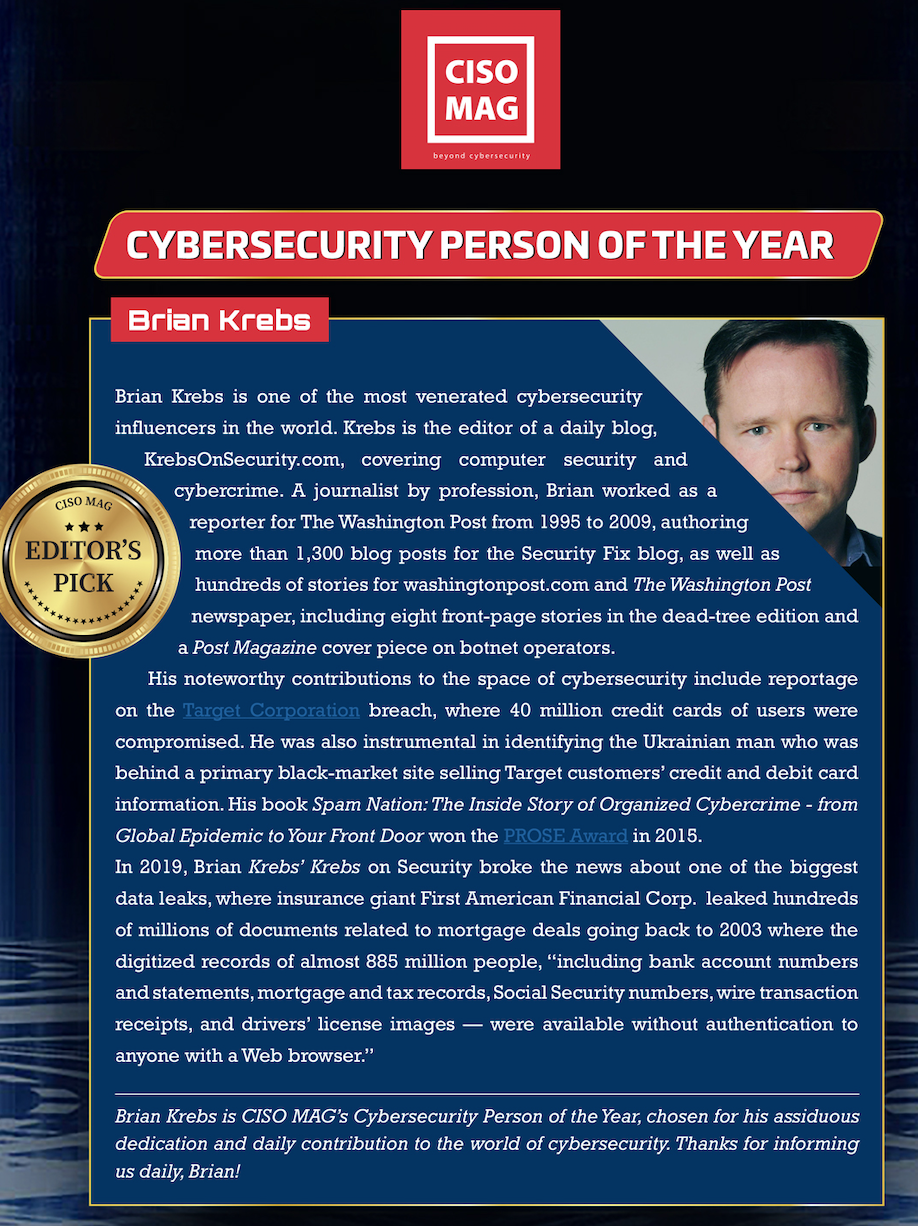
CISO Magazine, a publication dedicated to covering issues near and dear to corporate chief information security officers everywhere, has graciously awarded this author the designation of “Cybersecurity Person of the Year” in its December 2019 issue.

KrebsOnSecurity is grateful for the unexpected honor. But I can definitely think of quite a few people who are far more deserving of this title. In fact, if I’m eligible for any kind of recognition, perhaps “Bad News Harbinger of the Year” would be more apt.

As in years past, 2019 featured quite a few big breaches and more than a little public speaking. Almost without fail at each engagement multiple C-level folks will approach after my talk, hand me their business cards and say something like, “I hope you never have to use this, but if you do please call me first.”

I’ve taken that advice to heart, and now endeavor wherever possible to give a heads up to CISOs/CSOs about a breach before reaching out to the public relations folks. I fully realize that in many cases the person in that role will refer me to the PR department eventually or perhaps immediately.

But on balance, my experience so far is that an initial outreach to the top security person in the organization often results in that inquiry being taken far more seriously. And including this person in my initial outreach makes it much more likely that this individual ends up being on the phone when the company returns my call.

Too often, these conversations are led by the breached organization’s general counsel, which strikes me as an unnecessarily confrontational and strategically misguided approach. Especially if this is also their playbook for responding to random security researchers trying to let the company know about a dangerous security vulnerability, data breach or leak.

At least when there is a C-level security person on the phone when that call comes in I can be relatively sure I’m not going to get snowed on the technical details. While this may a distant concern for the organization in the throes of responding to a data security incident, the truth is that the first report is usually what gets repeated in the media — whether or not it is wholly accurate or fair.

This year’s CISO Magazine awards also honor the contributions of Rik Ferguson, vice president security research at Trend Micro, and Troy Hunt, an expert on web security and author of the data breach search website Have I Been Pwned? More at cisomag.com.

source https://krebsonsecurity.com/2019/12/ciso-magazine-honors-krebsonsecurity/

Ransomware at Colorado IT Provider Affects 100+ Dental Offices

A Colorado company that specializes in providing IT services to dental offices suffered a ransomware attack this week that is disrupting operations for more than 100 dentistry practices, KrebsOnSecurity has learned.

Multiple sources affected say their IT provider, Englewood, Colo. based Complete Technology Solutions (CTS), was hacked, allowing a potent strain of ransomware known as “Sodinokibi” or “rEvil” to be installed on computers at more than 100 dentistry businesses that rely on the company for a range of services — including network security, data backup and voice-over-IP phone service.

Reached via phone Friday evening, CTS President Herb Miner declined to answer questions about the incident. When asked about reports of a ransomware attack on his company, Miner simply said it was not a good time and hung up.

The attack on CTS comes little more than two months after Sodinokibi hit Wisconsin-based dental IT provider PerCSoft, an intrusion that encrypted files for approximately 400 dental practices.

Thomas Terronez, CEO of Iowa-based Medix Dental, said he’s heard from several affected practices that the attackers are demanding $700,000 in bitcoin from some of the larger victims to receive a key that can unlock files encrypted by the ransomware.

Others reported a ransom demand in the tens of thousands of dollars. In previous ransomware attacks, the assailants appear to have priced their ransom demands based on the number of workstation and/or server endpoints within the victim organization. According to CTS, its clients typically have anywhere from 10 to 100 workstations.

Terronez said he’s spoken with multiple other practices that have been sidelined by the ransomware attack, and that some CTS clients had usable backups of their data available off-site, while others have been working with third party companies to independently negotiate and pay the ransom for their practice only.

Many of CTS’s customers took to posting about the attack on a private Facebook group for dentists, discussing steps they’ve taken or attempted to take to get their files back.

“I would recommend everyone reach out to their insurance provider,” said one dentist based in Denver. “I was told by CTS that I would have to pay the ransom to get my corrupted files back.”

“My experience has been very different,” said dental practitioner based in Las Vegas. “No help from my insurance. Still not working, great loss of income, patients are mad, staff even worse.”

Terronez said the dental industry in general has fairly atrocious security practices, and that relatively few offices are willing to spend what’s needed to fend off sophisticated attackers. He said it’s common to see servers that haven’t been patched for over a year, backups that haven’t run for a while, Windows Defender as only point of detection, non-segmented wireless networks, and the whole staff having administrator access to the computers — sometimes all using the same or simple passwords.

“A lot of these [practices] are forced into a price point on what they’re willing to spend,” said Terronez, whose company also offers IT services to dental providers. “The most important thing for these offices is how fast can you solve their problems, and not necessarily the security stuff behind the scenes until it really matters.”

source https://krebsonsecurity.com/2019/12/ransomware-at-colorado-it-provider-affects-100-dental-offices/

Apple Explains Mysterious iPhone 11 Location Requests

KrebsOnSecurity ran a story this week that puzzled over Apple‘s response to inquiries about a potential privacy leak in its new iPhone 11 line, in which the devices appear to intermittently seek the user’s location even when all applications and system services are individually set never to request this data. Today, Apple disclosed that this behavior is tied to the inclusion of a short-range technology that lets iPhone 11 users share files locally with other nearby phones that support this feature, and that a future version of its mobile operating system will allow users to disable it.

I published Tuesday’s story mainly because Apple’s initial and somewhat dismissive response — that this was expected behavior and not a bug — was at odds with its own privacy policy and with its recent commercials stating that customers should be in full control over what they share via their phones and what their phones share about them.

But in a statement provided today, Apple said the location beaconing I documented in a video was related to Ultra Wideband technology that “provides spatial awareness allowing iPhone to understand its position relative to other Ultra Wideband enabled devices (i.e. all new iPhone 11s, including the Pro and Pro Max).

Ultra-wideband (a.k.a UWB) is a radio technology that uses a very low energy level for short-range, high-bandwidth communications of a large portion of the radio spectrum without interfering with more conventional transmissions.

“So users can do things like share a file with someone using AirDrop simply by pointing at another user’s iPhone,” Apple’s statement reads. The company further explained that the location information indicator (a small, upward-facing arrow to the left of the battery icon) appears because the device periodically checks to see whether it is being used in a handful of countries for which Apple hasn’t yet received approval to deploy Ultra Wideband.

“Ultra Wideband technology is an industry standard technology and is subject to international regulatory requirements that require it to be turned off in certain locations,” the statement continues. “iOS uses Location Services to help determine if iPhone is in these prohibited locations in order to disable Ultra Wideband and comply with regulations. The management of Ultrawide Band compliance and its use of location data is done entirely on the device and Apple is not collecting user location data.”

Apple’s privacy policy says users can disable all apps and system services that query the user’s location all at once by toggling the main “Location Services” option to “off.” Alternatively, it says, users can achieve the same results by individually turning off all System Services that use location in the iPhone settings.

What prompted my initial inquiry to Apple about this on Nov. 13 was that the location services icon on the iPhone 11 would reappear every few minutes even though all of the device’s individual location services had been disabled.

“It is expected behavior that the Location Services icon appears in the status bar when Location Services is enabled,” Apple stated in their initial response. “The icon appears for system services that do not have a switch in Settings” [emphasis added].

Now we know more about at least one of those services. Apple says it plans to include the option of a dedicated toggle in System Services to disable the UWB activity in an upcoming update of its iOS operating system, although it didn’t specify when that option might be available.

The one head-scratcher remaining is that the new iPhone seems to check whether it’s in a country that allows UWB fairly frequently, even though the list of countries where this feature is not yet permitted is fairly small, and includes Argentina, Indonesia and Paraguay. A complete list of countries where iPhones can use UWB is here. The principal remaining concern may be that these periodic checks unnecessarily drain the iPhone 11’s battery.

It is never my intention to create alarm where none should exist; there are far too many real threats to security and privacy that deserve greater public attention and scrutiny from the news media. However, Apple does itself and its users no favors when it takes weeks to respond (or not, as my colleague Zack Whittaker at TechCrunch discovered) to legitimate privacy concerns, and then does so in a way that only generates more questions.

source https://krebsonsecurity.com/2019/12/apple-explains-mysterious-iphone-11-location-requests/

The iPhone 11 Pro’s Location Data Puzzler

One of the more curious behaviors of Apple’s new iPhone 11 Pro is that it intermittently seeks the user’s location information even when all applications and system services on the phone are individually set to never request this data. Apple says this is by design, but that response seems at odds with the company’s own privacy policy.

The privacy policy available from the iPhone’s Location Services screen says, “If Location Services is on, your iPhone will periodically send the geo-tagged locations of nearby Wi-Fi hotspots and cell towers (where supported by a device) in an anonymous and encrypted form to Apple, to be used for augmenting this crowd-sourced database of Wi-Fi hotspot and cell tower locations.”

The policy explains users can disable all location services entirely with one swipe (by navigating to Settings > Privacy > Location Services, then switching “Location Services” to “off”). When one does this, the location services indicator — a small diagonal upward arrow to the left of the battery icon — no longer appears unless Location Services is re-enabled.

The policy continues: “You can also disable location-based system services by tapping on System Services and turning off each location-based system service.” But apparently there are some system services on this model (and possibly other iPhone 11 models) which request location data and cannot be disabled by users without completely turning off location services, as the arrow icon still appears periodically even after individually disabling all system services that use location.

On Nov. 13, KrebsOnSecurity contacted Apple to report this as a possible privacy bug in the new iPhone Pro and/or in iOS 13.x, sharing a video showing how the device still seeks the user’s location when each apps and system service is set to “never” request location information (but with the main Location Data service still turned on).

The video above was recorded on a brand new iPhone 11 Pro. The behavior appears to persist in the latest iPhone operating system (iOS 13.2.3) on iPhone 11 Pro devices. A review of Apple’s support forum indicates other users are experiencing the same issue. I was not able replicate this behavior on an older model iPhone 8 with the latest iOS.

This week Apple responded that the company does not see any concerns here and that the iPhone was performing as designed.

“We do not see any actual security implications,” an Apple engineer wrote in a response to KrebsOnSecurity. “It is expected behavior that the Location Services icon appears in the status bar when Location Services is enabled. The icon appears for system services that do not have a switch in Settings” [emphasis added].

Apple has not yet responded to follow-up questions, but it seems they are saying their phones have some system services that query your location regardless of whether one has disabled this setting individually for all apps and iOS system services.

Granted, the latest versions of iOS give users far more granular control over the sharing of this data than in the past, especially with respect to third-party apps. And perhaps this oddity is somehow related to adding support for super-fast new WiFi 6 routers, which may have involved the introduction of new hardware.

But it would be nice to know what has changed in the iPhone 11 and why, particularly given Apple’s recent commercials on how they respect user privacy choices — including location information. This post will be updated in the event Apple provides a more detailed response.

source https://krebsonsecurity.com/2019/12/the-iphone-11-pros-location-data-puzzler/