French Firms Rocked by Kasbah Hacker?

A large number of French critical infrastructure firms were hacked as part of an extended malware campaign that appears to have been orchestrated by at least one attacker based in Morocco, KrebsOnSecurity has learned. An individual thought to be involved has earned accolades from the likes of Apple, Dell, and Microsoft for helping to find and fix security vulnerabilities in their products.

In 2018, security intelligence firm HYAS discovered a malware network communicating with systems inside of a French national power company. The malware was identified as a version of the remote access trojan (RAT) known as njRAT, which has been used against millions of targets globally with a focus on victims in the Middle East.

Further investigation revealed the electricity provider was just one of many French critical infrastructure firms that had systems beaconing home to the malware network’s control center.

Other victims included one of France’s largest hospital systems; a French automobile manufacturer; a major French bank; companies that work with or manage networks for French postal and transportation systems; a domestic firm that operates a number of airports in France; a state-owned railway company; and multiple nuclear research facilities.

HYAS said it quickly notified the French national computer emergency team and the FBI about its findings, which pointed to a dynamic domain name system (DNS) provider on which the purveyors of this attack campaign relied for their various malware servers.

When it didn’t hear from French authorities after almost a week, HYAS asked the dynamic DNS provider to “sinkhole” the malware network’s control servers. Sinkholing is a practice by which researchers assume control over a malware network’s domains, redirecting any traffic flowing to those systems to a server the researchers control.

While sinkholing doesn’t clean up infected systems, it can prevent the attackers from continuing to harvest data from infected PCs or sending them new commands and malware updates. HYAS found that despite its notifications to the French authorities, some of the apparently infected systems were still attempting to contact the sinkholed control networks up until late 2019.

“Due to our remote visibility it is impossible for us to determine if the malware infections have been contained within the [affected] organizations,” HYAS wrote in a report summarizing their findings. “It is possible that an infected computer is beaconing, but is unable to egress to the command and control due to outbound firewall restrictions.”

About the only French critical infrastructure vertical not touched by the Kasbah hackers was the water management sector.

HYAS said given the entities compromised — and that only a handful of known compromises occurred outside of France — there’s a strong possibility this was the result of an orchestrated phishing campaign targeting French infrastructure firms. It also concluded the domains associated with this campaign were very likely controlled by a group of adversaries based in Morocco.

“What caught our attention was the nature of the victims and the fact that there were no other observed compromises outside of France,” said Sasha Angus, vice president of intelligence for HYAS. “With the exception of water management, when looking at the organizations involved, each fell within one of the verticals in France’s critical infrastructure strategic plan. While we couldn’t rule out financial crime as the actor’s potential motive, it didn’t appear that the actor leveraged any normal financial crime tools.”

‘FATAL’ ERROR

HYAS said the dynamic DNS provider shared information showing that one of the email addresses used to register a key DNS server for the malware network was tied to a domain for a legitimate business based in Morocco.

According to historic records maintained by Domaintools.com [an advertiser on this site], that email address — ing.equipepro@gmail.com — was used in 2016 to register the Web site talainine.com, a now-defunct business that offered recreational vehicle-based camping excursions just outside of a city in southern Morocco called Guelmim.

Archived copies of talainine.com indicate the business was managed by two individuals, including someone named Yassine Algangaf. A Google search for that name reveals a similarly named individual has been credited by a number of major software companies — including Apple, Dell and Microsoft — with reporting security vulnerabilities in their products.

A search on this name at Facebook turned up a page for another now-defunct business called Yamosoft.com that lists Algangaf as an owner. A cached copy of Yamosoft.com at archive.org says it was a Moroccan computer security service that specialized in security audits, computer hacking investigations, penetration testing and source code review.

A search on the ing.equipepro@gmail.com address at 4iq.com — a service that indexes account details like usernames and passwords exposed in Web site data breaches — shows this email address was used to register an account at the computer hacking forum cracked[.]to for a user named “fatal.001.”

A LinkedIn profile for a Yassine Algangaf says he’s a penetration tester from the Guelmim province of Morocco. Yet another LinkedIn profile under the same name and location says he is a freelance programmer and penetration tester. Both profiles include the phrase “attack prevention mechanisms researcher security tools proof of concepts developer” in the description of the user’s job experience.

Searching for this phrase in Google turns up another Facebook page, this time for a “Yassine Majidi,” under the profile name “FatalW01.” A review of Majidi’s Facebook profile shows that phrase as his tag line, and that he has signed several of his posts over the years as “Fatal.001.”

There are also two different Skype accounts registered to the ing.equipepro.com email address, one for Yassine Majidi and another for Yassine Algangaf. There is a third Skype account nicknamed “Fatal.001” that is tied to the same phone number included on talainine.com as a contact number for Yassine Algangaf (+212611604438). A video on Majidi’s Facebook page shows him logged in to the “Fatal.001” Skype account.

On his Facebook profile, Majidi includes screen shots of several emails from software companies thanking him for reporting vulnerabilities in their products. Fatal.001 was an active member on dev-point[.]com, an Arabic-language computer hacking forum. Throughout multiple posts, Fatal.001 discusses his work in developing spam tools and RAT malware.

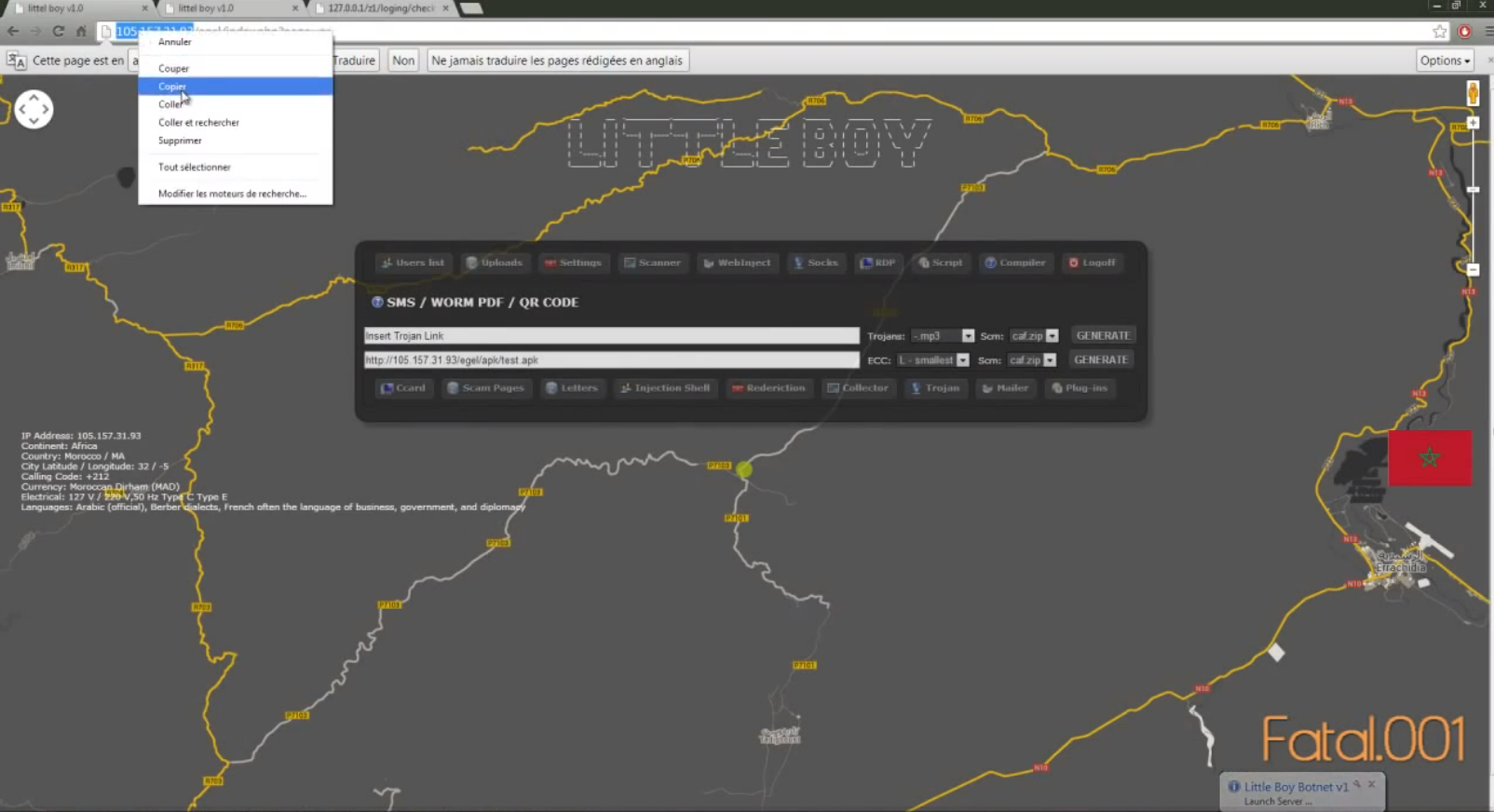
In this two-hour Arabic language YouTube tutorial from 2014, Fatal.001 explains how to use a RAT he developed called “Little Boy” to steal credit card numbers and passwords from victims. The main control screen for the Little Boy botnet interface includes a map of Morocco.
Reached via LinkedIn, Algangaf confirmed he used the pseudonyms Majidi and Fatal.001 for his security research and bug hunting. But he denied ever participating in illegal hacking activities. He acknowledged that ing.equipepro@gmail.com is his email address, but claims the email account was hacked at some point in 2017.

“It has already been hacked and recovered after a certain period,” Algangaf said. “Since I am a security researcher, I publish from time to time a set of blogs aimed at raising awareness of potential security risks.”

As for the notion that he has somehow been developing hacking programs for years, Algangaf says this, also, is untrue. He said he never sold any copies of the Little Boy botnet, and that this was one of several tools he created for raising awareness.

“In 2013, I developed a platform for security research through which penetration test can be done for phones and computers,” Algangaf said. “It contained concepts that could benefit from a controlled domain. As for the fact that unlawful attacks were carried out on others, it is impossible because I simply have no interest in blackhat [activities].”

source https://krebsonsecurity.com/2020/03/french-firms-rocked-by-kasbah-hacker/

FCC Proposes to Fine Wireless Carriers $200M for Selling Customer Location Data

The U.S. Federal Communications Commission (FCC) today proposed fines of more than $200 million against the nation’s four largest wireless carriers for selling access to their customers’ location information without taking adequate precautions to prevent unauthorized access to that data. While the fines would be among the largest the FCC has ever levied, critics say the penalties don’t go far enough to deter wireless carriers from continuing to sell customer location data.

The FCC proposed fining T-Mobile $91 million; AT&T faces more than $57 million in fines; Verizon is looking at more than $48 million in penalties; and the FCC said Sprint should pay more than $12 million.

An FCC statement (PDF) said “the size of the proposed fines for the four wireless carriers differs based on the length of time each carrier apparently continued to sell access to its customer location information without reasonable safeguards and the number of entities to which each carrier continued to sell such access.”

The fines are only “proposed” at this point because the carriers still have an opportunity to respond to the commission and contest the figures. The Wall Street Journal first reported earlier this week that the FCC was considering the fines.

The commission said it took action in response to a May 2018 story broken by The New York Times, which exposed how a company called Securus Technologies had been selling location data on customers of virtually any major mobile provider to law enforcement officials.

That same month, KrebsOnSecurity broke the news that LocationSmart — a data aggregation firm working with the major wireless carriers — had a free, unsecured demo of its service online that anyone could abuse to find the near-exact location of virtually any mobile phone in North America.

In response, the carriers promised to “wind down” location data sharing agreements with third-party companies. But in 2019, Joseph Cox at Vice.com showed that little had changed, detailing how he was able to locate a test phone after paying $300 to a bounty hunter who simply bought the data through a little-known third-party service.

Gigi Sohn is a fellow at the Georgetown Law Institute for Technology Law and Policy and a former senior adviser to former FCC Chair Tom Wheeler in 2015. Sohn said this debacle underscores the importance of having strong consumer privacy protections.

“The importance of having rules that protect consumers before they are harmed cannot be overstated,” Sohn said. “In 2016, the Wheeler FCC adopted rules that would have prevented most mobile phone users from suffering this gross violation of privacy and security. But [FCC] Chairman Pai and his friends in Congress eliminated those rules, because allegedly the burden on mobile wireless providers and their fixed broadband brethren would be too great. Clearly, they did not think for one minute about the harm that could befall consumers in the absence of strong privacy protections.”

Sen. Ron Wyden (D-Ore.), a longtime critic of the FCC’s inaction on wireless location data sharing, likewise called for more string consumer privacy laws, calling the proposed punishment “comically inadequate fines that won’t stop phone companies from abusing Americans’ privacy the next time they can make a quick buck.”

“Time and again, from Facebook to Equifax, massive companies take reckless disregard for Americans’ personal information, knowing they can write off comparatively tiny fines as the cost of doing business,” Wyden said in a written statement. “The only way to truly protect Americans’ personal information is to pass strong privacy legislation like my Mind Your Own Business Act [PDF] to put teeth into privacy laws and hold CEOs personally responsible for lying about protecting Americans’ privacy.”

source https://krebsonsecurity.com/2020/02/fcc-proposes-to-fine-wireless-carriers-200m-for-selling-customer-location-data/

Zyxel 0day Affects its Firewall Products, Too

On Monday, networking hardware maker Zyxel released security updates to plug a critical security hole in its network attached storage (NAS) devices that is being actively exploited by crooks who specialize in deploying ransomware. Today, Zyxel acknowledged the same flaw is present in many of its firewall products.

This week’s story on the Zyxel patch was prompted by the discovery that exploit code for attacking the flaw was being sold in the cybercrime underground for $20,000. Alex Holden, the security expert who first spotted the code for sale, said at the time the vulnerability was so “stupid” and easy to exploit that he wouldn’t be surprised to find other Zyxel products were similarly affected.

Now it appears Holden’s hunch was dead-on.

“We’ve now completed the investigation of all Zyxel products and found that firewall products running specific firmware versions are also vulnerable,” Zyxel wrote in an email to KrebsOnSecurity. “Hotfixes have been released immediately, and the standard firmware patches will be released in March.”

The updated security advisory from Zyxel states the exploit works against its UTM, ATP, and VPN firewalls running firmware version ZLD V4.35 Patch 0 through ZLD V4.35 Patch 2, and that those with firmware versions before ZLD V4.35 Patch 0 are not affected.

Zyxel’s new advisory suggests that some affected firewall product won’t be getting hotfixes or patches for this flaw, noting that the affected products listed in the advisory are only those which are “within their warranty support period.”

Indeed, while the exploit also works against more than a dozen of Zyxel’s NAS product lines, the company only released updates for NAS products that were newer than 2016. Its advice for those still using those unsupported NAS devices? “Do not leave the product directly exposed to the internet. If possible, connect it to a security router or firewall for additional protection.”

Hopefully, your vulnerable, unsupported Zyxel NAS isn’t being protected by a vulnerable, unsupported Zyxel firewall product.

CERT’s advisory on the flaw rate this vulnerability at a “10” — its most severe. My advice? If you can’t patch it, pitch it. The zero-day sales thread first flagged by Holden also hinted at the presence of post-authentication exploits in many Zyxel products, but the company did not address those claims in its security advisories.

Recent activity suggests that attackers known for deploying ransomware have been actively working to test the zero-day for use against targets. Holden said the exploit is now being used by a group of bad guys who are seeking to fold the exploit into Emotet, a powerful malware tool typically disseminated via spam that is frequently used to seed a target with malcode which holds the victim’s files for ransom.

“To me, a 0day exploit in Zyxel is not as scary as who bought it,” he said. “The Emotet guys have been historically targeting PCs, laptops and servers, but their venture now into IoT devices is very disturbing.”

source https://krebsonsecurity.com/2020/02/zyxel-0day-affects-its-firewall-products-too/

Zyxel Fixes 0day in Network Storage Devices

Patch comes amid active exploitation by ransomware gangs

Networking hardware vendor Zyxel today released an update to fix a critical flaw in many of its network attached storage (NAS) devices that can be used to remotely commandeer them. The patch comes 12 days after KrebsOnSecurity alerted the company that precise instructions for exploiting the vulnerability were being sold for $20,000 in the cybercrime underground.

Based in Taiwan, Zyxel Communications Corp. (a.k.a “ZyXEL”) is a maker of networking devices, including Wi-Fi routers, NAS products and hardware firewalls. The company has roughly 1,500 employees and boasts some 100 million devices deployed worldwide. While in many respects the class of vulnerability addressed in this story is depressingly common among Internet of Things (IoT) devices, the flaw is notable because it has attracted the interest of groups specializing in deploying ransomware at scale.

KrebsOnSecurity first learned about the flaw on Feb. 12 from Alex Holden, founder of Milwaukee-based security firm Hold Security. Holden had obtained a copy of the exploit code, which allows an attacker to remotely compromise more than a dozen types of Zyxel NAS products remotely without any help from users.

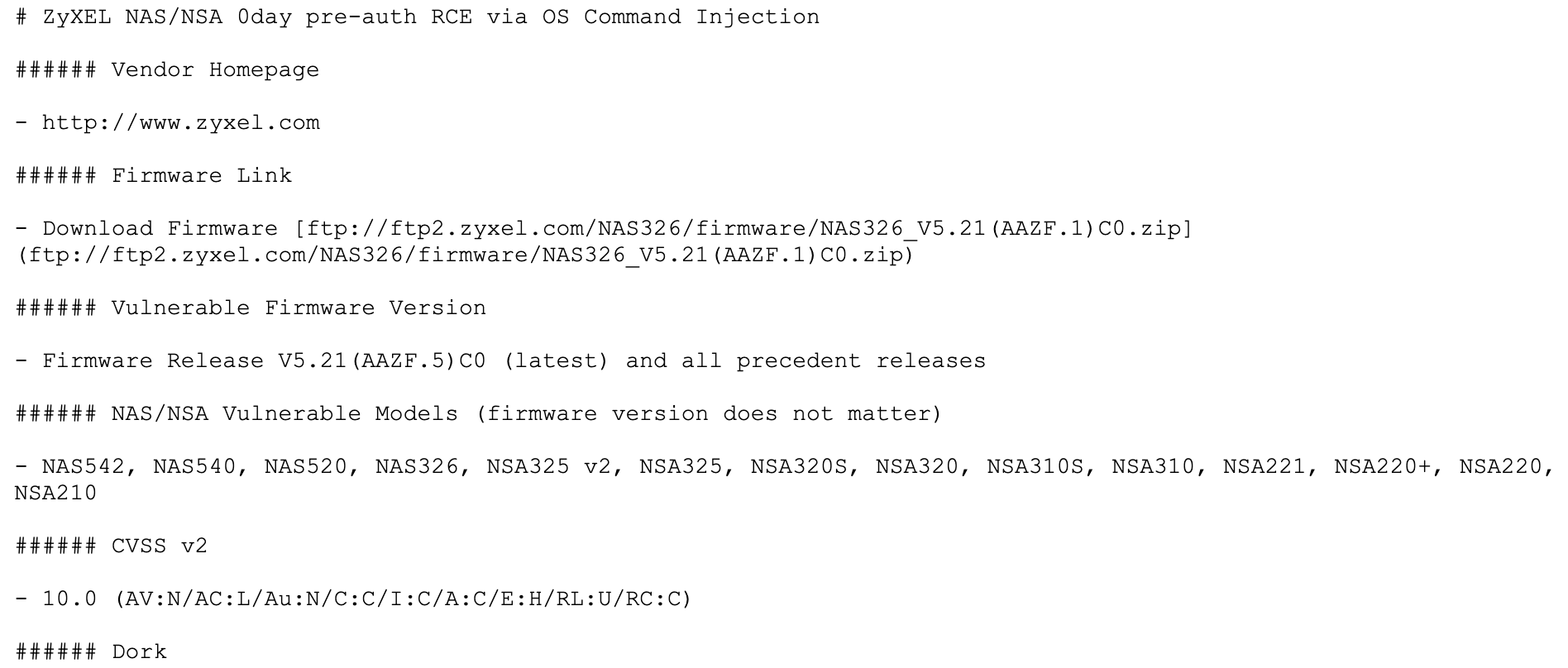
A snippet from the documentation provided by 500mhz for the Zyxel 0day.

Holden said the seller of the exploit code — a ne’er-do-well who goes by the nickname “500mhz” –is known for being reliable and thorough in his sales of 0day exploits (a.k.a. “zero-days,” these are vulnerabilities in hardware or software products that vendors first learn about when exploit code and/or active exploitation shows up online).

For example, this and previous zero-days for sale by 500mhz came with exhaustive documentation detailing virtually everything about the flaw, including any preconditions needed to exploit it, step-by-step configuration instructions, tips on how to remove traces of exploitation, and example search links that could be used to readily locate thousands of vulnerable devices.

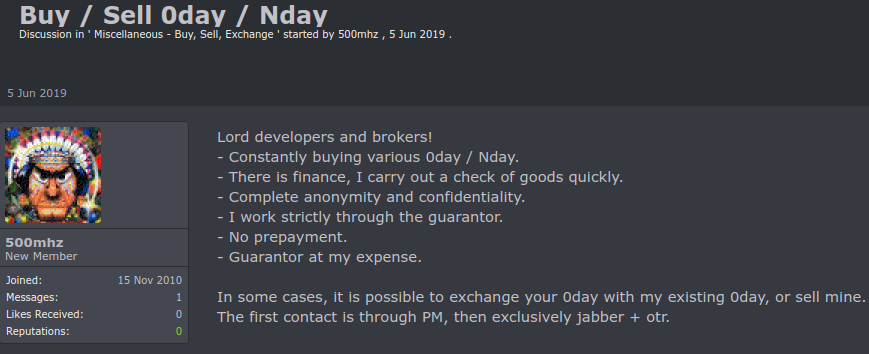
500mhz’s profile on one cybercrime forum states that he is constantly buying, selling and trading various 0day vulnerabilities.

“In some cases, it is possible to exchange your 0day with my existing 0day, or sell mine,” his Russian-language profile reads.

The profile page of 500mhz, translated from Russian to English via Google Chrome.

PARTIAL PATCH

KrebsOnSecurity first contacted Zyxel on Feb. 12, sharing a copy of the exploit code and description of the vulnerability. When four days elapsed without any response from the vendor to notifications sent via multiple methods, this author shared the same information with vulnerability analysts at the U.S. Department of Homeland Security (DHS) and with the CERT Coordination Center (CERT/CC), a partnership between DHS and Carnegie Mellon University.

Less than 24 hours after contacting DHS and CERT/CC, KrebsOnSecurity heard back from Zyxel, which thanked KrebsOnSecurity for the alert without acknowledging its failure to respond until they were sent the same information by others.

“Thanks for flagging,” Zyxel’s team wrote on Feb. 17. “We’ve just received an alert of the same vulnerabilities from US-CERT over the weekend, and we’re now in the process of investigating. Still, we heartily appreciate you bringing it to our attention.”

Earlier today, Zyxel sent a message saying it had published a security advisory and patch for the zero-day exploit in some of its affected products. The vulnerable devices include NAS542, NAS540, NAS520, NAS326, NSA325 v2, NSA325, NSA320S, NSA320, NSA310S, NSA310, NSA221, NSA220+, NSA220, and NSA210. The flaw is designated as CVE-2020-9054.

However, many of these devices are no longer supported by Zyxel and will not be patched. Zyxel’s advice for those users is simply “do not leave the product directly exposed to the internet.”

“If possible, connect it to a security router or firewall for additional protection,” the advisory reads.

Holden said given the simplicity of the exploit — which allows an attacker to seize remote control over an affected device by injecting just two characters to the username field of the login panel for Zyxel NAS devices — it’s likely other Zyxel products may have related vulnerabilities.

“Considering how stupid this exploit is, I’m guessing this is not the only one of its class in their products,” he said.

CERT’s advisory on the flaw rates it at a “10” — its most severe. The advisory includes additional mitigation instructions, including a proof-of-concept exploit that has the ability to power down affected Zyxel devices.

EMOTET GOES IOT?

Holden said recent activity suggests that attackers known for deploying ransomware have been actively working to test the zero-day for use against targets. Specifically, Holden said the exploit is now being used by a group of bad guys who are seeking to fold the exploit into Emotet, a powerful malware tool typically disseminated via spam that is frequently used to seed a target with malcode which holds the victim’s files for ransom.

Holden said 500mhz was offering the Zyxel exploit for $20,000 on cybercrime forums, although it’s not clear whether the Emotet gang paid anywhere near that amount for access to the code. Still, he said, ransomware gangs could easily earn back their investment by successfully compromising a single target with this simple but highly reliable exploit.

“From the attacker’s standpoint simple is better,” he said. “The commercial value of this exploit was set at $20,000, but that’s not much when you consider a ransomware gang could easily make that money back and then some in a short period of time.”

Emotet’s nascent forays into IoT come amid other disturbing developments for the prolific exploitation platform. Earlier this month, security researchers noted that Emotet now has the capability to spread in a worm-like fashion via Wi-Fi networks.

“To me, a 0day exploit in Zyxel is not as scary as who bought it,” he said. “The Emotet guys have been historically targeting PCs, laptops and servers, but their venture now into IoT devices is very disturbing.”

DISCLOSURE DEBATE

This experience was a good reminder that vulnerability reporting and remediation often can be a frustrating process. Twelve days turnaround is fairly quick as these things go, although probably not quick enough for customers using products affected by zero-day vulnerabilities.

It can be tempting when one is not getting any response from a vendor to simply publish an alert detailing one’s findings, and the pressure to do so certainly increases when there is a zero-day flaw involved. KrebsOnSecurity ultimately opted not to do that for three reasons.

Firstly, at the time there was no evidence that the flaws were being actively exploited, and because the vendor had assured DHS and CERT-CC that it would soon have a patch available.

Perhaps most importantly, public disclosure of an unpatched flaw could well have made a bad situation worse, without offering affected users much in the way of information about how to protect their systems.

Many hardware and software vendors include a link from their home pages to /security.txt, which is a proposed standard for allowing security researchers to quickly identify the points of contact at vendors when seeking to report security vulnerabilities. But even vendors who haven’t yet adopted this standard (Zyxel has not) usually will respond to reports at security@[vendordomainhere]; indeed, Zyxel encourages researchers to forward any such reports to security@zyxel.com.tw.

On the subject of full disclosure, I should note that while this author is listed by Hold Security’s site as an advisor, KrebsOnSecurity has never sought nor received remuneration of any kind in connection with this role.

source https://krebsonsecurity.com/2020/02/zyxel-fixes-0day-in-network-storage-devices/

Hackers Were Inside Citrix for Five Months

Networking software giant Citrix Systems says malicious hackers were inside its networks for five months between 2018 and 2019, making off with personal and financial data on company employees, contractors, interns, job candidates and their dependents. The disclosure comes almost a year after Citrix acknowledged that digital intruders had broken in by probing its employee accounts for weak passwords.

Citrix provides software used by hundreds of thousands of clients worldwide, including most of the Fortune 100 companies. It is perhaps best known for selling virtual private networking (VPN) software that lets users remotely access networks and computers over an encrypted connection.

In March 2019, the Federal Bureau of Investigation (FBI) alerted Citrix they had reason to believe cybercriminals had gained access to the company’s internal network. The FBI told Citrix the hackers likely got in using a technique called “password spraying,” a relatively crude but remarkably effective attack that attempts to access a large number of employee accounts (usernames/email addresses) using just a handful of common passwords.

In a statement released at the time, Citrix said it appeared hackers “may have accessed and downloaded business documents,” and that it was still working to identify what precisely was accessed or stolen.

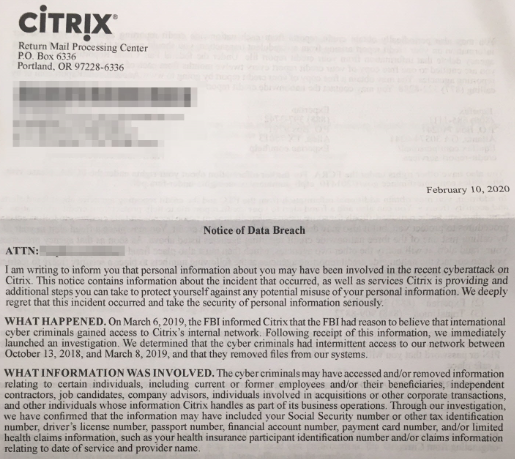
But in a letter sent to affected individuals dated Feb. 10, 2020, Citrix disclosed additional details about the incident. According to the letter, the attackers “had intermittent access” to Citrix’s internal network between Oct. 13, 2018 and Mar. 8, 2019, and that there was no evidence that the cybercrooks still remain in the company’s systems.

Citrix said the information taken by the intruders may have included Social Security Numbers or other tax identification numbers, driver’s license numbers, passport numbers, financial account numbers, payment card numbers, and/or limited health claims information, such as health insurance participant identification number and/or claims information relating to date of service and provider name.

It is unclear how many people received this letter, but the communication suggests Citrix is contacting a broad range of individuals who work or worked for the company at some point, as well as those who applied for jobs or internships there and people who may have received health or other benefits from the company by virtue of having a family member employed by the company.

Citrix’s letter was prompted by laws in virtually all U.S. states that require companies to notify affected consumers of any incident that jeopardizes their personal and financial data. While the notification does not specify whether the attackers stole proprietary data about the company’s software and internal operations, the intruders certainly had ample opportunity to access at least some of that information as well.

Shortly after Citrix initially disclosed the intrusion in March 2019, a little-known security company Resecurity claimed it had evidence Iranian hackers were responsible, had been in Citrix’s network for years, and had offloaded terabytes of data.

Iranian hackers recently have been blamed for hacking VPN servers around the world in a bid to plant backdoors in large corporate networks. A report released this week (PDF) by security firm ClearSky details how Iran’s government-backed hacking units have been busy exploiting security holes in popular VPN products from Citrix and a number of other software firms.

ClearSky says the attackers have focused on attacking VPN tools because they provide a long-lasting foothold at the targeted organizations, and frequently open the door to breaching additional companies through supply-chain attacks. The company says such tactics have allowed the Iranian hackers to gain persistent access to the networks of companies across a broad range of sectors, including IT, security, telecommunications, oil and gas, aviation, and government.

Among the VPN flaws available to attackers is a recently-patched vulnerability (CVE-2019-19781) in Citrix VPN servers dubbed “Shitrix” by some in the security community. The derisive nickname may have been chosen because while Citrix initially warned customers about the vulnerability in mid-December 2019, it didn’t start releasing patches to plug the holes until late January 2020 — roughly two weeks after attackers started using publicly released exploit code to break into vulnerable organizations.

How would your organization hold up to a password spraying attack? As the Citrix hack shows, if you don’t know you should probably check, and then act on the results accordingly. It’s a fair bet the bad guys are going to find out even if you don’t.

source https://krebsonsecurity.com/2020/02/hackers-were-inside-citrix-for-five-months/

Encoding Stolen Credit Card Data on Barcodes

Crooks are constantly dreaming up new ways to use and conceal stolen credit card data. According to the U.S. Secret Service, the latest scheme involves stolen card information embedded in barcodes affixed to phony money network rewards cards. The scammers then pay for merchandise by instructing a cashier to scan the barcode and enter the expiration date and card security code.

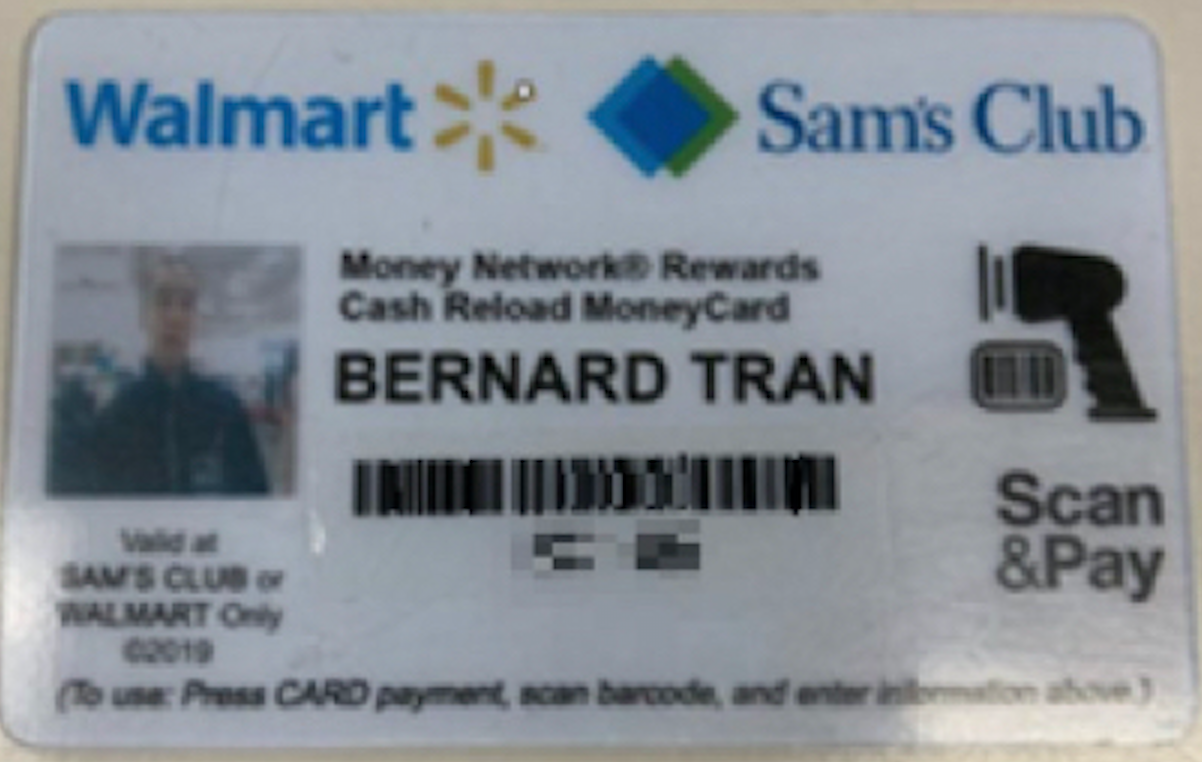
This phony reloadable rewards card conceals stolen credit card data written to a barcode. The barcode and other card data printed on the card have been obfuscated. Image: U.S. Secret Service.

Earlier this month, the Secret Service documented a recent fraud incident in Texas involving a counterfeit club membership card containing a barcode, and a card expiration date and CVV printed below the barcode.

“Located underneath the barcode are instructions to the cashier on the steps necessary to complete the transaction,” reads an alert the Secret Service sent to law enforcement agencies. “They instruct the cashier to select card payment, scan the barcode, then enter the expiration date and CVV. In this instance, the barcode was encoded with a VISA credit card number.”

The instructions on the phony rewards card are designed to make the cashier think it’s a payment alternative designed for use exclusively at Sam’s Club and WalMart stores. When the transaction goes through, it’s recorded as card-not-present purchase.

“This appears to be an evolution of the traditional card-not-present fraud, and early indications are linking this type of activity to criminal organizations of Asian descent,” the Secret Service memo observed.

“As a result of this emerging trend, instead of finding a large number of re-encoded credit cards during a search, a subject may only possess stickers or cards with barcodes that contain stolen card data,” the alert continues. “Additionally, the barcodes could be stored on the subject’s cell phone. If barcodes are discovered in the field, it could be beneficial to utilize a barcode scanning app to check the barcode for credit card data.”

source https://krebsonsecurity.com/2020/02/encoding-stolen-credit-card-data-on-barcodes/

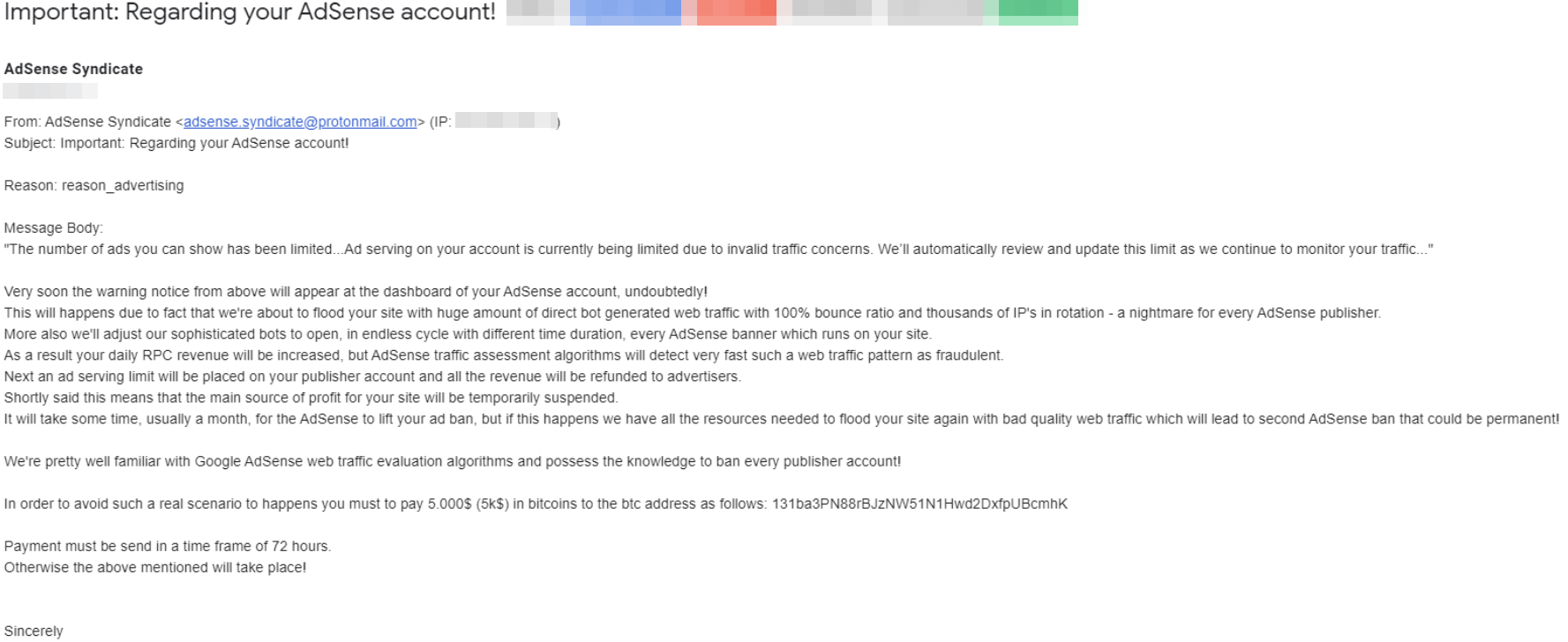
Pay Up, Or We’ll Make Google Ban Your Ads

A new email-based extortion scheme apparently is making the rounds, targeting Web site owners serving banner ads through Google’s AdSense program. In this scam, the fraudsters demand bitcoin in exchange for a promise not to flood the publisher’s ads with so much bot and junk traffic that Google’s automated anti-fraud systems suspend the user’s AdSense account for suspicious traffic.

A redacted extortion email targeting users of Google’s AdSense program.

Earlier this month, KrebsOnSecurity heard from a reader who maintains several sites that receive a fair amount of traffic. The message this reader shared began by quoting from an automated email Google’s systems might send if they detect your site is seeking to benefit from automated clicks. The message continues:

“Very soon the warning notice from above will appear at the dashboard of your AdSense account undoubtedly! This will happen due to the fact that we’re about to flood your site with huge amount of direct bot generated web traffic with 100% bounce ratio and thousands of IP’s in rotation — a nightmare for every AdSense publisher. More also we’ll adjust our sophisticated bots to open, in endless cycle with different time duration, every AdSense banner which runs on your site.”

The message goes on to warn that while the targeted site’s ad revenue will be briefly increased, “AdSense traffic assessment algorithms will detect very fast such a web traffic pattern as fraudulent.”

“Next an ad serving limit will be placed on your publisher account and all the revenue will be refunded to advertisers. This means that the main source of profit for your site will be temporarily suspended. It will take some time, usually a month, for the AdSense to lift your ad ban, but if this happens we will have all the resources needed to flood your site again with bad quality web traffic which will lead to second AdSense ban that could be permanent!”

The message demands $5,000 worth of bitcoin to forestall the attack. In this scam, the extortionists are likely betting that some publishers may see paying up as a cheaper alternative to having their main source of advertising revenue evaporate.

The reader who shared this email said while he considered the message likely to be a baseless threat, a review of his recent AdSense traffic statistics showed that detections in his “AdSense invalid traffic report” from the past month had increased substantially.

The reader, who asked not to be identified in this story, also pointed to articles about a recent AdSense crackdown in which Google announced it was enhancing its defenses by improving the systems that identify potentially invalid traffic or high risk activities before ads are served.

Google defines invalid traffic as “clicks or impressions generated by publishers clicking their own live ads,” as well as “automated clicking tools or traffic sources.”

“Pretty concerning, thought it seems this group is only saying they’re planning their attack,” the reader wrote.

Google declined to discuss this reader’s account, saying its contracts prevent the company from commenting publicly on a specific partner’s status or enforcement actions. But in a statement shared with KrebsOnSecurity, the company said the message appears to be a classic threat of sabotage, wherein an actor attempts to trigger an enforcement action against a publisher by sending invalid traffic to their inventory.

“We hear a lot about the potential for sabotage, it’s extremely rare in practice, and we have built some safeguards in place to prevent sabotage from succeeding,” the statement explained. “For example, we have detection mechanisms in place to proactively detect potential sabotage and take it into account in our enforcement systems.”

Google said it has extensive tools and processes to protect against invalid traffic across its products, and that most invalid traffic is filtered from its systems before advertisers and publishers are ever impacted.

“We have a help center on our website with tips for AdSense publishers on sabotage,” the statement continues. “There’s also a form we provide for publishers to contact us if they believe they are the victims of sabotage. We encourage publishers to disengage from any communication or further action with parties that signal that they will drive invalid traffic to their web properties. If there are concerns about invalid traffic, they should communicate that to us, and our Ad Traffic Quality team will monitor and evaluate their accounts as needed.”

source https://krebsonsecurity.com/2020/02/pay-up-or-well-make-google-ban-your-ads/

A Light at the End of Liberty Reserve’s Demise?

In May 2013, the U.S. Justice Department seized Liberty Reserve, alleging the virtual currency service acted as a $6 billion financial hub for the cybercrime world. Prompted by assurances that the government would one day afford Liberty Reserve users a chance to reclaim any funds seized as part of the takedown, KrebsOnSecurity filed a claim shortly thereafter to see if and when this process might take place. This week, an investigator with the U.S. Internal Revenue service finally got in touch to discuss my claim.

Federal officials charged that Liberty Reserve facilitated a “broad range of criminal activity, including credit card fraud, identity theft, investment fraud, computer hacking, child pornography, and narcotics trafficking.” The government says from 2006 until the service’s takedown, Liberty Reserve processed an estimated 55 million financial transactions worth more than $6 billion, with more than 600,000 accounts associated with users in the United States alone.

While it’s clear that the digital currency system for years was the go-to money-moving vehicle for many engaged in dodgy online activities, it also was favored by users primarily because it offered a relatively anonymous way to send irrevocable transfers globally with low fees.

Indeed, the two stories I wrote about the closure of Liberty Reserve in 2013 remain among the most-read on this site, and have generated an enormous volume of emails from readers who saw many thousands of dollars held in legal limbo — much of it related to investments in online gaming platforms, payments to and from adult entertainment services, and various investment schemes.

The IRS official who contacted me was not authorized to be quoted in the media (and indeed did not initially realize he was speaking to a member of the press when he called). But he told me the government had recently obtained legal access to some of the funds held in overseas bank accounts that were used by Liberty Reserve, and that IRS investigators were now starting to contact people and vet any claims made in the wake of the takedown.

“We’re just getting to the point where we have received funds,” the investigator said. “We’ve started to contact people who originally contacted us, to vet their claims, make sure they weren’t involved in any illegal activity, and that the claim amounts match the records that we have.”

The official said he didn’t know how much money in total the government was seeking to return to former Liberty Reserve users. Requests for this information from the Justice Department office that prosecuted the case — the U.S. Attorney for the Southern District of New York — went unanswered.

The founder of Liberty Reserve, 45-year-old Arthur Budovsky, pleaded guilty in 2016 to conspiring to commit money laundering. He was sentenced to 20 years in prison, ordered to pay a $500,000 fine and forfeit $122 million in company funds.

If you filed a monetary claim in response to the Liberty Reserve seizure years back, you may have already been contacted by federal investigators, or you may be soon. But please know that fraudsters will likely seize on public awareness about the possible repatriation of funds to fleece the unwary: KrebsOnSecurity has received more than a few emails from readers over the years who fell for various phishing scams that promised to return funds lost at Liberty Reserve in exchange for a bogus “processing fee.”

source https://krebsonsecurity.com/2020/02/a-light-at-the-end-of-liberty-reserves-demise/

Microsoft Patch Tuesday, February 2020 Edition

Microsoft today released updates to plug nearly 100 security holes in various versions of its Windows operating system and related software, including a zero-day vulnerability in Internet Explorer (IE) that is actively being exploited. Also, Adobe has issued a bevy of security updates for its various products, including Flash Player and Adobe Reader/Acrobat.

A dozen of the vulnerabilities Microsoft patched today are rated “critical,” meaning malware or miscreants could exploit them remotely to gain complete control over an affected system with little to no help from the user.

Last month, Microsoft released an advisory warning that attackers were exploiting a previously unknown flaw in IE. That vulnerability, assigned as CVE-2020-0674, has been patched with this month’s release. It could be used to install malware just by getting a user to browse to a malicious or hacked Web site.

Microsoft once again fixed a critical flaw in the way Windows handles shortcut (.lnk) files (CVE-2020-0729) that affects Windows 8 and 10 systems, as well as Windows Server 2008-2012. Allan Liska, intelligence analyst at Recorded Future, says Microsoft considers exploitation of the vulnerability unlikely, but that a similar vulnerability discovered last year, CVE-2019-1280, was being actively exploited by the Astaroth trojan as recently as September.

Another flaw fixed this month in Microsoft Exchange 2010 through 2019 may merit special attention. The bug could allow attackers to exploit the Exchange Server and execute arbitrary code just by sending a specially crafted email. This vulnerability (CVE-2020-0688) is rated “important” rather than “critical,” but Liska says it seems potentially dangerous, as Microsoft identifies this as a vulnerability that is likely to be exploited.

In addition, Redmond addressed a critical issue (CVE-2020-0618) in the way Microsoft SQL Server versions 2012-2016 handle page requests.

After a several-month respite from patches for its Flash Player browser plug-in, Adobe has once again blessed us with a security update for this program (fixes one critical flaw). Thankfully, Chrome and Firefox both now disable Flash by default, and Chrome and IE/Edge auto-update the program when new security updates are available. Adobe is slated to retire Flash Player later this year.

Other Adobe products for which the company shipped updates today include Experience Manager, Digital Editions, Framemaker and Acrobat/Reader (17 flaws). Security experts at Qualys note that on January 28th, Adobe also issued an out-of-band patch for Magento, labeled as Priority 2.

“While none of the vulnerabilities disclosed in Adobe’s release are known to be Actively Attacked today, all patches should be prioritized on systems with these products installed,” said Qualys’s Jimmy Graham.

Windows 7 users should be aware by now that while a fair number of flaws addressed this month by Microsoft affect Windows 7 systems, this operating system is no longer being supported with security updates (unless you’re an enterprise taking advantage of Microsoft’s paid extended security updates program, which is available to Windows 7 Professional and Windows 7 enterprise users).

If you rely on Windows 7 for day-to-day use, it’s probably time to think about upgrading to something newer. That might be a computer with Windows 10. Or maybe you have always wanted that shiny MacOS computer.

If cost is a primary motivator and the user you have in mind doesn’t do much with the system other than browsing the Web, perhaps a Chromebook or an older machine with a recent version of Linux is the answer (Ubuntu may be easiest for non-Linux natives). Whichever system you choose, it’s important to pick one that fits the owner’s needs and provides security updates on an ongoing basis.

Keep in mind that while staying up-to-date on Windows patches is a must, it’s important to make sure you’re updating only after you’ve backed up your important data and files. A reliable backup means you’re not losing your mind when the odd buggy patch causes problems booting the system.

So do yourself a favor and backup your files before installing any patches. Windows 10 even has some built-in tools to help you do that, either on a per-file/folder basis or by making a complete and bootable copy of your hard drive all at once.

As always, if you experience glitches or problems installing any of these patches this month, please consider leaving a comment about it below; there’s a better-than-even chance other readers have experienced the same and may chime in here with some helpful tips. Also, keep an eye on the AskWoody blog from Woody Leonhard, who keeps a close eye on buggy Microsoft updates each month.

source https://krebsonsecurity.com/2020/02/microsoft-patch-tuesday-february-2020-edition/

Significant cost increases likely for .COM domains

The following is most recent news from Namecheap:

“What’s happening

Last month, ICANN, the organization that oversees domain names, announced significant changes to the contract it has with Verisign, Inc. who operate the .COM top-level-domain (TLD).

ICANN made these changes in secret, without consulting or incorporating feedback from the ICANN community or Internet users. Although ICANN has a history of making similar deals behind closed doors, and also of ignoring unified opposition against such action, we are focused on leading the fight against price increases that will harm our customers (and the Internet as a whole). This is a crucial time to raise our voices given that .COM domains make up 40% of all registered domain names online.

What does this change mean?

Wholesale registries charge Namecheap a set fee per domain name per year. According to this new agreement, Verisign will be allowed to increase the wholesale price to registrars for .COM domains every year for 8 out of the next 10 years, and the increases don’t stop there.

This will mean that .COM wholesale domain prices can grow by more than 70% over and above current prices over the next decade. The contract also allows for other price increases, which could drive prices up further, ultimately making .COM domains less accessible and more expensive for everybody.

Why is ICANN doing this?

Alongside these contract changes, Verisign agreed to pay ICANN an additional $20 million dollars over five years to support ICANN’s domain name system initiatives, without any clarity about how ICANN will spend the money, or who will ensure that the funds are properly spent on domain infrastructure. “