Business ID Theft Soars Amid COVID Closures

Identity thieves who specialize in running up unauthorized lines of credit in the names of small businesses are having a field day with all of the closures and economic uncertainty wrought by the COVID-19 pandemic, KrebsOnSecurity has learned. This story is about the victims of a particularly aggressive business ID theft ring that’s spent years targeting small businesses across the country and is now pivoting toward using that access for pandemic assistance loans and unemployment benefits.

Most consumers are likely aware of the threat from identity theft, which occurs when crooks apply for new lines of credit in your name. But the same crime can be far more costly and damaging when thieves target small businesses. Unfortunately, far too many entrepreneurs are simply unaware of the threat or don’t know how to be watchful for it.

What’s more, with so many small enterprises going out of business or sitting dormant during the COVID-19 pandemic, organized fraud rings have an unusually rich pool of targets to choose from.

Short Hills, N.J.-based Dun & Bradstreet [NYSE:DNB] is a data analytics company that acts as a kind of de facto credit bureau for companies: When a business owner wants to open a new line of credit, creditors typically check with Dun & Bradstreet to gauge the business’s history and trustworthiness.

In 2019, Dun & Bradstreet saw more than a 100 percent increase in business identity theft. For 2020, the company estimates an overall 258 percent spike in the crime. Dun & Bradstreet said that so far this year it has received over 4,700 tips and leads where business identity theft or malfeasance are suspected.

“The ferocity of cyber criminals to take advantage of COVID-19 uncertainties by preying on small businesses is disturbing,” said Andrew LaMarca, who leads the global high-risk and fraud team at Dun & Bradstreet.

For the past several months, Milwaukee, Wisc. based cyber intelligence firm Hold Security has been monitoring the communications between and among a businesses ID theft gang apparently operating in Georgia and Florida but targeting businesses throughout the United States. That surveillance has helped to paint a detailed picture of how business ID thieves operate, as well as the tricks they use to gain credit in a company’s name.

Hold Security founder Alex Holden said the group appears to target both active and dormant or inactive small businesses. The gang typically will start by looking up the business ownership records at the Secretary of State website that corresponds to the company’s state of incorporation. From there, they identify the officers and owners of the company, acquire their Social Security and Tax ID numbers from the dark web and other sources online.

To prove ownership over the hijacked firms, they hire low-wage image editors online to help fabricate and/or modify a number of official documents tied to the business — including tax records and utility bills.

The scammers frequently then file phony documents with the Secretary of State’s office in the name(s) of the business owners, but include a mailing address that they control. They also create email addresses and domain names that mimic the names of the owners and the company to make future credit applications appear more legitimate, and submit the listings to business search websites, such as yellowpages.com.

For both dormant and existing businesses, the fraudsters attempt to create or modify the target company’s accounts at Dun & Bradstreet. In some cases, the scammers create dashboard accounts in the business’s names at Dun & Bradstreet’s credit builder portal; in others, the bad guys have actually hacked existing business accounts at DNB, requesting a new DUNS numbers for the business (a DUNS number is a unique, nine-digit identifier for businesses).
Finally, after the bogus profiles are approved by Dun & Bradstreet, the gang waits a few weeks or months and then starts applying for new lines of credit in the target business’s name at stores like Home Depot, Office Depot and Staples. Then they go on a buying spree with the cards issued by those stores.

Usually, the first indication a victim has that they’ve been targeted is when the debt collection companies start calling.

“They are using mostly small companies that are still active businesses but currently not operating because of COVID-19,” Holden said. “With this gang, we see four or five people working together. The team leader manages the work between people. One person seems to be in charge of getting stolen cards from the dark web to pay for the reactivation of businesses through the secretary of state sites. Another team member works on revising the business documents and registering them on various sites. The others are busy looking for specific businesses they want to revive.”

Holden said the gang appears to find success in getting new lines of credit with about 20 percent of the businesses they target.

“One’s personal credit is nothing compared to the ability of corporations to borrow money,” he said. “That’s bad because while the credit system may be flawed for individuals, it’s an even worse situation on average when we’re talking about businesses.”

Holden said over the past few months his firm has seen communications between the gang’s members indicating they have temporarily shifted more of their energy and resources to defrauding states and the federal government by filing unemployment insurance claims and apply for pandemic assistance loans with the Small Business Administration.

“It makes sense, because they’ve already got control over all these dormant businesses,” he said. “So they’re now busy trying to get unemployment payments and SBA loans in the names of these companies and their employees.”

PHANTOM OFFICES

Hold Security shared data intercepted from the gang that listed the personal and financial details of dozens of companies targeted for ID theft, including Dun & Bradstreet logins the crooks had created for the hijacked businesses. Dun & Bradstreet declined to comment on the matter, other than to say it was working with federal and state authorities to alert affected businesses and state regulators.

Among those targeted was Environmental Safety Consultants Inc. (ESC), a 37-year-old environmental engineering firm based in Bradenton, Fla. ESC owner Scott Russell estimates his company was initially targeted nearly two years ago, and that he first became aware something wasn’t right when he recently began getting calls from Home Depot’s corporate offices inquiring about the company’s delinquent account.

But Russell said he didn’t quite grasp the enormity of the situation until last year, when he was contacted by a the manager of a virtual office space across town who told him about a suspiciously large number of deliveries at an office space that was rented out in his name.

Russell had never rented that particular office. Rather, the thieves had done it for him, using his name and the name of his business. The office manager said the deliveries came virtually non-stop, even though there was apparently no business operating within the rented premises. And in each case, shortly after the shipments arrived someone would show up and cart them away.

“She said we don’t think it’s you,” he recalled. “Turns out, they had paid for a lease in my name with someone else’s credit card. She shared with me a copy of the lease, which included a fraudulent ID and even a vehicle insurance card for a Land Cruiser we got rid of like 15 years ago. The application listed our home address with me and some woman who was not my wife’s name.”

The crates and boxes being delivered to his erstwhile office space were mostly computers and other high-priced items ordered from 10 different Office Depot credit cards that also were not in his name.

“The total value of the electronic equipment that was bought and delivered there was something like $75,000,” Russell said, noting that it took countless hours and phone calls with Office Depot to make it clear they would no longer accept shipments addressed to him or his company. “It was quite spine-tingling to see someone penned a lease in the name of my business and personal identity.”

Even though the virtual office manager had the presence of mind to take photocopies of the driver’s licenses presented by the people arriving to pick up the fraudulent shipments, the local police seemed largely uninterested in pursuing the case, Russell said.

“I went to the local county sheriff’s office and showed them all the documentation I had and the guy just yawned and said he’d get right on it,” he recalled. “The place where the office space was rented was in another county, and the detective I spoke to there about it was interested, but he could never get anyone from my county to follow up.”

RECYCLING VICTIMS

Russell said he believes the fraudsters initially took out new lines of credit in his company’s name and then used those to defraud others in a similar way. One of those victims is another victim on the gang’s target list obtained by Hold Security — Mary McMahan, owner of Fan Experiences, an event management company in Winter Park, Fla.

McMahan also had stolen goods from Office Depot and other stores purchased in her company’s name and delivered to the same office space rented in Russell’s name. McMahan said she and her businesses have suffered hundreds of thousands of dollars in fraud, and spent nearly as much in legal fees fending off collections firms and restoring her company’s credit.

McMahan said she first began noticing trouble almost four years ago, when someone started taking out new credit cards in her company’s name. At the same time, her business was used to open a new lease on a virtual office space in Florida that also began receiving packages tied to other companies victimized by business ID theft.

“About four years back, they hit my credit hard for a year, getting all these new lines of credit at Home Depot, Office Depot, Office Max, you name it,” she said. “Then they came back again two years ago and hit it hard for another year. They even went to the [Florida Department of Motor Vehicles] to get a driver’s license in my name.”

McMahan said the thieves somehow hacked her DNB account, and then began adding new officers and locations for her business listing.

“They changed the email and mailing address, and even went on Yelp and Google and did the same,” she said.

McMahan said she’s since locked down her personal and business credit to the point where even she would have a tough time getting a new line of credit or mortgage if she tried.

“There’s no way they can even utilize me anymore because there’s so many marks on my credit stating that it’s been stolen” she said. “These guys are relentless, and they recycle victims to defraud others until they figure out they can’t recycle them anymore.”

SAY…THAT’S A NICE CREDIT PROFILE YOU GOT THERE…

McMahan says she, too, has filed multiple reports about the crimes with local police, but has so far seen little evidence that anyone is interested in following up on the matter. For now, she is paying Dun and Bradstreet more than a $100 a month to monitor her business credit profile.

Dun & Bradstreet does offer a free version of credit monitoring called Credit Signal that lets business owners check their business credit scores and any inquiries made in the previous 14 days up to four times a year. However, those looking for more frequent checks or additional information about specific credit inquiries beyond 14 days are steered toward DNB’s subscription-based services.

Eva Velasquez, president of the Identity Theft Resource Center, a California-based nonprofit that assists ID theft victims, said she finds that troubling.

“When we look at these institutions that are necessary for us to operate and function in society and they start to charge us a fee for a service to fix a problem they helped create through their infrastructure, that’s just unconscionable,” Velasquez said. “We need to take a hard look at the infrastructures that businesses are beholden to and make sure the risk minimization protections they’re entitled to are not fee-based — particularly if it’s a problem created by the very infrastructure of the system.”

Velasquez said it’s unfortunate that small business owners don’t have the same protections afforded to consumers. For example, only recently did the three major consumer reporting bureaus allow all U.S. residents to place a freeze on their credit files for free.

“We’ve done a good job in educating the public that anyone can be victim of identity theft, and in compelling our infrastructure to provide robust consumer protection and risk minimization processes that are more uniform,” she said. “It’s still not good by any means, but it’s definitely better for consumers than it is for businesses. We currently put all the responsibility on the small business owner, and very little on the infrastructure and processes that should be designed to protect them but aren’t doing a great job, frankly.”

Rather, the onus continues to be on the business owner to periodically check with DNB and state agencies to monitor for any signs of unauthorized changes. Worse still, too many private and public organizations still don’t do a good enough job protecting employee identification and tax ID numbers that are so often abused in business identity theft, Velasquez said.

“You can put alerts and other protections in place but the problem is you have to go on a department by department and case by case basis,” she said. “The place to begin is your secretary of state’s office or wherever you file your documents to operate your business.

For its part, Dun & Bradstreet recently published a blog post outlining recommendations for businesses to ward off identity thieves. DNB says anyone who suspects fraudulent activity on their account should contact its support team.

source https://krebsonsecurity.com/2020/07/business-id-theft-soars-amid-covid-closures/

Thinking of a Cybersecurity Career? Read This

Thousands of people graduate from colleges and universities each year with cybersecurity or computer science degrees only to find employers are less than thrilled about their hands-on, foundational skills. Here’s a look at a recent survey that identified some of the bigger skills gaps, and some thoughts about how those seeking a career in these fields can better stand out from the crowd.

Virtually every week KrebsOnSecurity receives at least one email from someone seeking advice on how to break into cybersecurity as a career. In most cases, the aspirants ask which certifications they should seek, or what specialization in computer security might hold the brightest future.

Rarely am I asked which practical skills they should seek to make themselves more appealing candidates for a future job. And while I always preface any response with the caveat that I don’t hold any computer-related certifications or degrees myself, I do speak with C-level executives in cybersecurity and recruiters on a regular basis and frequently ask them for their impressions of today’s cybersecurity job candidates.

A common theme in these C-level executive responses is that a great many candidates simply lack hands-on experience with the more practical concerns of operating, maintaining and defending the information systems which drive their businesses.

Granted, most people who have just graduated with a degree lack practical experience. But happily, a somewhat unique aspect of cybersecurity is that one can gain a fair degree of mastery of hands-on skills and foundational knowledge through self-directed study and old fashioned trial-and-error.

One key piece of advice I nearly always include in my response to readers involves learning the core components of how computers and other devices communicate with one another. I say this because a mastery of networking is a fundamental skill that so many other areas of learning build upon. Trying to get a job in security without a deep understanding of how data packets work is a bit like trying to become a chemical engineer without first mastering the periodic table of elements.

But please don’t take my word for it. The SANS Institute, a Bethesda, Md. based security research and training firm, recently conducted a survey of more than 500 cybersecurity practitioners at 284 different companies in an effort to suss out which skills they find most useful in job candidates, and which are most frequently lacking.

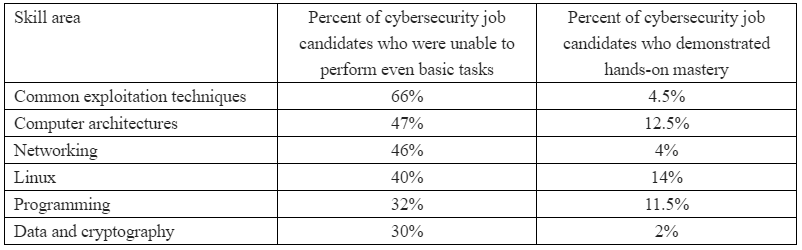
The survey asked respondents to rank various skills from “critical” to “not needed.” Fully 85 percent ranked networking as a critical or “very important” skill, followed by a mastery of the Linux operating system (77 percent), Windows (73 percent), common exploitation techniques (73 percent), computer architectures and virtualization (67 percent) and data and cryptography (58 percent). Perhaps surprisingly, only 39 percent ranked programming as a critical or very important skill (I’ll come back to this in a moment).

How did the cybersecurity practitioners surveyed grade their pool of potential job candidates on these critical and very important skills? The results may be eye-opening:

“Employers report that student cybersecurity preparation is largely inadequate and are frustrated that they have to spend months searching before they find qualified entry-level employees if any can be found,” said Alan Paller, director of research at the SANS Institute. “We hypothesized that the beginning of a pathway toward resolving those challenges and helping close the cybersecurity skills gap would be to isolate the capabilities that employers expected but did not find in cybersecurity graduates.”

The truth is, some of the smartest, most insightful and talented computer security professionals I know today don’t have any computer-related certifications under their belts. In fact, many of them never even went to college or completed a university-level degree program.

Rather, they got into security because they were passionately and intensely curious about the subject, and that curiosity led them to learn as much as they could — mainly by reading, doing, and making mistakes (lots of them).

I mention this not to dissuade readers from pursuing degrees or certifications in the field (which may be a basic requirement for many corporate HR departments) but to emphasize that these should not be viewed as some kind of golden ticket to a rewarding, stable and relatively high-paying career.

More to the point, without a mastery of one or more of the above-mentioned skills, you simply will not be a terribly appealing or outstanding job candidate when the time comes.

BUT..HOW?

So what should you focus on, and what’s the best way to get started? First, understand that while there are a near infinite number of ways to acquire knowledge and virtually no limit to the depths you can explore, getting your hands dirty is the fastest way to learning.

No, I’m not talking about breaking into someone’s network, or hacking some poor website. Please don’t do that without permission. If you must target third-party services and sites, stick to those that offer recognition and/or incentives for doing so through bug bounty programs, and then make sure you respect the boundaries of those programs.

Besides, almost anything you want to learn by doing can be replicated locally. Hoping to master common vulnerability and exploitation techniques? There are innumerable free resources available; purpose-built exploitation toolkits like Metasploit, WebGoat, and custom Linux distributions like Kali Linux that are well supported by tutorials and videos online. Then there are a number of free reconnaissance and vulnerability discovery tools like Nmap, Nessus, OpenVAS and Nikto. This is by no means a complete list.

Set up your own hacking labs. You can do this with a spare computer or server, or with older hardware that is plentiful and cheap on places like eBay or Craigslist. Free virtualization tools like VirtualBox can make it simple to get friendly with different operating systems without the need of additional hardware.

Or look into paying someone else to set up a virtual server that you can poke at. Amazon’s EC2 services are a good low-cost option here. If it’s web application testing you wish to learn, you can install any number of web services on computers within your own local network, such as older versions of WordPress, Joomla or shopping cart systems like Magento.

Want to learn networking? Start by getting a decent book on TCP/IP and really learning the network stack and how each layer interacts with the other.

And while you’re absorbing this information, learn to use some tools that can help put your newfound knowledge into practical application. For example, familiarize yourself with Wireshark and Tcpdump, handy tools relied upon by network administrators to troubleshoot network and security problems and to understand how network applications work (or don’t). Begin by inspecting your own network traffic, web browsing and everyday computer usage. Try to understand what applications on your computer are doing by looking at what data they are sending and receiving, how, and where.

ON PROGRAMMING

While being able to program in languages like Go, Java, Perl, Python, C or Ruby may or may not be at the top of the list of skills demanded by employers, having one or more languages in your skillset is not only going to make you a more attractive hire, it will also make it easier to grow your knowledge and venture into deeper levels of mastery.

It is also likely that depending on which specialization of security you end up pursuing, at some point you will find your ability to expand that knowledge is somewhat limited without understanding how to code.

For those intimidated by the idea of learning a programming language, start by getting familiar with basic command line tools on Linux. Just learning to write basic scripts that automate specific manual tasks can be a wonderful stepping stone. What’s more, a mastery of creating shell scripts will pay handsome dividends for the duration of your career in almost any technical role involving computers (regardless of whether you learn a specific coding language).

GET HELP

Make no mistake: Much like learning a musical instrument or a new language, gaining cybersecurity skills takes most people a good deal of time and effort. But don’t get discouraged if a given topic of study seems overwhelming at first; just take your time and keep going.

That’s why it helps to have support groups. Seriously. In the cybersecurity industry, the human side of networking takes the form of conferences and local meetups. I cannot stress enough how important it is for both your sanity and career to get involved with like-minded people on a semi-regular basis.

Many of these gatherings are free, including Security BSides eventsDEFCON groups, and OWASP chapters. And because the tech industry continues to be disproportionately populated by men, there are also a number cybersecurity meetups and membership groups geared toward women, such as the Women’s Society of Cyberjutsu and others listed here.

Unless you live in the middle of nowhere, chances are there’s a number of security conferences and security meetups in your general area. But even if you do reside in the boonies, the good news is many of these meetups are going virtual to avoid the ongoing pestilence that is the COVID-19 epidemic.

In summary, don’t count on a degree or certification to prepare you for the kinds of skills employers are going to understandably expect you to possess. That may not be fair or as it should be, but it’s likely on you to develop and nurture the skills that will serve your future employer(s) and employability in this field.

I’m certain that readers here have their own ideas about how newbies, students and those contemplating a career shift into cybersecurity can best focus their time and efforts. Please feel free to sound off in the comments. I may even update this post to include some of the better recommendations.

source https://krebsonsecurity.com/2020/07/thinking-of-a-cybersecurity-career-read-this/

NY Charges First American Financial for Massive Data Leak

In May 2019, KrebsOnSecurity broke the news that the website of mortgage title insurance giant First American Financial Corp. had exposed approximately 885 million records related to mortgage deals going back to 2003. On Wednesday, regulators in New York announced that First American was the target of their first ever cybersecurity enforcement action in connection with the incident, charges that could bring steep financial penalties.

First American Financial Corp.

Santa Ana, Calif.-based First American [NYSE:FAF] is a leading provider of title insurance and settlement services to the real estate and mortgage industries. It employs some 18,000 people and brought in $6.2 billion in 2019.

As first reported here last year, First American’s website exposed 16 years worth of digitized mortgage title insurance records — including bank account numbers and statements, mortgage and tax records, Social Security numbers, wire transaction receipts, and drivers license images.

The documents were available without authentication to anyone with a Web browser.

According to a filing (PDF) by the New York State Department of Financial Services (DFS), the weakness that exposed the documents was first introduced during an application software update in May 2014 and went undetected for years.

Worse still, the DFS found, the vulnerability was discovered in a penetration test First American conducted on its own in December 2018.

“Remarkably, Respondent instead allowed unfettered access to the personal and financial data of millions of its customers for six more months until the breach and its serious ramifications were widely publicized by a nationally recognized cybersecurity industry journalist,” the DFS explained in a statement on the charges.

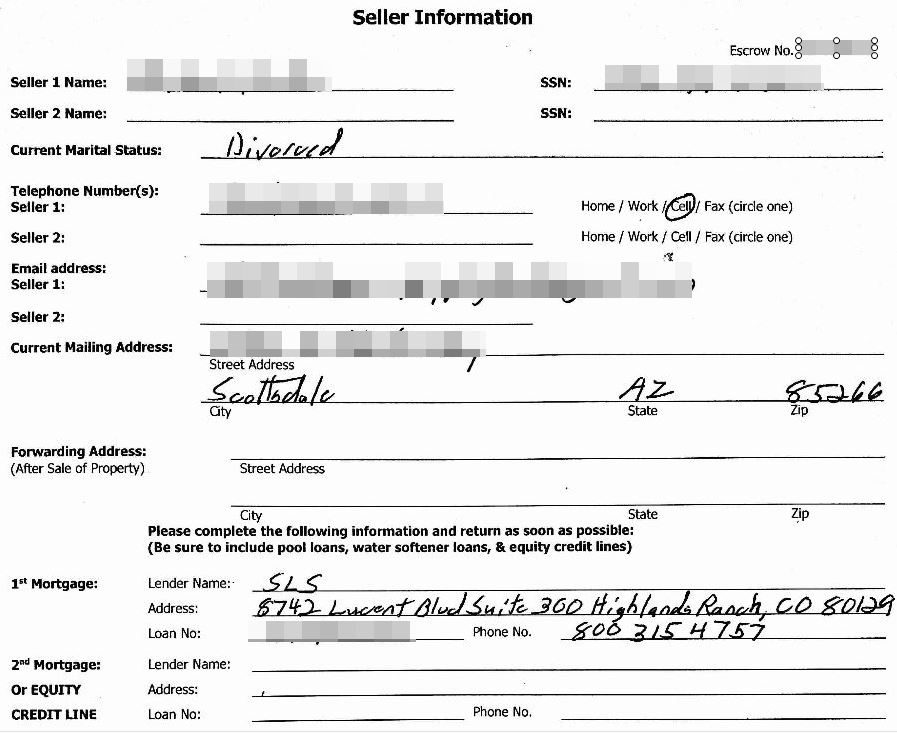
A redacted screenshot of one of many millions of sensitive records exposed by First American’s Web site.

Reuters reports that the penalties could be significant for First American: The DFS considers each instance of exposed personal information a separate violation, and the company faces penalties of up to $1,000 per violation.

In a written statement, First American said it strongly disagrees with the DFS’s findings, and that its own investigation determined only a “very limited number” of consumers — and none from New York — had personal data accessed without permission.

In August 2019, the company said a third-party investigation into the exposure identified just 32 consumers whose non-public personal information likely was accessed without authorization.

When KrebsOnSecurity asked last year how long it maintained access logs or how far back in time that review went, First American declined to be more specific, saying only that its logs covered a period that was typical for a company of its size and nature.

But in Wednesday’s filing, the DFS said First American was unable to determine whether records were accessed prior to Jun 2018.

“Respondent’s forensic investigation relied on a review of web logs retained from June 2018 onward,” the DFS found. “Respondent’s own analysis demonstrated that during this 11-month period, more than 350,000 documents were accessed without authorization by automated ‘bots’ or ‘scraper’ programs designed to collect information on the Internet.

The records exposed by First American would have been a virtual gold mine for phishers and scammers involved in so-called Business Email Compromise (BEC) scams, which often impersonate real estate agents, closing agencies, title and escrow firms in a bid to trick property buyers into wiring funds to fraudsters. According to the FBI, BEC scams are the most costly form of cybercrime today.

First American’s stock price fell more than 6 percent the day after news of their data leak was published here. In the days that followed, the DFS and U.S. Securities and Exchange Commission each announced they were investigating the company.

First American released its first quarter 2020 earnings today. A hearing on the charges alleged by the DFS is slated for Oct. 26.

source https://krebsonsecurity.com/2020/07/ny-charges-first-american-financial-for-massive-data-leak/

Twitter Hacking for Profit and the LoLs

The New York Times last week ran an interview with several young men who claimed to have had direct contact with those involved in last week’s epic hack against Twitter. These individuals said they were only customers of the person who had access to Twitter’s internal employee tools, and were not responsible for the actual intrusion or bitcoin scams that took place that day. But new information suggests that at least two of them operated a service that resold access to Twitter employees for the purposes of modifying or seizing control of prized Twitter profiles.

As first reported here on July 16, prior to bitcoin scam messages being blasted out from such high-profile Twitter accounts @barackobama, @joebiden, @elonmusk and @billgates, several highly desirable short-character Twitter account names changed hands, including @L, @6 and @W.

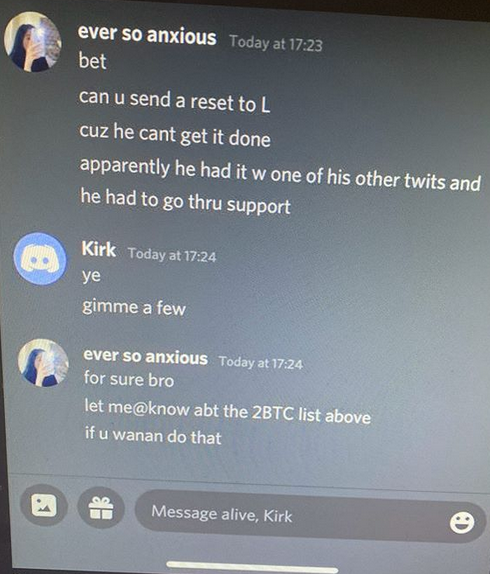
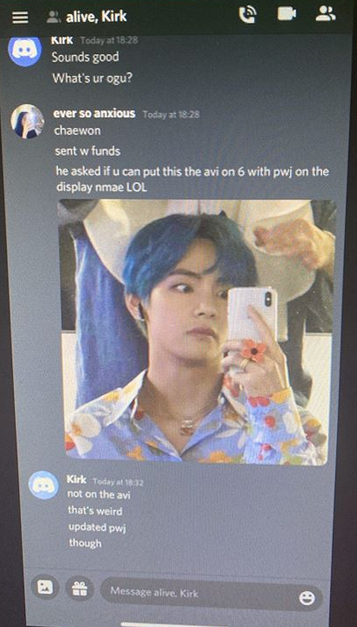
A screenshot of a Discord discussion between the key Twitter hacker “Kirk” and several people seeking to hijack high-value Twitter accounts.

Known as “original gangster” or “OG” accounts, short-character profile names confer a measure of status and wealth in certain online communities, and such accounts can often fetch thousands of dollars when resold in the underground.

The people involved in obtaining those OG accounts on July 15 said they got them from a person identified only as “Kirk,” who claimed to be a Twitter employee. According to The Times, Kirk first reached out to the group through a hacker who used the screen name “lol” on OGusers, a forum dedicated to helping users hijack and resell OG accounts from Twitter and other social media platforms. From The Times’s story:

“The hacker ‘lol’ and another one he worked with, who went by the screen name ‘ever so anxious,’ told The Times that they wanted to talk about their work with Kirk in order to prove that they had only facilitated the purchases and takeovers of lesser-known Twitter addresses early in the day. They said they had not continued to work with Kirk once he began more high-profile attacks around 3:30 p.m. Eastern time on Wednesday.

‘lol’ did not confirm his real-world identity, but said he lived on the West Coast and was in his 20s. “ever so anxious” said he was 19 and lived in the south of England with his mother.

Kirk connected with “lol” late Tuesday and then “ever so anxious” on Discord early on Wednesday, and asked if they wanted to be his middlemen, selling Twitter accounts to the online underworld where they were known. They would take a cut from each transaction.”

Twice in the past year, the OGUsers forum was hacked, and both times its database of usernames, email addresses and private messages was leaked online. A review of the private messages for “lol” on OGUsers provides a glimpse into the vibrant market for the resale of prized OG accounts.

On OGUsers, lol was known to other members as someone who had a direct connection to one or more people working at Twitter who could be used to help fellow members gain access to Twitter profiles, including those that had been suspended for one reason or another. In fact, this was how lol introduced himself to the OGUsers community when he first joined.

“I have a twitter contact who I can get users from (to an extent) and I believe I can get verification from,” lol explained.

In a direct message exchange on OGUsers from November 2019, lol is asked for help from another OGUser member whose Twitter account had been suspended for abuse.

“hello saw u talking about a twitter rep could you please ask if she would be able to help unsus [unsuspend] my main and my friends business account will pay 800-1k for each,” the OGUusers profile inquires of lol.

Lol says he can’t promise anything but will look into it. “I sent her that, not sure if I will get a reply today bc its the weekend but ill let u know,” Lol says.

In another exchange, an OGUser denizen quizzes lol about his Twitter hookup.

“Does she charge for escalations? And how do you know her/what is her department/job. How do you connect with them if I may ask?”

“They are in the Client success team,” lol replies. “No they don’t charge, and I know them through a connection.”

As for how he got access to the Twitter employee, lol declines to elaborate, saying it’s a private method. “It’s a lil method, sorry I cant say.”

In another direct message, lol asks a fellow OGUser member to edit a comment in a forum discussion which included the Twitter account “@tankska,” saying it was his IRL (in real life) Twitter account and that he didn’t want to risk it getting found out or suspended (Twitter says this account doesn’t exist, but a simple text search on Twitter shows the profile was active until late 2019).

“can u edit that comment out, @tankska is a gaming twitter of mine and i dont want it to be on ogu :D’,” lol wrote. “just dont want my irl getting sus[pended].”

Still another OGUser member would post lol’s identifying information into a forum thread, calling lol by his first name — “Josh” — in a post asking lol what he might offer in an auction for a specific OG name.

“Put me down for 100, but don’t note my name in the thread please,” lol wrote.

WHO IS LOL?

The information in lol’s OGUsers registration profile indicates he was probably being truthful with The Times about his location. The hacked forum database shows a user “tankska” registered on OGUsers back in July 2018, but only made one post asking about the price of an older Twitter account for sale.

The person who registered the tankska account on OGUsers did so with the email address jperry94526@gmail.com, and from an Internet address tied to the San Ramon Unified School District in Danville, Calif.

According to 4iq.com, a service that indexes account details like usernames and passwords exposed in Web site data breaches, the jperry94526 email address was used to register accounts at several other sites over the years, including one at the apparel store Stockx.com under the profile name Josh Perry.

Tankska was active only briefly on OGUsers, but the hacked OGUsers database shows that “lol” changed his username three times over the years. Initially, it was “freej0sh,” followed by just “j0sh.”

lol did not respond to requests for comment sent to email addresses tied to his various OGU profiles and Instagram accounts.

ALWAYS IN DISCORD

Last week’s story on the Twitter compromise noted that just before the bitcoin scam tweets went out, several OG usernames changed hands. The story traced screenshots of Twitter tools posted online back to a moniker that is well-known in the OGUsers circle: PlugWalkJoe, a 21-year-old from the United Kingdom.

Speaking with The Times, PlugWalkJoe — whose real name is Joseph O’Connor — said while he acquired a single OG Twitter account (@6) through one of the hackers in direct communication with Kirk, he was otherwise not involved in the conversation.

“I don’t care,” O’Connor told The Times. “They can come arrest me. I would laugh at them. I haven’t done anything.”

In an interview with KrebsOnSecurity, O’Connor likewise asserted his innocence, suggesting at least a half dozen other hacker handles that may have been Kirk or someone who worked with Kirk on July 15, including “Voku,” “Crim/Criminal,” “Promo,” and “Aqua.”

“That twit screenshot was the first time in a while I joke[d], and evidently I shouldn’t have,” he said. “Joking is what got me into this mess.”

O’Connor shared a number of screenshots from a Discord chat conversation on the day of the Twitter hack between Kirk and two others: “Alive,” which is another handle used by lol, and “Ever So Anxious.” Both were described by The Times as middlemen who sought to resell OG Twitter names obtained from Kirk. O’Connor is referenced in these screenshots as both “PWJ” and by his Discord handle, “Beyond Insane.”

The negotiations over highly-prized OG Twitter usernames took place just prior to the hijacked celebrity accounts tweeting out bitcoin scams.

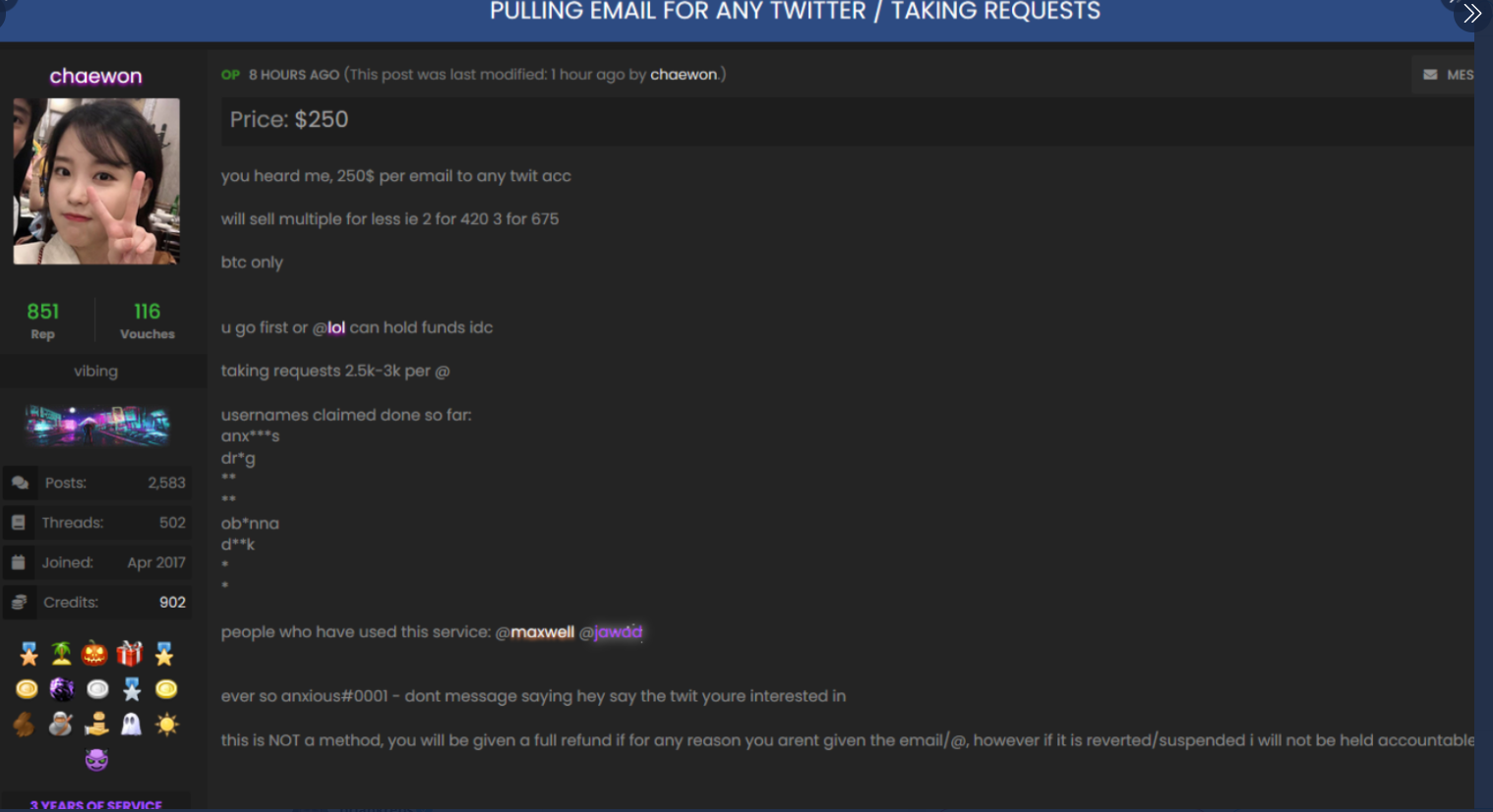
Ever So Anxious told Kirk his OGU nickname was “Chaewon,” which corresponds to a user in the United Kingdom. Just prior to the Twitter compromise, Chaewon advertised a service on the forum that could change the email address tied to any Twitter account for around $250 worth of bitcoin. O’Connor said Chaewon also operates under the hacker alias “Mason.”

“Ever So Anxious” tells Kirk his OGUsers handle is “Chaewon,” and asks Kirk to modify the display names of different OG Twitter handles to read “lol” and “PWJ”.

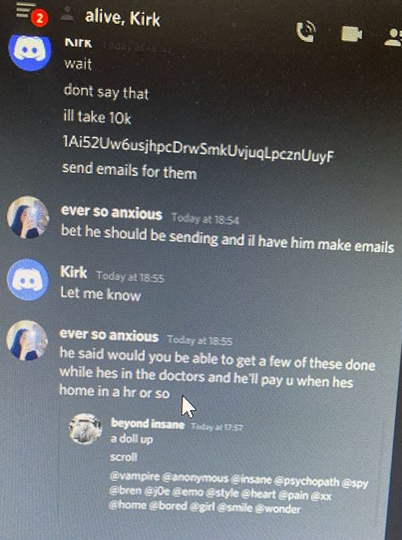
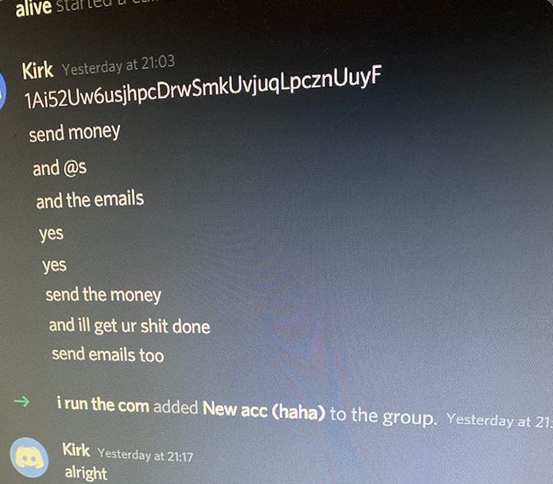
At one point in the conversation, Kirk tells Alive and Ever So Anxious to send funds for any OG usernames they want to this bitcoin address. The payment history of that address shows that it indeed also received approximately $180,000 worth of bitcoin from the wallet address tied to the scam messages tweeted out on July 15 by the compromised celebrity accounts.

The Twitter hacker “Kirk” telling lol/Alive and Chaewon/Mason/Ever So Anxious where to send the funds for the OG Twitter accounts they wanted.

SWIMPING

My July 15 story observed there were strong indications that the people involved in the Twitter hack have connections to SIM swapping, an increasingly rampant form of crime that involves bribing, hacking or coercing employees at mobile phone and social media companies into providing access to a target’s account.

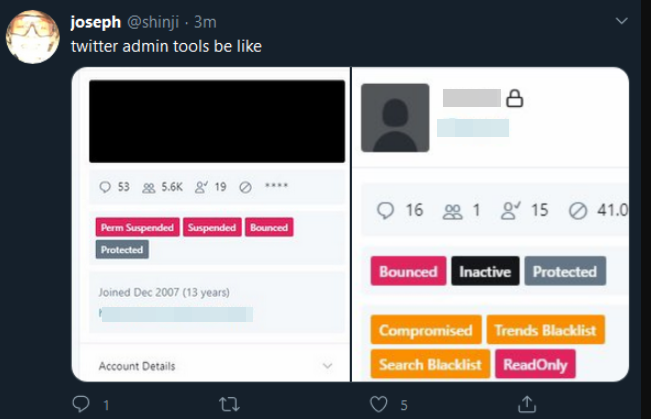
The account “@shinji,” a.k.a. “PlugWalkJoe,” tweeting a screenshot of Twitter’s internal tools interface.

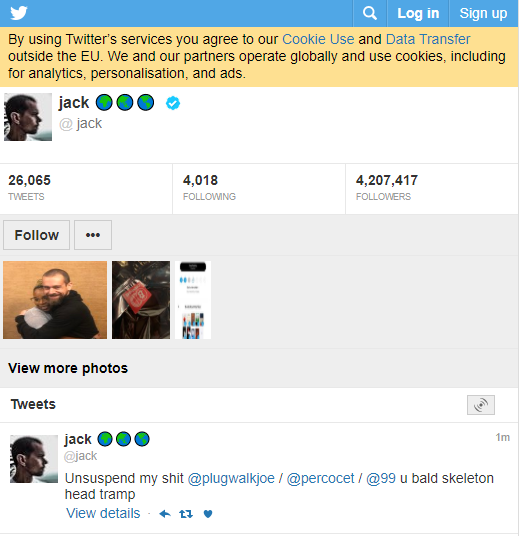
SIM swapping was thought to be behind the hijacking of Twitter CEO Jack Dorsey‘s Twitter account last year. As recounted by Wired.com, @jack was hijacked after the attackers conducted a SIM swap attack against AT&T, the mobile provider for the phone number tied to Dorsey’s Twitter account.

Immediately after Jack Dorsey’s Twitter handle was hijacked, the hackers tweeted out several shout-outs, including one to @PlugWalkJoe. O’Connor told KrebsOnSecurity he has never been involved in SIM swapping, although that statement was contradicted by two law enforcement sources who closely track such crimes.

However, Chaewon’s private messages on OGusers indicate that he very much was involved in SIM swapping. Use of the term “SIM swapping” was not allowed on OGusers, and the forum administrations created an automated script that would watch for anyone trying to post the term into a private message or discussion thread.

The script would replace the term with “I do not condone illegal activities.” Hence, a portmanteau was sometimes used: “Swimping.”

“Are you still swimping?” one OGUser member asks of Chaewon on Mar. 24, 2020. “If so and got targs lmk your discord.” Chaewon responds in the affirmative, and asks the other user to share his account name on Wickr, an encrypted online messaging app that automatically deletes messages after a few days.

Chaewon/Ever So Anxious/Mason did not respond to requests for comment.

O’Connor told KrebsOnSecurity that one of the individuals thought to be associated with the July 15 Twitter hack — a young man who goes by the nickname “Voku” — is still actively involved in SIM-swapping, particularly against customers of AT&T and Verizon.

Voku is one of several hacker handles used by a Canton, Mich. youth whose mom turned him in to the local police in February 2018 when she overheard him talking on the phone and pretending to be an AT&T employee. Officers responding to the report searched the residence and found multiple cell phones and SIM cards, as well as files on the kid’s computer that included “an extensive list of names and phone numbers of people from around the world.”

The following month, Michigan authorities found the same individual accessing personal consumer data via public Wi-Fi at a local library, and seized 45 SIM cards, a laptop and a Trezor wallet — a hardware device designed to store crytpocurrency account data. In April 2018, Voku’s mom again called the cops on her son — identified only as confidential source #1 (“CS1”) in the criminal complaint against him — saying he’d obtained yet another mobile phone.

Voku’s cooperation with authorities led them to bust up a conspiracy involving at least nine individuals who stole millions of dollars worth of cryptocurrency and other items of value from their targets.

CONSPIRACY

Samy Tarazi, an investigator with the Santa Clara County District Attorney’s Office, has spent hundreds of hours tracking young hackers during his tenure with REACT, a task force set up to combat SIM swapping and bring SIM swappers to justice.

According to Tarazi, multiple actors in the cybercrime underground are constantly targeting people who work in key roles at major social media and online gaming platforms, from Twitter and Instagram to Sony, Playstation and Xbox.

Tarazi said some people engaged in this activity seek to woo their targets, sometimes offering them bribes in exchange for the occasional request to unban or change the ownership of specific accounts.

All too often, however, employees at these social media and gaming platforms find themselves the object of extremely hostile and persistent personal attacks that threaten them and their families unless and until they give in to demands.

“In some cases, they’re just hitting up employees saying, ‘Hey, I’ve got a business opportunity for you, do you want to make some money?’” Tarazi explained. “In other cases, they’ve done everything from SIM swapping and swatting the victim many times to posting their personal details online or extorting the victims to give up access.”

Allison Nixon is chief research officer at Unit 221B, a cyber investigations company based in New York. Nixon says she doesn’t buy the idea that PlugWalkJoe, lol, and Ever So Anxious are somehow less culpable in the Twitter compromise, even if their claims of not being involved in the July 15 Twitter bitcoin scam are accurate.

“You have the hackers like Kirk who can get the goods, and the money people who can help them profit — the buyers and the resellers,” Nixon said. “Without the buyers and the resellers, there is no incentive to hack into all these social media and gaming companies.”

Mark Rasch, Unit 221B’s general counsel and a former U.S. federal prosecutor, said all of the players involved in the Twitter compromise of July 15 can be charged with conspiracy, a legal concept in the criminal statute which holds that any co-conspirators are liable to the acts of any other co-conspirator in furtherance of the crime, even if they don’t know who those other people are in real life or what else they may have been doing at the time.

“Conspiracy has been called the prosecutor’s friend because it makes the agreement the crime,” Rasch said. “It’s a separate crime in addition to the underlying crime, whether it be breaking in to a network, data theft or account takeover. The ‘I just bought some usernames and gave or sold them to someone else’ excuse is wrong because it’s a conspiracy and these people obviously don’t realize that.”

In a statement on its ongoing investigation into the July 15 incident, Twitter said it resulted from a small number of employees being manipulated through a social engineering scheme. Twitter said at least 130 accounts were targeted by the attackers, who succeeded in sending out unauthorized tweets from 45 of them and may have been able to view additional information about those accounts, such as direct messages.

On eight of the compromised accounts, Twitter said, the attackers managed to download the account history using the Your Twitter Data tool. Twitter added that it is working with law enforcement and is rolling out additional company-wide training to guard against social engineering tactics.

source https://krebsonsecurity.com/2020/07/twitter-hacking-for-profit-and-the-lols/

Who’s Behind Wednesday’s Epic Twitter Hack?

Twitter was thrown into chaos on Wednesday after accounts for some of the world’s most recognizable public figures, executives and celebrities starting tweeting out links to bitcoin scams. Twitter says the attack happened because someone tricked or coerced an employee into providing access to internal Twitter administrative tools. This post is an attempt to lay out some of the timeline of this attack, and point to clues about who may have been behind it.

The first public signs of the intrusion came around 3 PM EST, when the Twitter account for the cryptocurrency exchange Binance tweeted a message saying it had partnered with “CryptoForHealth” to give back 5000 bitcoin to the community, with a link where people could donate or send money.

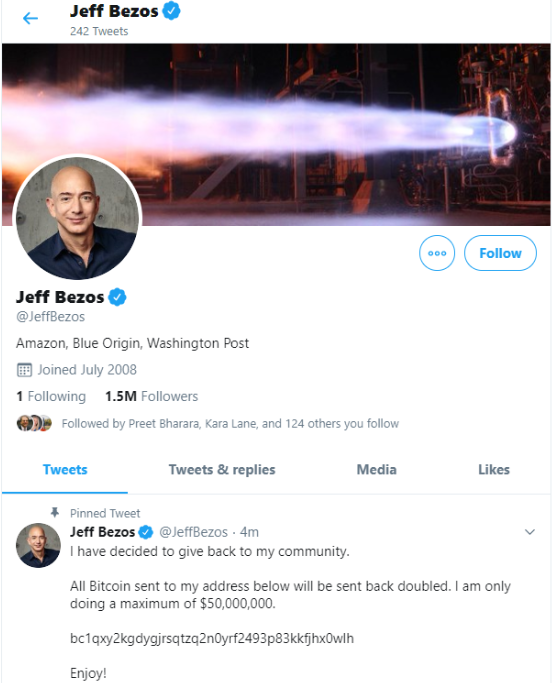
Minutes after that, similar tweets went out from the accounts of other cryptocurrency exchanges, and from the Twitter accounts for democratic presidential candidate Joe Biden, Amazon CEO Jeff Bezos, President Barak Obama, Tesla CEO Elon Musk, former New York Mayor Michael Bloomberg and investment mogul Warren Buffet.

While it may sound ridiculous that anyone would be fooled into sending bitcoin in response to these tweets, an analysis of the BTC wallet promoted by many of the hacked Twitter profiles shows that on July 15 the account processed 383 transactions and received almost 13 bitcoin on July 15 — or approximately USD $117,000.

Twitter issued a statement saying it detected “a coordinated social engineering attack by people who successfully targeted some of our employees with access to internal systems and tools. We know they used this access to take control of many highly-visible (including verified) accounts and Tweet on their behalf. We’re looking into what other malicious activity they may have conducted or information they may have accessed and will share more here as we have it.”

There are strong indications that this attack was perpetrated by individuals who’ve traditionally specialized in hijacking social media accounts via “SIM swapping,” an increasingly rampant form of crime that involves bribing, hacking or coercing employees at mobile phone and social media companies into providing access to a target’s account.

People within the SIM swapping community are obsessed with hijacking so-called “OG” social media accounts. Short for “original gangster,” OG accounts typically are those with one- or two-letter account names (such as @B or @joe). Possession of these OG accounts confers a measure of status and perceived influence and wealth in SIM swapping circles, as such accounts can often fetch thousands of dollars when resold in the underground.

In the days leading up to Wednesday’s attack on Twitter, there were signs that some actors in the SIM swapping community were selling the ability to change an email address tied to any Twitter account. In a post on OGusers — a forum dedicated to account hijacking — a user named “Chaewon” advertised they could change email address tied to any Twitter account for $250, and provide direct access to accounts for between $2,000 and $3,000 apiece.

The OGUsers forum user “Chaewon” taking requests to modify the email address tied to any twitter account.

“This is NOT a method, you will be given a full refund if for any reason you aren’t given the email/@, however if it is revered/suspended I will not be held accountable,” Chaewon wrote in their sales thread, which was titled “Pulling email for any Twitter/Taking Requests.”

Hours before any of the Twitter accounts for cryptocurrency platforms or public figures began blasting out bitcoin scams on Wednesday, the attackers appear to have focused their attention on hijacking a handful of OG accounts, including “@6.

That Twitter account was formerly owned by Adrian Lamo — the now-deceased “homeless hacker” perhaps best known for breaking into the New York Times’s network and for reporting Chelsea Manning’s theft of classified documents from the FBI. @6 is now controlled by Lamo’s longtime friend, a security researcher and phone phreaker who asked to be identified in this story only by his Twitter nickname, “Lucky225.”

Lucky225 said that just before 2 p.m. EST on Wednesday, he received a password reset confirmation code via Google Voice for the @6 Twitter account. Lucky said he’d previously disabled SMS notifications via his Google Voice number as a means of receiving multi-factor codes from Twitter, opting instead to have one-time codes generated by a mobile authentication app.

But because the attackers were able to change the email address tied to the @6 account and disable multi-factor authentication, the one-time authentication code was sent to both his Google Voice account and to the new email address added by the attackers.

“The way the attack worked was that within Twitter’s admin tools, apparently you can update the email address of any Twitter user, and it does this without sending any kind of notification to the user,” Lucky told KrebsOnSecurity. “So [the attackers] could avoid detection by updating the email address on the account first, and then turning off 2FA.”

Lucky said he still hasn’t been able to review whether any tweets were sent from his account during the time it was hijacked because he still doesn’t have access to it (he has put together a breakdown of the entire episode at this Medium post).

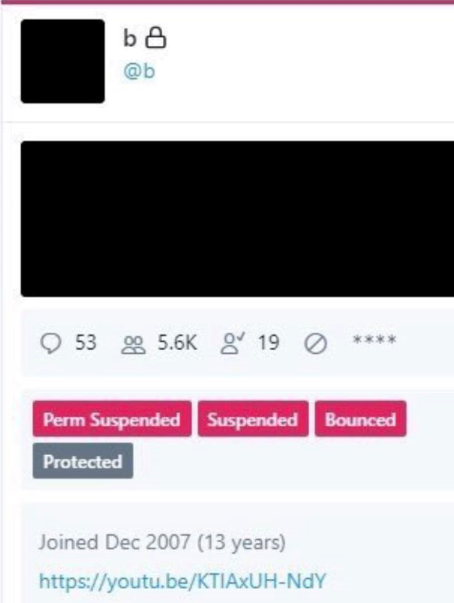
But around the same time @6 was hijacked, another OG account – @B — was swiped. The person in control of that account then began tweeting out pictures of Twitter’s internal tools panel.

A screenshot of the hijacked OG Twitter account “@B,” shows the hijackers logged in to Twitter’s internal account tools interface.

Twitter responded by removing any tweets across its platform that included screenshots of its internal tools, and in some cases temporarily suspended the ability of those accounts to tweet further.

Another Twitter account — @shinji — also was tweeting out screenshots of Twitters internal tools. Minutes before Twitter terminated the @shinji account, it was seen publishing a tweet saying “follow @6,” referring to the account hijacked from Lucky225.

The account “@shinji” tweeting a screenshot of Twitter’s internal tools interface.

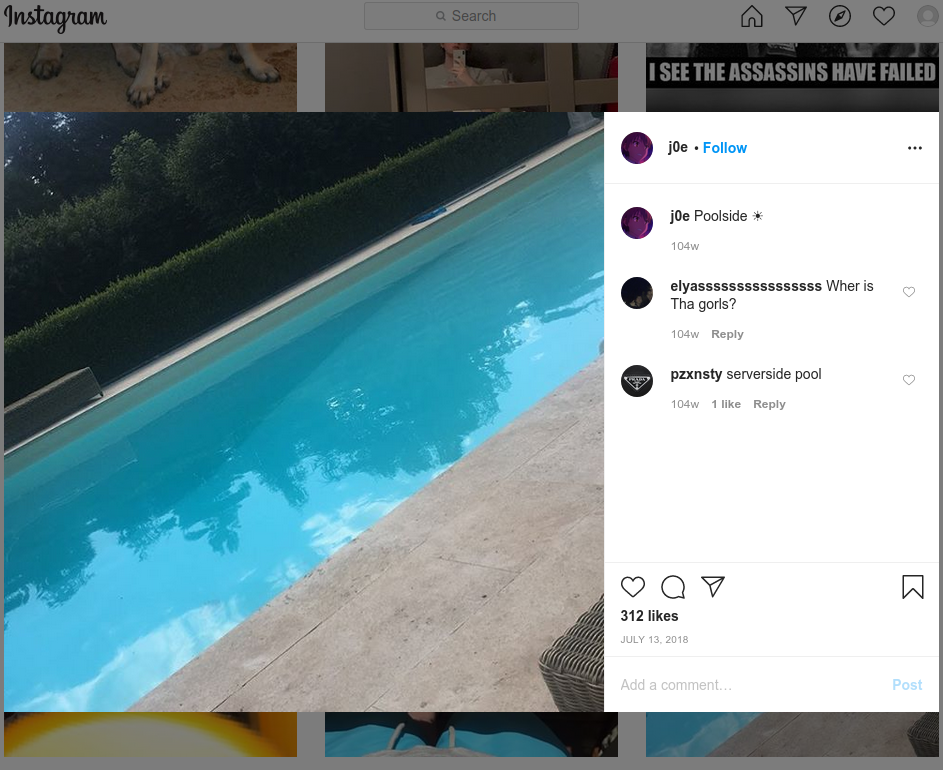
Cached copies of @Shinji’s tweets prior to Wednesday’s attack on Twitter are available here and here from the Internet Archive. Those caches show Shinji claims ownership of two OG accounts on Instagram — “j0e” and “dead.”

KrebsOnSecurity heard from a source who works in security at one of the largest U.S.-based mobile carriers, who said the “j0e” and “dead” Instagram accounts are tied to a notorious SIM swapper who goes by the nickname “PlugWalkJoe.” Investigators have been tracking PlugWalkJoe because he is thought to have been involved in multiple SIM swapping attacks over the years that preceded high-dollar bitcoin heists.

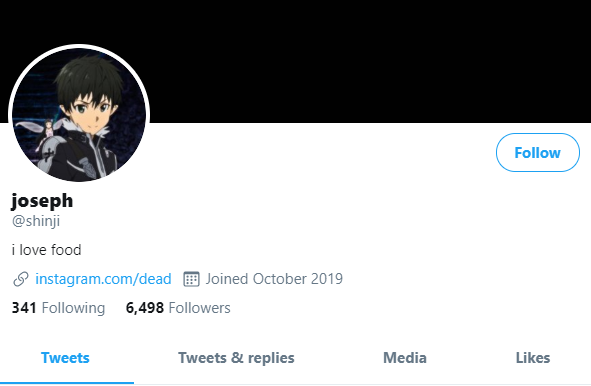
Archived copies of the @Shinji account on twitter shows one of Joe’s OG Instagram accounts, “Dead.”

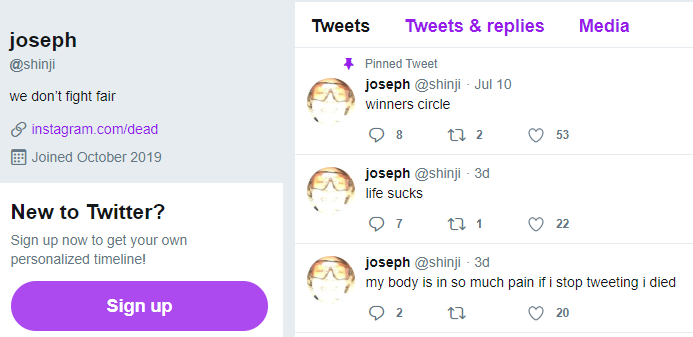
Now look at the profile image in the other Archive.org index of the @shinji Twitter account (pictured below). It is the same image as the one included in the @Shinji screenshot above from Wednesday in which Joseph/@Shinji was tweeting out pictures of Twitter’s internal tools.

Image: Archive.org

This individual, the source said, was a key participant in a group of SIM swappers that adopted the nickname “ChucklingSquad,” and was thought to be behind the hijacking of Twitter CEO Jack Dorsey‘s Twitter account last year. As Wired.com recounted, @jack was hijacked after the attackers conducted a SIM swap attack against AT&T, the mobile provider for the phone number tied to Dorsey’s Twitter account.

A tweet sent out from Twitter CEO Jack Dorsey’s account while it was hijacked shouted out to PlugWalkJoe and other Chuckling Squad members.

The mobile industry security source told KrebsOnSecurity that PlugWalkJoe in real life is a 21-year-old from Liverpool, U.K. named Joseph James Connor. The source said PlugWalkJoe is in Spain where he was attending a university until earlier this year. He added that PlugWalkJoe has been unable to return home on account of travel restrictions due to the COVID-19 pandemic.

The mobile industry source said PlugWalkJoe was recently the subject of an investigation in which a female investigator was hired to strike up a conversation with PlugWalkJoe and convince him to agree to a video chat. The source further explained that a video which they recorded of that chat showed a distinctive swimming pool in the background.

According to that same source, the pool pictured on PlugWalkJoe’s Instagram account (instagram.com/j0e) is the same one they saw in their video chat with him.

If PlugWalkJoe was in fact pivotal to this Twitter compromise, it’s perhaps fitting that he was identified in part via social engineering. Maybe we should all grateful the perpetrators of this attack on Twitter did not set their sights on more ambitious aims, such as disrupting an election or the stock market, or attempting to start a war by issuing false, inflammatory tweets from world leaders.

Also, it seems clear that this Twitter hack could have let the attackers view the direct messages of anyone on Twitter, information that is difficult to put a price on but which nevertheless would be of great interest to a variety of parties, from nation states to corporate spies and blackmailers.

This is a fast-moving story. Please stay tuned for further updates.

source https://krebsonsecurity.com/2020/07/whos-behind-wednesdays-epic-twitter-hack/

‘Wormable’ Flaw Leads July Microsoft Patches

Microsoft today released updates to plug a whopping 123 security holes in Windows and related software, including fixes for a critical, “wormable” flaw in Windows Server versions that Microsoft says is likely to be exploited soon. While this particular weakness mainly affects enterprises, July’s care package from Redmond has a little something for everyone. So if you’re a Windows (ab)user, it’s time once again to back up and patch up (preferably in that order).

Top of the heap this month in terms of outright scariness is CVE-2020-1350, which concerns a remotely exploitable bug in more or less all versions of Windows Server that attackers could use to install malicious software simply by sending a specially crafted DNS request.
Microsoft said it is not aware of reports that anyone is exploiting the weakness (yet), but the flaw has been assigned a CVSS score of 10, which translates to “easy to attack” and “likely to be exploited.”

“We consider this to be a wormable vulnerability, meaning that it has the potential to spread via malware between vulnerable computers without user interaction,” Microsoft wrote in its documentation of CVE-2020-1350. “DNS is a foundational networking component and commonly installed on Domain Controllers, so a compromise could lead to significant service interruptions and the compromise of high level domain accounts.”

CVE-2020-1350 is just the latest worry for enterprise system administrators in charge of patching dangerous bugs in widely-used software. Over the past couple of weeks, fixes for flaws with high severity ratings have been released for a broad array of software products typically used by businesses, including Citrix, F5, Juniper, Oracle and SAP. This at a time when many organizations are already short-staffed and dealing with employees working remotely thanks to the COVID-19 pandemic.

The Windows Server isn’t the only nasty one addressed this month that malware or malcontents can use to break into systems without any help from users. A full 17 other critical flaws fixed in this release tackle security weaknesses that Microsoft assigned its most dire “critical” rating, such as in Office, Internet Exploder, SharePoint, Visual Studio, and Microsoft’s .NET Framework.

Some of the more eyebrow-raising critical bugs addressed this month include CVE-2020-1410, which according to Recorded Future concerns the Windows Address Book and could be exploited via a malicious vcard file. Then there’s CVE-2020-1421, which protects against potentially malicious .LNK files (think Stuxnet) that could be exploited via an infected removable drive or remote share. And we have the dynamic duo of CVE-2020-1435 and CVE-2020-1436, which involve problems with the way Windows handles images and fonts that could both be exploited to install malware just by getting a user to click a booby-trapped link or document.

Not to say flaws rated “important” as opposed to critical aren’t also a concern. Chief among those is CVE-2020-1463, a problem within Windows 10 and Server 2016 or later that was detailed publicly prior to this month’s Patch Tuesday.

Before you update with this month’s patch batch, please make sure you have backed up your system and/or important files. It’s not uncommon for a particular Windows update to hose one’s system or prevent it from booting properly, and some updates even have been known to erase or corrupt files. Last month’s bundle of joy from Microsoft sent my Windows 10 system into a perpetual crash state. Thankfully, I was able to restore from a recent backup.

So do yourself a favor and backup before installing any patches. Windows 10 even has some built-in tools to help you do that, either on a per-file/folder basis or by making a complete and bootable copy of your hard drive all at once.

Also, keep in mind that Windows 10 is set to apply patches on its own schedule, which means if you delay backing up you could be in for a wild ride. If you wish to ensure the operating system has been set to pause updating so you can back up your files and/or system before the operating system decides to reboot and install patches whenever it sees fit, see this guide.

As always, if you experience glitches or problems installing any of these patches this month, please consider leaving a comment about it below; there’s a better-than-even chance other readers have experienced the same and may chime in here with some helpful tips. Also, keep an eye on the AskWoody blog from Woody Leonhard, who keeps a reliable lookout for buggy Microsoft updates each month.

source https://krebsonsecurity.com/2020/07/wormable-flaw-leads-july-microsoft-patches/

Breached Data Indexer ‘Data Viper’ Hacked

Data Viper, a security startup that provides access to some 15 billion usernames, passwords and other information exposed in more than 8,000 website breaches, has itself been hacked and its user database posted online. The hackers also claim they are selling on the dark web roughly 2 billion records Data Viper collated from numerous breaches and data leaks, including data from several companies that likely either do not know they have been hacked or have not yet publicly disclosed an intrusion.

The apparent breach at St. Louis, Mo. based Data Viper offers a cautionary and twisted tale of what can happen when security researchers seeking to gather intelligence about illegal activity online get too close to their prey or lose sight of their purported mission. The incident also highlights the often murky area between what’s legal and ethical in combating cybercrime.

Data Viper is the brainchild of Vinny Troia, a security researcher who runs a cyber threat intelligence company called Night Lion Security. Since its inception in 2018, Data Viper has billed itself as a “threat intelligence platform designed to provide organizations, investigators and law enforcement with access to the largest collection of private hacker channels, pastes, forums and breached databases on the market.”

Many private companies sell access to such information to vetted clients — mainly law enforcement officials and anti-fraud experts working in security roles at major companies that can foot the bill for these often pricey services.

Data Viper has sought to differentiate itself by advertising “access to private and undisclosed breach data.” As KrebsOnSecurity noted in a 2018 story, Troia has acknowledged posing as a buyer or seller on various dark web forums as a way to acquire old and newly-hacked databases from other forum members.

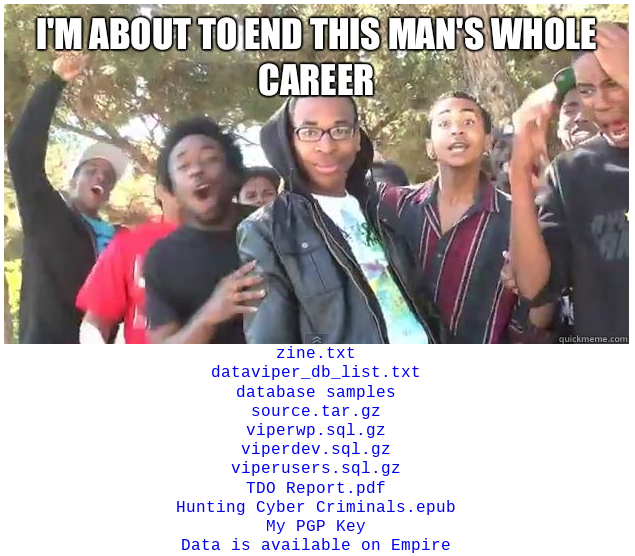
But this approach may have backfired over the weekend, when someone posted to the deep web a link to an “e-zine” (electronic magazine) describing the Data Viper hack and linking to the Data Viper user base. The anonymous poster alleged he’d been inside Data Viper for months and had exfiltrated hundreds of gigabytes of breached data from the service without notice.

The intruder also linked to several dozen new sales threads on the dark web site Empire Market, where they advertise the sale of hundreds of millions of account details from dozens of leaked or hacked website databases that Data Viper allegedly acquired via trading with others on cybercrime forums.

An online post by the attackers who broke into Data Viper.

Some of the databases for sale tie back to known, publicly reported breaches. But others correspond to companies that do not appear to have disclosed a security incident. As such, KrebsOnSecurity is not naming most of those companies and is currently attempting to ascertain the validity of the claims.

KrebsOnSecurity did speak with Victor Ho, the CEO of Fivestars.com, a company that helps smaller firms run customer loyalty programs. The hackers claimed they are selling 44 million records taken from Fivestars last year. Ho said he was unaware of any data security incident and that no such event had been reported to his company, but that Fivestars is now investigating the claims. Ho allowed that the number of records mentioned in the dark web sales thread roughly matches the number of users his company had last year.

But on Aug. 3, 2019, Data Viper’s Twitter account casually noted, “FiveStars — 44m breached records added – incl Name, Email, DOB.” The post, buried among a flurry of similar statements about huge caches of breached personal information added to Data Viper, received hardly any attention and garnered just one retweet.

GNOSTIC PLAYERS, SHINY HUNTERS

Reached via Twitter, Troia acknowledged that his site had been hacked, but said the attackers only got access to the development server for Data Viper, and not the more critical production systems that power the service and which house his index of compromised credentials.

Troia said the people responsible for compromising his site are the same people who hacked the databases they are now selling on the dark web and claiming to have obtained exclusively from his service.

What’s more, Troia believes the attack was a preemptive strike in response to a keynote he’s giving in Boston this week: On June 29, Troia tweeted that he plans to use the speech to publicly expose the identities of the hackers, who he suspects are behind a large number of website break-ins over the years.

Hacked or leaked credentials are prized by cybercriminals engaged in “credential stuffing,” a rampant form of cybercrime that succeeds when people use the same passwords across multiple websites. Armed with a list of email addresses and passwords from a breached site, attackers will then automate login attempts using those same credentials at hundreds of other sites.

Password re-use becomes orders of magnitude more dangerous when website developers engage in this unsafe practice. Indeed, a January 2020 post on the Data Viper blog suggests credential stuffing is exactly how the group he plans to discuss in his upcoming talk perpetrated their website compromises.

In that post, Troia wrote that the hacker group, known variously as “Gnostic Players” and “Shiny Hunters,” plundered countless website databases using roughly the same method: Targeting developers using credential stuffing attacks to log into their GitHub accounts.

“While there, they would pillage the code repositories, looking for AWS keys and similar credentials that were checked into code repositories,” Troia wrote.

Troia said the intrusion into his service wasn’t the result of the credential re-use, but instead because his developer accidentally left his credentials exposed in documents explaining how customers can use Data Viper’s application programming interface.

“I will say the irony of how they got in is absolutely amazing,” Troia said. “But all of this stuff they claim to be selling is [databases] they were already selling. All of this is from Gnostic players. None of it came from me. It’s all for show to try and discredit my report and my talk.”

Troia said he didn’t know how many of the databases Gnostic Players claimed to have obtained from his site were legitimate hacks or even public yet.

“As for public reporting on the databases, a lot of that will be in my report Wednesday,” he said. “All of my ‘reporting’ goes to the FBI.”

SMOKE AND MIRRORS

The e-zine produced by the Data Viper hackers claimed that Troia used many nicknames on various cybercrime forums, including the moniker “Exabyte” on OGUsers, a forum that’s been closely associated with account takeovers.

In a conversation with KrebsOnSecurity, Troia acknowledged that this Exabyte attribution was correct, noting that he was happy about the exposure because it further solidified his suspicions about who was responsible for hacking his site.

This is interesting because some of the hacked databases the intruders claimed to have acquired after compromising Data Viper correspond to discoveries credited to Troia in which companies inadvertently exposed tens of millions of user details by leaving them publicly accessible online at cloud services like Amazon’s EC2.

For example, in March 2019, Troia said he’d co-discovered a publicly accessible database containing 150 gigabytes of plaintext marketing data — including 763 million unique email addresses. The data had been exposed online by Verifications.io, an email validation firm.

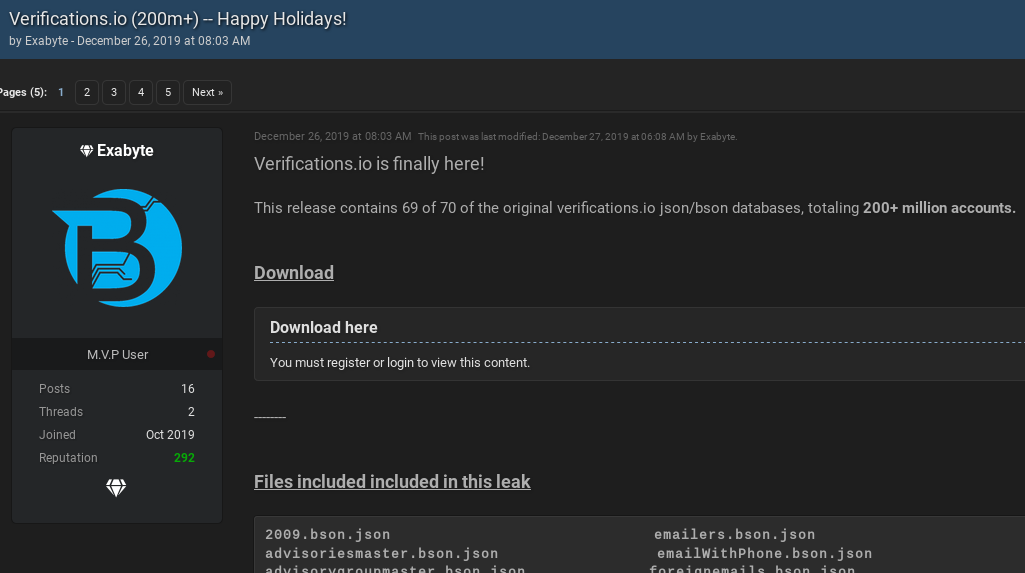
On Oct 12, 2019, a new user named Exabyte registered on RaidForums — a site dedicated to sharing hacked databases and tools to perpetrate credential stuffing attacks. That Exabyte account was registered less than two weeks after Troia created his Exabyte identity on OGUsers. The Exabyte on RaidForums posted on Dec. 26, 2019 that he was providing the community with something of a belated Christmas present: 200 million accounts leaked from Verifications.io.

“Verifications.io is finally here!” Exabyte enthused. “This release contains 69 of 70 of the original verifications.io databases, totaling 200+ million accounts.”

Exabyte’s offer of the Verifications.io database on RaidForums.

In May 2018, Troia was featured in Wired.com and many other publications after discovering that sales intelligence firm Apollo left 125 million email addresses and nine billion data points publicly exposed in a cloud service. As I reported in 2018, prior to that disclosure Troia had sought my help in identifying the source of the exposed data, which he’d initially and incorrectly concluded was exposed by LinkedIn.com. Rather, Apollo had scraped and collated the data from many different sites, including LinkedIn.

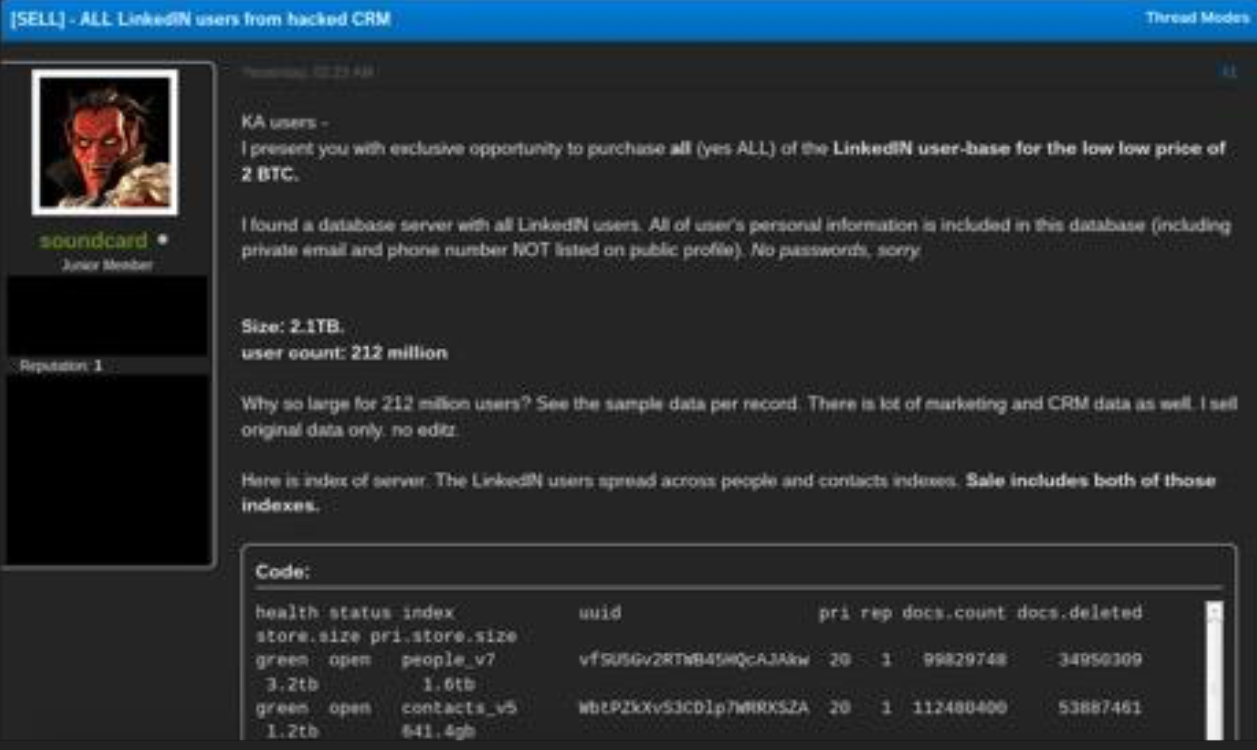
Then in August 2018, someone using the nickname “Soundcard” posted a sales thread to the now-defunct Kickass dark web forum offering the personal information of 212 million LinkedIn users in exchange for two bitcoin (then the equivalent of ~$12,000 USD). Incredibly, Troia had previously told me that he was the person behind that Soundcard identity on the Kickass forum.

Soundcard, a.k.a. Troia, offering to sell what he claimed was all of LinkedIn’s user data, on the Dark Web forum Kickass.

Asked about the Exabyte posts on RaidForums, Troia said he wasn’t the only one who had access to the Verifications.io data, and that the full scope of what’s been going on would become clearer soon.

“More than one person can have the same name ‘Exabyte,” Troia said. “So much from both sides you are seeing is smoke and mirrors.”

Smoke and mirrors, indeed. It’s entirely possible this incident is an elaborate and cynical PR stunt by Troia to somehow spring a trap on the bad guys. Troia recently published a book on threat hunting, and on page 360 (PDF) he describes how he previously staged a hack against his own site and then bragged about the fake intrusion on cybercrime forums in a bid to gather information about specific cybercriminals who took the bait — the same people, by the way, he claims are behind the attack on his site.

MURKY WATERS

While the trading of hacked databases may not technically be illegal in the United States, it’s fair to say the U.S. Department of Justice (DOJ) takes a dim view of those who operate services marketed to cybercriminals.

In January 2020, U.S. authorities seized the domain of WeLeakInfo.com, an online service that for three years sold access to data hacked from other websites. Two men were arrested in connection with that seizure. In February 2017, the Justice Department took down LeakedSource, a service that operated similarly to WeLeakInfo.

The DOJ recently released guidance (PDF) to help threat intelligence companies avoid the risk of prosecution when gathering and purchasing data from illicit sources online. The guidelines suggest that some types of intelligence gathering — particularly exchanging ill-gotten information with others on crime forums as a way to gain access to other data or to increase one’s status on the forum — could be especially problematic.

“If a practitioner becomes an active member of a forum and exchanges information and communicates directly with other forum members, the practitioner can quickly become enmeshed in illegal conduct, if not careful,” reads the Feb. 2020 DOJ document.

The document continues:

“It may be easier for an undercover practitioner to extract information from sources on the forum who have learned to trust the practitioner’s persona, but developing trust and establishing bona fides as a fellow criminal may involve offering useful information, services, or tools that can be used to commit crimes.”

“Engaging in such activities may well result in violating federal criminal law. Whether a crime has occurred usually hinges on an individual’s actions and intent. A practitioner must avoid doing anything that furthers the criminal objectives of others on the forums. Even though the practitioner has no intention of committing a crime, assisting others engaged in criminal conduct can constitute the federal offense of aiding and abetting.”

“An individual may be found liable for aiding and abetting a federal offense if her or she takes an affirmative act — even an act that is lawful on its own — that is in furtherance of the crime and conducted with the intent of facilitating the crime’s commission.”

source https://krebsonsecurity.com/2020/07/breached-data-indexer-data-viper-hacked/

E-Verify’s “SSN Lock” is Nothing of the Sort

One of the most-read advice columns on this site is a 2018 piece called “Plant Your Flag, Mark Your Territory,” which tried to impress upon readers the importance of creating accounts at websites like those at the Social Security Administration, the IRS and others before crooks do it for you. A key concept here is that these services only allow one account per Social Security number — which for better or worse is the de facto national identifier in the United States. But KrebsOnSecurity recently discovered that this is not the case with all federal government sites built to help you manage your identity online.

A reader who was recently the victim of unemployment insurance fraud said he was told he should create an account at the Department of Homeland Security‘s myE-Verify website, and place a lock on his Social Security number (SSN) to minimize the chances that ID thieves might abuse his identity for employment fraud in the future.

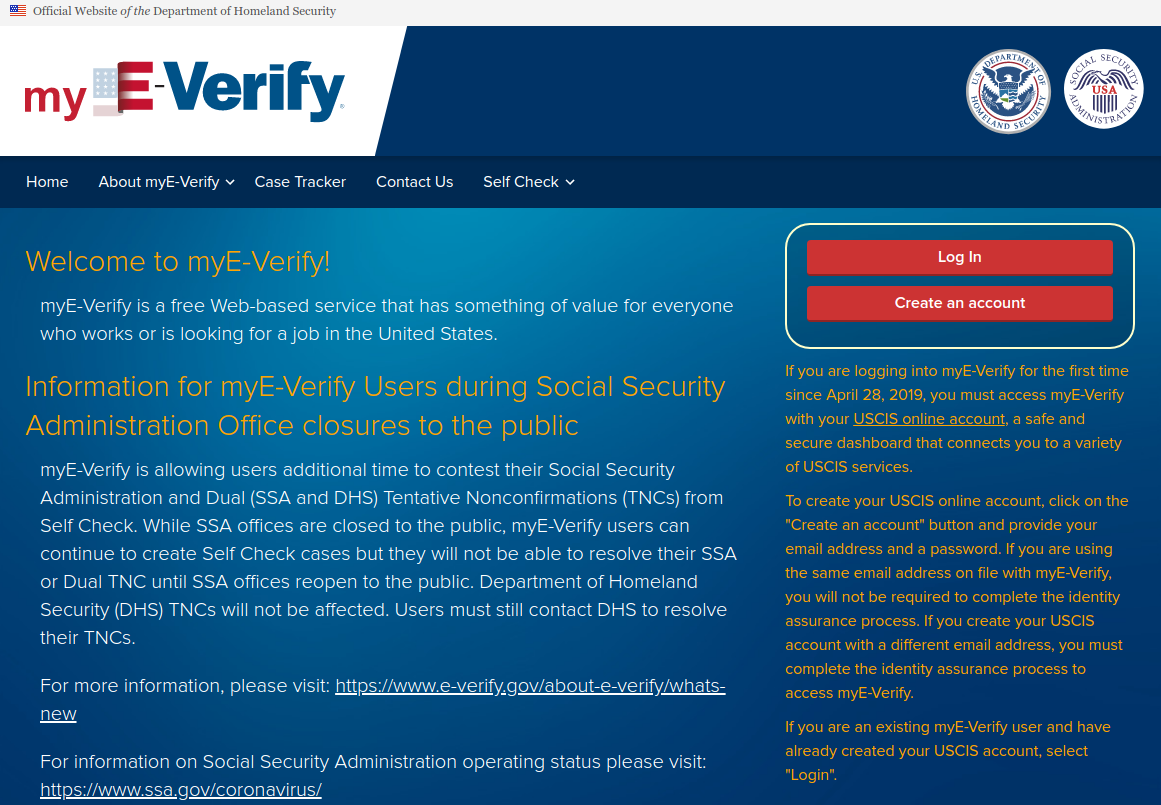
DHS’s myE-Verify homepage.

According to the website, roughly 600,000 employers at over 1.9 million hiring sites use E-Verify to confirm the employment eligibility of new employees. E-Verify’s consumer-facing portal myE-Verify lets users track and manage employment inquiries made through the E-Verify system. It also features a “Self Lock” designed to prevent the misuse of one’s SSN in E-Verify.

Enabling this lock is supposed to mean that for the next year thereafter, if an unauthorized individual attempts to fraudulently use a SSN for employment authorization, he or she cannot use the SSN in E-Verify, even if the SSN is that of an employment authorized individual. But in practice, this service may actually do little to deter ID thieves from impersonating you to a potential employer.

At the request of the reader who reached out (and in the interest of following my own advice to plant one’s flag), KrebsOnSecurity decided to sign up for a myE-Verify account. After verifying my email address, I was asked to pick a strong password and select a form of multi-factor authentication (MFA). The most secure MFA option offered (a one-time code generated by an app like Google Authenticator or Authy) was already pre-selected, so I chose that.

The site requested my name, address, SSN, date of birth and phone number. I was then asked to select five questions and answers that might be asked if I were to try to reset my password, such as “In what city/town did you meet your spouse,” and “What is the name of the company of your first paid job.” I chose long, gibberish answers that had nothing to do with the questions (yes, these password questions are next to useless for security and frequently are the cause of account takeovers, but we’ll get to that in a minute).

Password reset questions selected, the site proceeded to ask four, multiple-guess “knowledge-based authentication” questions to verify my identity. The U.S. Federal Trade Commission‘s primer page on preventing job-related ID theft says people who have placed a security freeze on their credit files with the major credit bureaus will need to lift or thaw the freeze before being able to answer these questions successfully at myE-Verify. However, I did not find that to be the case, even though my credit file has been frozen with the major bureaus for years.

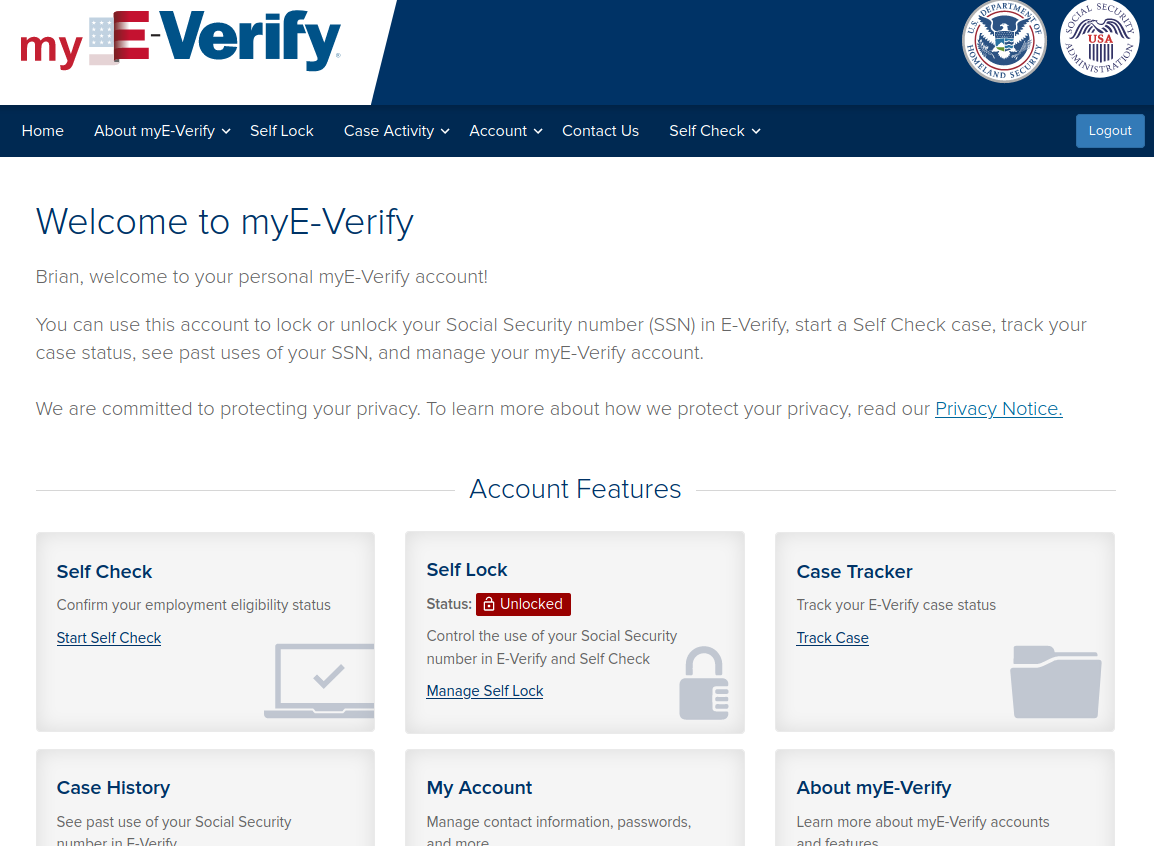
After successfully answering the KBA questions (the answer to each was “none of the above,” by the way), the site declared I’d successfully created my account! I could then see that I had the option to place a “Self Lock” on my SSN within the E-Verify system.

Doing so required me to pick three more challenge questions and answers. The site didn’t explain why it was asking me to do this, but I assumed it would prompt me for the answers in the event that I later chose to unlock my SSN within E-Verify.

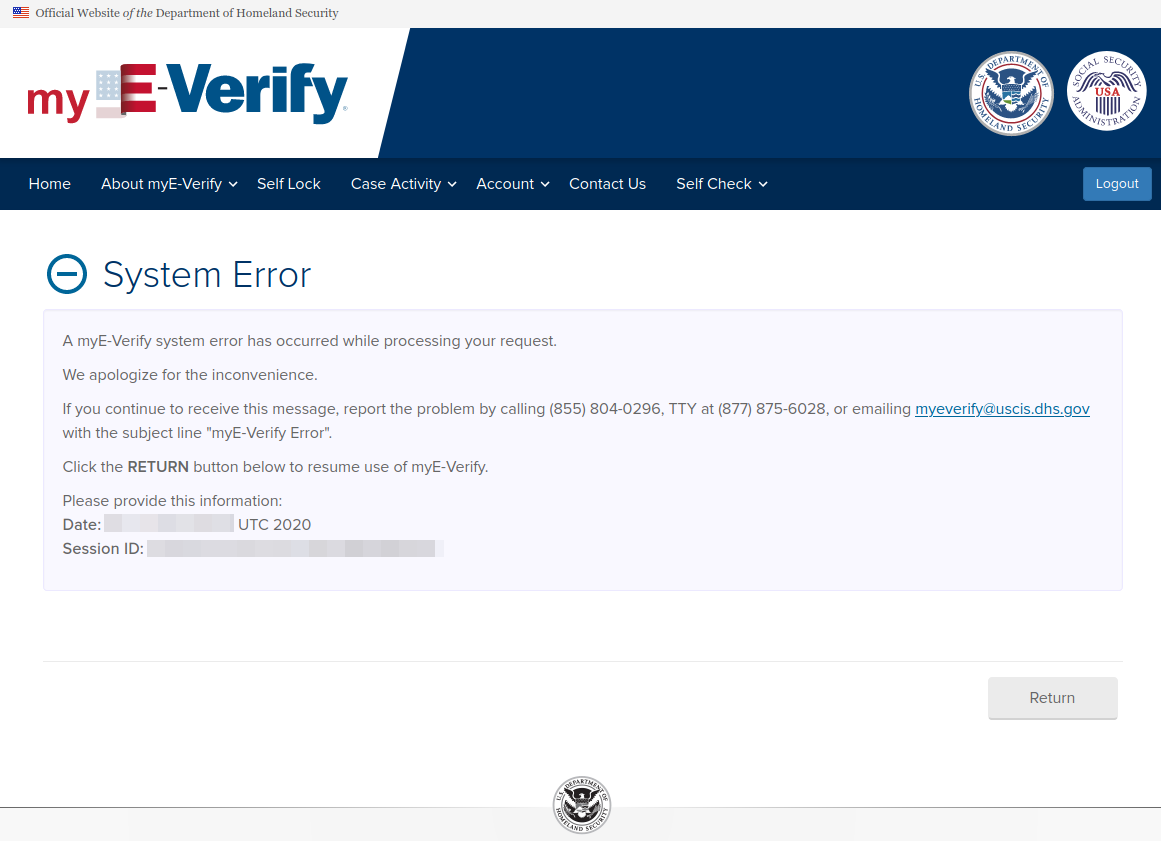
After selecting and answering those questions and clicking the “Lock my SSN” button, the site generated an error message saying something went wrong and it couldn’t proceed.

Alas, logging out and logging back in again showed that the site did in fact proceed and that my SSN was locked. Joy.

But I still had to know one thing: Could someone else come along pretending to be me and create another account using my SSN, date of birth and address but under a different email address? Using a different browser and Internet address, I proceeded to find out.

Imagine my surprise when I was able to create a separate account as me with just a different email address (once again, the correct answers to all of the KBA questions was “none of the above”). Upon logging in, I noticed my SSN was indeed locked within E-Verify. So I chose to unlock it.

Did the system ask any of the challenge questions it had me create previously? Nope. It just reported that my SSN was now unlocked. Logging out and logging back in to the original account I created (again under a different IP and browser) confirmed that my SSN was unlocked.

ANALYSIS

Obviously, if the E-Verify system allows multiple accounts to be created using the same name, address, phone number, SSN and date of birth, this is less than ideal and somewhat defeats the purpose of creating one for the purposes of protecting one’s identity from misuse.

Lest you think your SSN and DOB is somehow private information, you should know this static data about U.S. residents has been exposed many times over in countless data breaches, and in any case these digits are available for sale on most Americans via Dark Web sites for roughly the bitcoin equivalent of a fancy caffeinated drink at Starbucks.

Being unable to proceed through knowledge-based authentication questions without first unfreezing one’s credit file with one or all of the big three credit bureaus (Equifax, Experian and TransUnion) can actually be a plus for those of us who are paranoid about identity theft. I couldn’t find any mention on the E-Verify site of which company or service it uses to ask these questions, but the fact that the site doesn’t seem to care whether one has a freeze in place is troubling.

And when the correct answer to all of the KBA questions that do get asked is invariably “none of the above,” that somewhat lessens the value of asking them in the first place. Maybe that was just the luck of the draw in my case, but also troubling nonetheless. Either way, these KBA questions are notoriously weak security because the answers to them often are pulled from records that are public anyway, and can sometimes be deduced by studying the information available on a target’s social media profiles.

Speaking of silly questions, relying on “secret questions” or “challenge questions” as an alternative method of resetting one’s password is severely outdated and insecure. A 2015 study by Google titled “Secrets, Lies and Account Recovery” (PDF) found that secret questions generally offer a security level that is far lower than just user-chosen passwords. Also, the idea that an account protected by multi-factor authentication could be undermined by successfully guessing the answer(s) to one or more secret questions (answered truthfully and perhaps located by thieves through mining one’s social media accounts) is bothersome.

Finally, the advice given to the reader whose inquiry originally prompted me to sign up at myE-Verify doesn’t seem to have anything to do with preventing ID thieves from fraudulently claiming unemployment insurance benefits in one’s name at the state level. KrebsOnSecurity followed up with four different readers who left comments on this site about being victims of unemployment fraud recently, and none of them saw any inquiries about this in their myE-Verify accounts after creating them. Not that they should have seen signs of this activity in the E-Verify system; I just wanted to emphasize that one seems to have little to do with the other.

source https://krebsonsecurity.com/2020/07/e-verifys-ssn-lock-is-nothing-of-the-sort/

Ransomware Gangs Don’t Need PR Help

We’ve seen an ugly trend recently of tech news stories and cybersecurity firms trumpeting claims of ransomware attacks on companies large and small, apparently based on little more than the say-so of the ransomware gangs themselves. Such coverage is potentially quite harmful and plays deftly into the hands of organized crime.

Often the rationale behind couching these events as newsworthy is that the attacks involve publicly traded companies or recognizable brands, and that investors and the public have a right to know. But absent any additional information from the victim company or their partners who may be affected by the attack, these kinds of stories and blog posts look a great deal like ambulance chasing and sensationalism.

Currently, nearly two dozen ransomware crime gangs have erected their own blogs to publish sensitive data from victims. A few of these blogs routinely issue self-serving press releases, some of which gallingly refer to victims as “clients” and cast themselves in a beneficent light. Usually, the blog posts that appear on ransom sites are little more than a teaser — screenshots of claimed access to computers, or a handful of documents that expose proprietary or financial information.

The goal behind the publication of these teasers is clear, and the ransomware gangs make no bones about it: To publicly pressure the victim company into paying up. Those that refuse to be extorted are told to expect that huge amounts of sensitive company data will be published online or sold on the dark web (or both).

Emboldened by their successes, several ransomware gangs recently have started demanding two ransoms: One payment to secure a digital key that can unlock files, folders and directories encrypted by their malware, and a second to avoid having any stolen information published or shared with others.

KrebsOnSecurity has sought to highlight ransomware incidents at companies whose core business involves providing technical services to others — particularly managed service providers that have done an exceptionally poor job communicating about the attack with their customers.

Overall, I’ve tried to use each story to call attention to key failures that frequently give rise to ransomware infections, and to offer information about how other companies can avoid a similar fate.

But simply parroting what professional extortionists have posted on their blog about victims of cybercrime smacks of providing aid and comfort to an enemy that needs and deserves neither.

Maybe you disagree, dear readers? Feel free to sound off in the comments below.

source https://krebsonsecurity.com/2020/07/ransomware-gangs-dont-need-pr-help/

COVID-19 ‘Breach Bubble’ Waiting to Pop?

The COVID-19 pandemic has made it harder for banks to trace the source of payment card data stolen from smaller, hacked online merchants. On the plus side, months of quarantine have massively decreased demand for account information that thieves buy and use to create physical counterfeit credit cards. But fraud experts say recent developments suggest both trends are about to change — and likely for the worse.

The economic laws of supply and demand hold just as true in the business world as they do in the cybercrime space. Global lockdowns from COVID-19 have resulted in far fewer fraudsters willing or able to visit retail stores to use their counterfeit cards, and the decreased demand has severely depressed prices in the underground for purloined card data.

An ad for a site selling stolen payment card data, circa March 2020.

That’s according to Gemini Advisory, a New York-based cyber intelligence firm that closely tracks the inventories of dark web stores trafficking in stolen payment card data.

Stas Alforov, Gemini’s director of research and development, said that since the beginning of 2020 the company has seen a steep drop in demand for compromised “card present” data — digits stolen from hacked brick-and-mortar merchants with the help of malicious software surreptitiously installed on point-of-sale (POS) devices.

Alforov said the median price for card-present data has dropped precipitously over the past few months.

“Gemini Advisory has seen over 50 percent decrease in demand for compromised card present data since the mandated COVID-19 quarantines in the United States as well as the majority of the world,” he told KrebsOnSecurity.

Meanwhile, the supply of card-present data has remained relatively steady. Gemini’s latest find — a 10-month-long card breach at dozens of Chicken Express locations throughout Texas and other southern states that the fast-food chain first publicly acknowledged today after being contacted by this author — saw an estimated 165,000 cards stolen from eatery locations recently go on sale at one of the dark web’s largest cybercrime bazaars.

“Card present data supply hasn’t wavered much during the COVID-19 period,” Alforov said. “This is likely due to the fact that most of the sold data is still coming from breaches that occurred in 2019 and early 2020.”

A lack of demand for and steady supply of stolen card-present data in the underground has severely depressed prices since the beginning of the COVID-19 pandemic. Image: Gemini Advisory

Naturally, crooks who ply their trade in credit card thievery also have been working from home more throughout the COVID-19 pandemic. That means demand for stolen “card-not-present” data — customer payment information extracted from hacked online merchants and typically used to defraud other e-commerce vendors — remains high. And so have prices for card-not-present data: Gemini found prices for this commodity actually increased slightly over the past few months.

Andrew Barratt is an investigator with Coalfire, the cyber forensics firm hired by Chicken Express to remediate the breach and help the company improve security going forward. Barratt said there’s another curious COVID-19 dynamic going on with e-commerce fraud recently that is making it more difficult for banks and card issuers to trace patterns in stolen card-not-present data back to hacked web merchants — particularly smaller e-commerce shops.

“One of the concerns that has been expressed to me is that we’re getting [fewer] overlapping hotspots,” Barratt said. “For a lot of the smaller, more frequently compromised merchants there has been a large drop off in transactions. Whilst big e-commerce has generally done okay during the COVID-19 pandemic, a number of more modest sized or specialty online retailers have not had the same access to their supply chain and so have had to close or drastically reduce the lines they’re selling.”

Banks routinely take groups of customer cards that have experienced fraudulent activity and try to see if some or all of them were used at the same merchant during a similar timeframe, a basic anti-fraud process known as “common point of purchase” or CPP analysis. But ironically, this analysis can become more challenging when there are fewer overall transactions going through a compromised merchant’s site, Barratt said.

“With a smaller transactional footprint means less Common Point of Purchase alerts and less data to work on to trigger a forensic investigation or fraud alert,” Barratt said. “It does also mean less fraud right now – which is a positive. But one of the big concerns that has been raised to us as investigators — literally asking if we have capacity for what’s coming — has been that merchants are getting compromised by ‘lie in wait’ type intruders.”

Barratt says there’s a suspicion that hackers may have established beachheads [breachheads?] in a number of these smaller online merchants and are simply biding their time. If and when transaction volumes for these merchants do pick up, the concern is then hackers may be in a better position to mix the sale of cards stolen from many hacked merchants and further confound CPP analysis efforts.

“These intruders may have a beachhead in a number of small and/or middle market e-commerce entities and they’re just waiting for the transaction volumes to go back up again and they’ve suddenly got the capability to have skimmers capturing lots of card data in the event of a sudden uptick in consumer spending,” he said. “They’d also have a diverse portfolio of compromise so could possibly even evade common point of purchase detection for a while too. Couple all of that with major shopping cart platforms going out of support (like Magento 1 this month) and furloughed IT and security staff, and there’s a potentially large COVID-19 breach bubble waiting to pop.”

With a majority of payment cards issued in the United States now equipped with a chip that makes the cards difficult and expensive for thieves to clone, cybercriminals have continued to focus on hacking smaller merchants that have not yet installed chip card readers and are still swiping the cards’ magnetic stripe at the register.

Barratt said his company has tied the source of the breach to malware known as “PwnPOS,” an ancient strain of point-of-sale malware that first surfaced more than seven years ago, if not earlier.

Chicken Express CEO Ricky Stuart told KrebsOnSecurity that apart from “a handful” of locations his family owns directly, most of his 250 stores are franchisees that decide on their own how to secure their payment operations. Nevertheless, the company is now forced to examine each store’s POS systems to remediate the breach.

Stuart blamed the major point-of-sale vendors for taking their time in supporting and validating chip-capable payment systems. But when asked how many of the company’s 250 stores had chip-capable readers installed, Stuart said he didn’t know. Ditto for the handful of stores he owns directly.

“I don’t know how many,” he said. “I would think it would be a majority. If not, I know they’re coming.”

source https://krebsonsecurity.com/2020/06/covid-19-breach-bubble-waiting-to-pop/