‘Snatch’ Ransom Group Exposes Visitor IP Addresses

The victim shaming site operated by the Snatch ransomware group is leaking data about its true online location and internal operations, as well as the Internet addresses of its visitors, KrebsOnSecurity has found. The leaked data suggest that Snatch is one of several ransomware groups using paid ads on Google.com to trick people into installing malware disguised as popular free software, such as Microsoft Teams, Adobe Reader, Mozilla Thunderbird, and Discord.

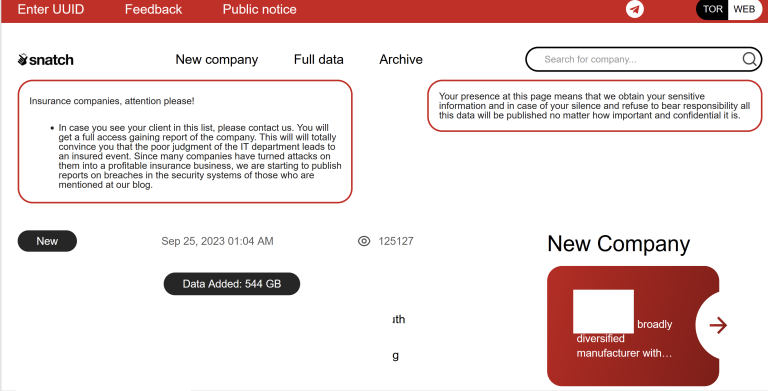
First spotted in 2018, the Snatch ransomware group has published data stolen from hundreds of organizations that refused to pay a ransom demand. Snatch publishes its stolen data at a website on the open Internet, and that content is mirrored on the Snatch team’s darknet site, which is only reachable using the global anonymity network Tor.

The victim shaming website for the Snatch ransomware gang.

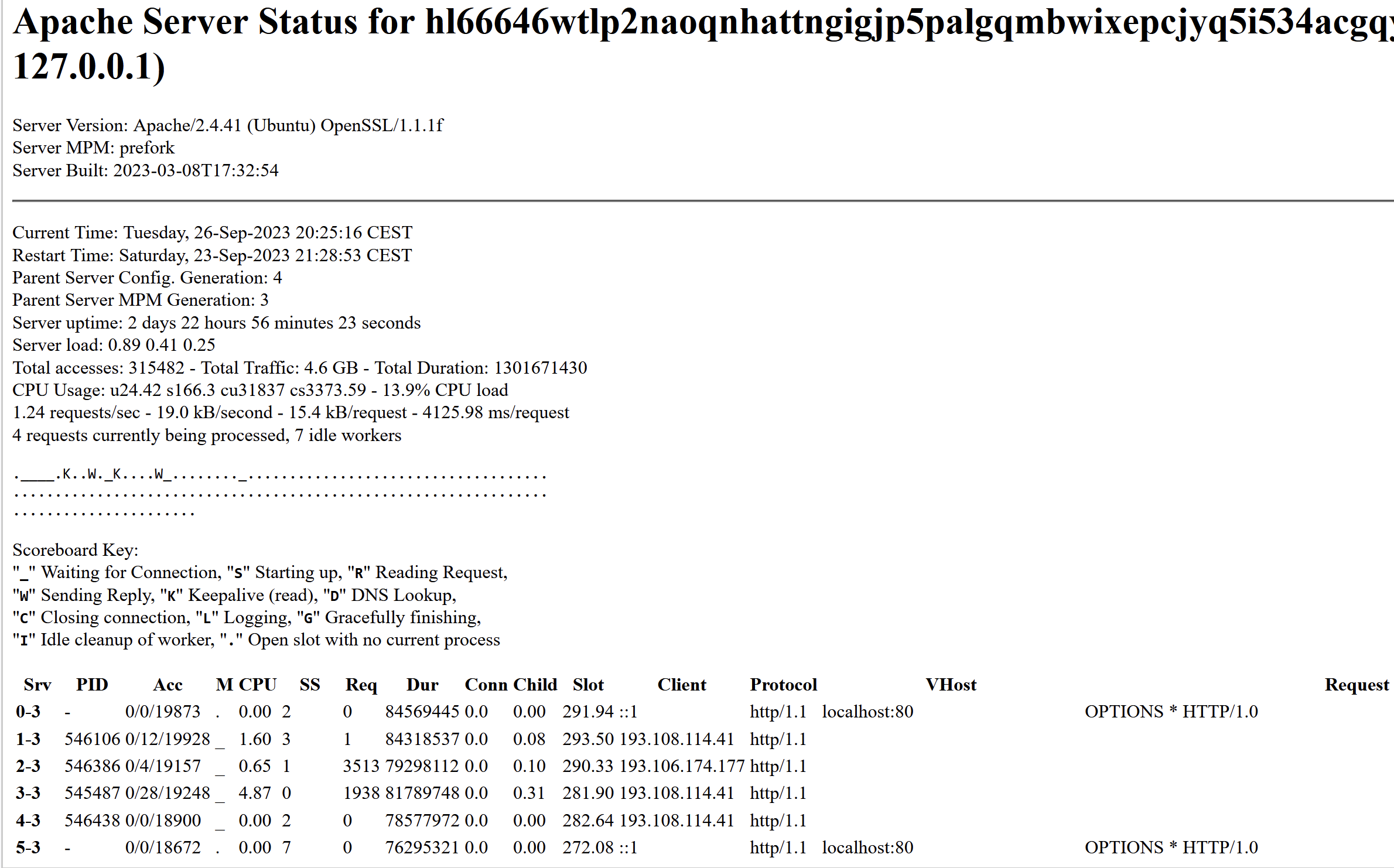
KrebsOnSecurity has learned that Snatch’s darknet site exposes its “server status” page, which includes information about the true Internet addresses of users accessing the website.

Refreshing this page every few seconds shows that the Snatch darknet site generates a decent amount of traffic, often attracting thousands of visitors each day. But by far the most frequent repeat visitors are coming from Internet addresses in Russia that either currently host Snatch’s clear web domain names or recently did.

The Snatch ransomware gang’s victim shaming site on the darknet is leaking data about its visitors. This “server status” page says that Snatch’s website is on Central European Summer Time (CEST) and is powered by OpenSSL/1.1.1f, which is no longer supported by security updates.

Probably the most active Internet address accessing Snatch’s darknet site is 193.108.114[.]41, which is a server in Yekaterinburg, Russia that hosts several Snatch domains, including snatchteam[.]top, sntech2ch[.]top, dwhyj2[.]top and sn76930193ch[.]top. It could well be that this Internet address is showing up frequently because Snatch’s clear-web site features a toggle button at the top that lets visitors switch over to accessing the site via Tor.

Another Internet address that showed up frequently in the Snatch server status page was 194.168.175[.]226, currently assigned to Matrix Telekom in Russia. According to DomainTools.com, this address also hosts or else recently hosted the usual coterie of Snatch domains, as well as quite a few domains phishing known brands such as Amazon and Cashapp.

The Moscow Internet address 80.66.64[.]15 accessed the Snatch darknet site all day long, and that address also housed the appropriate Snatch clear-web domains. More interestingly, that address is home to multiple recent domains that appear confusingly similar to known software companies, including libreoff1ce[.]com and www-discord[.]com.

This is interesting because the phishing domains associated with the Snatch ransomware gang were all registered to the same Russian name — Mihail Kolesnikov, a name that is somewhat synonymous with recent phishing domains tied to malicious Google ads.

Kolesnikov could be a nod to a Russian general made famous during Boris Yeltsin’s reign. Either way, it’s clearly a pseudonym, but there are some other commonalities among these domains that may provide insight into how Snatch and other ransomware groups are sourcing their victims.

DomainTools says there are more than 1,300 current and former domain names registered to Mihail Kolesnikov between 2013 and July 2023. About half of the domains appear to be older websites advertising female escort services in major cities around the United States (e.g. the now-defunct pittsburghcitygirls[.]com).

The other half of the Kolesnikov websites are far more recent phishing domains mostly ending in “.top” and “.app” that appear designed to mimic the domains of major software companies, including www-citrix[.]top, www-microsofteams[.]top, www-fortinet[.]top, ibreoffice[.]top, www-docker[.]top, www-basecamp[.]top, ccleaner-cdn[.]top, adobeusa[.]top, and http://www.real-vnc[.]top.

In August 2023, researchers with Trustwave Spiderlabs said they encountered domains registered to Mihail Kolesnikov being used to disseminate the Rilide information stealer trojan.

But it appears multiple crime groups may be using these domains to phish people and disseminate all kinds of information-stealing malware. In February 2023, Spamhaus warned of a huge surge in malicious ads that were hijacking search results in Google.com, and being used to distribute at least five different families of information stealing trojans, including AuroraStealer, IcedID/Bokbot, Meta Stealer, RedLine Stealer and Vidar.

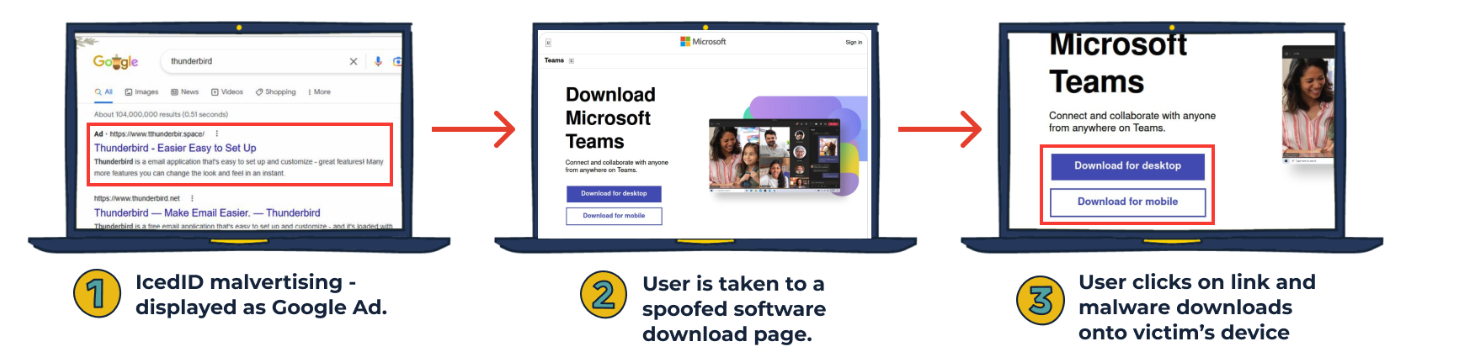
For example, Spamhaus said victims of these malicious ads would search for Microsoft Teams in Google.com, and the search engine would often return a paid ad spoofing Microsoft or Microsoft Teams as the first result — above all other results. The malicious ad would include a logo for Microsoft and at first glance appear to be a safe and trusted place to download the Microsoft Teams client.

However, anyone who clicked on the result was whisked away instead to mlcrosofteams-us[.]top — yet another malicious domain registered to Mr. Kolesnikov. And while visitors to this website may believe they are only downloading the Microsoft Teams client, the installer file includes a copy of the IcedID malware, which is really good at stealing passwords and authentication tokens from the victim’s web browser.

Image: Spamhaus

The founder of the Swiss anti-abuse website abuse.ch told Spamhaus it is likely that some cybercriminals have started to sell “malvertising as a service” on the dark web, and that there is a great deal of demand for this service.

In other words, someone appears to have built a very profitable business churning out and promoting new software-themed phishing domains and selling that as a service to other cybercriminals. Or perhaps they are simply selling any stolen data (and any corporate access) to active and hungry ransomware group affiliates.

The tip about the exposed “server status” page on the Snatch darkweb site came from @htmalgae, the same security researcher who alerted KrebsOnSecurity earlier this month that the darknet victim shaming site run by the 8Base ransomware gang was inadvertently left in development mode.

That oversight revealed not only the true Internet address of the hidden 8Base site (in Russia, naturally), but also the identity of a programmer in Moldova who apparently helped to develop the 8Base code.

@htmalgae said the idea of a ransomware group’s victim shaming site leaking data that they did not intend to expose is deliciously ironic.

“This is a criminal group that shames others for not protecting user data,” @htmalgae said. “And here they are leaking their user data.”

All of the malware mentioned in this story is designed to run on Microsoft Windows devices. But Malwarebytes recently covered the emergence of a Mac-based information stealer trojan called AtomicStealer that was being advertised through malicious Google ads and domains that were confusingly similar to software brands.

Please be extra careful when you are searching online for popular software titles. Cracked, pirated copies of major software titles are a frequent source of infostealer infections, as are these rogue ads masquerading as search results. Make sure to double-check you are actually at the domain you believe you’re visiting *before* you download and install anything.

Stay tuned for Part II of this post, which includes a closer look at the Snatch ransomware group and their founder.

Further reading:

@HTMalgae’s list of the top Internet addresses seen accessing Snatch’s darknet site

Ars Technica: Until Further Notice Think Twice Before Using Google to Download Software

Bleeping Computer: Hackers Abuse Google Ads to Spread Malware in Legit Software

source https://krebsonsecurity.com/2023/09/snatch-ransom-group-exposes-visitor-ip-addresses/

LastPass: ‘Horse Gone Barn Bolted’ is Strong Password

The password manager service LastPass is now forcing some of its users to pick longer master passwords. LastPass says the changes are needed to ensure all customers are protected by their latest security improvements. But critics say the move is little more than a public relations stunt that will do nothing to help countless early adopters whose password vaults were exposed in a 2022 breach at LastPass.

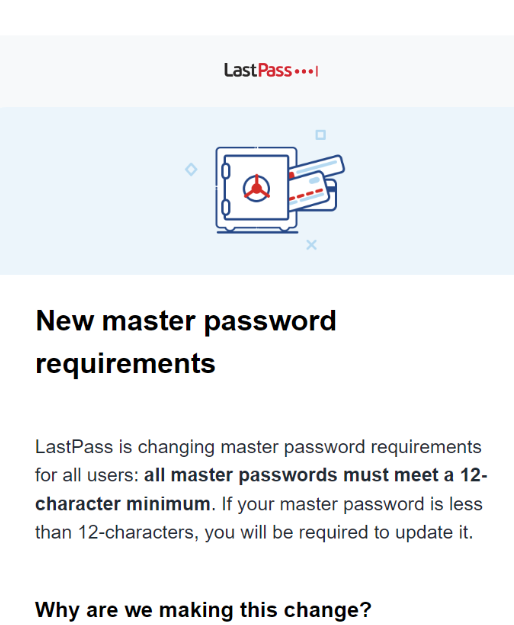
LastPass sent this notification to users earlier this week.

LastPass told customers this week they would be forced to update their master password if it was less than 12 characters. LastPass officially instituted this change back in 2018, but some undisclosed number of the company’s earlier customers were never required to increase the length of their master passwords.

This is significant because in November 2022, LastPass disclosed a breach in which hackers stole password vaults containing both encrypted and plaintext data for more than 25 million users.

Since then, a steady trickle of six-figure cryptocurrency heists targeting security-conscious people throughout the tech industry has led some security experts to conclude that crooks likely have succeeded at cracking open some of the stolen LastPass vaults.

KrebsOnSecurity last month interviewed a victim who recently saw more than three million dollars worth of cryptocurrency siphoned from his account. That user signed up with LastPass nearly a decade ago, stored their cryptocurrency seed phrase there, and yet never changed his master password — which was just eight characters. Nor was he ever forced to improve his master password.

That story cited research from Adblock Plus creator Wladimir Palant, who said LastPass failed to upgrade many older, original customers to more secure encryption protections that were offered to newer customers over the years.

For example, another important default setting in LastPass is the number of “iterations,” or how many times your master password is run through the company’s encryption routines. The more iterations, the longer it takes an offline attacker to crack your master password.

Palant said that for many older LastPass users, the initial default setting for iterations was anywhere from “1” to “500.” By 2013, new LastPass customers were given 5,000 iterations by default. In February 2018, LastPass changed the default to 100,100 iterations. And very recently, it upped that again to 600,000. Still, Palant and others impacted by the 2022 breach at LastPass say their account security settings were never forcibly upgraded.

Palant called this latest action by LastPass a PR stunt.

“They sent this message to everyone, whether they have a weak master password or not – this way they can again blame the users for not respecting their policies,” Palant said. “But I just logged in with my weak password, and I am not forced to change it. Sending emails is cheap, but they once again didn’t implement any technical measures to enforce this policy change.”

Either way, Palant said, the changes won’t help people affected by the 2022 breach.

“These people need to change all their passwords, something that LastPass still won’t recommend,” Palant said. “But it will somewhat help with the breaches to come.”

LastPass CEO Karim Toubba said changing master password length (or even the master password itself) is not designed to address already stolen vaults that are offline.

“This is meant to better protect customers’ online vaults and encourage them to bring their accounts up to the 2018 LastPass standard default setting of a 12-character minimum (but could opt out from),” Toubba said in an emailed statement. “We know that some customers may have chosen convenience over security and utilized less complex master passwords despite encouragement to use our (or others) password generator to do otherwise.”

A basic functionality of LastPass is that it will pick and remember lengthy, complex passwords for each of your websites or online services. To automatically populate the appropriate credentials at any website going forward, you simply authenticate to LastPass using your master password.

LastPass has always emphasized that if you lose this master password, that’s too bad because they don’t store it and their encryption is so strong that even they can’t help you recover it.

But experts say all bets are off when cybercrooks can get their hands on the encrypted vault data itself — as opposed to having to interact with LastPass via its website. These so-called “offline” attacks allow the bad guys to conduct unlimited and unfettered “brute force” password cracking attempts against the encrypted data using powerful computers that can each try millions of password guesses per second.

A chart on Palant’s blog post offers an idea of how increasing password iterations dramatically increases the costs and time needed by the attackers to crack someone’s master password. Palant said it would take a single high-powered graphics card about a year to crack a password of average complexity with 500 iterations, and about 10 years to crack the same password run through 5,000 iterations.

Image: palant.info

However, these numbers radically come down when a determined adversary also has other large-scale computational assets at their disposal, such as a bitcoin mining operation that can coordinate the password-cracking activity across multiple powerful systems simultaneously.

Meaning, LastPass users whose vaults were never upgraded to higher iterations and whose master passwords were weak (less than 12 characters) likely have been a primary target of distributed password-cracking attacks ever since the LastPass user vaults were stolen late last year.

Asked why some LastPass users were left behind on older security minimums, Toubba said a “small percentage” of customers had corrupted items in their password vaults that prevented those accounts from properly upgrading to the new requirements and settings.

“We have been able to determine that a small percentage of customers have items in their vaults that are corrupt and when we previously utilized automated scripts designed to re-encrypt vaults when the master password or iteration count is changed, they did not complete,” Toubba said. “These errors were not originally apparent as part of these efforts and, as we have discovered them, we have been working to be able to remedy this and finish the re-encryption.”

Nicholas Weaver, a researcher at University of California, Berkeley’s International Computer Science Institute (ICSI) and lecturer at UC Davis, said LastPass made a huge mistake years ago by not force-upgrading the iteration count for existing users.

“And now this is blaming the users — ‘you should have used a longer passphrase’ — not them for having weak defaults that were never upgraded for existing users,” Weaver said. “LastPass in my book is one step above snake-oil. I used to be, ‘Pick whichever password manager you want,’ but now I am very much, ‘Pick any password manager but LastPass.’”

Asked why LastPass isn’t recommending that users change all of the passwords secured by the encrypted master password that was stolen when the company got hacked last year, Toubba said it’s because “the data demonstrates that the majority of our customers follow our recommendations (or greater), and the probability of successfully brute forcing vault encryption is greatly reduced accordingly.”

“We’ve been telling customers since December of 2022 that they should be following recommended guidelines,” Toubba continued. “And if they haven’t followed the guidelines we recommended that they change their downstream passwords.”

source https://krebsonsecurity.com/2023/09/lastpass-horse-gone-barn-bolted-is-strong-password/

Who’s Behind the 8Base Ransomware Website?

The victim shaming website operated by the cybercriminals behind 8Base — currently one of the more active ransomware groups — was until earlier today leaking quite a bit of information that the crime group probably did not intend to be made public. The leaked data suggests that at least some of website’s code was written by a 36-year-old programmer residing in the capital city of Moldova.

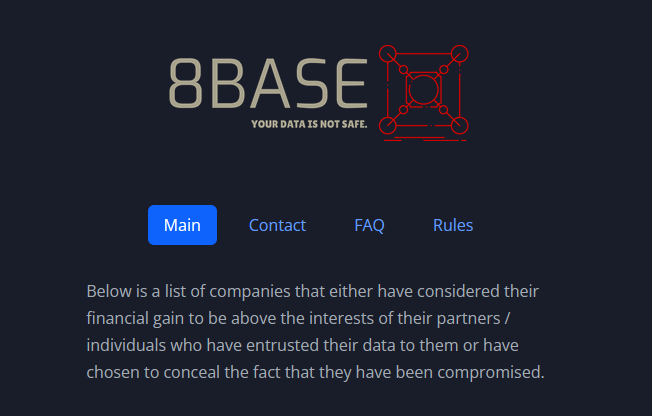
The 8Base ransomware group’s victim shaming website on the darknet.

8Base maintains a darknet website that is only reachable via Tor, a freely available global anonymity network. The site lists hundreds of victim organizations and companies — all allegedly hacking victims that refused to pay a ransom to keep their stolen data from being published.

The 8Base darknet site also has a built-in chat feature, presumably so that 8Base victims can communicate and negotiate with their extortionists. This chat feature, which runs on the Laravel web application framework, works fine as long as you are *sending* information to the site (i.e., by making a “POST” request).

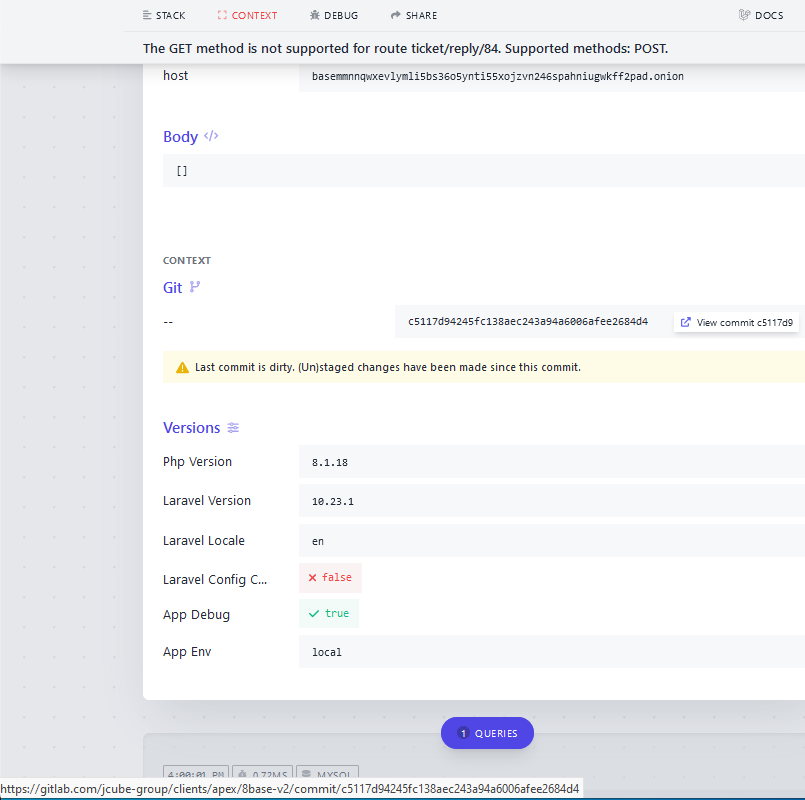
However, if one were to try to fetch data from the same chat service (i.e., by making a “GET” request), the website until quite recently generated an extremely verbose error message:

The verbose error message when one tries to pull data from 8Base’s darknet site. Notice the link at the bottom of this image, which is generated when one hovers over the “View commit” message under the “Git” heading.

That error page revealed the true Internet address of the Tor hidden service that houses the 8Base website: 95.216.51[.]74, which according to DomainTools.com is a server in Finland that is tied to the Germany-based hosting giant Hetzner.

But that’s not the interesting part: Scrolling down the lengthy error message, we can see a link to a private Gitlab server called Jcube-group: gitlab[.]com/jcube-group/clients/apex/8base-v2. Digging further into this Gitlab account, we can find some curious data points available in the JCube Group’s public code repository.

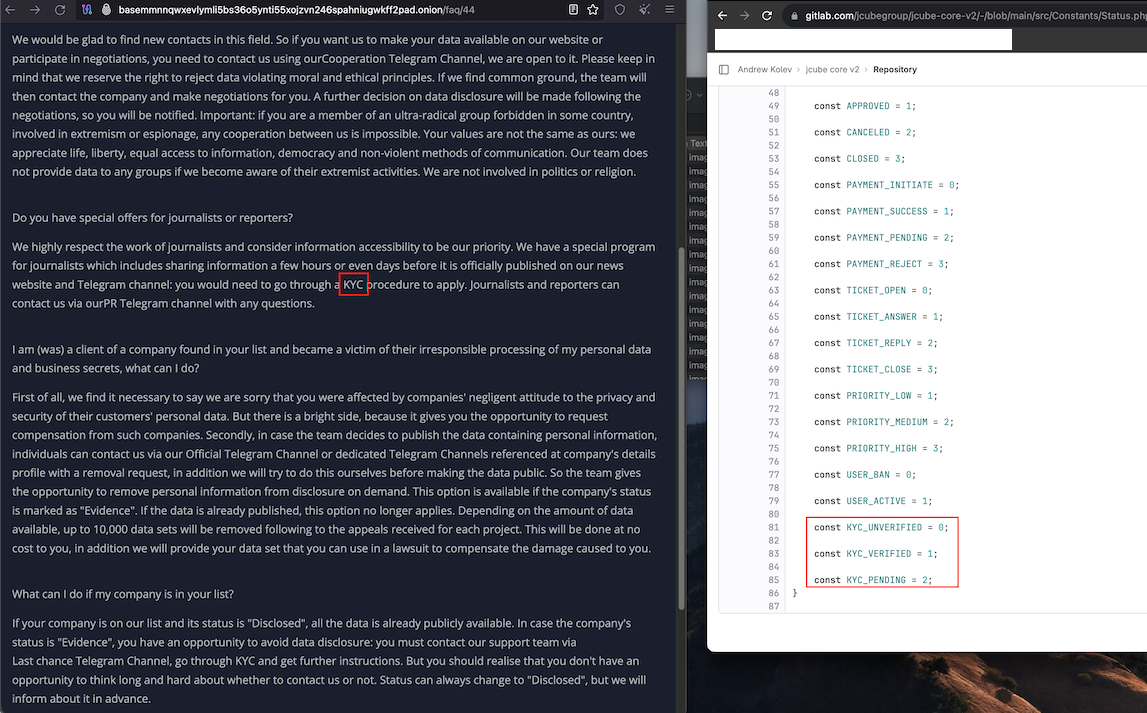
For example, this “status.php” page, which was committed to JCube Group’s Gitlab repository roughly one month ago, includes code that makes several mentions of the term “KYC” (e.g. KYC_UNVERIFIED, KYC_VERIFIED, and KYC_PENDING).

This is curious because a FAQ on the 8Base darknet site includes a section on “special offers for journalists and reporters,” which says the crime group is open to interviews but that journalists will need to prove their identity before any interview can take place. The 8base FAQ refers to this vetting process as “KYC,” which typically stands for “Know Your Customer.”

“We highly respect the work of journalists and consider information to be our priority,” the 8Base FAQ reads. “We have a special program for journalists which includes sharing information a few hours or even days before it is officially published on our news website and Telegram channel: you would need to go through a KYC procedure to apply. Journalists and reporters can contact us via our PR Telegram channel with any questions.”

The 8Base FAQ (left) and the KYC code in Kolev’s Gitlab account (right)

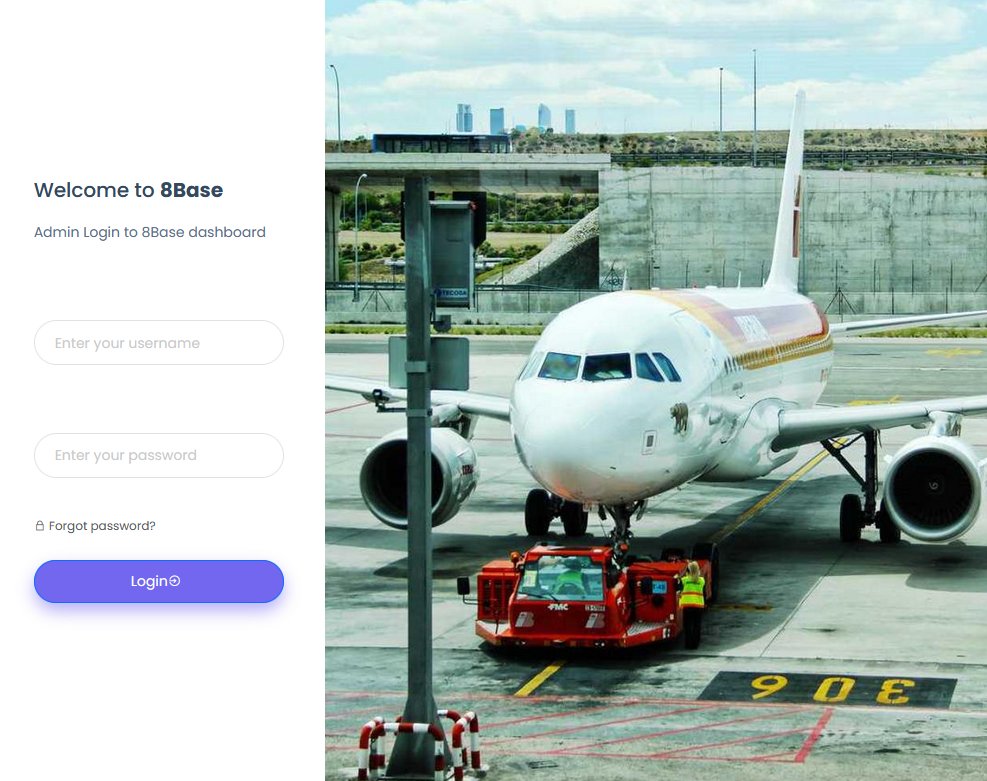
The 8Base darknet site also has a publicly accessible “admin” login page, which features an image of a commercial passenger plane parked at what appears to be an airport. Next to the airplane photo is a message that reads, “Welcome to 8Base. Admin Login to 8Base dashboard.”

The login page on the 8Base ransomware group’s darknet website.

Right-clicking on the 8Base admin page and selecting “View Source” produces the page’s HTML code. That code is virtually identical to a “login.blade.php” page that was authored and committed to JCube Group’s Gitlab repository roughly three weeks ago.

It appears the person responsible for the JCube Group’s code is a 36-year-old developer from Chisinau, Moldova named Andrei Kolev. Mr. Kolev’s LinkedIn page says he’s a full-stack developer at JCube Group, and that he’s currently looking for work. The homepage for Jcubegroup[.]com lists an address and phone number that Moldovan business records confirm is tied to Mr. Kolev.

The posts on the Twitter account for Mr. Kolev (@andrewkolev) are all written in Russian, and reference several now-defunct online businesses, including pluginspro[.]ru.

Reached for comment via LinkedIn, Mr. Kolev said he had no idea why the 8Base darknet site was pulling code from the “clients” directory of his private JCube Group Gitlab repository, or how the 8Base name was even included.

“I [don’t have] a clue, I don’t have that project in my repo,” Kolev explained. “They [aren’t] my clients. Actually we currently have just our own projects.”

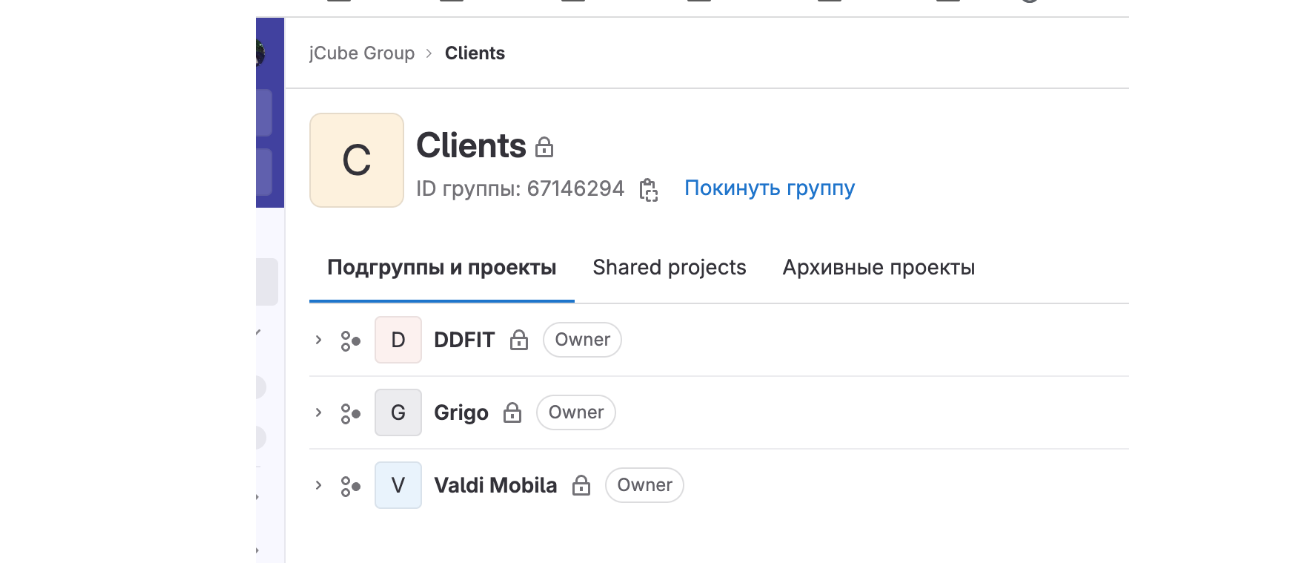
Mr. Kolev shared a screenshot of his current projects, but very quickly after that deleted the image he’d shared. However, KrebsOnSecurity captured a copy of it before it was removed:

A screenshot of Mr. Kolev’s current projects that he quickly deleted.

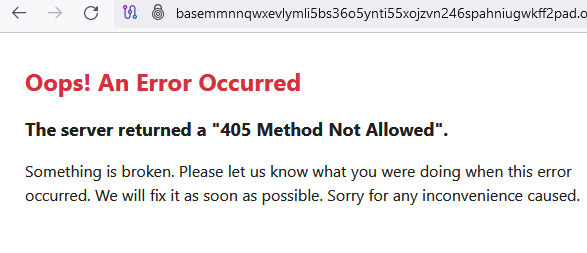
Within minutes of explaining why I was reaching out to Mr. Kolev and walking him through the process of finding this connection, the 8Base website was changed, and the error message that linked to the JCube Group private Gitlab repository no longer appeared. Instead, trying the same “GET” method described above caused the 8Base website to return a “405 Method Not Allowed” error page:

Mr. Kolev claimed he didn’t know anything about the now-removed error page on 8Base’s site that referenced his private Gitlab repo, and said he deleted the screenshot from our LinkedIn chat because it contained private information.

Ransomware groups are known to remotely hire developers for specific projects without disclosing exactly who they are or how the new hire’s code is intended to be used, and it is possible that one of Mr. Kolev’s clients is merely a front for 8Base. But despite 8Base’s statement that they are happy to correspond with journalists, KrebsOnSecurity is still waiting for a reply from the group via their Telegram channel.

The tip about the leaky 8Base website was provided by a reader who asked to remain anonymous. That reader, a legitimate security professional and researcher who goes by the handle @htmalgae on Twitter, said it is likely that whoever developed the 8Base website inadvertently left it in “development mode,” which is what caused the site to be so verbose with its error messages.

“If 8Base was running the app in production mode instead of development mode, this Tor de-anonymization would have never been possible,” @htmalgae said.

A recent blog post from VMware called the 8Base ransomware group “a heavy hitter” that has remained relatively unknown despite the massive spike in activity in Summer of 2023.

“8Base is a Ransomware group that has been active since March 2022 with a significant spike in activity in June of 2023,” VMware researchers wrote. “Describing themselves as ‘simple pen testers,’ their leak site provided victim details through Frequently Asked Questions and Rules sections as well as multiple ways to contact them. ”

According to VMware, what’s particularly interesting about 8Base’s communication style is the use of verbiage that is strikingly familiar to another known cybercriminal group: RansomHouse.

“The group utilizes encryption paired with ‘name-and-shame’ techniques to compel their victims to pay their ransoms,” VMware researchers wrote. “8Base has an opportunistic pattern of compromise with recent victims spanning across varied industries. Despite the high amount of compromises, the information regarding identities, methodology, and underlying motivation behind these incidents still remains a mystery.”

source https://krebsonsecurity.com/2023/09/whos-behind-the-8base-ransomware-website/

FBI Hacker Dropped Stolen Airbus Data on 9/11

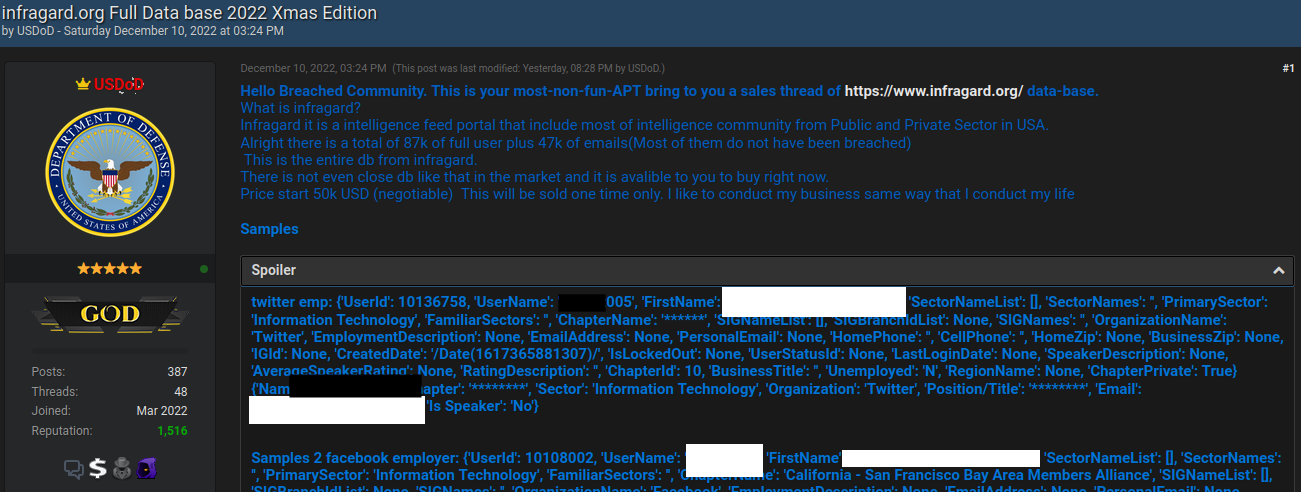
In December 2022, KrebsOnSecurity broke the news that a cybercriminal using the handle “USDoD” had infiltrated the FBI‘s vetted information sharing network InfraGard, and was selling the contact information for all 80,000 members. The FBI responded by reverifying InfraGard members and by seizing the cybercrime forum where the data was being sold. But on Sept. 11, 2023, USDoD resurfaced after a lengthy absence to leak sensitive employee data stolen from the aerospace giant Airbus, while promising to visit the same treatment on top U.S. defense contractors.

USDoD’s avatar used to be the seal of the U.S. Department of Defense. Now it’s a charming kitten.

In a post on the English language cybercrime forum BreachForums, USDoD leaked information on roughly 3,200 Airbus vendors, including names, addresses, phone numbers, and email addresses. USDoD claimed they grabbed the data by using passwords stolen from a Turkish airline employee who had third-party access to Airbus’ systems.

USDoD didn’t say why they decided to leak the data on the 22nd anniversary of the 9/11 attacks, but there was definitely an aircraft theme to the message that accompanied the leak, which concluded with the words, “Lockheed martin, Raytheon and the entire defense contractos [sic], I’m coming for you [expletive].”

Airbus has apparently confirmed the cybercriminal’s account to the threat intelligence firm Hudson Rock, which determined that the Airbus credentials were stolen after a Turkish airline employee infected their computer with a prevalent and powerful info-stealing trojan called RedLine.

Info-stealers like RedLine typically are deployed via opportunistic email malware campaigns, and by secretly bundling the trojans with cracked versions of popular software titles made available online. Credentials stolen by info-stealers often end up for sale on cybercrime shops that peddle purloined passwords and authentication cookies (these logs also often show up in the malware scanning service VirusTotal).

Hudson Rock said it recovered the log files created by a RedLine infection on the Turkish airline employee’s system, and found the employee likely infected their machine after downloading pirated and secretly backdoored software for Microsoft Windows.

Hudson Rock says info-stealer infections from RedLine and a host of similar trojans have surged in recent years, and that they remain “a primary initial attack vector used by threat actors to infiltrate organizations and execute cyberattacks, including ransomware, data breaches, account overtakes, and corporate espionage.”

The prevalence of RedLine and other info-stealers means that a great many consequential security breaches begin with cybercriminals abusing stolen employee credentials. In this scenario, the attacker temporarily assumes the identity and online privileges assigned to a hacked employee, and the onus is on the employer to tell the difference.

In addition to snarfing any passwords stored on or transmitted through an infected system, info-stealers also siphon authentication cookies or tokens that allow one to remain signed-in to online services for long periods of time without having to resupply one’s password and multi-factor authentication code. By stealing these tokens, attackers can often reuse them in their own web browser, and bypass any authentication normally required for that account.

Microsoft Corp. this week acknowledged that a China-backed hacking group was able to steal one of the keys to its email kingdom that granted near-unfettered access to U.S. government inboxes. Microsoft’s detailed post-mortem cum mea culpa explained that a secret signing key was stolen from an employee in an unlucky series of unfortunate events, and thanks to TechCrunch we now know that the culprit once again was “token-stealing malware” on the employee’s system.

In April 2023, the FBI seized Genesis Market, a bustling, fully automated cybercrime store that was continuously restocked with freshly hacked passwords and authentication tokens stolen by a network of contractors who deployed RedLine and other info-stealer malware.

In March 2023, the FBI arrested and charged the alleged administrator of BreachForums (aka Breached), the same cybercrime community where USDoD leaked the Airbus data. In June 2023, the FBI seized the BreachForums domain name, but the forum has since migrated to a new domain.

USDoD’s InfraGard sales thread on Breached.

Unsolicited email continues to be a huge vector for info-stealing malware, but lately the crooks behind these schemes have been gaming the search engines so that their malicious sites impersonating popular software vendors actually appear before the legitimate vendor’s website. So take special care when downloading software to ensure that you are in fact getting the program from the original, legitimate source whenever possible.

Also, unless you really know what you’re doing, please don’t download and install pirated software. Sure, the cracked program might do exactly what you expect it to do, but the chances are good that it is also laced with something nasty. And when all of your passwords are stolen and your important accounts have been hijacked or sold, you will wish you had simply paid for the real thing.

source https://krebsonsecurity.com/2023/09/fbi-hacker-dropped-stolen-airbus-data-on-9-11/

Adobe, Apple, Google & Microsoft Patch 0-Day Bugs

Microsoft today issued software updates to fix at least five dozen security holes in Windows and supported software, including patches for two zero-day vulnerabilities that are already being exploited. Also, Adobe, Google Chrome and Apple iOS users may have their own zero-day patching to do.

On Sept. 7, researchers at Citizen Lab warned they were seeing active exploitation of a “zero-click,” zero-day flaw to install spyware on iOS devices without any interaction from the victim.

“The exploit chain was capable of compromising iPhones running the latest version of iOS (16.6) without any interaction from the victim,” the researchers wrote.

According to Citizen Lab, the exploit uses malicious images sent via iMessage, an embedded component of Apple’s iOS that has been the source of previous zero-click flaws in iPhones and iPads.

Apple says the iOS flaw (CVE-2023-41064) does not seem to work against devices that have its ultra-paranoid “Lockdown Mode” enabled. This feature restricts non-essential iOS features to reduce the device’s overall attack surface, and it was designed for users concerned that they may be subject to targeted attacks. Citizen Lab says the bug it discovered was being exploited to install spyware made by the Israeli cyber surveillance company NSO Group.

This vulnerability is fixed in iOS 16.6.1 and iPadOS 16.6.1. To turn on Lockdown Mode in iOS 16, go to Settings, then Privacy and Security, then Lockdown Mode.

Not to be left out of the zero-day fun, Google acknowledged on Sept. 11 that an exploit for a heap overflow bug in Chrome is being exploited in the wild. Google says it is releasing updates to fix the flaw, and that restarting Chrome is the way to apply any pending updates. Interestingly, Google says this bug was reported by Apple and Citizen Lab.

On the Microsoft front, a zero-day in Microsoft Word is among the more concerning bugs fixed today. Tracked as CVE-2023-36761, it is flagged as an “information disclosure” vulnerability. But that description hardly grasps at the sensitivity of the information potentially exposed here.

Tom Bowyer, manager of product security at Automox, said exploiting this vulnerability could lead to the disclosure of Net-NTLMv2 hashes, which are used for authentication in Windows environments.

“If a malicious actor gains access to these hashes, they can potentially impersonate the user, gaining unauthorized access to sensitive data and systems,” Bowyer said, noting that CVE-2023-36761 can be exploited just by viewing a malicious document in the Windows preview pane. “They could also conduct pass-the-hash attacks, where the attacker uses the hashed version of a password to authenticate themselves without needing to decrypt it.”

The other Windows zero-day fixed this month is CVE-2023-36802. This is an “elevation of privilege” flaw in the “Microsoft Streaming Service Proxy,” which is built into Windows 10, 11 and Windows Server versions. Microsoft says an attacker who successfully exploits the bug can gain SYSTEM level privileges on a Windows computer.

Five of the flaws Microsoft fixed this month earned its “critical” rating, which the software giant reserves for vulnerabilities that can be exploited by malware or malcontents with little or no interaction by Windows users.

According to the SANS Internet Storm Center, the most serious critical bug in September’s Patch Tuesday is CVE-2023-38148, which is a weakness in the Internet Connection Sharing service on Windows. Microsoft says an unauthenticated attacker could leverage the flaw to install malware just sending a specially crafted data packet to a vulnerable Windows system.

Finally, Adobe has released critical security updates for its Adobe Reader and Acrobat software that also fixes a zero-day vulnerability (CVE-2023-26369). More details are at Adobe’s advisory.

For a more granular breakdown of the Windows updates pushed out today, check out Microsoft Patch Tuesday by Morphus Labs. In the meantime, consider backing up your data before updating Windows, and keep an eye on AskWoody.com for reports of any widespread problems with any of the updates released as part of September’s Patch Tuesday.

source https://krebsonsecurity.com/2023/09/adobe-apple-google-microsoft-patch-0-day-bugs/

Experts Fear Crooks are Cracking Keys Stolen in LastPass Breach

In November 2022, the password manager service LastPass disclosed a breach in which hackers stole password vaults containing both encrypted and plaintext data for more than 25 million users. Since then, a steady trickle of six-figure cryptocurrency heists targeting security-conscious people throughout the tech industry has led some security experts to conclude that crooks likely have succeeded at cracking open some of the stolen LastPass vaults.

Taylor Monahan is founder and CEO of MetaMask, a popular software cryptocurrency wallet used to interact with the Ethereum blockchain. Since late December 2022, Monahan and other researchers have identified a highly reliable set of clues that they say connect recent thefts targeting more than 150 people, Collectively, these individuals have been robbed of more than $35 million worth of crypto.

Monahan said virtually all of the victims she has assisted were longtime cryptocurrency investors, and security-minded individuals. Importantly, none appeared to have suffered the sorts of attacks that typically preface a high-dollar crypto heist, such as the compromise of one’s email and/or mobile phone accounts.

“The victim profile remains the most striking thing,” Monahan wrote. “They truly all are reasonably secure. They are also deeply integrated into this ecosystem, [including] employees of reputable crypto orgs, VCs [venture capitalists], people who built DeFi protocols, deploy contracts, run full nodes.”

Monahan has been documenting the crypto thefts via Twitter/X since March 2023, frequently expressing frustration in the search for a common cause among the victims. Then on Aug. 28, Monahan said she’d concluded that the common thread among nearly every victim was that they’d previously used LastPass to store their “seed phrase,” the private key needed to unlock access to their cryptocurrency investments.
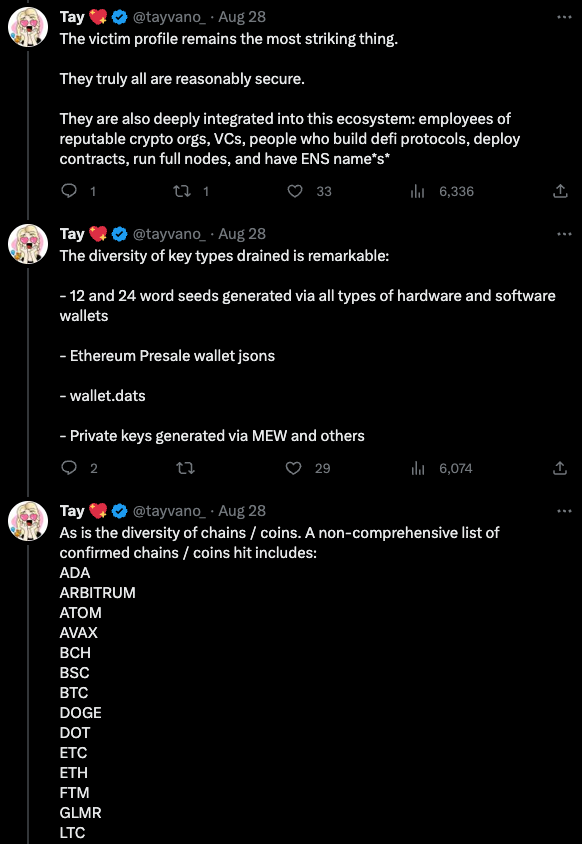
MetaMask owner Taylor Monahan on Twitter. Image: twitter.com/tayvano

Armed with your secret seed phrase, anyone can instantly access all of the cryptocurrency holdings tied to that cryptographic key, and move the funds to anywhere they like.

Which is why the best practice for many cybersecurity enthusiasts has long been to store their seed phrases either in some type of encrypted container — such as a password manager — or else inside an offline, special-purpose hardware encryption device, such as a Trezor or Ledger wallet.

“The seed phrase is literally the money,” said Nick Bax, director of analytics at Unciphered, a cryptocurrency wallet recovery company. “If you have my seed phrase, you can copy and paste that into your wallet, and then you can see all my accounts. And you can transfer my funds.”

Unciphered works with both cryptocurrency theft victims and clients who seek the company’s expertise in probate proceedings, which involves being hired by the family of a recently deceased person to discover the crypto seed phrase that unlocks a potentially huge inheritance for surviving family members.

Bax said he closely reviewed the massive trove of cryptocurrency theft data that Taylor Monahan and others have collected and linked together.

“It’s one of the broadest and most complex cryptocurrency investigations I’ve ever seen,” Bax said. “I ran my own analysis on top of their data and reached the same conclusion that Taylor reported. The threat actor moved stolen funds from multiple victims to the same blockchain addresses, making it possible to strongly link those victims.”

Bax, Monahan and others interviewed for this story say they’ve identified a unique signature that links the theft of more than $35 million in crypto from more than 150 confirmed victims, with roughly two to five high-dollar heists happening each month since December 2022.

KrebsOnSecurity has reviewed this signature but is not publishing it at the request of Monahan and other researchers, who say doing so could cause the attackers to alter their operations in ways that make their criminal activity more difficult to track.

But the researchers have published findings about the dramatic similarities in the ways that victim funds were stolen and laundered through specific cryptocurrency exchanges. They also learned the attackers frequently grouped together victims by sending their cryptocurrencies to the same destination crypto wallet.
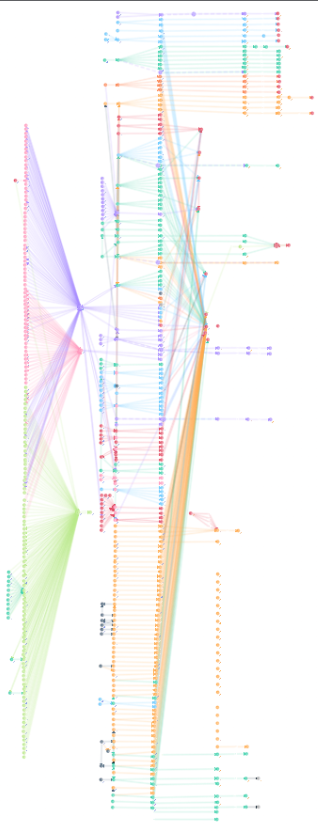
A graphic published by @tayvano on Twitter depicting the movement of stolen cryptocurrencies from victims who used LastPass to store their crypto seed phrases.

By identifying points of overlap in these destination addresses, the researchers were then able to track down and interview new victims. For example, the researchers said their methodology identified a recent multi-million dollar crypto heist victim as an employee at Chainalysis, a blockchain analysis firm that works closely with law enforcement agencies to help track down cybercriminals and money launderers.

Chainalysis confirmed that the employee had suffered a high-dollar cryptocurrency heist late last month, but otherwise declined to comment for this story.

Bax said the only obvious commonality between the victims who agreed to be interviewed was that they had stored the seed phrases for their cryptocurrency wallets in LastPass.

“On top of the overlapping indicators of compromise, there are more circumstantial behavioral patterns and tradecraft which are also consistent between different thefts and support the conclusion,” Bax told KrebsOnSecuirty. “I’m confident enough that this is a real problem that I’ve been urging my friends and family who use LastPass to change all of their passwords and migrate any crypto that may have been exposed, despite knowing full well how tedious that is.”

LastPass declined to answer questions about the research highlighted in this story, citing an ongoing law enforcement investigation and pending litigation against the company in response to its 2022 data breach.

“Last year’s incident remains the subject of an ongoing investigation by law enforcement and is also the subject of pending litigation,” LastPass said in a written statement provided to KrebsOnSecurity. “Since last year’s attack on LastPass, we have remained in contact with law enforcement and continue to do so.”

Their statement continues:

“We have shared various technical information, Indicators of Compromise (IOCs), and threat actor tactics, techniques, and procedures (TTPs) with our law enforcement contacts as well as our internal and external threat intelligence and forensic partners in an effort to try and help identify the parties responsible. In the meantime, we encourage any security researchers to share any useful information they believe they may have with our Threat Intelligence team by contacting securitydisclosure@lastpass.com.”

THE LASTPASS BREACH(ES)

On August 25, 2022, LastPass CEO Karim Toubba wrote to users that the company had detected unusual activity in its software development environment, and that the intruders stole some source code and proprietary LastPass technical information. On Sept. 15, 2022, LastPass said an investigation into the August breach determined the attacker did not access any customer data or password vaults.

But on Nov. 30, 2022, LastPass notified customers about another, far more serious security incident that the company said leveraged data stolen in the August breach. LastPass disclosed that criminal hackers had compromised encrypted copies of some password vaults, as well as other personal information.

In February 2023, LastPass disclosed that the intrusion involved a highly complex, targeted attack against a DevOps engineer who was one of only four LastPass employees with access to the corporate vault.

“This was accomplished by targeting the DevOps engineer’s home computer and exploiting a vulnerable third-party media software package, which enabled remote code execution capability and allowed the threat actor to implant keylogger malware,” LastPass officials wrote. “The threat actor was able to capture the employee’s master password as it was entered, after the employee authenticated with MFA, and gain access to the DevOps engineer’s LastPass corporate vault.”

Dan Goodin at Ars Technica reported and then confirmed that the attackers exploited a known vulnerability in a Plex media server that the employee was running on his home network, and succeeded in installing malicious software that stole passwords and other authentication credentials. The vulnerability exploited by the intruders was patched back in 2020, but the employee never updated his Plex software.

As it happens, Plex announced its own data breach one day before LastPass disclosed its initial August intrusion. On August 24, 2022, Plex’s security team urged users to reset their passwords, saying an intruder had accessed customer emails, usernames and encrypted passwords.

OFFLINE ATTACKS

A basic functionality of LastPass is that it will pick and remember lengthy, complex passwords for each of your websites or online services. To automatically populate the appropriate credentials at any website going forward, you simply authenticate to LastPass using your master password.

LastPass has always emphasized that if you lose this master password, that’s too bad because they don’t store it and their encryption is so strong that even they can’t help you recover it.

But experts say all bets are off when cybercrooks can get their hands on the encrypted vault data itself — as opposed to having to interact with LastPass via its website. These so-called “offline” attacks allow the bad guys to conduct unlimited and unfettered “brute force” password cracking attempts against the encrypted data using powerful computers that can each try millions of password guesses per second.

“It does leave things vulnerable to brute force when the vaults are stolen en masse, especially if info about the vault HOLDER is available,” said Nicholas Weaver, a researcher at University of California, Berkeley’s International Computer Science Institute (ICSI) and lecturer at UC Davis. “So you just crunch and crunch and crunch with GPUs, with a priority list of vaults you target.”

How hard would it be for well-resourced criminals to crack the master passwords securing LastPass user vaults? Perhaps the best answer to this question comes from Wladimir Palant, a security researcher and the original developer behind the Adblock Plus browser plugin.

In a December 2022 blog post, Palant explained that the crackability of the LastPass master passwords depends largely on two things: The complexity of the master password, and the default settings for LastPass users, which appear to have varied quite a bit based on when those users began patronizing the service.

LastPass says that since 2018 it has required a twelve-character minimum for master passwords, which the company said “greatly minimizes the ability for successful brute force password guessing.”

But Palant said while LastPass indeed improved its master password defaults in 2018, it did not force all existing customers who had master passwords of lesser lengths to pick new credentials that would satisfy the 12-character minimum.

“If you are a LastPass customer, chances are that you are completely unaware of this requirement,” Palant wrote. “That’s because LastPass didn’t ask existing customers to change their master password. I had my test account since 2018, and even today I can log in with my eight-character password without any warnings or prompts to change it.”

Palant believes LastPass also failed to upgrade many older, original customers to more secure encryption protections that were offered to newer customers over the years. One important setting in LastPass is the number of “iterations,” or how many times your master password is run through the company’s encryption routines. The more iterations, the longer it takes an offline attacker to crack your master password.

Palant noted last year that for many older LastPass users, the initial default setting for iterations was anywhere from “1” to “500.” By 2013, new LastPass customers were given 5,000 iterations by default. In February 2018, LastPass changed the default to 100,100 iterations. And very recently, it upped that again to 600,000.

Palant said the 2018 change was in response to a security bug report he filed about some users having dangerously low iterations in their LastPass settings.

“Worse yet, for reasons that are beyond me, LastPass didn’t complete this migration,” Palant wrote. “My test account is still at 5,000 iterations, as are the accounts of many other users who checked their LastPass settings. LastPass would know how many users are affected, but they aren’t telling that. In fact, it’s painfully obvious that LastPass never bothered updating users’ security settings. Not when they changed the default from 1 to 500 iterations. Not when they changed it from 500 to 5,000. Only my persistence made them consider it for their latest change. And they still failed implementing it consistently.”

A chart on Palant’s blog post offers an idea of how increasing password iterations dramatically increases the costs and time needed by the attackers to crack someone’s master password. Palant said it would take a single GPU about a year to crack a password of average complexity with 500 iterations, and about 10 years to crack the same password run through 5,000 iterations.
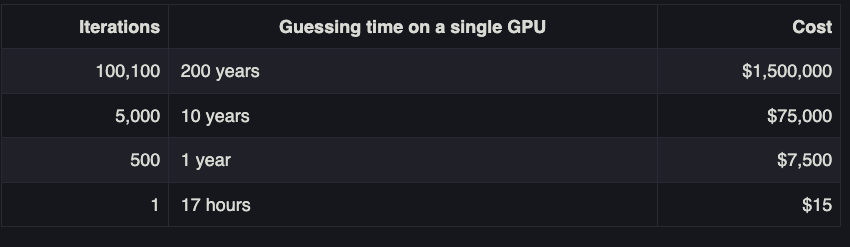
Image: palant.info

However, these numbers radically come down when a determined adversary also has other large-scale computational assets at their disposal, such as a bitcoin mining operation that can coordinate the password-cracking activity across multiple powerful systems simultaneously.

Weaver said a password or passphrase with average complexity — such as “Correct Horse Battery Staple” is only secure against online attacks, and that its roughly 40 bits of randomness or “entropy” means a graphics card can blow through it in no time.

“An Nvidia 3090 can do roughly 4 million [password guesses] per second with 1000 iterations, but that would go down to 8 thousand per second with 500,000 iterations, which is why iteration count matters so much,” Weaver said. “So a combination of ‘not THAT strong of a password’ and ‘old vault’ and ‘low iteration count’ would make it theoretically crackable but real work, but the work is worth it given the targets.”

Reached by KrebsOnSecurity, Palant said he never received a response from LastPass about why the company apparently failed to migrate some number of customers to more secure account settings.

“I know exactly as much as everyone else,” Palant wrote in reply. “LastPass published some additional information in March. This finally answered the questions about the timeline of their breach – meaning which users are affected. It also made obvious that business customers are very much at risk here, Federated Login Services being highly compromised in this breach (LastPass downplaying as usual of course).”

Palant said upon logging into his LastPass account a few days ago, he found his master password was still set at 5,000 iterations.

INTERVIEW WITH A VICTIM

KrebsOnSecurity interviewed one of the victims tracked down by Monahan, a software engineer and startup founder who recently was robbed of approximately $3.4 million worth of different cryptocurrencies. The victim agreed to tell his story in exchange for anonymity because he is still trying to claw back his losses. We’ll refer to him here as “Connor” (not his real name).

Connor said he began using LastPass roughly a decade ago, and that he also stored the seed phrase for his primary cryptocurrency wallet inside of LastPass. Connor chose to protect his LastPass password vault with an eight character master password that included numbers and symbols (~50 bits of entropy).

“I thought at the time that the bigger risk was losing a piece of paper with my seed phrase on it,” Connor said. “I had it in a bank security deposit box before that, but then I started thinking, ‘Hey, the bank might close or burn down and I could lose my seed phrase.’”

Those seed phrases sat in his LastPass vault for years. Then, early on the morning of Sunday, Aug. 26, 2023, Connor was awoken by a service he’d set up to monitor his cryptocurrency addresses for any unusual activity: Someone was draining funds from his accounts, and fast.

Like other victims interviewed for this story, Connor didn’t suffer the usual indignities that typically presage a cryptocurrency robbery, such as account takeovers of his email inbox or mobile phone number.

Connor said he doesn’t know the number of iterations his master password was given originally, or what it was set at when the LastPass user vault data was stolen last year. But he said he recently logged into his LastPass account and the system forced him to upgrade to the new 600,000 iterations setting.

“Because I set up my LastPass account so early, I’m pretty sure I had whatever weak settings or iterations it originally had,” he said.

Connor said he’s kicking himself because he recently started the process of migrating his cryptocurrency to a new wallet protected by a new seed phrase. But he never finished that migration process. And then he got hacked.

“I’d set up a brand new wallet with new keys,” he said. “I had that ready to go two months ago, but have been procrastinating moving things to the new wallet.”

Connor has been exceedingly lucky in regaining access to some of his stolen millions in cryptocurrency. The Internet is swimming with con artists masquerading as legitimate cryptocurrency recovery experts. To make matters worse, because time is so critical in these crypto heists, many victims turn to the first quasi-believable expert who offers help.

Instead, several friends steered Connor to Flashbots.net, a cryptocurrency recovery firm that employs several custom techniques to help clients claw back stolen funds — particularly those on the Ethereum blockchain.

According to Connor, Flashbots helped rescue approximately $1.5 million worth of the $3.4 million in cryptocurrency value that was suddenly swept out of his account roughly a week ago. Lucky for him, Connor had some of his assets tied up in a type of digital loan that allowed him to borrow against his various cryptocurrency assets.

Without giving away too many details about how they clawed back the funds, here’s a high level summary: When the crooks who stole Connor’s seed phrase sought to extract value from these loans, they were borrowing the maximum amount of credit that he hadn’t already used. But Connor said that left open an avenue for some of that value to be recaptured, basically by repaying the loan in many small, rapid chunks.

WHAT SHOULD LASTPASS USERS DO?

According to MetaMask’s Monahan, users who stored any important passwords with LastPass — particularly those related to cryptocurrency accounts — should change those credentials immediately, and migrate any crypto holdings to new offline hardware wallets.

“Really the ONLY thing you need to read is this,” Monahan pleaded to her 70,000 followers on Twitter/X: “PLEASE DON’T KEEP ALL YOUR ASSETS IN A SINGLE KEY OR SECRET PHRASE FOR YEARS. THE END. Split up your assets. Get a hw [hardware] wallet. Migrate. Now.”

If you also had passwords tied to banking or retirement accounts, or even just important email accounts — now would be a good time to change those credentials as well.

I’ve never been comfortable recommending password managers, because I’ve never seriously used them myself. Something about putting all your eggs in one basket. Heck, I’m so old-fashioned that most of my important passwords are written down and tucked away in safe places.

But I recognize this antiquated approach to password management is not for everyone. Connor says he now uses 1Password, a competing password manager that recently earned the best overall marks from Wired and The New York Times.

1Password says that three things are needed to decrypt your information: The encrypted data itself, your account password, and your Secret Key. Only you know your account password, and your Secret Key is generated locally during setup.

“The two are combined on-device to encrypt your vault data and are never sent to 1Password,” explains a 1Password blog post ‘What If 1Password Gets Hacked?‘ “Only the encrypted vault data lives on our servers, so neither 1Password nor an attacker who somehow manages to guess or steal your account password would be able to access your vaults – or what’s inside them.

Weaver said that Secret Key adds an extra level of randomness to all user master passwords that LastPass didn’t have.

“With LastPass, the idea is the user’s password vault is encrypted with a cryptographic hash (H) of the user’s passphrase,” Weaver said. “The problem is a hash of the user’s passphrase is remarkably weak on older LastPass vaults with master passwords that do not have many iterations. 1Password uses H(random-key||password) to generate the password, and it is why you have the QR code business when adding a new device.”

Weaver said LastPass deserves blame for not having upgraded iteration counts for all users a long time ago, and called the latest forced upgrades “a stunning indictment of the negligence on the part of LastPass.”

“That they never even notified all those with iteration counts of less than 100,000 — who are really vulnerable to brute force even with 8-character random passwords or ‘correct horse battery staple’ type passphrases — is outright negligence,” Weaver said. “I would personally advocate that nobody ever uses LastPass again: Not because they were hacked. Not because they had an architecture (unlike 1Password) that makes such hacking a problem. But because of their consistent refusal to address how they screwed up and take proactive efforts to protect their customers.”

Bax and Monahan both acknowledged that their research alone can probably never conclusively tie dozens of high-dollar crypto heists over the past year to the LastPass breach. But Bax says at this point he doesn’t see any other possible explanation.

“Some might say it’s dangerous to assert a strong connection here, but I’d say it’s dangerous to assert there isn’t one,” he said. “I was arguing with my fiance about this last night. She’s waiting for LastPass to tell her to change everything. Meanwhile, I’m telling her to do it now.”

source https://krebsonsecurity.com/2023/09/experts-fear-crooks-are-cracking-keys-stolen-in-lastpass-breach/
Why is .US Being Used to Phish So Many of Us?

Domain names ending in “.US” — the top-level domain for the United States — are among the most prevalent in phishing scams, new research shows. This is noteworthy because .US is overseen by the U.S. government, which is frequently the target of phishing domains ending in .US. Also, .US domains are only supposed to be available to U.S. citizens and to those who can demonstrate that they have a physical presence in the United States.

.US is the “country code top-level domain” or ccTLD of the United States. Dozens of countries have their own ccTLDs: .MX for Mexico, for example, or .CA for Canada. But few other major countries in the world have anywhere near as many phishing domains each year as .US.

That’s according to The Interisle Consulting Group, which gathers phishing data from multiple industry sources and publishes an annual report on the latest trends. Interisle’s newest study examined six million phishing reports between May 1, 2022 and April 30, 2023, and found 30,000 .US phishing domains.

.US is overseen by the National Telecommunications and Information Administration (NTIA), an executive branch agency of the U.S. Department of Commerce. However, NTIA currently contracts out the management of the .US domain to GoDaddy, by far the world’s largest domain registrar.

Under NTIA regulations, the administrator of the .US registry must take certain steps to verify that their customers actually reside in the United States, or own organizations based in the U.S. But Interisle found that whatever GoDaddy was doing to manage that vetting process wasn’t working.

“The .US ‘nexus’ requirement theoretically limits registrations to parties with a national connection, but .US had very high numbers of phishing domains,” Interisle wrote. “This indicates a possible problem with the administration or application of the nexus requirements.”

Dean Marks is executive director and legal counsel for a group called the Coalition for Online Accountability, which has been critical of the NTIA’s stewardship of .US. Marks says virtually all European Union member state ccTLDs that enforce nexus restrictions also have massively lower levels of abuse due to their policies and oversight.

“Even very large ccTLDs, like .de for Germany — which has a far larger market share of domain name registrations than .US — have very low levels of abuse, including phishing and malware,” Marks told KrebsOnSecurity. “In my view, this situation with .US should not be acceptable to the U.S. government overall, nor to the US public.”

Marks said there are very few phishing domains ever registered in other ccTLDs that also restrict registrations to their citizens, such as .HU (Hungary), .NZ (New Zealand), and .FI (Finland), where a connection to the country, a proof of identity, or evidence of incorporation are required.

“Or .LK (Sri Lanka), where the acceptable use policy includes a ‘lock and suspend’ if domains are reported for suspicious activity,” Marks said. “These ccTLDs make a strong case for validating domain registrants in the interest of public safety.”

Sadly, .US has been a cesspool of phishing activity for many years. As far back as 2018, Interisle found .US domains were the worst in the world for spam, botnet (attack infrastructure for DDOS etc.) and illicit or harmful content. Back then, .US was being operated by a different contractor.

In response to questions from KrebsOnSecurity, GoDaddy said all .US registrants must certify that they meet the NTIA’s nexus requirements. But this appears to be little more than an affirmative response that is already pre-selected for all new registrants.

Attempting to register a .US domain through GoDaddy, for example, leads to a U.S. Registration Information page that auto-populates the nexus attestation field with the response, “I am a citizen of the United States.” Other options include, “I am a permanent resident of the US,” and “My primary domicile is in the US.” It currently costs just $4.99 to obtain a .US domain through GoDaddy.

GoDaddy said it also conducts a scan of selected registration request information, and conducts “spot checks” on registrant information.

“We conduct regular reviews, per policy, of registration data within the Registry database to determine Nexus compliance with ongoing communications to registrars and registrants,” the company said in a written statement.

GoDaddy says it “is committed to supporting a safer online environment and proactively addressing this issue by assessing it against our own anti-abuse mitigation system.”

“We stand against DNS abuse in any form and maintain multiple systems and protocols to protect all the TLDs we operate,” the statement continued. “We will continue to work with registrars, cybersecurity firms and other stakeholders to make progress with this complex challenge.”

Interisle found significant numbers of .US domains were registered to attack some of the United States’ most prominent companies, including Bank of America, Amazon, AppleAT&T, Citi, Comcast, Microsoft, Meta, and Target.

“Ironically, at least 109 of the .US domains in our data were used to attack the United States government, specifically the United States Postal Service and its customers,” Interisle wrote. “.US domains were also used to attack foreign government operations: six .US domains were used to attack Australian government services, six attacked Great’s Britain’s Royal Mail, one attacked Canada Post, and one attacked the Denmark Tax Authority.”

The NTIA recently published a proposal that would allow GoDaddy to redact registrant data from WHOIS registration records. The current charter for .US specifies that all .US registration records be public.

Interisle argues that without more stringent efforts to verify a United States nexus for new .US domain registrants, the NTIA’s proposal will make it even more difficult to identify phishers and verify registrants’ identities and nexus qualifications.

The NTIA has not yet responded to requests for comment.

Interisle sources its phishing data from several places, including the Anti-Phishing Working Group (APWG), OpenPhish, PhishTank, and Spamhaus. For more phishing facts, see Interisle’s 2023 Phishing Landscape report (PDF).

source https://krebsonsecurity.com/2023/09/why-is-us-being-used-to-phish-so-many-of-us/

U.S. Hacks QakBot, Quietly Removes Botnet Infections

The U.S. government today announced a coordinated crackdown against QakBot, a complex malware family used by multiple cybercrime groups to lay the groundwork for ransomware infections. The international law enforcement operation involved seizing control over the botnet’s online infrastructure, and quietly removing the Qakbot malware from tens of thousands of infected Microsoft Windows computers.

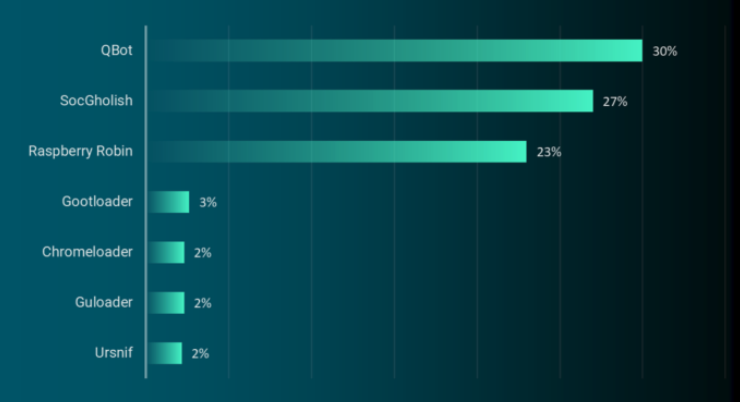
Qakbot/Qbot was once again the top malware loader observed in the wild in the first six months of 2023. Source: Reliaquest.com.

In an international operation announced today dubbed “Duck Hunt,” the U.S. Department of Justice (DOJ) and Federal Bureau of Investigation (FBI) said they obtained court orders to remove Qakbot from infected devices, and to seize servers used to control the botnet.

“This is the most significant technological and financial operation ever led by the Department of Justice against a botnet,” said Martin Estrada, the U.S. attorney for the Southern District of California, at a press conference this morning in Los Angeles.

Estrada said Qakbot has been implicated in 40 different ransomware attacks over the past 18 months, intrusions that collectively cost victims more than $58 million in losses.

Emerging in 2007 as a banking trojan, QakBot (a.k.a. Qbot and Pinkslipbot) has morphed into an advanced malware strain now used by multiple cybercriminal groups to prepare newly compromised networks for ransomware infestations. QakBot is most commonly delivered via email phishing lures disguised as something legitimate and time-sensitive, such as invoices or work orders.

Don Alway, assistant director in charge of the FBI’s Los Angeles field office, said federal investigators gained access to an online panel that allowed cybercrooks to monitor and control the actions of the botnet. From there, investigators obtained court-ordered approval to instruct all infected systems to uninstall Qakbot and to disconnect themselves from the botnet, Alway said.

The DOJ says their access to the botnet’s control panel revealed that Qakbot had been used to infect more than 700,000 machines in the past year alone, including 200,000 systems in the United States.

Working with law enforcement partners in France, Germany, Latvia, the Netherlands, Romania and the United Kingdom, the DOJ said it was able to seize more than 50 Internet servers tied to the malware network, and nearly $9 million in ill-gotten cryptocurrency from QakBot’s cybercriminal overlords. The DOJ declined to say whether any suspects were questioned or arrested in connection with Qakbot, citing an ongoing investigation.

According to recent figures from the managed security firm Reliaquest, QakBot is by far the most prevalent malware “loader” — malicious software used to secure access to a hacked network and help drop additional malware payloads. Reliaquest says QakBot infections accounted for nearly one-third of all loaders observed in the wild during the first six months of this year.

Researchers at AT&T Alien Labs say the crooks responsible for maintaining the QakBot botnet have rented their creation to various cybercrime groups over the years. More recently, however, QakBot has been closely associated with ransomware attacks from Black Basta, a prolific Russian-language criminal group that was thought to have spun off from the Conti ransomware gang in early 2022.

Today’s operation is not the first time the U.S. government has used court orders to remotely disinfect systems compromised with malware. In April 2022, the DOJ quietly removed malware from computers around the world infected by the “Snake” malware, an even older malware family that has been tied to the GRU, an intelligence arm of the Russian military.

Documents published by the DOJ in support of today’s takedown state that beginning on Aug. 25, 2023, law enforcement gained access to the Qakbot botnet, redirected botnet traffic to and through servers controlled by law enforcement, and instructed Qakbot-infected computers to download a Qakbot Uninstall file that uninstalled Qakbot malware from the infected computer.

“The Qakbot Uninstall file did not remediate other malware that was already installed on infected computers,” the government explained. “Instead, it was designed to prevent additional Qakbot malware from being installed on the infected computer by untethering the victim computer from the Qakbot botnet.”

The DOJ said it also recovered more than 6.5 million stolen passwords and other credentials, and that it has shared this information with two websites that let users check to see if their credentials were exposed: Have I Been Pwned, and a “Check Your Hack” website erected by the Dutch National Police.

Further reading:

The DOJ’s application for a search warrant application tied to Qakbot uninstall file (PDF)
The search warrant application connected to QakBot server infrastructure in the United States (PDF)
The government’s application for a warrant to seize virtual currency from the QakBot operators (PDF)

source https://krebsonsecurity.com/2023/08/u-s-hacks-qakbot-quietly-removes-botnet-infections/

Kroll Employee SIM-Swapped for Crypto Investor Data

Security consulting giant Kroll disclosed today that a SIM-swapping attack against one of its employees led to the theft of user information for multiple cryptocurrency platforms that are relying on Kroll services in their ongoing bankruptcy proceedings. And there are indications that fraudsters may already be exploiting the stolen data in phishing attacks.

Cryptocurrency lender BlockFi and the now-collapsed crypto trading platform FTX each disclosed data breaches this week thanks to a recent SIM-swapping attack targeting an employee of Kroll — the company handling both firms’ bankruptcy restructuring.

In a statement released today, New York City-based Kroll said it was informed that on Aug. 19, 2023, someone targeted a T-Mobile phone number belonging to a Kroll employee “in a highly sophisticated ‘SIM swapping’ attack.”

“Specifically, T-Mobile, without any authority from or contact with Kroll or its employees, transferred that employee’s phone number to the threat actor’s phone at their request,” the statement continues. “As a result, it appears the threat actor gained access to certain files containing personal information of bankruptcy claimants in the matters of BlockFi, FTX and Genesis.”

T-Mobile has not yet responded to requests for comment.

Countless websites and online services use SMS text messages for both password resets and multi-factor authentication. This means that stealing someone’s phone number often can let cybercriminals hijack the target’s entire digital life in short order — including access to any financial, email and social media accounts tied to that phone number.

SIM-swapping groups will typically call employees on their mobile devices, pretend to be someone from the company’s IT department, and then try to get the person on the other end of the line to visit a phishing website that mimics the company’s employee login page.

Multiple SIM-swapping gangs have had great success targeting T-Mobile employees for the purposes of reselling a cybercrime service that can be hired to divert any T-Mobile user’s text messages and phone calls to another device.

In February 2023, KrebsOnSecurity chronicled SIM-swapping attacks claimed by these groups against T-Mobile employees in more than 100 separate incidents in the second half of 2022. The average cost to SIM swap any T-Mobile phone number was approximately $1,500.

The unfortunate result of the SIM-swap against the Kroll employee is that people who had financial ties to BlockFi, FTX, or Genesis now face increased risk of becoming targets of SIM-swapping and phishing attacks themselves.

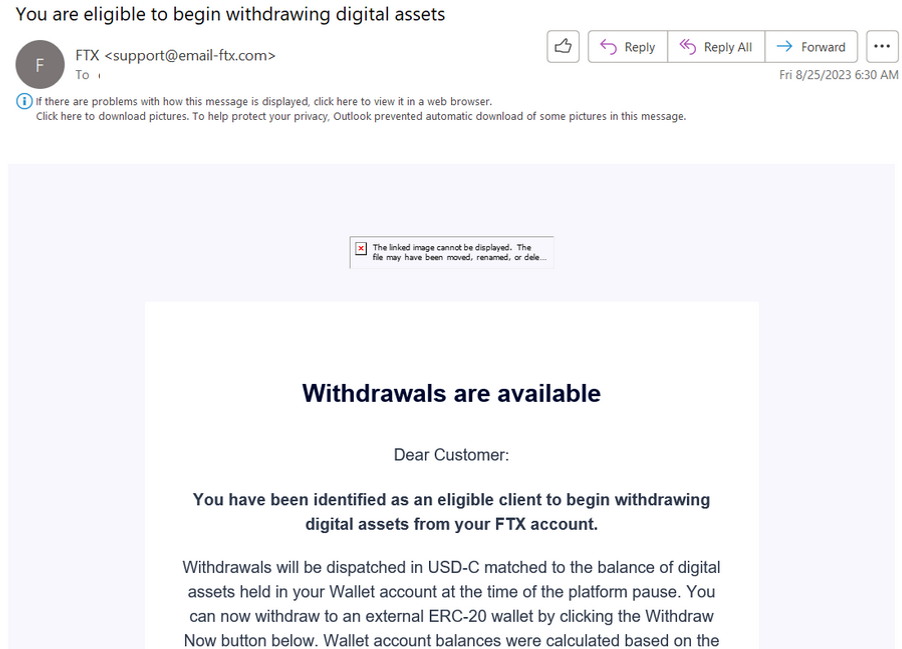
And there is some indication this is already happening. Multiple readers who said they got breach notices from Kroll today also shared phishing emails they received this morning that spoofed FTX and claimed, “You have been identified as an eligible client to begin withdrawing digital assets from your FTX account.”

A phishing message targeting FTX users that went out en masse today.

A major portion of Kroll’s business comes from helping organizations manage cyber risk. Kroll is often called in to investigate data breaches, and it also sells identity protection services to companies that recently experienced a breach and are grasping at ways to demonstrate that they doing something to protect their customers from further harm.

Kroll did not respond to questions. But it’s a good bet that BlockFi, FTX and Genesis customers will soon enjoy yet another offering of free credit monitoring as a result of the T-Mobile SIM swap.

Kroll’s website says it employs “elite cyber risk leaders uniquely positioned to deliver end-to-end cyber security services worldwide.” Apparently, these elite cyber risk leaders did not consider the increased attack surface presented by their employees using T-Mobile for wireless service.

The SIM-swapping attack against Kroll is a timely reminder that you should do whatever you can to minimize your reliance on mobile phone companies for your security. For example, many online services require you to provide a phone number upon registering an account, but that number can often be removed from your profile afterwards.

Why do I suggest this? Many online services allow users to reset their passwords just by clicking a link sent via SMS, and this unfortunately widespread practice has turned mobile phone numbers into de facto identity documents. Which means losing control over your phone number thanks to an unauthorized SIM swap or mobile number port-out, divorce, job termination or financial crisis can be devastating.

If you haven’t done so lately, take a moment to inventory your most important online accounts, and see how many of them can still have their password reset by receiving an SMS at the phone number on file. This may require stepping through the website’s account recovery or lost password flow.

If the account that stores your mobile phone number does not allow you to delete your number, check to see whether there is an option to disallow SMS or phone calls for authentication and account recovery. If more secure options are available, such as a security key or a one-time code from a mobile authentication app, please take advantage of those instead. The website 2fa.directory is a good starting point for this analysis.

Now, you might think that the mobile providers would share some culpability when a customer suffers a financial loss because a mobile store employee got tricked into transferring that customer’s phone number to criminals. But earlier this year, a California judge dismissed a lawsuit against AT&T that stemmed from a 2017 SIM-swapping attack which netted the thieves more than $24 million in cryptocurrency.

source https://krebsonsecurity.com/2023/08/kroll-employee-sim-swapped-for-crypto-investor-data/

Tourists Give Themselves Away by Looking Up. So Do Most Network Intruders.

In large metropolitan areas, tourists are often easy to spot because they’re far more inclined than locals to gaze upward at the surrounding skyscrapers. Security experts say this same tourist dynamic is a dead giveaway in virtually all computer intrusions that lead to devastating attacks like data theft and ransomware, and that more organizations should set simple virtual tripwires that sound the alarm when authorized users and devices are spotted exhibiting this behavior.

In a blog post published last month, Cisco Talos said it was seeing a worrisome “increase in the rate of high-sophistication attacks on network infrastructure.” Cisco’s warning comes amid a flurry of successful data ransom and state-sponsored cyber espionage attacks targeting some of the most well-defended networks on the planet.

But despite their increasing complexity, a great many initial intrusions that lead to data theft could be nipped in the bud if more organizations started looking for the telltale signs of newly-arrived cybercriminals behaving like network tourists, Cisco says.

“One of the most important things to talk about here is that in each of the cases we’ve seen, the threat actors are taking the type of ‘first steps’ that someone who wants to understand (and control) your environment would take,” Cisco’s Hazel Burton wrote. “Examples we have observed include threat actors performing a ‘show config,’ ‘show interface,’ ‘show route,’ ‘show arp table’ and a ‘show CDP neighbor.’ All these actions give the attackers a picture of a router’s perspective of the network, and an understanding of what foothold they have.”

Cisco’s alert concerned espionage attacks from China and Russia that abused vulnerabilities in aging, end-of-life network routers. But at a very important level, it doesn’t matter how or why the attackers got that initial foothold on your network.

It might be zero-day vulnerabilities in your network firewall or file-transfer appliance. Your more immediate and primary concern has to be: How quickly can you detect and detach that initial foothold?

The same tourist behavior that Cisco described attackers exhibiting vis-a-vis older routers is also incredibly common early on in ransomware and data ransom attacks — which often unfurl in secret over days or weeks as attackers methodically identify and compromise a victim’s key network assets.

These virtual hostage situations usually begin with the intruders purchasing access to the target’s network from dark web brokers who resell access to stolen credentials and compromised computers. As a result, when those stolen resources first get used by would-be data thieves, almost invariably the attackers will run a series of basic commands asking the local system to confirm exactly who and where they are on the victim’s network.

This fundamental reality about modern cyberattacks — that cybercriminals almost always orient themselves by “looking up” who and where they are upon entering a foreign network for the first time — forms the business model of an innovative security company called Thinkst, which gives away easy-to-use tripwires or “canaries” that can fire off an alert whenever all sorts of suspicious activity is witnessed.

“Many people have pointed out that there are a handful of commands that are overwhelmingly run by attackers on compromised hosts (and seldom ever by regular users/usage),” the Thinkst website explains. “Reliably alerting when a user on your code-sign server runs whoami.exe can mean the difference between catching a compromise in week-1 (before the attackers dig in) and learning about the attack on CNN.”

These canaries — or “canary tokens” — are meant to be embedded inside regular files, acting much like a web beacon or web bug that tracks when someone opens an email.

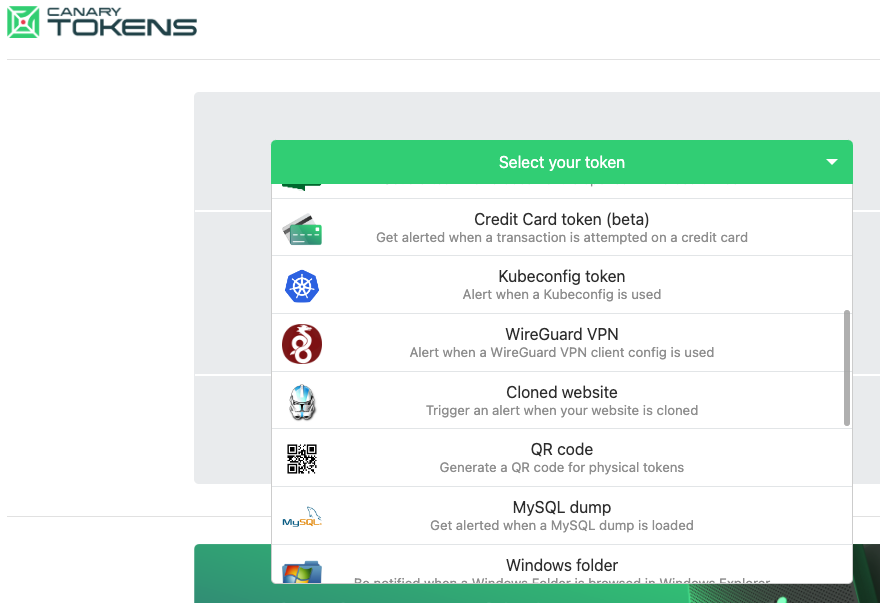
The Canary Tokens website from Thinkst Canary lists nearly two-dozen free customizable canaries.

“Imagine doing that, but for file reads, database queries, process executions or patterns in log files,” the Canary Tokens documentation explains. “Canarytokens does all this and more, letting you implant traps in your production systems rather than setting up separate honeypots.”

Thinkst operates alongside a burgeoning industry offering so-called “deception” or “honeypot” services — those designed to confuse, disrupt and entangle network intruders. But in an interview with KrebsOnSecurity, Thinkst founder and CEO Haroon Meer said most deception techniques involve some degree of hubris.

“Meaning, you’ll have deception teams in your network playing spy versus spy with people trying to break in, and it becomes this whole counterintelligence thing,” Meer said. “Nobody really has time for that. Instead, we are saying literally the opposite: That you’ve probably got all these [security improvement] projects that are going to take forever. But while you’re doing all that, just drop these 10 canaries, because everything else is going to take a long time to do.”

The idea here is to lay traps in sensitive areas of your network or web applications where few authorized users should ever trod. Importantly, the canary tokens themselves are useless to an attacker. For example, that AWS canary token sure looks like the digital keys to your cloud, but the token itself offers no access. It’s just a lure for the bad guys, and you get an alert when and if it is ever touched.

One nice thing about canary tokens is that Thinkst gives them away for free. Head over to canarytokens.org, and choose from a drop-down menu of available tokens, including:

-a web bug / URL token, designed to alert when a particular URL is visited;
-a DNS token, which alerts when a hostname is requested;
-an AWS token, which alerts when a specific Amazon Web Services key is used;
-a “custom exe” token, to alert when a specific Windows executable file or DLL is run;
-a “sensitive command” token, to alert when a suspicious Windows command is run.
-a Microsoft Excel/Word token, which alerts when a specific Excel or Word file is accessed.

Much like a “wet paint” sign often encourages people to touch a freshly painted surface anyway, attackers often can’t help themselves when they enter a foreign network and stumble upon what appear to be key digital assets, Meer says.

“If an attacker lands on your server and finds a key to your cloud environment, it’s really hard for them not to try it once,” Meer said. “Also, when these sorts of actors do land in a network, they have to orient themselves, and while doing that they are going to trip canaries.”

Meer says canary tokens are as likely to trip up attackers as they are “red teams,” security experts hired or employed by companies seeking to continuously probe their own computer systems and networks for security weaknesses.

“The concept and use of canary tokens has made me very hesitant to use credentials gained during an engagement, versus finding alternative means to an end goal,” wrote Shubham Shah, a penetration tester and co-founder of the security firm Assetnote. “If the aim is to increase the time taken for attackers, canary tokens work well.”

Thinkst makes money by selling Canary Tools, which is a paid version of Thinkst that is powered by a small hardware device designed to be installed on the local network as a canary token server.

“If you’ve got a sophisticated defense team, you can start putting these things in really interesting places,” Meer said. “Everyone says their stuff is simple, but we obsess over it. It’s really got to be so simple that people can’t mess it up. And if it works, it’s the best bang for your security buck you’re going to get.”

Further reading:

Dark Reading: Credential Canaries Create Minefield for Attackers
NCC Group: Extending a Thinkst Canary to Become an Interactive Honeypot
Cruise Automation’s experience deploying canary tokens

source https://krebsonsecurity.com/2023/08/tourists-give-themselves-away-by-looking-up-so-do-most-network-intruders/