Report: U.S. Cyber Command Behind Trickbot Tricks

A week ago, KrebsOnSecurity broke the news that someone was attempting to disrupt the Trickbot botnet, a malware crime machine that has infected millions of computers and is often used to spread ransomware. A new report Friday says the coordinated attack was part of an operation carried out by the U.S. military’s Cyber Command.

Image: Shuttstock.

On October 2, KrebsOnSecurity reported that twice in the preceding ten days, an unknown entity that had inside access to the Trickbot botnet sent all infected systems a command telling them to disconnect themselves from the Internet servers the Trickbot overlords used to control compromised Microsoft Windows computers.

On top of that, someone had stuffed millions of bogus records about new victims into the Trickbot database — apparently to confuse or stymie the botnet’s operators.

In a story published Oct. 9, The Washington Post reported that four U.S. officials who spoke on condition of anonymity said the Trickbot disruption was the work of U.S. Cyber Command, a branch of the Department of Defense headed by the director of the National Security Agency (NSA).

The Post report suggested the action was a bid to prevent Trickbot from being used to somehow interfere with the upcoming presidential election, noting that Cyber Command was instrumental in disrupting the Internet access of Russian online troll farms during the 2018 midterm elections.

The Post said U.S. officials recognized their operation would not permanently dismantle Trickbot, describing it rather as “one way to distract them for at least a while as they seek to restore their operations.”

Alex Holden, chief information security officer and president of Milwaukee-based Hold Security, has been monitoring Trickbot activity before and after the 10-day operation. Holden said while the attack on Trickbot appears to have cut its operators off from a large number of victim computers, the bad guys still have passwords, financial data and reams of other sensitive information stolen from more than 2.7 million systems around the world.

Holden said the Trickbot operators have begun rebuilding their botnet, and continue to engage in deploying ransomware at new targets.

“They are running normally and their ransomware operations are pretty much back in full swing,” Holden said. “The are not slowing down because they still have a great deal of stolen data.”

Holden added that since news of the disruption first broke a week ago, the Russian-speaking cybercriminals behind Trickbot have been discussing how to recoup their losses, and have been toying with the idea of massively increasing the amount of money demanded from future ransomware victims.

“There is a conversation happening in the back channels,” Holden said. “Normally, they will ask for [a ransom amount] that is something like 10 percent of the victim company’s annual revenues. Now, some of the guys involved are talking about increasing that to 100 percent or 150 percent.”

source https://krebsonsecurity.com/2020/10/report-u-s-cyber-command-behind-trickbot-tricks/

Amid an Embarrassment of Riches, Ransom Gangs Increasingly Outsource Their Work

There’s an old adage in information security: “Every company gets penetration tested, whether or not they pay someone for the pleasure.” Many organizations that do hire professionals to test their network security posture unfortunately tend to focus on fixing vulnerabilities hackers could use to break in. But judging from the proliferation of help-wanted ads for offensive pentesters in the cybercrime underground, today’s attackers have exactly zero trouble gaining that initial intrusion: The real challenge seems to be hiring enough people to help everyone profit from the access already gained.

One of the most common ways such access is monetized these days is through ransomware, which holds a victim’s data and/or computers hostage unless and until an extortion payment is made. But in most cases, there is a yawning gap of days, weeks or months between the initial intrusion and the deployment of ransomware within a victim organization.

That’s because it usually takes time and a good deal of effort for intruders to get from a single infected PC to seizing control over enough resources within the victim organization where it makes sense to launch the ransomware.

This includes pivoting from or converting a single compromised Microsoft Windows user account to an administrator account with greater privileges on the target network; the ability to sidestep and/or disable any security software; and gaining the access needed to disrupt or corrupt any data backup systems the victim firm may have.

Each day, millions of malware-laced emails are blasted out containing booby-trapped attachments. If the attachment is opened, the malicious document proceeds to quietly download additional malware and hacking tools to the victim machine (here’s one video example of a malicious Microsoft Office attachment from the malware sandbox service any.run). From there, the infected system will report home to a malware control server operated by the spammers who sent the missive.

At that point, control over the victim machine may be transferred or sold multiple times between different cybercriminals who specialize in exploiting such access. These folks are very often contractors who work with established ransomware groups, and who are paid a set percentage of any eventual ransom payments made by a victim company.

THE DOCTOR IS IN

Enter subcontractors like “Dr. Samuil,” a cybercriminal who has maintained a presence on more than a dozen top Russian-language cybercrime forums over the past 15 years. In a series of recent advertisements, Dr. Samuil says he’s eagerly hiring experienced people who are familiar with tools used by legitimate pentesters for exploiting access once inside of a target company — specifically, post-exploit frameworks like the closely-guarded Cobalt Strike.

“You will be regularly provided select accesses which were audited (these are about 10-15 accesses out of 100) and are worth a try,” Dr. Samuil wrote in one such help-wanted ad. “This helps everyone involved to save time. We also have private software that bypasses protection and provides for smooth performance.”

From other classified ads he posted in August and September 2020, it seems clear Dr. Samuil’s team has some kind of privileged access to financial data on targeted companies that gives them a better idea of how much cash the victim firm may have on hand to pay a ransom demand. To wit:

“There is huge insider information on the companies which we target, including information if there are tape drives and clouds (for example, Datto that is built to last, etc.), which significantly affects the scale of the conversion rate.

Requirements:
– experience with cloud storage, ESXi.
– experience with Active Directory.
– privilege escalation on accounts with limited rights.

* Serious level of insider information on the companies with which we work. There are proofs of large payments, but only for verified LEADs.
* There is also a private MEGA INSIDE , which I will not write about here in public, and it is only for experienced LEADs with their teams.
* We do not look at REVENUE / NET INCOME / Accountant reports, this is our MEGA INSIDE, in which we know exactly how much to confidently squeeze to the maximum in total.

According to cybersecurity firm Intel 471, Dr. Samuil’s ad is hardly unique, and there are several other seasoned cybercriminals who are customers of popular ransomware-as-a-service offerings that are hiring sub-contractors to farm out some of the grunt work.

“Within the cybercriminal underground, compromised accesses to organizations are readily bought, sold and traded,” Intel 471 CEO Mark Arena said. “A number of security professionals have previously sought to downplay the business impact cybercriminals can have to their organizations.”

“But because of the rapidly growing market for compromised accesses and the fact that these could be sold to anyone, organizations need to focus more on efforts to understand, detect and quickly respond to network compromises,” Arena continued. “That covers faster patching of the vulnerabilities that matter, ongoing detection and monitoring for criminal malware, and understanding the malware you are seeing in your environment, how it got there, and what it has or could have dropped subsequently.”

WHO IS DR. SAMUIL?

In conducting research for this story, KrebsOnSecurity learned that Dr. Samuil is the handle used by the proprietor of multi-vpn[.]biz, a long-running virtual private networking (VPN) service marketed to cybercriminals who are looking to anonymize and encrypt their online traffic by bouncing it through multiple servers around the globe.

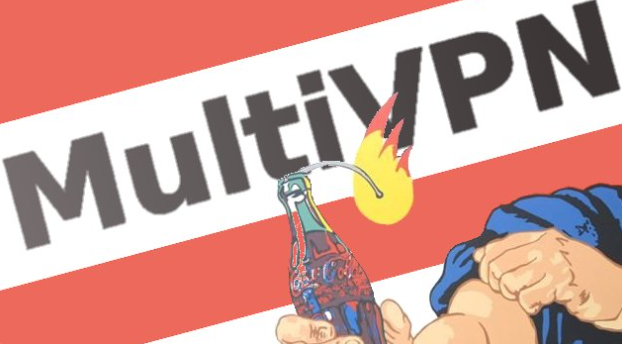
Have a Coke and a Molotov cocktail. Image: twitter.com/multivpn

MultiVPN is the product of a company called Ruskod Networks Solutions (a.k.a. ruskod[.]net), which variously claims to be based in the offshore company havens of Belize and the Seychelles, but which appears to be run by a guy living in Russia.

The domain registration records for ruskod[.]net were long ago hidden by WHOIS privacy services. But according to Domaintools.com [an advertiser on this site], the original WHOIS records for the site from the mid-2000s indicate the domain was originally registered by a Sergey Rakityansky.

This is not an uncommon name in Russia or in many surrounding Eastern European nations. But a former business partner of MultiVPN who had a rather public falling out with Dr. Samuil in the cybercrime underground told KrebsOnSecurity that Rakityansky is indeed Dr. Samuil’s real surname, and that he is a 32- or 33-year-old currently living in Bryansk, a city located approximately 200 miles southwest of Moscow.

Neither Dr. Samuil nor MultiVPN have responded to requests for comment.

source https://krebsonsecurity.com/2020/10/amid-an-embarrassment-of-riches-ransom-gangs-increasingly-outsource-their-work/

Promising Infusions of Cash, Fake Investor John Bernard Walked Away With $30M

September featured two stories on a phony tech investor named John Bernard, a pseudonym used by a convicted thief named John Clifton Davies who’s fleeced dozens of technology companies out of an estimated $30 million with the promise of lucrative investments. Those stories prompted a flood of tips from Davies’ victims that paint a much clearer picture of this serial con man and his cohorts, including allegations of hacking, smuggling, bank fraud and murder.

KrebsOnSecurity interviewed more than a dozen of Davies’ victims over the past five years, none of whom wished to be quoted here out of fear of reprisals from a man they say runs with mercenaries and has connections to organized crime.

As described in Part II of this series, John Bernard is in fact John Clifton Davies, a 59-year-old U.K. citizen who absconded from justice before being convicted on multiple counts of fraud in 2015. Prior to his conviction, Davies served 16 months in jail before being cleared of murdering his third wife on their honeymoon in India.

The scam artist John Bernard (left) in a recent Zoom call, and a photo of John Clifton Davies from 2015.

After eluding justice in the U.K., Davies reinvented himself as The Private Office of John Bernard, pretending to a be billionaire Swiss investor who made his fortunes in the dot-com boom 20 years ago and who was seeking investment opportunities.

In case after case, Bernard would promise to invest millions in tech startups, and then insist that companies pay tens of thousands of dollars worth of due diligence fees up front. However, the due diligence company he insisted on using — another Swiss firm called Inside Knowledge — also was secretly owned by Bernard, who would invariably pull out of the deal after receiving the due diligence money.

Bernard found a constant stream of new marks by offering extraordinarily generous finders fees to investment brokers who could introduce him to companies seeking an infusion of cash. When it came time for companies to sign legal documents, Bernard’s victims invariably interacted with a 40-something Inside Knowledge employee named “Katherine Miller,” who claimed to be his lawyer.

It turns out that Katherine Miller is a onetime Moldovan attorney who was previously known as Ecaterina “Katya” Dudorenko. She is listed as a Romanian lawyer in the U.K. Companies House records for several companies tied to John Bernard, including Inside Knowledge Solutions Ltd., Docklands Enterprise Ltd., and Secure Swiss Data Ltd (more on Secure Swiss data in a moment).

Another of Bernard’s associates listed as a director at Docklands Enterprise Ltd. is Sergey Valentinov Pankov. This is notable because in 2018, Pankov and Dudorenko were convicted of cigarette smuggling in the United Kingdom.

Sergey Pankov and Ecaterina Dudorenco, in undated photos. Source: Mynewsdesk.com

According to the Organized Crime and Corruption Reporting Project, “illicit trafficking of tobacco is a multibillion-dollar business today, fueling organized crime and corruption [and] robbing governments of needed tax money. So profitable is the trade that tobacco is the world’s most widely smuggled legal substance. This booming business now stretches from counterfeiters in China and renegade factories in Russia to Indian reservations in New York and warlords in Pakistan and North Africa.”

Like their erstwhile boss Mr. Davies, both Pankov and Dudorenko disappeared before their convictions in the U.K. They were sentenced in absentia to two and a half years in prison.

Incidentally, Davies was detained by Ukrainian authorities in 2018, although he is not mentioned by name in this story from the Ukrainian daily Pravda. The story notes that the suspect moved to Kiev in 2014 and lived in a rented apartment with his Ukrainian wife.

John’s fourth wife, Iryna Davies, is listed as a director of one of the insolvency consulting businesses in the U.K. that was part of John Davies’ 2015 fraud conviction. Pravda reported that in order to confuse the Ukrainian police and hide from them, Mr. Davies constantly changed their place of residence.

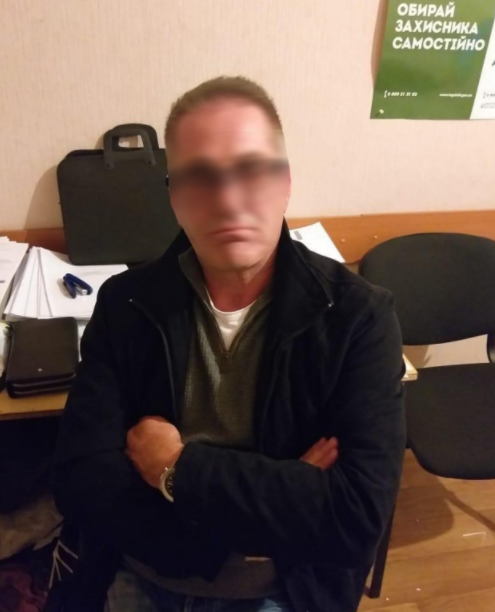
John Clifton Davies, a.k.a. John Bernard. Image: Ukrainian National Police.

The Pravda story says Ukrainian authorities were working with the U.K. government to secure Davies’ extradition, but he appears to have slipped away once again. That’s according to one investment broker who’s been tracking Davies’ trail of fraud since 2015.

According to that source — who we’ll call “Ben” — Inside Knowledge and The Private Office of John Bernard have fleeced dozens of companies out of nearly USD $30 million in due diligence fees over the years, with one company reportedly paying over $1 million.

Ben said he figured out that Bernard was Davies through a random occurrence. Ben said he’d been told by a reliable source that Bernard traveled everywhere in Kiev with several armed guards, and that his entourage rode in a convoy that escorted Davies’ high-end Bentley. Ben said Davies’ crew was even able to stop traffic in the downtown area in what was described as a quasi military maneuver so that Davies’ vehicle could proceed unobstructed (and presumably without someone following his car).

Ben said he’s spoken to several victims of Bernard who saw phony invoices for payments to be made to banks in Eastern Europe appear to come from people within their own organization shortly after cutting off contact with Bernard and his team.

While Ben allowed that these invoices could have come from another source, it’s worth noting that by virtue of participating in the due diligence process, the companies targeted by these schemes would have already given Bernard’s office detailed information about their finances, bank accounts and security processes.

In some cases, the victims had agreed to use Bernard’s Secure Swiss Data software and services to store documents for the due diligence process. Secure Swiss Data is one of several firms founded by Davies/Inside Knowledge and run by Dudorenko, and it advertised itself as a Swiss company that provides encrypted email and data storage services. In February 2020, Secure Swiss Data was purchased in an “undisclosed multimillion buyout” by SafeSwiss Secure Communication AG.

Shortly after the first story on John Bernard was published here, virtually all of the employee profiles tied to Bernard’s office removed him from their work experience as listed on their LinkedIn resumes — or else deleted their profiles altogether. Also, John Bernard’s main website — the-private-office.ch — replaced the content on its homepage with a note saying it was closing up shop.

Incredibly, even after the first two stories ran, Bernard/Davies and his crew continued to ply their scam with companies that had already agreed to make due diligence payments, or that had made one or all of several installment payments.

One of those firms actually issued a press release in August saying it had been promised an infusion of millions in cash from John Bernard’s Private Office. They declined to be quoted here, and continue to hold onto hope that Mr. Bernard is not the crook that he plainly is.

source https://krebsonsecurity.com/2020/10/promising-infusions-of-cash-fake-investor-john-bernard-walked-away-with-30m/

Attacks Aimed at Disrupting the Trickbot Botnet

Over the past 10 days, someone has been launching a series of coordinated attacks designed to disrupt Trickbot, an enormous collection of more than two million malware-infected Windows PCs that are constantly being harvested for financial data and are often used as the entry point for deploying ransomware within compromised organizations.

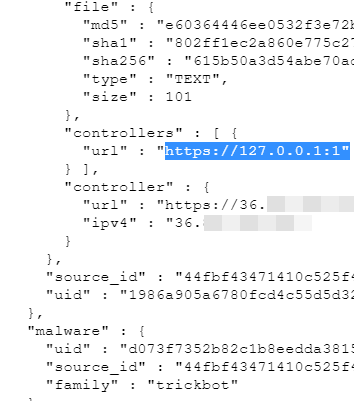
A text snippet from one of the bogus Trickbot configuration updates. Source: Intel 471

On Sept. 22, someone pushed out a new configuration file to Windows computers currently infected with Trickbot. The crooks running the Trickbot botnet typically use these config files to pass new instructions to their fleet of infected PCs, such as the Internet address where hacked systems should download new updates to the malware.

But the new configuration file pushed on Sept. 22 told all systems infected with Trickbot that their new malware control server had the address 127.0.0.1, which is a “localhost” address that is not reachable over the public Internet, according to an analysis by cyber intelligence firm Intel 471.

It’s not known how many Trickbot-infected systems received the phony update, but it seems clear this wasn’t just a mistake by Trickbot’s overlords. Intel 471 found that it happened yet again on Oct. 1, suggesting someone with access to the inner workings of the botnet was trying to disrupt its operations.

“Shortly after the bogus configs were pushed out, all Trickbot controllers stopped responding correctly to bot requests,” Intel 471 wrote in a note to its customers. “This possibly means central Trickbot controller infrastructure was disrupted. The close timing of both events suggested an intentional disruption of Trickbot botnet operations.”

Intel 471 CEO Mark Arena said it’s anyone’s guess at this point who is responsible.

“Obviously, someone is trying to attack Trickbot,” Arena said. “It could be someone in the security research community, a government, a disgruntled insider, or a rival cybercrime group. We just don’t know at this point.

Arena said it’s unclear how successful these bogus configuration file updates will be given that the Trickbot authors built a fail-safe recovery system into their malware. Specifically, Trickbot has a backup control mechanism: A domain name registered on EmerDNS, a decentralized domain name system.

“This domain should still be in control of the Trickbot operators and could potentially be used to recover bots,” Intel 471 wrote.

But whoever is screwing with the Trickbot purveyors appears to have adopted a multi-pronged approach: Around the same time as the second bogus configuration file update was pushed on Oct. 1, someone stuffed the control networks that the Trickbot operators use to keep track of data on infected systems with millions of new records.

Alex Holden is chief technology officer and founder of Hold Security, a Milwaukee-based cyber intelligence firm that helps recover stolen data. Holden said at the end of September Trickbot held passwords and financial data stolen from more than 2.7 million Windows PCs.

By October 1, Holden said, that number had magically grown to more than seven million.

“Someone is flooding the Trickbot system with fake data,” Holden said. “Whoever is doing this is generating records that include machine names indicating these are infected systems in a broad range of organizations, including the Department of Defense, U.S. Bank, JP Morgan Chase, PNC and Citigroup, to name a few.”

Holden said the flood of new, apparently bogus, records appears to be an attempt by someone to dilute the Trickbot database and confuse or stymie the Trickbot operators. But so far, Holden said, the impact has been mainly to annoy and aggravate the criminals in charge of Trickbot.

“Our monitoring found at least one statement from one of the ransomware groups that relies on Trickbot saying this pisses them off, and they’re going to double the ransom they’re asking for from a victim,” Holden said. “We haven’t been able to confirm whether they actually followed through with that, but these attacks are definitely interfering with their business.”

Intel 471’s Arena said this could be part of an ongoing campaign to dismantle or wrest control over the Trickbot botnet. Such an effort would hardly be unprecedented. In 2014, for example, U.S. and international law enforcement agencies teamed up with multiple security firms and private researchers to commandeer the Gameover Zeus Botnet, a particularly aggressive and sophisticated malware strain that had enslaved up to 1 million Windows PCs globally.

Trickbot would be an attractive target for such a takeover effort because it is widely viewed as a platform used to find potential ransomware victims. Intel 471 describes Trickbot as “a malware-as-a-service platform that caters to a relatively small number of top-tier cybercriminals.”

One of the top ransomware gangs in operation today — which deploys ransomware strains known variously as “Ryuk” and “Conti,” is known to be closely associated with Trickbot infections. Both ransomware families have been used in some of the most damaging and costly malware incidents to date.

The latest Ryuk victim is Universal Health Services (UHS), a Fortune 500 hospital and healthcare services provider that operates more than 400 facilities in the U.S. and U.K.

On Sunday, Sept. 27, UHS shut down its computer systems at healthcare facilities across the United States in a bid to stop the spread of the malware. The disruption has reportedly caused the affected hospitals to redirect ambulances and relocate patients in need of surgery to other nearby hospitals.

source https://krebsonsecurity.com/2020/10/attacks-aimed-at-disrupting-the-trickbot-botnet/

Ransomware Victims That Pay Up Could Incur Steep Fines from Uncle Sam

Companies victimized by ransomware and firms that facilitate negotiations with ransomware extortionists could face steep fines from the U.S. federal government if the crooks who profit from the attack are already under economic sanctions, the Treasury Department warned today.

Image: Shutterstock

In its advisory (PDF), the Treasury’s Office of Foreign Assets Control (OFAC) said “companies that facilitate ransomware payments to cyber actors on behalf of victims, including financial institutions, cyber insurance firms, and companies involved in digital forensics and incident response, not only encourage future ransomware payment demands but also may risk violating OFAC regulations.”

As financial losses from cybercrime activity and ransomware attacks in particular have skyrocketed in recent years, the Treasury Department has imposed economic sanctions on several cybercriminals and cybercrime groups, effectively freezing all property and interests of these persons (subject to U.S. jurisdiction) and making it a crime to transact with them.

A number of those sanctioned have been closely tied with ransomware and malware attacks, including the North Korean Lazarus Group; two Iranians thought to be tied to the SamSam ransomware attacks; Evgeniy Bogachev, the developer of Cryptolocker; and Evil Corp, a Russian cybercriminal syndicate that has used malware to extract more than $100 million from victim businesses.

Those that run afoul of OFAC sanctions without a special dispensation or “license” from Treasury can face several legal repercussions, including fines of up to $20 million.

The Federal Bureau of Investigation (FBI) and other law enforcement agencies have tried to discourage businesses hit by ransomware from paying their extortionists, noting that doing so only helps bankroll further attacks.

But in practice, a fair number of victims find paying up is the fastest way to resume business as usual. In addition, insurance providers often help facilitate the payments because the amount demanded ends up being less than what the insurer might have to pay to cover the cost of the affected business being sidelined for days or weeks at a time.

While it may seem unlikely that companies victimized by ransomware might somehow be able to know whether their extortionists are currently being sanctioned by the U.S. government, they still can be fined either way, said Ginger Faulk, a partner in the Washington, D.C. office of the law firm Eversheds Sutherland.

Faulk said OFAC may impose civil penalties for sanctions violations based on “strict liability,” meaning that a person subject to U.S. jurisdiction may be held civilly liable even if it did not know or have reason to know it was engaging in a transaction with a person that is prohibited under sanctions laws and regulations administered by OFAC.

“In other words, in order to be held liable as a civil (administrative) matter (as opposed to criminal), no mens rea or even ‘reason to know’ that the person is sanctioned is necessary under OFAC regulations,” Faulk said.

But Fabian Wosar, chief technology officer at computer security firm Emsisoft, said Treasury’s policies here are nothing new, and that they mainly constitute a warning for individual victim firms who may not already be working with law enforcement and/or third-party security firms.

Wosar said companies that help ransomware victims negotiate lower payments and facilitate the financial exchange are already aware of the legal risks from OFAC violations, and will generally refuse clients who get hit by certain ransomware strains.

“In my experience, OFAC and cyber insurance with their contracted negotiators are in constant communication,” he said. “There are often even clearing processes in place to ascertain the risk of certain payments violating OFAC.”

Along those lines, OFAC said the degree of a person/company’s awareness of the conduct at issue is a factor the agency may consider in assessing civil penalties. OFAC said it would consider “a company’s self-initiated, timely, and complete report of a ransomware attack to law enforcement to be a significant mitigating factor in determining an appropriate enforcement outcome if the situation is later determined to have a sanctions nexus.”

source https://krebsonsecurity.com/2020/10/ransomware-victims-that-pay-up-could-incur-steep-fines-from-uncle-sam/

Who’s Behind Monday’s 14-State 911 Outage?

Emergency 911 systems were down for more than an hour on Monday in towns and cities across 14 U.S. states. The outages led many news outlets to speculate the problem was related to Microsoft‘s Azure web services platform, which also was struggling with a widespread outage at the time. However, multiple sources tell KrebsOnSecurity the 911 issues stemmed from some kind of technical snafu involving Intrado and Lumen, two companies that together handle 911 calls for a broad swath of the United States.

Image: West.com

On the afternoon of Monday, Sept. 28, several states including Arizona, California, Colorado, Delaware, Florida, Illinois, Indiana, Minnesota, Nevada, North Carolina, North Dakota, Ohio, Pennsylvania and Washington reported 911 outages in various cities and localities.

Multiple news reports suggested the outages might have been related to an ongoing service disruption at Microsoft. But a spokesperson for the software giant told KrebsOnSecurity, “we’ve seen no indication that the multi-state 911 outage was a result of yesterday’s Azure service disruption.”

Inquiries made with emergency dispatch centers at several of the towns and cities hit by the 911 outage pointed to a different source: Omaha, Neb.-based Intrado — until last year known as West Safety Communications — a provider of 911 and emergency communications infrastructure, systems and services to telecommunications companies and public safety agencies throughout the country.

Intrado did not respond to multiple requests for comment. But according to officials in Henderson County, NC, which experienced its own 911 failures yesterday, Intrado said the outage was the result of a problem with an unspecified service provider.

“On September 28, 2020, at 4:30pm MT, our 911 Service Provider observed conditions internal to their network that resulted in impacts to 911 call delivery,” reads a statement Intrado provided to county officials. “The impact was mitigated, and service was restored and confirmed to be functional by 5:47PM MT.  Our service provider is currently working to determine root cause.”

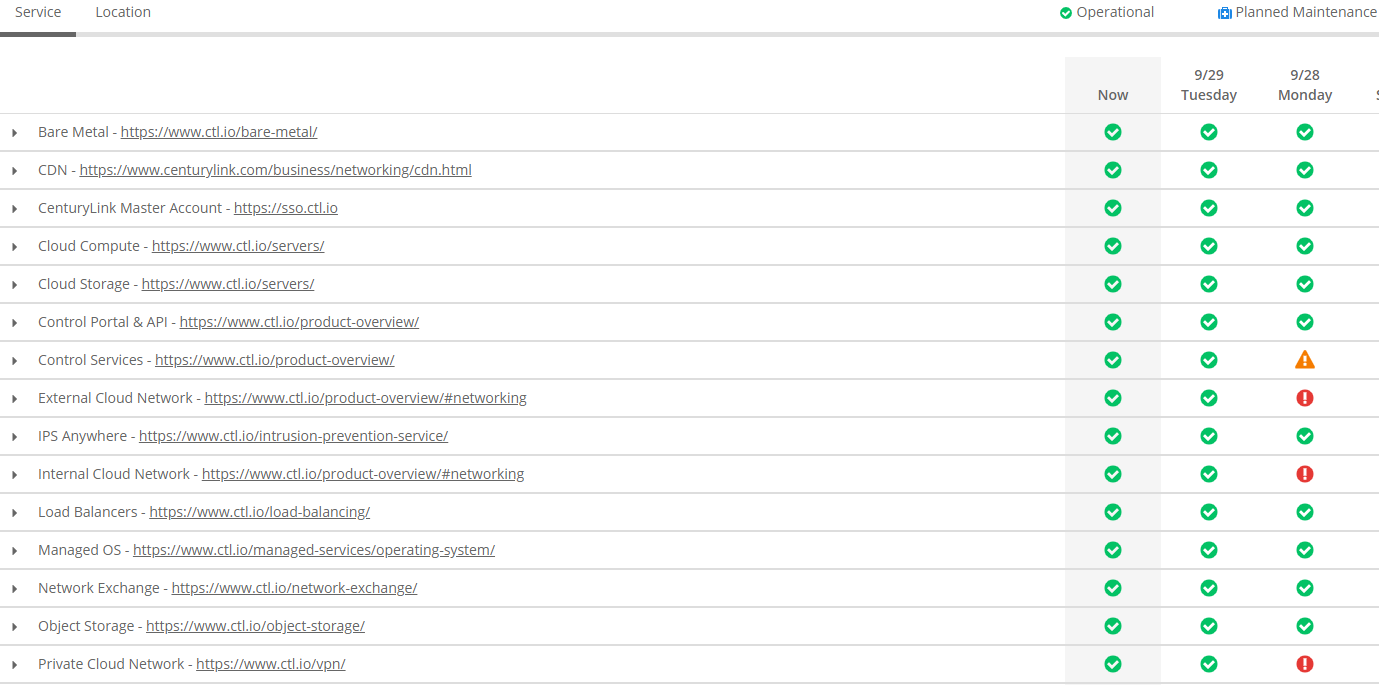
The service provider referenced in Intrado’s statement appears to be Lumen, a communications firm and 911 provider that until very recently was known as CenturyLink Inc. A look at the company’s status page indicates multiple Lumen systems experienced total or partial service disruptions on Monday, including its private and internal cloud networks and its control systems network.

Lumen’s status page indicates the company’s private and internal cloud and control system networks had outages or service disruptions on Monday.

In a statement provided to KrebsOnSecurity, Lumen blamed the issue on Intrado.

“At approximately 4:30 p.m. MT, some Lumen customers were affected by a vendor partner event that impacted 911 services in AZ, CO, NC, ND, MN, SD, and UT,” the statement reads. “Service was restored in less than an hour and all 911 traffic is routing properly at this time. The vendor partner is in the process of investigating the event.”

It may be no accident that both of these companies are now operating under new names, as this would hardly be the first time a problem between the two of them has disrupted 911 access for a large number of Americans.

In 2019, Intrado/West and CenturyLink agreed to pay $575,000 to settle an investigation by the Federal Communications Commission (FCC) into an Aug. 2018 outage that lasted 65 minutes. The FCC found that incident was the result of a West Safety technician bungling a configuration change to the company’s 911 routing network.

On April 6, 2014, some 11 million people across the United States were disconnected from 911 services for eight hours thanks to an “entirely preventable” software error tied to Intrado’s systems. The incident affected 81 call dispatch centers, rendering emergency services inoperable in all of Washington and parts of North Carolina, South Carolina, Pennsylvania, California, Minnesota and Florida.

According to a 2014 Washington Post story about a subsequent investigation and report released by the FCC, that issue involved a problem with the way Intrado’s automated system assigns a unique identifying code to each incoming call before passing it on to the appropriate “public safety answering point,” or PSAP.

“On April 9, the software responsible for assigning the codes maxed out at a pre-set limit,” The Post explained. “The counter literally stopped counting at 40 million calls. As a result, the routing system stopped accepting new calls, leading to a bottleneck and a series of cascading failures elsewhere in the 911 infrastructure.”

Compounding the length of the 2014 outage, the FCC found, was that the Intrado server responsible for categorizing and keeping track of service interruptions classified them as “low level” incidents that were never flagged for manual review by human beings.

The FCC ultimately fined Intrado and CenturyLink $17.4 million for the multi-state 2014 outage. An FCC spokesperson declined to comment on Monday’s outage, but said the agency was investigating the incident.

source https://krebsonsecurity.com/2020/09/whos-behind-mondays-14-state-911-outage/

Who is Tech Investor John Bernard?

John Bernard, the subject of a story here last week about a self-proclaimed millionaire investor who has bilked countless tech startups, appears to be a pseudonym for John Clifton Davies, a U.K. man who absconded from justice before being convicted on multiple counts of fraud in 2015. Prior to his conviction, Davies served 16 months in jail before being cleared of murdering his wife on their honeymoon in India.

The Private Office of John Bernard, which advertises itself as a capital investment firm based in Switzerland, has for years been listed on multiple investment sites as the home of a millionaire who made his fortunes in the dot-com boom 20 years ago and who has oodles of cash to invest in tech startups.

But as last week’s story noted, Bernard’s investment company is a bit like a bad slot machine that never pays out. KrebsOnSecurity interviewed multiple investment brokers who all told the same story: After promising to invest millions after one or two phone calls and with little or no pushback, Bernard would insist that companies pay tens of thousands of dollars worth of due diligence fees up front.

However, the due diligence company he insisted on using — another Swiss firm called Inside Knowledge — also was secretly owned by Bernard, who would invariably pull out of the deal after receiving the due diligence money.

Neither Mr. Bernard nor anyone from his various companies responded to multiple requests for comment over the past few weeks. What’s more, virtually all of the employee profiles tied to Bernard’s office have since last week removed those firms from their work experience as listed on their LinkedIn resumes — or else deleted their profiles altogether.

Sometime on Thursday John Bernard’s main website — the-private-office.ch — replaced the content on its homepage with a note saying it was closing up shop.

“We are pleased to announce that we are currently closing The Private Office fund as we have reached our intended investment level and that we now plan to focus on helping those companies we have invested into to grow and succeed,” the message reads.

As noted in last week’s story, the beauty of a scam like the one multiple investment brokers said was being run by Mr. Bernard is that companies bilked by small-time investment schemes rarely pursue legal action, mainly because the legal fees involved can quickly surpass the losses. What’s more, most victims will likely be too ashamed to come forward.

Also, John Bernard’s office typically did not reach out to investment brokers directly. Rather, he had his firm included on a list of angel investors focused on technology companies, so those seeking investments usually came to him.

Finally, multiple sources interviewed for this story said Bernard’s office offered a finders fee for any investment leads that brokers brought his way. While such commissions are not unusual, the amount promised — five percent of the total investment in a given firm that signed an agreement — is extremely generous. However, none of the investment brokers who spoke to KrebsOnSecurity were able to collect those fees, because Bernard’s office never actually consummated any of the deals they referred to him.

PAY NO ATTENTION TO THE EMPTY BOOKSHELVES

After last week’s story ran, KrebsOnSecurity heard from a number of other investment brokers who had near identical experiences with Bernard. Several said they at one point spoke with him via phone or Zoom conference calls, and that he had a distinctive British accent.

When questioned about why his staff was virtually all based in Ukraine when his companies were supposedly in Switzerland, Bernard replied that his wife was Ukrainian and that they were living there to be closer to her family.

One investment broker who recently got into a deal with Bernard shared a screen shot from a recent Zoom call with him. That screen shot shows Bernard bears a striking resemblance to one John Clifton Davies, a 59-year-old from Milton Keynes, a large town in Buckinghamshire, England about 50 miles (80 km) northwest of London.
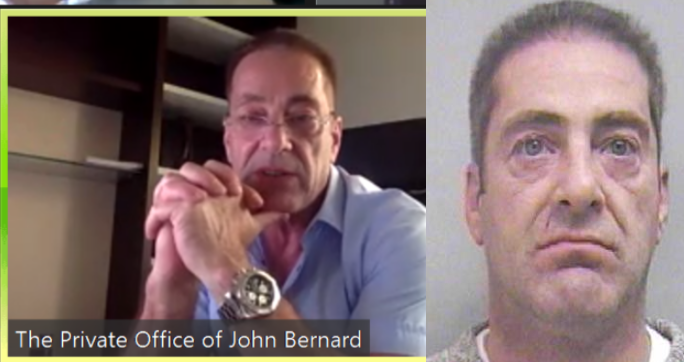
John Bernard (left) in a recent Zoom call, and a photo of John Clifton Davies from 2015.

In 2015, Mr. Davies was convicted of stealing more than GBP 750,000 from struggling companies looking to restructure their debt. For at least seven years, Davies ran multiple scam businesses that claimed to provide insolvency consulting to distressed companies, even though he was not licensed to do so.

“After gaining the firm’s trust, he took control of their assets and would later pocket the cash intended for creditors,” according to a U.K. news report from 2015. “After snatching the cash, Davies proceeded to spend the stolen money on a life of luxury, purchasing a new upmarket home fitted with a high-tech cinema system and new kitchen.”

Davies disappeared before he was convicted of fraud in 2015. Two years before that, Davies was released from prison after being held in custody for 16 months on suspicion of murdering his new bride in 2004 on their honeymoon in India.

Davies’ former wife Colette Davies, 39, died after falling 80 feet from a viewing point at a steep gorge in the Himachal Pradesh region of India. Mr. Davies was charged with murder and fraud after he attempted to collect GBP 132,000 in her life insurance payout, but British prosecutors ultimately conceded they did not have enough evidence to convict him.

THE SWISS AND UKRAINE CONNECTIONS

While the photos above are similar, there are other clues that suggest the two identities may be the same person. A review of business records tied to Davies’ phony insolvency consulting businesses between 2007 and 2013 provides some additional pointers.

John Clifton Davies’ former listing at the official U.K. business registrar Companies House show his company was registered at the address 26 Dean Forest Way, Broughton, Milton Keynes.

A search on that street address at 4iq.com turns up several interesting results, including a listing for senecaequities.com registered to a John Davies at the email address john888@myswissmail.ch.

A Companies House official record for Seneca Equities puts it at John Davies’ old U.K. address at 26 Dean Forest Way and lists 46-year-old Iryna Davies as a director. “Iryna” is a uniquely Ukrainian spelling of the name Irene (the Russian equivalent is typically “Irina”).

A search on John Clifton Davies and Iryna turned up this 2013 story from The Daily Mirror which says Iryna is John C. Davies’ fourth wife, and that the two were married in 2010.

KrebsOnSecurity sought comment from both the U.K. police district that prosecuted Davies’ case and the U.K.’s National Crime Agency (NCA). Neither wished to comment on the findings. “We can neither confirm nor deny the existence of an investigation or subjects of interest,” a spokesperson for the NCA said.

source https://krebsonsecurity.com/2020/09/who-is-tech-investor-john-bernard/
Microsoft: Attackers Exploiting ‘ZeroLogon’ Windows Flaw

Microsoft warned on Wednesday that malicious hackers are exploiting a particularly dangerous flaw in Windows Server systems that could be used to give attackers the keys to the kingdom inside a vulnerable corporate network. Microsoft’s warning comes just days after the U.S. Department of Homeland Security issued an emergency directive instructing all federal agencies to patch the vulnerability by Sept. 21 at the latest.

DHS’s Cybersecurity and Infrastructure Agency (CISA) said in the directive that it expected imminent exploitation of the flaw — CVE-2020-1472 and dubbed “ZeroLogon” — because exploit code which can be used to take advantage of it was circulating online.

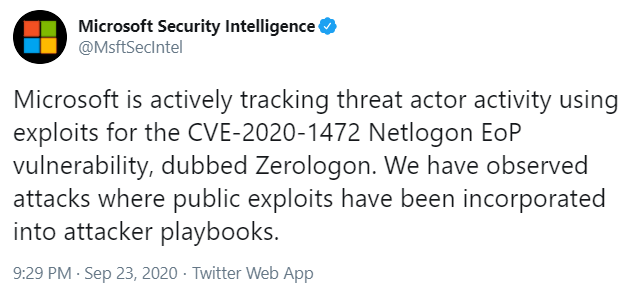
Last night, Microsoft’s Security Intelligence unit tweeted that the company is “tracking threat actor activity using exploits for the CVE-2020-1472 Netlogon vulnerability.”

“We have observed attacks where public exploits have been incorporated into attacker playbooks,” Microsoft said. “We strongly recommend customers to immediately apply security updates.”

Microsoft released a patch for the vulnerability in August, but it is not uncommon for businesses to delay deploying updates for days or weeks while testing to ensure the fixes do not interfere with or disrupt specific applications and software.

CVE-2020-1472 earned Microsoft’s most-dire “critical” severity rating, meaning attackers can exploit it with little or no help from users. The flaw is present in most supported versions of Windows Server, from Server 2008 through Server 2019.

The vulnerability could let an unauthenticated attacker gain administrative access to a Windows domain controller and run an application of their choosing. A domain controller is a server that responds to security authentication requests in a Windows environment, and a compromised domain controller can give attackers the keys to the kingdom inside a corporate network.

Scott Caveza, research engineering manager at security firm Tenable, said several samples of malicious .NET executables with the filename ‘SharpZeroLogon.exe’ have been uploaded to VirusTotal, a service owned by Google that scans suspicious files against dozens of antivirus products.

“Given the flaw is easily exploitable and would allow an attacker to completely take over a Windows domain, it should come as no surprise that we’re seeing attacks in the wild,” Caveza said. “Administrators should prioritize patching this flaw as soon as possible. Based on the rapid speed of exploitation already, we anticipate this flaw will be a popular choice amongst attackers and integrated into malicious campaigns.”

source https://krebsonsecurity.com/2020/09/microsoft-attackers-exploiting-zerologon-windows-flaw/

Bad Actor Caught

A suspect initially investigated by my former Team in Washington, D.C. approximately 3 years ago was just recently indicted on 126 counts of felony charges related to fraud at the federal level. Although the original Team responsible for initially finding and investigating this bad actor is no longer in service, this indictment serves as just one testimony to the effectiveness of my former team in hunting and catching bad hombres such as this for the greater good. We didn’t catch ’em all—but we did make a few sizeable dents.

Govt. Services Firm Tyler Technologies Hit in Apparent Ransomware Attack

Tyler Technologies, a Texas-based company that bills itself as the largest provider of software and technology services to the United States public sector, is battling a network intrusion that has disrupted its operations. The company declined to discuss the exact cause of the disruption, but their response so far is straight out of the playbook for responding to ransomware incidents.

Plano, Texas-based Tyler Technologies [NYSE:TYL] has some 5,300 employees and brought in revenues of more than $1 billion in 2019. It sells a broad range of services to state and local governments, including appraisal and tax software, integrated software for courts and justice agencies, enterprise financial software systems, public safety software, records/document management software solutions and transportation software solutions for schools.

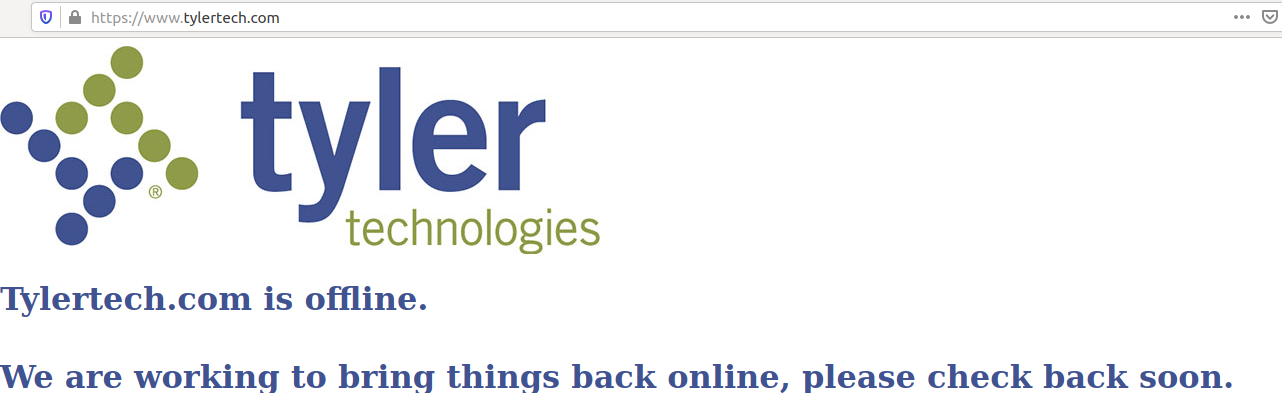
Earlier today, the normal content on tylertech.com was replaced with a notice saying the site was offline. In a statement provided to KrebsOnSecurity after the markets closed central time, Tyler Tech said early this morning the company became aware that an unauthorized intruder had gained access to its phone and information technology systems.

“Upon discovery and out of an abundance of caution, we shut down points of access to external systems and immediately began investigating and remediating the problem,” Tyler’s Chief Information Officer Matt Bieri said. “We have since engaged outside IT security and forensics experts to conduct a detailed review and help us securely restore affected equipment. We are implementing enhanced monitoring systems, and we have notified law enforcement.”

“At this time and based on the evidence available to us to-date, all indications are that the impact of this incident is limited to our internal network and phone systems,” their statement continues. “We currently have no reason to believe that any client data, client servers, or hosted systems were affected.”

While it may be comforting to hear that last bit, the reality is that it is still early in the company’s investigation. Also, ransomware has moved well past just holding a victim firm’s IT systems hostage in exchange for an extortion payment: These days, ransomware purveyors will offload as much personal and financial data that they can before unleashing their malware, and then often demand a second ransom payment in exchange for a promise to delete the stolen information or to refrain from publishing it online.

Tyler Technologies declined to say how the intrusion is affecting its customers. But several readers who work in IT roles at local government systems that rely on Tyler Tech said the outage had disrupted the ability of people to pay their water bills or court payments.

“Tyler has access to a lot of these servers in cities and counties for remote support, so it was very thoughtful of them to keep everyone in the dark and possibly exposed if the attackers made off with remote support credentials while waiting for the stock market to close,” said one reader who asked to remain anonymous.

Depending on how long it takes for Tyler to recover from this incident, it could have a broad impact on the ability of many states and localities to process payments for services or provide various government resources online.

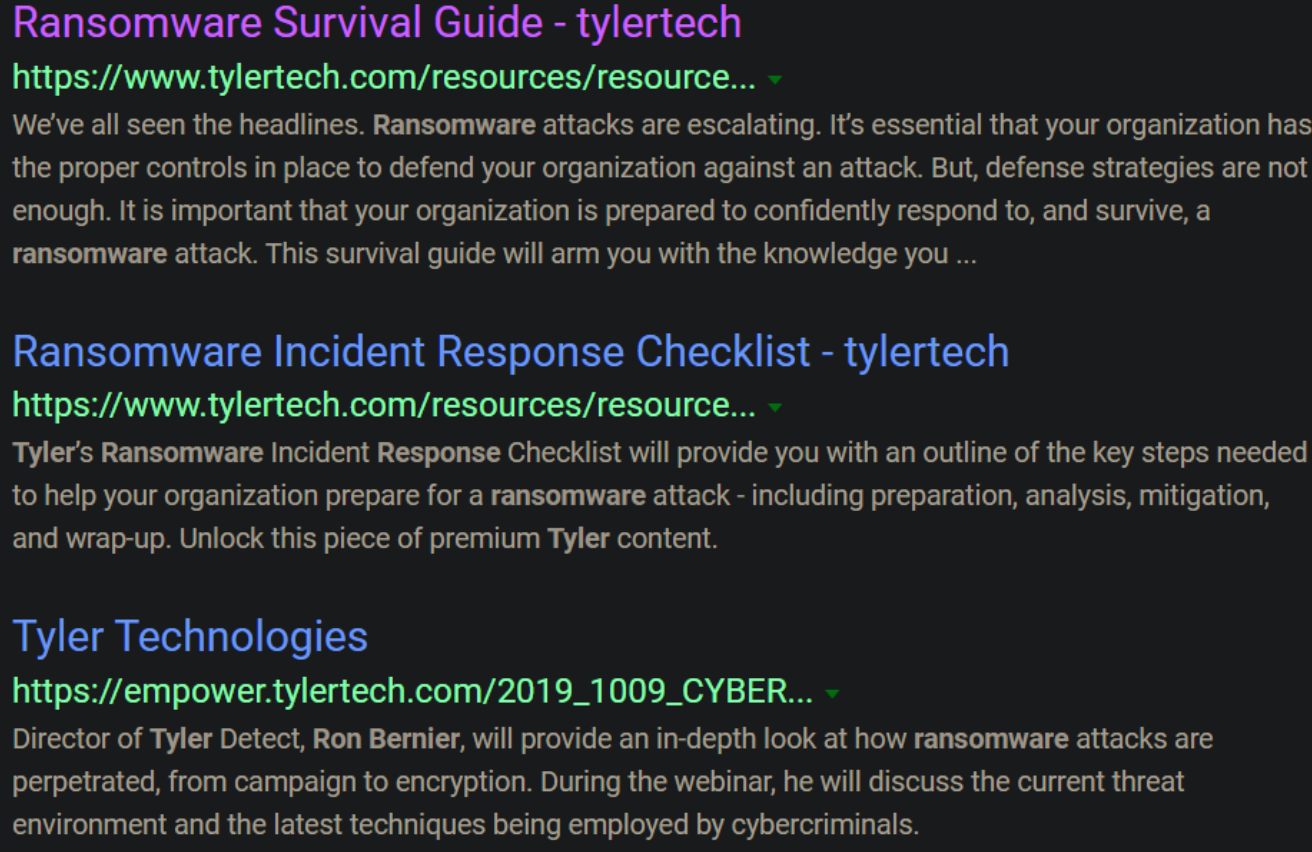
Tyler Tech has pivoted on the threat of ransomware as a selling point for many of its services, using its presence on social media to promote ransomware survival guides and incident response checklists. With any luck, the company was following some of its own advice and will weather this storm quickly.

source https://krebsonsecurity.com/2020/09/govt-services-firm-tyler-technologies-hit-in-apparent-ransomware-attack/