Why Paying to Delete Stolen Data is Bonkers

Companies hit by ransomware often face a dual threat: Even if they avoid paying the ransom and can restore things from scratch, about half the time the attackers also threaten to release sensitive stolen data unless the victim pays for a promise to have the data deleted. Leaving aside the notion that victims might have any real expectation the attackers will actually destroy the stolen data, new research suggests a fair number of victims who do pay up may see some or all of the stolen data published anyway.
The findings come in a report today from Coveware, a company that specializes in helping firms recover from ransomware attacks. Coveware says nearly half of all ransomware cases now include the threat to release exfiltrated data.

“Previously, when a victim of ransomware had adequate backups, they would just restore and go on with life; there was zero reason to even engage with the threat actor,” the report observes. “Now, when a threat actor steals data, a company with perfectly restorable backups is often compelled to at least engage with the threat actor to determine what data was taken.”

Coveware said it has seen ample evidence of victims seeing some or all of their stolen data published after paying to have it deleted; in other cases, the data gets published online before the victim is even given a chance to negotiate a data deletion agreement.

“Unlike negotiating for a decryption key, negotiating for the suppression of stolen data has no finite end,” the report continues. “Once a victim receives a decryption key, it can’t be taken away and does not degrade with time. With stolen data, a threat actor can return for a second payment at any point in the future. The track records are too short and evidence that defaults are selectively occurring is already collecting.”
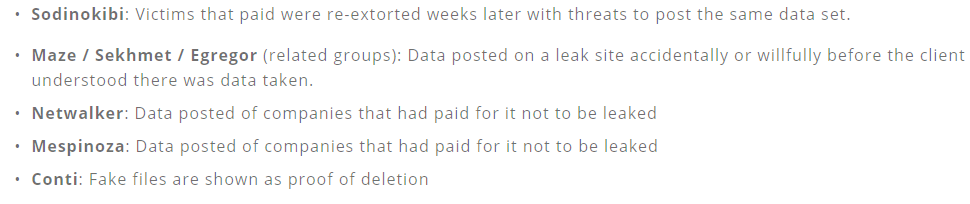
Image: Coveware Q3 2020 report.

The company said it advises clients never to pay a data deletion ransom, but rather to engage competent privacy attorneys, perform an investigation into what data was stolen, and notify any affected customers according to the advice of counsel and application data breach notification laws.

Fabian Wosar, chief technology officer at computer security firm Emsisoft, said ransomware victims often acquiesce to data publication extortion demands when they are trying to prevent the public from learning about the breach.

“The bottom line is, ransomware is a business of hope,” Wosar said. “The company doesn’t want the data to be dumped or sold. So they pay for it hoping the threat actor deletes the data. Technically speaking, whether they delete the data or not doesn’t matter from a legal point of view. The data was lost at the point when it was exfiltrated.”

Ransomware victims who pay for a digital key to unlock servers and desktop systems encrypted by the malware also are relying on hope, Wosar said, because it’s also not uncommon that a decryption key fails to unlock some or all of the infected machines.

“When you look at a lot of ransom notes, you can actually see groups address this very directly and have texts that say stuff along the lines of, Yeah, you are fucked now. But if you pay us, everything can go back to before we fucked you.’”

source https://krebsonsecurity.com/2020/11/why-paying-to-delete-stolen-data-is-bonkers/
Two Charged in SIM Swapping, Vishing Scams

Two young men from the eastern United States have been hit with identity theft and conspiracy charges for allegedly stealing bitcoin and social media accounts by tricking employees at wireless phone companies into giving away credentials needed to remotely access and modify customer account information.

Prosecutors say Jordan K. Milleson, 21 of Timonium, Md. and 19-year-old Kingston, Pa. resident Kyell A. Bryan hijacked social media and bitcoin accounts using a mix of voice phishing or “vishing” attacks and “SIM swapping,” a form of fraud that involves bribing or tricking employees at mobile phone companies.

Investigators allege the duo set up phishing websites that mimicked legitimate employee portals belonging to wireless providers, and then emailed and/or called employees at these providers in a bid to trick them into logging in at these fake portals.

According to the indictment (PDF), Milleson and Bryan used their phished access to wireless company employee tools to reassign the subscriber identity module (SIM) tied to a target’s mobile device. A SIM card is a small, removable smart chip in mobile phones that links the device to the customer’s phone number, and their purloined access to employee tools meant they could reassign any customer’s phone number to a SIM card in a mobile device they controlled.

That allowed them to seize control over a target’s incoming phone calls and text messages, which were used to reset the password for email, social media and cryptocurrency accounts tied to those numbers.

Interestingly, the conspiracy appears to have unraveled over a business dispute between the two men. Prosecutors say on June 26, 2019, “Bryan called the Baltimore County Police Department and falsely reported that he, purporting to be a resident of the Milleson family residence, had shot his father at the residence.”

“During the call, Bryan, posing as the purported shooter, threatened to shoot himself and to shoot at police officers if they attempted to confront him,” reads a statement from the U.S. Attorney’s Office for the District of Maryland. “The call was a ‘swatting’ attack, a criminal harassment tactic in which a person places a false call to authorities that will trigger a police or special weapons and tactics (SWAT) team response — thereby causing a life-threatening situation.”

The indictment alleges Bryan swatted his alleged partner in retaliation for Milleson failing to share the proceeds of a digital currency theft. Milleson and Bryan are facing charges of wire fraud, unauthorized access to protected computers, aggravated identity theft and wire fraud conspiracy.

The indictment doesn’t specify the wireless companies targeted by the phishing and vishing schemes, but sources close to the investigation tell KrebsOnSecurity the two men were active members of OGusers, an online forum that caters to people selling access to hijacked social media accounts.

Bryan allegedly used the nickname “Champagne” on OGusers. On at least two occasions in the past few years, the OGusers forum was hacked and its user database — including private messages between forum members — were posted online. In a private message dated Nov. 15, 2019, Champagne can be seen asking another OGusers member to create a phishing site mimicking T-Mobile’s employee login page (t-mobileupdates[.]com).

Sources tell KrebsOnSecurity the two men are part of a larger conspiracy involving individuals from the United States and United Kingdom who’ve used vishing and phishing to trick work-at-home employees into giving away credentials needed to remotely access their employers’ networks.

source https://krebsonsecurity.com/2020/11/two-charged-in-sim-swapping-vishing-scams/

FBI, DHS, HHS Warn of Imminent, Credible Ransomware Threat Against U.S. Hospitals

On Monday, Oct. 27, KrebsOnSecurity began following up on a tip from a reliable source that an aggressive Russian cybercriminal gang known for deploying ransomware was preparing to disrupt information technology systems at hundreds of hospitals, clinics and medical care facilities across the United States. Today, officials from the FBI and the U.S. Department of Homeland Security hastily assembled a conference call with healthcare industry executives warning about an “imminent cybercrime threat to U.S. hospitals and healthcare providers.”

The agencies on the conference call, which included the U.S. Department of Health and Human Services (HHS), warned participants about “credible information of an increased and imminent cybercrime threat to US hospitals and healthcare providers.”

The agencies said they were sharing the information “to provide warning to healthcare providers to ensure that they take timely and reasonable precautions to protect their networks from these threats.”

The warning came less than 24 hours after this author received a tip from Alex Holden, founder of Milwaukee-based cyber intelligence firm Hold Security. Holden said he saw online communications this week between cybercriminals affiliated with a Russian-speaking ransomware group known as Ryuk in which group members discussed plans to deploy ransomware at more than 400 healthcare facilities in the U.S.

One participant on the government conference call today said the agencies offered few concrete details of how healthcare organizations might better protect themselves against this threat actor or purported malware campaign.

“They didn’t share any IoCs [indicators of compromise], so it’s just been ‘patch your systems and report anything suspicious’,” said a healthcare industry veteran who sat in on the discussion.

However, others on the call said IoCs may be of little help for hospitals that have already been infiltrated by Ryuk. That’s because the malware infrastructure used by the Ryuk gang is often unique to each victim, including everything from the Microsoft Windows executable files that get dropped on the infected hosts to the so-called “command and control” servers used to transmit data between and among compromised systems.

Nevertheless, cybersecurity incident response firm Mandiant today released a list of domains and Internet addresses used by Ryuk in previous attacks throughout 2020 and up to the present day. Mandiant refers to the group by the threat actor classification “UNC1878,” and aired a webcast today detailing some of Ryuk’s latest exploitation tactics.

Charles Carmakal, senior vice president for Mandiant, told Reuters that UNC1878 is one of most brazen, heartless, and disruptive threat actors he’s observed over the course of his career.

“Multiple hospitals have already been significantly impacted by Ryuk ransomware and their networks have been taken offline,” Carmakal said.

One health industry veteran who participated in the call today and who spoke with KrebsOnSecurity on condition of anonymity said if there truly are hundreds of medical facilities at imminent risk here, that would seem to go beyond the scope of any one hospital group and may implicate some kind of electronic health record provider that integrates with many care facilities.

So far, however, nothing like hundreds of facilities have publicly reported ransomware incidents. But there have been a handful of hospitals dealing with ransomware attacks in the past few days.

Becker’s Hospital Review reported today that a ransomware attack hit Klamath Falls, Ore.-based Sky Lakes Medical Center’s computer systems.

WWNY’s Channel 7 News in New York reported yesterday that a Ryuk ransomware attack on St. Lawrence Health System led to computer infections at Caton-Potsdam, Messena and Gouverneur hospitals.

SWNewsMedia.com on Monday reported on “unidentified network activity” that caused disruption to certain operations at Ridgeview Medical Center in Waconia, Minn. SWNews says Ridgeview’s system includes Chaska’s Two Twelve Medical Center, three hospitals, clinics and other emergency and long-term care sites around the metro area.

This is a developing story. Stay tuned for further updates.

source https://krebsonsecurity.com/2020/10/fbi-dhs-hhs-warn-of-imminent-credible-ransomware-threat-against-u-s-hospitals/

Security Blueprints of Many Companies Leaked in Hack of Swedish Firm Gunnebo

In March 2020, KrebsOnSecurity alerted Swedish security giant Gunnebo Group that hackers had broken into its network and sold the access to a criminal group which specializes in deploying ransomware. In August, Gunnebo said it had successfully thwarted a ransomware attack, but this week it emerged that the intruders stole and published online tens of thousands of sensitive documents — including schematics of client bank vaults and surveillance systems.

The Gunnebo Group is a Swedish multinational company that provides physical security to a variety of customers globally, including banks, government agencies, airports, casinos, jewelry stores, tax agencies and even nuclear power plants. The company has operations in 25 countries, more than 4,000 employees, and billions in revenue annually.

Acting on a tip from Milwaukee, Wis.-based cyber intelligence firm Hold Security, KrebsOnSecurity in March told Gunnebo about a financial transaction between a malicious hacker and a cybercriminal group which specializes in deploying ransomware. That transaction included credentials to a Remote Desktop Protocol (RDP) account apparently set up by a Gunnebo Group employee who wished to access the company’s internal network remotely.

Five months later, Gunnebo disclosed it had suffered a cyber attack targeting its IT systems that forced the shutdown of internal servers. Nevertheless, the company said its quick reaction prevented the intruders from spreading the ransomware throughout its systems, and that the overall lasting impact from the incident was minimal.

Earlier this week, Swedish news agency Dagens Nyheter confirmed that hackers recently published online at least 38,000 documents stolen from Gunnebo’s network. Linus Larsson, the journalist who broke the story, says the hacked material was uploaded to a public server during the second half of September, and it is not known how many people may have gained access to it.

Larsson quotes Gunnebo CEO Stefan Syrén saying the company never considered paying the ransom the attackers demanded in exchange for not publishing its internal documents. What’s more, Syrén seemed to downplay the severity of the exposure.

“I understand that you can see drawings as sensitive, but we do not consider them as sensitive automatically,” the CEO reportedly said. “When it comes to cameras in a public environment, for example, half the point is that they should be visible, therefore a drawing with camera placements in itself is not very sensitive.”

It remains unclear whether the stolen RDP credentials were a factor in this incident. But the password to the Gunnebo RDP account — “password01” — suggests the security of its IT systems may have been lacking in other areas as well.

After this author posted a request for contact from Gunnebo on Twitter, KrebsOnSecurity heard from Rasmus Jansson, an account manager at Gunnebo who specializes in protecting client systems from electromagnetic pulse (EMP) attacks or disruption, short bursts of energy that can damage electrical equipment.

Jansson said he relayed the stolen credentials to the company’s IT specialists, but that he does not know what actions the company took in response. Reached by phone today, Jansson said he quit the company in August, right around the time Gunnebo disclosed the thwarted ransomware attack. He declined to comment on the particulars of the extortion incident.

Ransomware attackers often spend weeks or months inside of a target’s network before attempting to deploy malware across the network that encrypts servers and desktop systems unless and until a ransom demand is met.

That’s because gaining the initial foothold is rarely the difficult part of the attack. In fact, many ransomware groups now have such an embarrassment of riches in this regard that they’ve taken to hiring external penetration testers to carry out the grunt work of escalating that initial foothold into complete control over the victim’s network and any data backup systems  — a process that can be hugely time consuming.

But prior to launching their ransomware, it has become common practice for these extortionists to offload as much sensitive and proprietary data as possible. In some cases, this allows the intruders to profit even if their malware somehow fails to do its job. In other instances, victims are asked to pay two extortion demands: One for a digital key to unlock encrypted systems, and another in exchange for a promise not to publish, auction or otherwise trade any stolen data.

While it may seem ironic when a physical security firm ends up having all of its secrets published online, the reality is that some of the biggest targets of ransomware groups continue to be companies which may not consider cybersecurity or information systems as their primary concern or business — regardless of how much may be riding on that technology.

Indeed, companies that persist in viewing cyber and physical security as somehow separate seem to be among the favorite targets of ransomware actors. Last week, a Russian journalist published a video on Youtube claiming to be an interview with the cybercriminals behind the REvil/Sodinokibi ransomware strain, which is the handiwork of a particularly aggressive criminal group that’s been behind some of the biggest and most costly ransom attacks in recent years.

In the video, the REvil representative stated that the most desirable targets for the group were agriculture companies, manufacturers, insurance firms, and law firms. The REvil actor claimed that on average roughly one in three of its victims agrees to pay an extortion fee.

Mark Arena, CEO of cybersecurity threat intelligence firm Intel 471, said while it might be tempting to believe that firms which specialize in information security typically have better cybersecurity practices than physical security firms, few organizations have a deep understanding of their adversaries.

Arena said this is a particularly acute shortcoming with many managed service providers (MSPs), companies that provide outsourced security services to hundreds or thousands of clients who might not otherwise be able to afford to hire cybersecurity professionals.

“The harsh and unfortunate reality is the security of a number of security companies is shit,” Arena said. “Most companies tend to have a lack of ongoing and up to date understanding of the threat actors they face.”

source https://krebsonsecurity.com/2020/10/security-blueprints-of-many-companies-leaked-in-hack-of-swedish-firm-gunnebo/

Google Mending Another Crack in Widevine

For the second time in as many years, Google is working to fix a weakness in its Widevine digital rights management (DRM) technology used by online streaming sites like Disney, Hulu and Netflix to prevent their content from being pirated.

The latest cracks in Widevine concern the encryption technology’s protection for L3 streams, which is used for low-quality video and audio streams only. Google says the weakness does not affect L1 and L2 streams, which encompass more high-definition video and audio content.

“As code protection is always evolving to address new threats, we are currently working to update our Widevine software DRM with the latest advancements in code protection to address this issue,” Google said in a written statement provided to KrebsOnSecurity.

In January 2019, researcher David Buchanan tweeted about the L3 weakness he found, but didn’t release any proof-of-concept code that others could use to exploit it before Google fixed the problem.

This latest Widevine hack, however, has been made into an extension for Microsoft Windows users of the Google Chrome web browser and posted for download on the software development platform Github.

Tomer Hadad, the researcher who developed the browser extension, said his proof-of-concept code “was done to further show that code obfuscation, anti-debugging tricks, whitebox cryptography algorithms and other methods of security-by-obscurity will eventually by defeated anyway, and are, in a way, pointless.”

Google called the weakness a bug that would be fixed. But Hadad took issue with that characterization.

“It’s not a bug but an inevitable flaw because of the use of software, which is also why L3 does not offer the best quality,” Hadad wrote in an email. “L3 is usually used on desktops because of the lack of hardware trusted zones.”

Media companies that stream video online using Widevine can select different levels of protection for delivering their content, depending on the capabilities of the device requesting access. Most modern smartphones and mobile devices support much more robust L1 and L2 Widevine protections that do not rely on L3.

Further reading: Breaking Content Protection on Streaming Websites

source https://krebsonsecurity.com/2020/10/google-mending-another-crack-in-widevine/

The Now-Defunct Firms Behind 8chan, QAnon

Some of the world’s largest Internet firms have taken steps to crack down on disinformation spread by QAnon conspiracy theorists and the hate-filled anonymous message board 8chan. But according to a California-based security researcher, those seeking to de-platform these communities may have overlooked a simple legal solution to that end: Both the Nevada-based web hosting company owned by 8chan’s current figurehead and the California firm that provides its sole connection to the Internet are defunct businesses in the eyes of their respective state regulators.

In practical terms, what this means is that the legal contracts which granted these companies temporary control over large swaths of Internet address space are now null and void, and American Internet regulators would be well within their rights to cancel those contracts and reclaim the space.

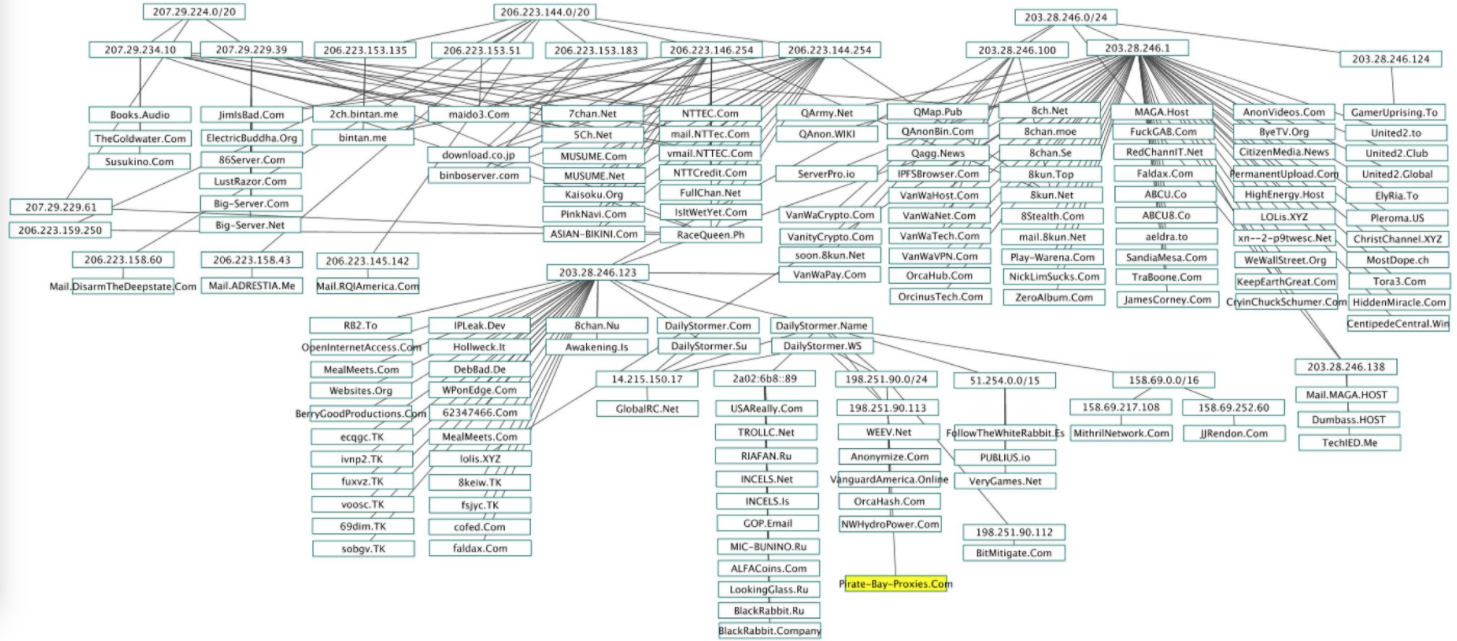
The IP address ranges in the upper-left portion of this map of QAnon and 8kun-related sites — some 21,000 IP addresses beginning in “206.” and “207.” — are assigned to N.T. Technology Inc. Image source: twitter.com/Redrum_of_Crows

That idea was floated by Ron Guilmette, a longtime anti-spam crusader who recently turned his attention to disrupting the online presence of QAnon and 8chan (recently renamed “8kun”).

On Sunday, 8chan and a host of other sites related to QAnon conspiracy theories were briefly knocked offline after Guilmette called 8chan’s anti-DDoS provider and convinced them to stop protecting the site from crippling online attacks (8Chan is now protected by an anti-DDoS provider in St. Petersburg, Russia).

The public face of 8chan is Jim Watkins, a pig farmer in the Philippines who many experts believe is also the person behind the shadowy persona of “Q” at the center of the conspiracy theory movement.

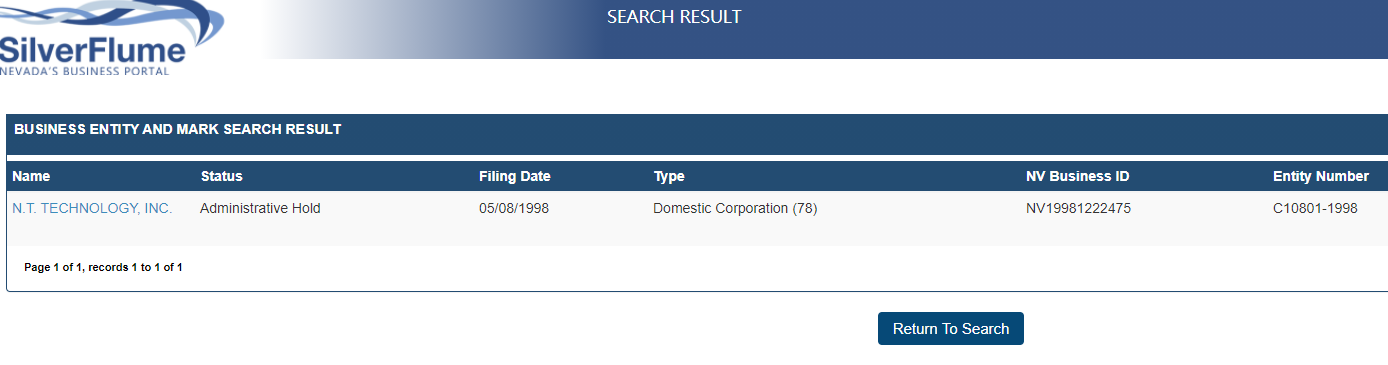
Watkin owns and operates a Reno, Nev.-based hosting firm called N.T. Technology Inc. That company has a legal contract with the American Registry for Internet Numbers (ARIN), the non-profit which administers IP addresses for entities based in North America.

ARIN’s contract with N.T. Technology gives the latter the right to use more than 21,500 IP addresses. But as Guilmette discovered recently, N.T. Technology is listed in Nevada Secretary of State records as under an “administrative hold,” which according to Nevada statute is a “terminated” status indicator meaning the company no longer has the right to transact business in the state.

N.T. Technology’s listing in the Nevada Secretary of State records. Click to Enlarge.

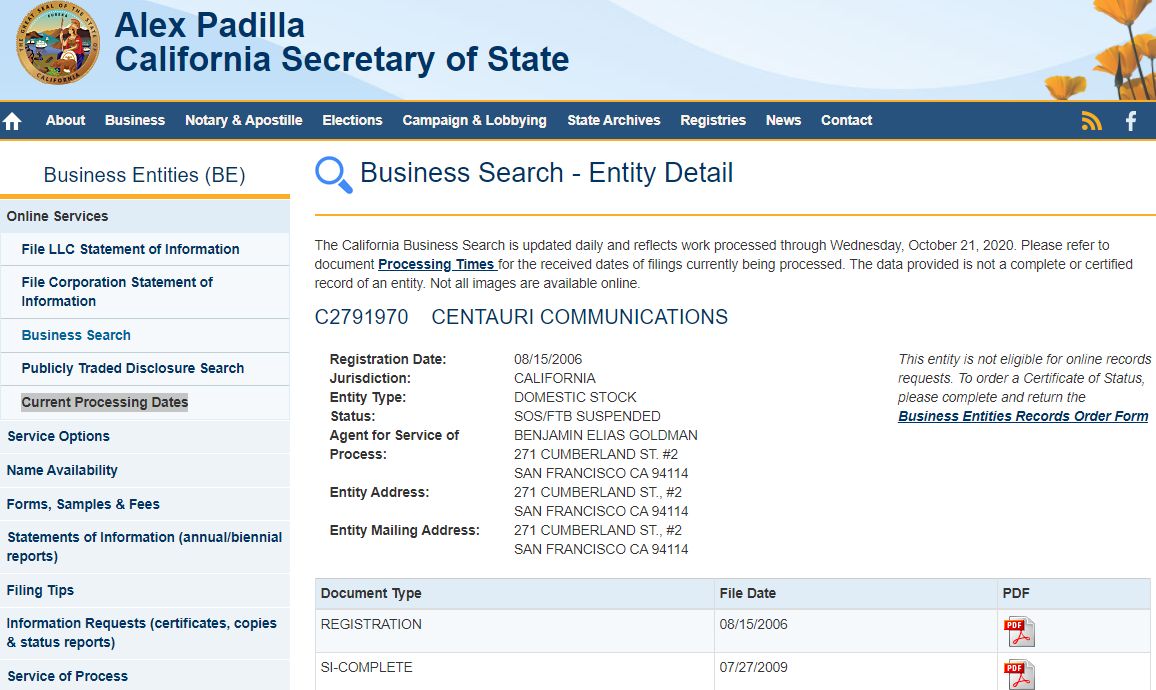
The same is true for Centauri Communications, a Freemont, Calif.-based Internet Service Provider that serves as N.T. Technology’s colocation provider and sole connection to the larger Internet. Centauri was granted more than 4,000 IPv4 addresses by ARIN more than a decade ago.

According to the California Secretary of State, Centauri’s status as a business in the state is “suspended.” It appears that Centauri hasn’t filed any business records with the state since 2009, and the state subsequently suspended the company’s license to do business in Aug. 2012. Separately, the California State Franchise Tax Board (FTB) suspended this company as of April 1, 2014.

Centauri Communications’ listing with the California Secretary of State’s office.

Neither Centauri Communications nor N.T. Technology responded to repeated requests for comment.

KrebsOnSecurity shared Guilmette’s findings with ARIN, which said it would investigate the matter.

“ARIN has received a fraud report from you and is evaluating it,” a spokesperson for ARIN said. “We do not comment on such reports publicly.”

Guilmette said apart from reclaiming the Internet address space from Centauri and NT Technology, ARIN could simply remove each company’s listings from the global WHOIS routing records. Such a move, he said, would likely result in most ISPs blocking access to those IP addresses.

“If ARIN were to remove these records from the WHOIS database, it would serve to de-legitimize the use of these IP blocks by the parties involved,” he said. “And globally, it would make it more difficult for the parties to find people willing to route packets to and from those blocks of addresses.”

source https://krebsonsecurity.com/2020/10/the-now-defunct-firms-behind-8chan-qanon/

QAnon/8Chan Sites Briefly Knocked Offline

A phone call to an Internet provider in Oregon on Sunday evening was all it took to briefly sideline multiple websites related to 8chan/8kun — a controversial online image board linked to several mass shootings — and QAnon, the far-right conspiracy theory which holds that a cabal of Satanic pedophiles is running a global child sex-trafficking ring and plotting against President Donald Trump. Following a brief disruption, the sites have come back online with the help of an Internet company based in St. Petersburg, Russia.

The IP address range in the upper-right portion of this map of QAnon and 8kun-related sites — 203.28.246.0/24 — is assigned to VanwaTech and briefly went offline this evening. Source: twitter.com/Redrum_of_Crows.

A large number of 8kun and QAnon-related sites (see map above) are connected to the Web via a single Internet provider in Vancouver, Wash. called VanwaTech (a.k.a. “OrcaTech“). Previous appeals to VanwaTech to disconnect these sites have fallen on deaf ears, as the company’s owner Nick Lim reportedly has been working with 8kun’s administrators to keep the sites online in the name of protecting free speech.

But VanwaTech also had a single point of failure on its end: The swath of Internet addresses serving the various 8kun/QAnon sites were being protected from otherwise crippling and incessant distributed-denial-of-service (DDoS) attacks by Hillsboro, Ore. based CNServers LLC.

On Sunday evening, security researcher Ron Guilmette placed a phone call to CNServers’ owner, who professed to be shocked by revelations that his company was helping QAnon and 8kun keep the lights on.

Within minutes of that call, CNServers told its customer — Spartan Host Ltd., which is registered in Belfast, Northern Ireland — that it would no longer be providing DDoS protection for the set of 254 Internet addresses that Spartan Host was routing on behalf of VanwaTech.

Contacted by KrebsOnSecurity, the person who answered the phone at CNServers asked not to be named in this story for fear of possible reprisals from the 8kun/QAnon crowd. But they confirmed that CNServers had indeed terminated its service with Spartan Host. That person added they weren’t a fan of either 8kun or QAnon, and said they would not self-describe as a Trump supporter.

CNServers said that shortly after it withdrew its DDoS protection services, Spartan Host changed its settings so that VanwaTech’s Internet addresses were protected from attacks by ddos-guard[.]net, a company based in St. Petersburg, Russia.

Spartan Host’s founder, 25-year-old Ryan McCully, confirmed CNServers’ report. McCully declined to say for how long VanwaTech had been a customer, or whether Spartan Host had experienced any attacks as a result of CNServers’ action.

McCully said while he personally doesn’t subscribe to the beliefs espoused by QAnon or 8kun, he intends to keep VanwaTech as a customer going forward.

“We follow the ‘law of the land’ when deciding what we allow to be hosted with us, with some exceptions to things that may cause resource issues etc.,” McCully said in a conversation over instant message. “Just because we host something, it doesn’t say anything about we do and don’t support, our opinions don’t come into hosted content decisions.”

But according to Guilmette, Spartan Host’s relationship with VanwaTech wasn’t widely known previously because Spartan Host had set up what’s known as a “private peering” agreement with VanwaTech. That is to say, the two companies had a confidential business arrangement by which their mutual connections were not explicitly stated or obvious to other Internet providers on the global Internet.

Guilmette said private peering relationships often play a significant role in a good deal of behind-the-scenes-mischief when the parties involved do not want anyone else to know about their relationship.

“These arrangements are business agreements that are confidential between two parties, and no one knows about them, unless you start asking questions,” Guilmette said. “It certainly appears that a private peering arrangement was used in this instance in order to hide the direct involvement of Spartan Host in providing connectivity to VanwaTech and thus to 8kun. Perhaps Mr. McCully was not eager to have his involvement known.”

8chan, which rebranded last year as 8kun, has been linked to white supremacism, neo-Nazism, antisemitism, multiple mass shootings, and is known for hosting child pornography. After three mass shootings in 2019 revealed the perpetrators had spread their manifestos on 8chan and even streamed their killings live there, 8chan was ostracized by one Internet provider after another.

The FBI last year identified QAnon as a potential domestic terror threat, noting that some of its followers have been linked to violent incidents motivated by fringe beliefs.

Further reading:

What Is QAnon?

QAnon: A Timeline of Violent Linked to the Conspiracy Theory

source https://krebsonsecurity.com/2020/10/qanon-8chan-sites-briefly-knocked-offline/

Breach at Dickey’s BBQ Smokes 3M Cards

One of the digital underground’s most popular stores for peddling stolen credit card information began selling a batch of more than three million new card records this week. KrebsOnSecurity has learned the data was stolen in a lengthy data breach at more than 100 Dickey’s Barbeque Restaurant locations around the country.

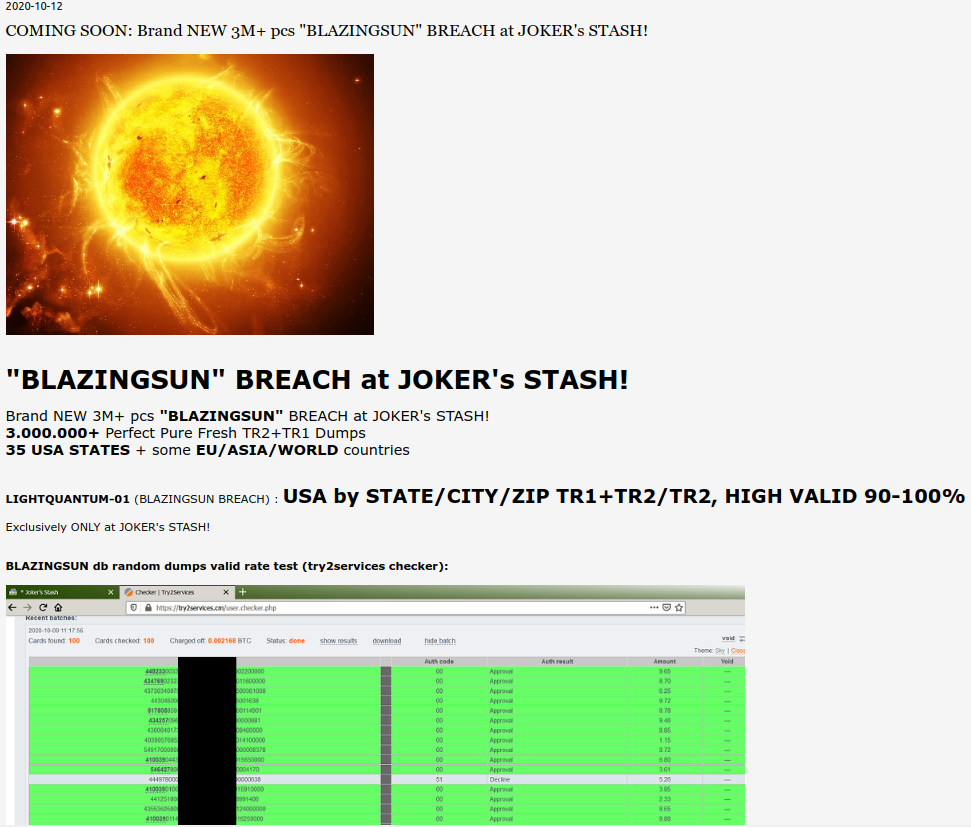
An ad on the popular carding site Joker’s Stash for “BlazingSun,” which fraud experts have traced back to a card breach at Dickey’s BBQ.

On Monday, the carding bazaar Joker’s Stash debuted “BlazingSun,” a new batch of more than three million stolen card records, advertising “valid rates” of between 90-100 percent. This is typically an indicator that the breached merchant is either unaware of the compromise or has only just begun responding to it.

Multiple companies that track the sale in stolen payment card data say they have confirmed with card-issuing financial institutions that the accounts for sale in the BlazingSun batch have one common theme: All were used at various Dickey’s BBQ locations over the past 13-15 months.

KrebsOnSecurity first contacted Dallas-based Dickey’s on Oct. 13. Today, the company shared a statement saying it was aware of a possible payment card security incident at some of its eateries:

“We received a report indicating that a payment card security incident may have occurred. We are taking this incident very seriously and immediately initiated our response protocol and an investigation is underway. We are currently focused on determining the locations affected and time frames involved. We are utilizing the experience of third parties who have helped other restaurants address similar issues and also working with the FBI and payment card networks. We understand that payment card network rules generally provide that individuals who timely report unauthorized charges to the bank that issued their card are not responsible for those charges.”

The confirmations came from Miami-based Q6 Cyber and Gemini Advisory in New York City.

Q6Cyber CEO Eli Dominitz said the breach appears to extend from May 2019 through September 2020.

“The financial institutions we’ve been working with have already seen a significant amount of fraud related to these cards,” Dominitz said.

Gemini says its data indicated some 156 Dickey’s locations across 30 states likely had payment systems compromised by card-stealing malware, with the highest exposure in California and Arizona. Gemini puts the exposure window between July 2019 and August 2020.

“Low-and-slow” aptly describes the card breach at Dickie’s, which persisted for at least 13 months.

With the threat from ransomware attacks grabbing all the headlines, it may be tempting to assume plain old credit card thieves have moved on to more lucrative endeavors. Alas, cybercrime bazaars like Joker’s Stash have continued plying their trade, undeterred by a push from the credit card associations to encourage more merchants to install credit card readers that require more secure chip-based payment cards.

That’s because there are countless restaurant locations — usually franchise locations of an established eatery chain — that are left to decide for themselves whether and how quickly they should make the upgrades necessary to dip the chip versus swipe the stripe.

“Dickey’s operates on a franchise model, which often allows each location to dictate the type of point-of-sale (POS) device and processors that they utilize,” Gemini wrote in a blog post about the incident. “However, given the widespread nature of the breach, the exposure may be linked to a breach of the single central processor, which was leveraged by over a quarter of all Dickey’s locations.”

While there have been sporadic reports about criminals compromising chip-based payment systems used by merchants in the U.S., the vast majority of the payment card data for sale in the cybercrime underground is stolen from merchants who are still swiping chip-based cards.

This isn’t conjecture; relatively recent data from the stolen card shops themselves bear this out. In July, KrebsOnSecurity wrote about an analysis by researchers at New York University, which looked at patterns surrounding more than 19 million stolen payment cards that were exposed after the hacking of BriansClub, a top competitor to the Joker’s Stash carding shop.

The NYU researchers found BriansClub earned close to $104 million in gross revenue from 2015 to early 2019, and listed over 19 million unique card numbers for sale. Around 97% of the inventory was stolen magnetic stripe data, commonly used to produce counterfeit cards for in-person payments.

Visa and MasterCard instituted new rules in October 2015 that put retailers on the hook for all of the losses associated with counterfeit card fraud tied to breaches if they haven’t implemented chip-based card readers and enforced the dipping of the chip when a customer presents a chip-based card.

Dominitz said he never imagined back in 2015 when he founded Q6Cyber that we would still be seeing so many merchants dealing with magstripe-based data breaches.

“Five years ago I did not expect we would be in this position today with card fraud,” he said. “You’d think the industry in general would have made a bigger dent in this underground economy a while ago.”

Tired of having your credit card re-issued and updating your payment records at countless e-commerce sites every time some restaurant you frequent has a breach? Here’s a radical idea: Next time you visit an eatery (okay, if that ever happens again post-COVID, etc), ask them if they use chip-based card readers. If not, consider taking your business elsewhere.

source https://krebsonsecurity.com/2020/10/breach-at-dickeys-bbq-smokes-3m-cards/

Microsoft Patch Tuesday, October 2020 Edition

It’s Cybersecurity Awareness Month! In keeping with that theme, if you (ab)use Microsoft Windows computers you should be aware the company shipped a bevy of software updates today to fix at least 87 security problems in Windows and programs that run on top of the operating system. That means it’s once again time to backup and patch up.

Eleven of the vulnerabilities earned Microsoft’s most-dire “critical” rating, which means bad guys or malware could use them to gain complete control over an unpatched system with little or no help from users.

Worst in terms of outright scariness is probably CVE-2020-16898, which is a nasty bug in Windows 10 and Windows Server 2019 that could be abused to install malware just by sending a malformed packet of data at a vulnerable system. CVE-2020-16898 earned a CVSS Score of 9.8 (10 is the most awful).

Security vendor McAfee has dubbed the flaw “Bad Neighbor,” and in a blog post about it said a proof-of-concept exploit shared by Microsoft with its partners appears to be “both extremely simple and perfectly reliable,” noting that this sucker is imminently “wormable” — i.e. capable of being weaponized into a threat that spreads very quickly within networks.

“It results in an immediate BSOD (Blue Screen of Death), but more so, indicates the likelihood of exploitation for those who can manage to bypass Windows 10 and Windows Server 2019 mitigations,” McAfee’s Steve Povolny wrote. “The effects of an exploit that would grant remote code execution would be widespread and highly impactful, as this type of bug could be made wormable.”

Trend Micro’s Zero Day Initiative (ZDI) calls special attention to another critical bug quashed in this month’s patch batch: CVE-2020-16947, which is a problem with Microsoft Outlook that could result in malware being loaded onto a system just by previewing a malicious email in Outlook.

“The Preview Pane is an attack vector here, so you don’t even need to open the mail to be impacted,” said ZDI’s Dustin Childs.

While there don’t appear to be any zero-day flaws in October’s release from Microsoft, Todd Schell from Ivanti points out that a half-dozen of these flaws were publicly disclosed prior to today, meaning bad guys have jump start on being able to research and engineer working exploits.

Other patches released today tackle problems in Exchange Server, Visual Studio, .NET Framework, and a whole mess of other core Windows components.

For any of you who’ve been pining for a Flash Player patch from Adobe, your days of waiting are over. After several months of depriving us of Flash fixes, Adobe’s shipped an update that fixes a single — albeit critical — flaw in the program that crooks could use to install bad stuff on your computer just by getting you to visit a hacked or malicious website.

Chrome and Firefox both now disable Flash by default, and Chrome and IE/Edge auto-update the program when new security updates are available. Mercifully, Adobe is slated to retire Flash Player later this year, and Microsoft has said it plans to ship updates at the end of the year that will remove Flash from Windows machines.

It’s a good idea for Windows users to get in the habit of updating at least once a month, but for regular users (read: not enterprises) it’s usually safe to wait a few days until after the patches are released, so that Microsoft has time to iron out any chinks in the new armor.

But before you update, please make sure you have backed up your system and/or important files. It’s not uncommon for a Windows update package to hose one’s system or prevent it from booting properly, and some updates even have known to erase or corrupt files.

So do yourself a favor and backup before installing any patches. Windows 10 even has some built-in tools to help you do that, either on a per-file/folder basis or by making a complete and bootable copy of your hard drive all at once.

And if you wish to ensure Windows has been set to pause updating so you can back up your files and/or system before the operating system decides to reboot and install patches on its own schedule, see this guide.

As always, if you experience glitches or problems installing any of these patches this month, please consider leaving a comment about it below; there’s a better-than-even chance other readers have experienced the same and may chime in here with some helpful tips.

source https://krebsonsecurity.com/2020/10/microsoft-patch-tuesday-october-2020-edition/

Microsoft Uses Trademark Law to Disrupt Trickbot Botnet

Microsoft Corp. has executed a coordinated legal sneak attack in a bid to disrupt the malware-as-a-service botnet Trickbot, a global menace that has infected millions of computers and is used to spread ransomware. A court in Virginia granted Microsoft control over many Internet servers Trickbot uses to plunder infected systems, based on novel claims that the crime machine abused the software giant’s trademarks. However, it appears the operation has not completely disabled the botnet.

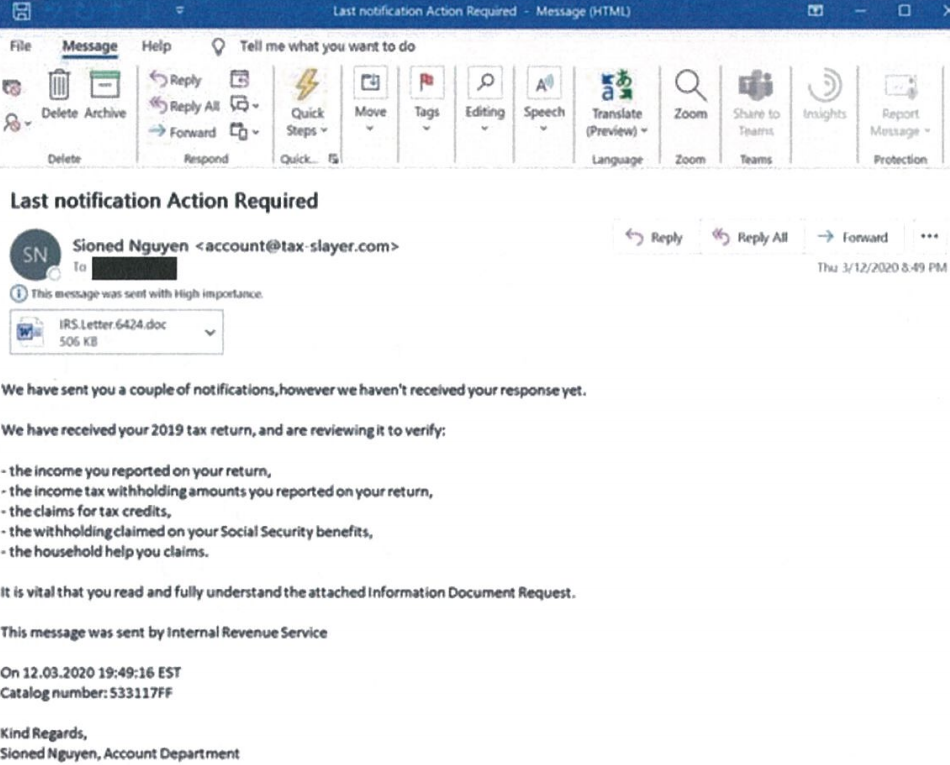
A spam email containing a Trickbot-infected attachment that was sent earlier this year. Image: Microsoft.

“We disrupted Trickbot through a court order we obtained as well as technical action we executed in partnership with telecommunications providers around the world,” wrote Tom Burt, corporate vice president of customer security and trust at Microsoft, in a blog post this morning about the legal maneuver. “We have now cut off key infrastructure so those operating Trickbot will no longer be able to initiate new infections or activate ransomware already dropped into computer systems.”

Microsoft’s action comes just days after the U.S. military’s Cyber Command carried out its own attack that sent all infected Trickbot systems a command telling them to disconnect themselves from the Internet servers the Trickbot overlords used to control them. The roughly 10-day operation by Cyber Command also stuffed millions of bogus records about new victims into the Trickbot database in a bid to confuse the botnet’s operators.

In legal filings, Microsoft argued that Trickbot irreparably harms the company “by damaging its reputation, brands, and customer goodwill. Defendants physically alter and corrupt Microsoft products such as the Microsoft Windows products. Once infected, altered and controlled by Trickbot, the Windows operating system ceases to operate normally and becomes tools for Defendants to conduct their theft.”

From the civil complaint Microsoft filed on October 6 with the U.S. District Court for the Eastern District of Virginia:

“However, they still bear the Microsoft and Windows trademarks. This is obviously meant to and does mislead Microsoft’s customers, and it causes extreme damage to Microsoft’s brands and trademarks.”

“Users subject to the negative effects of these malicious applications incorrectly believe that Microsoft and Windows are the source of their computing device problems. There is great risk that users may attribute this problem to Microsoft and associate these problems with Microsoft’s Windows products, thereby diluting and tarnishing the value of the Microsoft and Windows trademarks and brands.”

Microsoft said it will leverage the seized Trickbot servers to identify and assist Windows users impacted by the Trickbot malware in cleaning the malware off of their systems.

Trickbot has been used to steal passwords from millions of infected computers, and reportedly to hijack access to well more than 250 million email accounts from which new copies of the malware are sent to the victim’s contacts.

Trickbot’s malware-as-a-service feature has made it a reliable vehicle for deploying various strains of ransomware, locking up infected systems on a corporate network unless and until the company agrees to make an extortion payment.

A particularly destructive ransomware strain that is closely associated with Trickbot — known as “Ryuk” or “Conti” — has been responsible for costly attacks on countless organizations over the past year, including healthcare providers, medical research centers and hospitals.

One recent Ryuk victim is Universal Health Services (UHS), a Fortune 500 hospital and healthcare services provider that operates more than 400 facilities in the U.S. and U.K.

On Sunday, Sept. 27, UHS shut down its computer systems at healthcare facilities across the United States in a bid to stop the spread of the malware. The disruption caused some of the affected hospitals to redirect ambulances and relocate patients in need of surgery to other nearby hospitals.

Microsoft said it did not expect its action to permanently disrupt Trickbot, noting that the crooks behind the botnet will likely make efforts to revive their operations. But so far it’s not clear whether Microsoft succeeded in commandeering all of Trickbot’s control servers, or when exactly the coordinated seizure of those servers occurred.

As the company noted in its legal filings, the set of Internet address used as Trickbot controllers is dynamic, making attempts to disable the botnet more challenging.

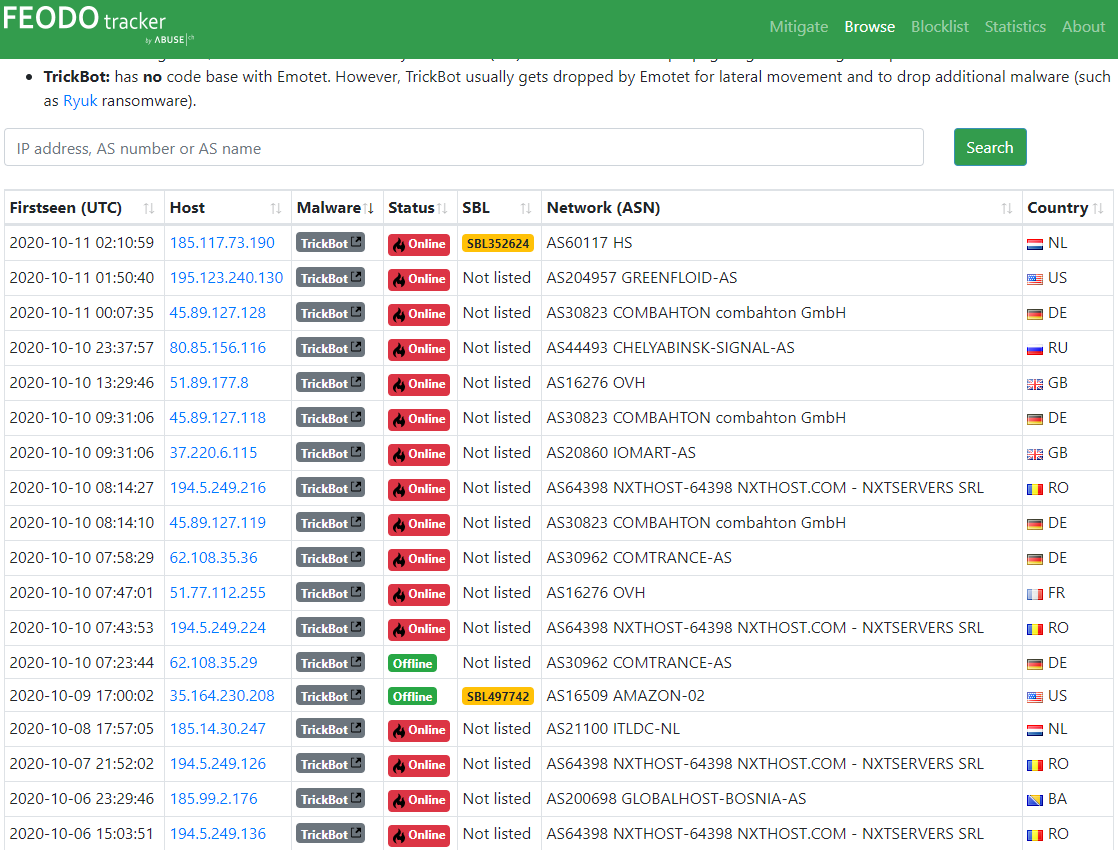
Indeed, according to real-time information posted by Feodo Tracker, a Swiss security site that tracks Internet servers used as controllers for Trickbot and other botnets, nearly two dozen Trickbot control servers — some of which first went active at beginning of this month — are still live and responding to requests at the time of this publication.

Trickbot control servers that are currently online. Source: Feodotracker.abuse.ch

source https://krebsonsecurity.com/2020/10/microsoft-uses-copyright-law-to-disrupt-trickbot-botnet/