U.K. Arrest in ‘SMS Bandits’ Phishing Service

Authorities in the United Kingdom have arrested a 20-year-old man for allegedly operating an online service for sending high-volume phishing campaigns via mobile text messages. The service, marketed in the underground under the name “SMS Bandits,” has been responsible for blasting out huge volumes of phishing lures spoofing everything from COVID-19 pandemic relief efforts to PayPal, telecommunications providers and tax revenue agencies.
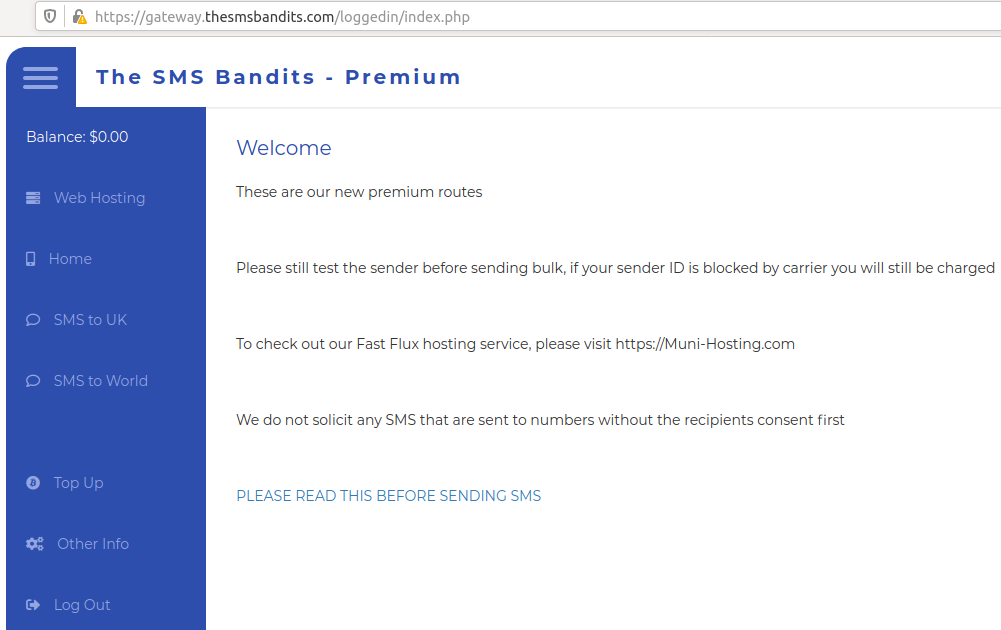
The U.K.’s National Crime Agency (NCA) declined to name the suspect, but confirmed that the Metropolitan Police Service’s cyber crime unit had detained an individual from Birmingham in connection to a business that supplied “criminal services related to phishing offenses.”

The proprietors of the phishing service were variously known on cybercrime forums under handles such as SMSBandits, “Gmuni,” “Bamit9,” and “Uncle Munis.” SMS Bandits offered an SMS phishing (a.k.a. “smishing”) service for the mass sending of text messages designed to phish account credentials for different popular websites and steal personal and financial data for resale.
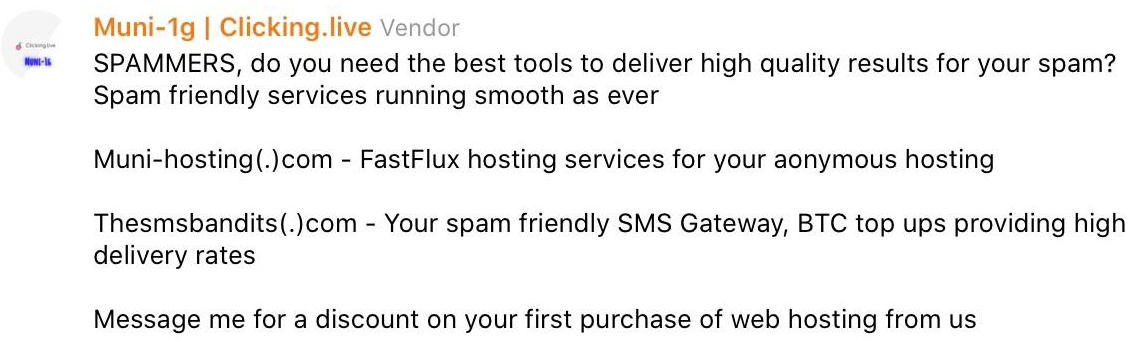
Image: osint.fans

Sasha Angus is a partner at Scylla Intel, a cyber intelligence startup that did a great deal of research into the SMS Bandits leading up to the arrest. Angus said the phishing lures sent by the SMS Bandits were unusually well-done and free of grammar and spelling mistakes that often make it easy to spot a phony message.

“Just by virtue of these guys being native English speakers, the quality of their phishing kits and lures were considerably better than most,” Angus said.

According to Scylla, the SMS Bandits made a number of operational security (or “opsec”) mistakes that made it relatively easy to find out who they were in real life, but the technical side SMS Bandits’ operation was rather advanced.

“They were launching fairly high-volume smishing campaigns from SMS gateways, but overall their opsec was fairly lousy,” Angus said. “But on the telecom front they were using fairly sophisticated tactics.”
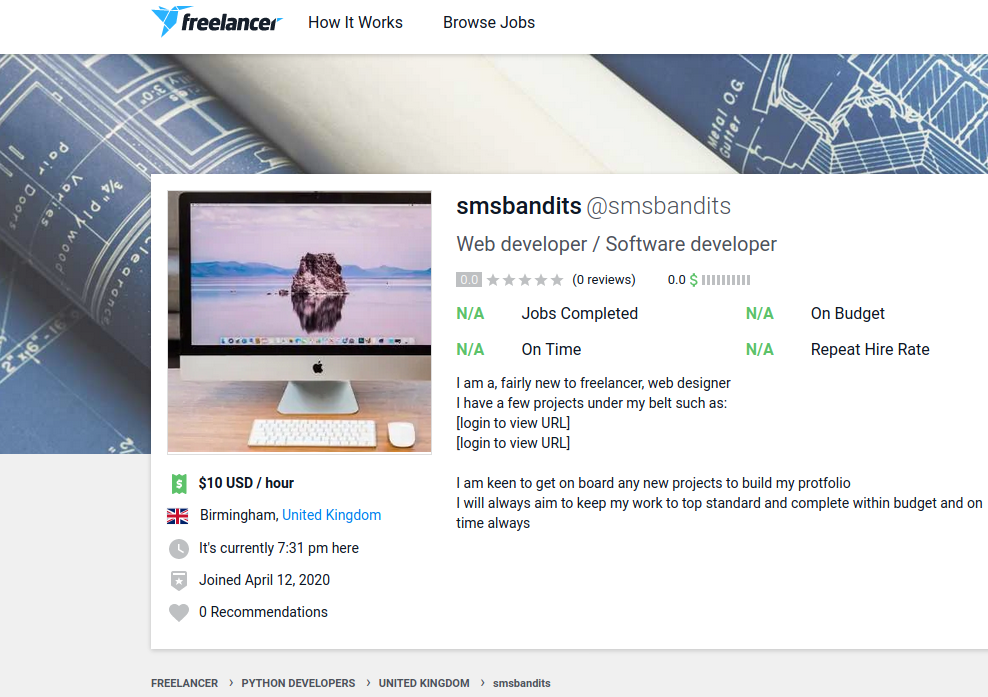
The proprietor of the SMS Bandits, telling the world he lives in Birmingham.

For example, the SMS Bandits automated systems to check whether the phone number list provided by their customers was indeed tied to actual mobile numbers, and not landlines that might tip off telecommunications companies about mass spam campaigns.

“The telcos are monitoring for malicious SMS messages on a number of fronts,” Angus said. “One way to tip off an SMS gateway or wireless provider is to start blasting text messages to phone numbers that can’t receive them.”

Scylla gathered reams of evidence showing the SMS Bandits used email addresses and passwords stolen through its services to validate a variety of account credentials — from PayPal to bank accounts and utilities providers. They would then offload the working credentials onto marketplaces they controlled, and to third-party vendors. One of SMS Bandits’ key offerings: An “auto-shop” web panel for selling stolen account credentials.

SMS Bandits also provided their own “bulletproof hosting” service advertised as a platform that supported “freedom of speach” [sic] where customers could “host any content without restriction.” Invariably, that content constituted sites designed to phish credentials from users of various online services.
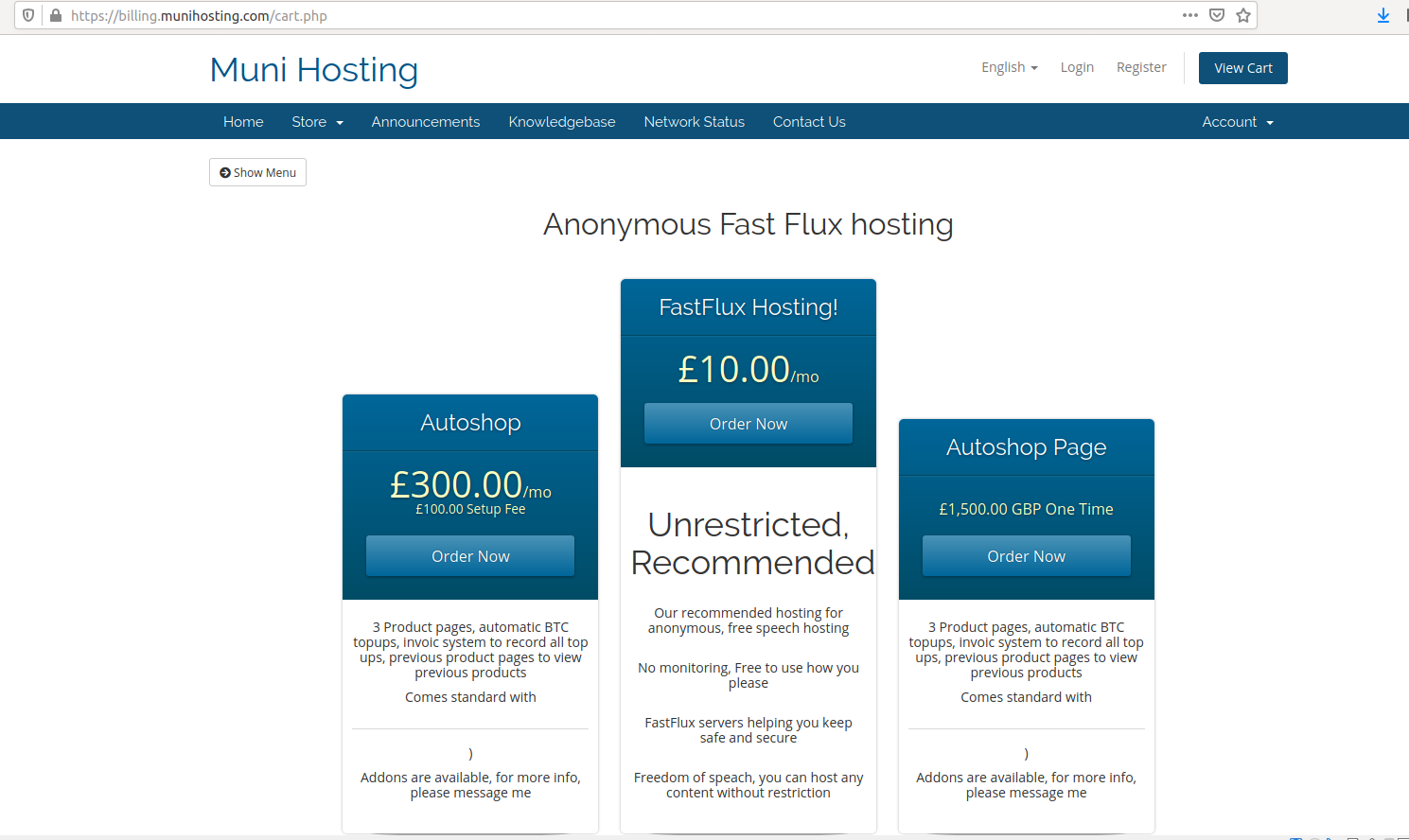
The “bulletproof” offerings of Muni Hosting (pronounced “Money Hosting”).

The SMS Bandits phishing service is tied to another crime-friendly service called “OTP Agency,” a bulk SMS provider that appears catered to phishers: The service’s administrator stated on multiple forums that he worked directly with the SMS Bandits.

Otp[.]agency advertises a service designed to help intercept one-time passwords needed to log in to various websites. The customer enters the target’s phone number and name, and OTP Agency will initiate an automated phone call to the target that alerts them about unauthorized activity on their account.

The call prompts the target to enter a one-time password generated by their phone’s mobile app, and that code is then relayed back to the scammer’s user panel at the OTP Agency website.

“We call the holder with an automatic calling bot, with a very believable script, they enter the OTP on the phone, and you’ll see it in real time,” OTP Agency explained on their Telegram channel. The service, which costs anywhere from $40 to $125 per week, advertises unlimited international calling, as well as multiple call scripts and voice accents.
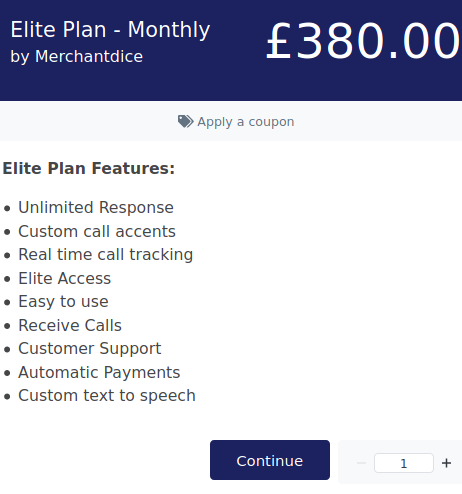
One of the pricing plans available to OTP Agency users.

The volume of SMS-based phishing skyrocketed in 2020 — by more than 328 percent — according to a recent report from Proofpoint, a security firm that processes more than 80 percent of North America’s mobile messages [Full disclosure: Proofpoint is currently an advertiser on this site].

source https://krebsonsecurity.com/2021/02/u-k-arrest-in-sms-bandits-phishing-service/

The Taxman Cometh for ID Theft Victims

The unprecedented volume of unemployment insurance fraud witnessed in 2020 hasn’t abated, although news coverage of the issue has largely been pushed off the front pages by other events. But the ID theft problem is coming to the fore once again: Countless Americans will soon be receiving notices from state regulators saying they owe thousands of dollars in taxes on benefits they never received last year.

One state’s experience offers a window into the potential scope of the problem. Hackers, identity thieves and overseas criminal rings stole over $11 billion in unemployment benefits from California last year, or roughly 10 percent of all such claims the state paid out in 2020, the state’s labor secretary told reporters this week. Another 17 percent of claims — nearly $20 billion more – are suspected fraud.
California’s experience is tracked at a somewhat smaller scale in dozens of other states, where chronically underfunded and technologically outdated unemployment insurance systems were caught flat-footed by an avalanche of fraudulent claims. The scammers typically use stolen identity data to claim benefits, and then have the funds credited to an online account that they control.

States are required to send out 1099-G forms reporting taxable income by Jan. 31, and under federal law unemployment benefits are considered taxable income. Unfortunately, many states have not reconciled their forms with confirmed incidences of fraudulent unemployment insurance claims, meaning many people are being told they owe a great deal more in taxes than they actually do.

In a notice posted Jan. 28, the U.S. Internal Revenue Service urged taxpayers who receive forms 1099-G for unemployment benefits they didn’t actually get because of ID theft to contact their appropriate state agency and request a corrected form.

But the IRS’s advice ignores two rather inconvenient realities. The first is that the same 1099-G forms which states are sending to their citizens also are reported to the IRS — typically at the same time the notices are mailed to residents. The other is that many state agencies are completely overwhelmed right now.

Karl Fava, a certified public accountant in Michigan, told KrebsOnSecurity two of his clients have received 1099-G forms from Michigan regarding thousands of dollars in unemployment payments that they had neither requested nor received.

Fava said Michigan recently stood up a website where victims of unemployment insurance fraud who’ve received incorrect 1099-Gs can report it, but said he’s not confident the state will issue corrected notices before the April 15 tax filing deadline.

“In both cases, the recipients contacted the state but couldn’t get any help,” Fava said. “We’re not getting a lot of traction in resolving this issue. But the fact that they’ve now created a web page where people can input information about receiving these tells you they have to know how prevalent this is.”

Fava said for now he’s advising his clients who are dealing with this problem to acknowledge the amount of fraudulent income on their federal tax returns, but also to subtract an equal amount on the return and note that the income reported by the state was due to fraud.

“That way, things can be consistent with what the IRS already knows,” Fava said. “Not to acknowledge an issue like this on a federal return is just asking for a notice from the IRS.”

The Taxpayer Advocate Service, an independent office of the U.S. Internal Revenue Service (IRS) that champions taxpayer advocacy issues, said it recently became aware that some taxpayers are receiving 1099-Gs that include reported income due to unemployment insurance identity theft. The office said it is hearing about a lot of such issues in Ohio particularly, but that the problem is happening nationally.

Another perennial (albeit not directly related) identity theft scourge involving taxes each year is refund fraud. Tax refund fraud involves the use of identity information and often stolen or misdirected W-2 forms to electronically file an unauthorized tax return for the purposes of claiming a refund in the name of a taxpayer.

Victims usually first learn of the crime after having their returns rejected because scammers beat them to it. Even those who are not required to file a return can be victims of refund fraud, as can those who are not actually due a refund from the IRS.  

The best way to avoid tax refund fraud is to file your taxes as early possible. This year, that date is Feb. 12. One way the IRS has sought to stem the flow of bogus tax refund applications is to issue the IP PIN, which is a six-digit number assigned to taxpayers that helps prevent the use of their Social Security number on a fraudulent income tax return. Each PIN is good only for the tax year for which it was issued.

Until recently the IRS restricted who could apply for an IP PIN, but the program has since been opened to all taxpayers. To create one, if you haven’t already done so you will need to plant your flag at the IRS by stepping through the agency’s “secure access authentication” process.

Creating an account requires supplying a great deal of personal data; the information that will be requested is listed here.

The signup process requires one to validate ownership of a mobile phone number in one’s name, and it will reject any voice-over-IP-based numbers such as those tied to Skype or Google Voice. If the process fails at this point, the site should offer to send an activation code via postal mail to your address on file.

Once you have an account at the IRS and are logged in, you can request an IP PIN by visiting this link and following the prompts. The site will then display a six digit PIN that needs to be included on your federal return before it can be accepted. Be sure to print out a copy and save it in a secure place.

source https://krebsonsecurity.com/2021/01/the-taxman-cometh-for-id-theft-victims/

Arrest, Seizures Tied to Netwalker Ransomware

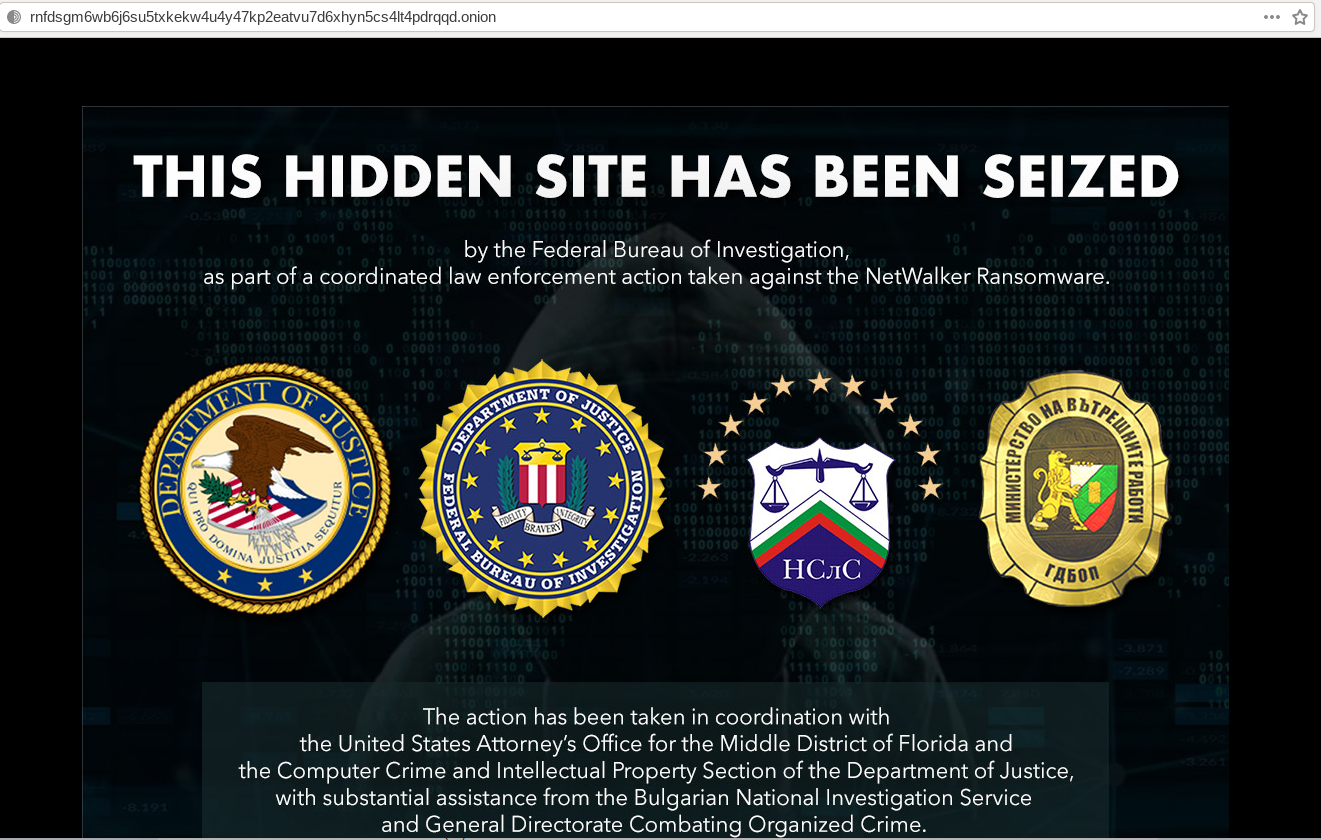
U.S. and Bulgarian authorities this week seized the darkweb site used by the NetWalker ransomware cybercrime group to publish data stolen from its victims. In connection with the seizure, a Canadian national suspected of extorting more than $27 million through the spreading of NetWalker was charged in a Florida court.

The victim shaming site maintained by the NetWalker ransomware group, after being seized by authorities this week.

NetWalker is a ransomware-as-a-service crimeware product in which affiliates rent access to the continuously updated malware code in exchange for a percentage of any funds extorted from victims. The crooks behind NetWalker used the now-seized website to publish personal and proprietary data stolen from their prey, as part of a public pressure campaign to convince victims to pay up.

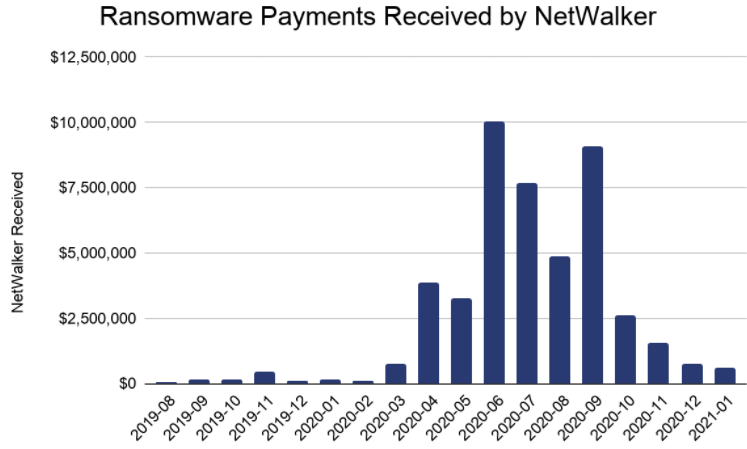
NetWalker has been among the most rapacious ransomware strains, hitting at least 305 victims from 27 countries — the majority in the United States, according to Chainalysis, a company that tracks the flow virtual currency payments.

“Chainalysis has traced more than $46 million worth of funds in NetWalker ransoms since it first came on the scene in August 2019,” the company said in a blog post detailing its assistance with the investigation. “It picked up steam in mid-2020, growing the average ransom to $65,000 last year, up from $18,800 in 2019.”

Image: Chainalysis

In a statement on the seizure, the Justice Department said the NetWalker ransomware has impacted numerous victims, including companies, municipalities, hospitals, law enforcement, emergency services, school districts, colleges, and universities. For example, the University of California, San Francisco paid $1.4 million last summer in exchange for a digital key needed to unlock files encrypted by the ransomware.

“Attacks have specifically targeted the healthcare sector during the COVID-19 pandemic, taking advantage of the global crisis to extort victims,” the DOJ said.

U.S. prosecutors say one of NetWalker’s top affiliates was Sebastien Vachon-Desjardins, of Gatineau, in Ottawa, Canada. An indictment unsealed today in Florida alleges Vachon-Desjardins obtained at least $27.6 million from the scheme.

The DOJ’s media advisory doesn’t mention the defendant’s age, but a 2015 report in the Gatineau local news website ledroit.com suggests this may not be his first offense. According to the story, a then-27-year-old Sebastien Vachon-Desjardins was sentenced to more than three years in prison for drug trafficking: He was reportedly found in possession of more than 50,000 methamphetamine tablets.

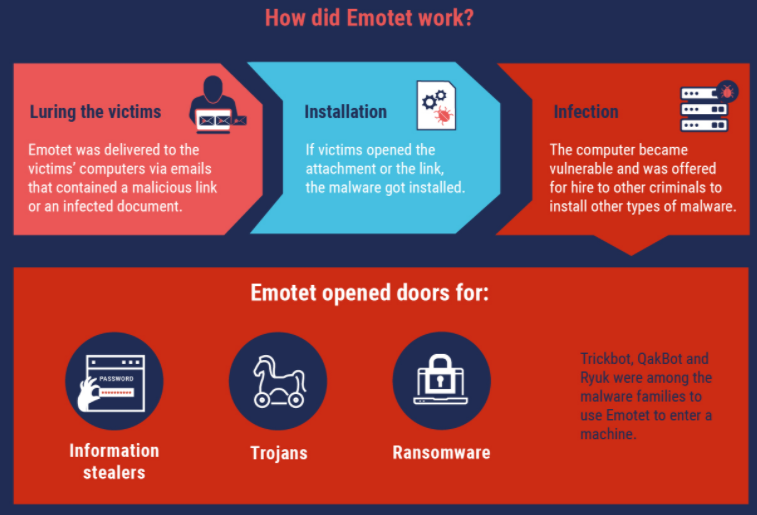
The NetWalker action came on the same day that European authorities announced a coordinated takedown targeting the Emotet crimeware-as-a-service network. Emotet is a pay-per-install botnet that is used by several distinct cybercrime groups to deploy secondary malware — most notably the ransomware strain Ryuk and Trickbot, a powerful banking trojan.

The NetWalker ransomware affiliate program kicked off in March 2020, when the administrator of the crimeware project began recruiting people on the dark web. Like many other ransomware programs, NetWalker does not permit affiliates to infect systems physically located in Russia or in any other countries that are part of the Commonwealth of Independent States (CIS) — which includes most of the nations in the former Soviet Union. This is a prohibition typically made by cybercrime operations that are coordinated out of Russia and/or other CIS nations because it helps minimize the chances that local authorities will investigate their crimes.

The following advertisement (translated into English by cybersecurity firm Intel 471) was posted by the NetWalker affiliate program manager last year to a top cybercrime forum. It illustrates the allure of the ransomware affiliate model, which handles everything from updating the malware to slip past the latest antivirus updates, to leasing space on the dark web where affiliates can interact with victims and negotiate payment. The affiliate, on the other hand, need only focus on finding new victims.

We are recruiting affiliates for network processing and spamming.
We are interested in people whose priority is quality and not quantity.
We prefer candidates who can work with large networks and have their own access to them.
We are going to recruit a limited number of affiliates and then close the openings until they are available again.

We offer you prompt and flexible ransomware, a user-friendly admin panel in Tor, an automated service.

Encryption of shared accesses: if several users are logged in to the target computer, the ransomware will infect their mapped drives, as well as network resources where those users are logged in — shared accesses/NAS etc.

Powershell build. Each build is unique, in that the malware is inside the script – it is not downloaded from the internet. This makes bypassing antivirus protection easier, including Windows Defender (cloud+).

A fully automated blog where the victim’s dumped data is directed. The data is published according to your settings. Instant and automated payouts: initially 20 percent, no less than 16 percent.

Accessibility of a crypting service to avoid AV detections.

The ransomware has been in use since September 2019 and proved to be reliable. The files encrypted with it cannot be decrypted.

Targeting Russia or the CIS is prohibited.

You’ll get all the information about the ransomware as well as terms and conditions after you place an application via PM.

Application form:
1) The field you specialize in.
2) Your experience. What other affiliate programs have you been in and what was your profit?
3) How many accesses [to networks] do you have? When are you ready to start? How many accesses do you plan on monetizing?

source https://krebsonsecurity.com/2021/01/arrest-seizures-tied-to-netwalker-ransomware/

International Action Targets Emotet Crimeware

Authorities across Europe on Tuesday said they’d seized control over Emotet, a prolific malware strain and cybercrime-as-service operation. Investigators say the action could help quarantine more than a million Microsoft Windows systems currently compromised with malware tied to Emotet infections.

First surfacing in 2014, Emotet began as a banking trojan, but over the years it has evolved into one of the more aggressive platforms for spreading malware that lays the groundwork for ransomware attacks.

In a statement published Wednesday morning on an action dubbed “Operation Ladybird,” the European police agency Europol said the investigation involved authorities in the Netherlands, Germany, United States, the United Kingdom, France, Lithuania, Canada and Ukraine.

“The EMOTET infrastructure essentially acted as a primary door opener for computer systems on a global scale,” Europol said. “Once this unauthorised access was established, these were sold to other top-level criminal groups to deploy further illicit activities such data theft and extortion through ransomware.”

Experts say Emotet is a pay-per-install botnet that is used by several distinct cybercrime groups to deploy secondary malware — most notably the ransomware strain Ryuk and Trickbot, a powerful banking trojan. It propagates mainly via malicious links and attachments sent through compromised email accounts, blasting out tens of thousands of malware-laced missives daily.

Emotet relies on several hierarchical tiers of control servers that communicate with infected systems. Those controllers coordinate the dissemination of second-stage malware and the theft of passwords and other data, and their distributed nature is designed to make the crimeware infrastructure more difficult to dismantle or commandeer.

In a separate statement on the malware takeover, the Dutch National police said two of the three primary servers were located in the Netherlands.

“A software update is placed on the Dutch central servers for all infected computer systems,” the Dutch authorities wrote. “All infected computer systems will automatically retrieve the update there, after which the Emotet infection will be quarantined. Simultaneous action in all the countries concerned was necessary to be able to effectively dismantle the network and thwart any reconstruction.”

A statement from the German Federal Criminal Police Office about their participation in Operation Ladybird said prosecutors seized 17 servers in Germany that acted as Emotet controllers.

“As part of this investigation, various servers were initially identified in Germany with which the malicious software is distributed and the victim systems are monitored and controlled using encrypted communication,” the German police said.

Sources close to the investigation told KrebsOnSecurity the law enforcement action included the arrest of several suspects in Europe thought to be connected to the crimeware gang, although that could not be confirmed. The core group of criminals behind Emotet are widely considered to be operating out of Russia.

A video released to YouTube by the National Police of Ukraine this morning shows authorities there raiding a residence, seizing cash and computer equipment, and what appear to be numerous large bars made of gold.

Police in the Netherlands seized huge volumes of data stolen by Emotet infections, including email addresses, usernames and passwords. A tool on the Dutch police website lets users learn if their email address has been compromised by Emotet.

But because Emotet is typically used to install additional malware that gets its hooks deeply into infected systems, cleaning up after it is going to be far more complicated and may require a complete rebuild of compromised computers.

The U.S. Cybersecurity & Infrastructure Security Agency has labeled Emotet “one of the most prevalent ongoing threats” that is difficult to combat because of its ‘worm-like’ features that enable network-wide infections.” Hence, a single Emotet infection can often lead to multiple systems on the same network getting compromised.

It is too soon to say how effective this operation has been in fully wresting control over Emotet, but a takedown of this size is a significant action.

In October, Microsoft used trademark law to disrupt the Trickbot botnet. Around the same time, the U.S. Cyber Command also took aim at Trickbot. However, neither of those actions completely dismantled the crimeware network, which remains in operation today.

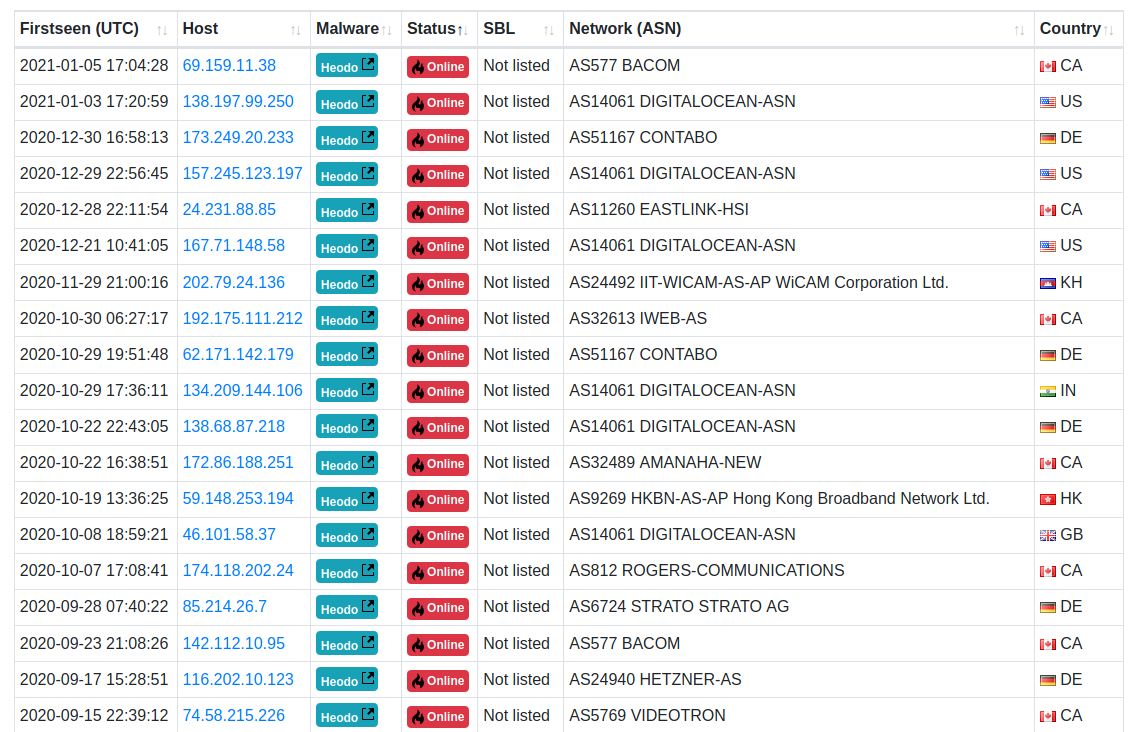
Roman Hüssy, a Swiss information technology expert who maintains Feodotracker — a site that lists the location of major botnet controllers — told KrebsOnSecurity that prior to January 25, some 98 Emotet control servers were active. The site now lists 20 Emotet controllers online, although it is unclear if any of those remaining servers have been commandeered as part of the quarantine effort.

A current list of Emotet control servers online. Source: Feodotracker.abuse.ch

source https://krebsonsecurity.com/2021/01/international-action-targets-emotet-crimeware/

DDoS-Guard To Forfeit Internet Space Occupied by Parler

Parler, the beleaguered social network advertised as a “free speech” alternative to Facebook and Twitter, has had a tough month. Apple and Google removed the Parler app from its stores, and Amazon blocked the platform from using its hosting services. Parler has since found a home in DDoS-Guard, a Russian digital infrastructure company. But now it appears DDoS-Guard is about to be relieved of more than two-thirds of the Internet address space the company leases to clients — including the Internet addresses currently occupied by Parler.

The pending disruption for DDoS-Guard and Parler comes compliments of Ron Guilmette, a researcher who has made it something of a personal mission to de-platform conspiracy theorist and far-right groups.

In October, a phone call from Guilmette to an Internet provider in Oregon was all it took to briefly sideline a vast network of sites tied to 8chan/8kun — a controversial online image board linked to several mass shootings — and QAnon, the far-right conspiracy theory which holds that a cabal of Satanic pedophiles is running a global child sex-trafficking ring and plotting against President Donald Trump. As a result, those QAnon and 8chan sites also ultimately ended up in the arms of DDoS-Guard.

Much like Internet infrastructure firm CloudFlare, DDoS-Guard typically doesn’t host sites directly but instead acts as a go-between to simultaneously keep the real Internet addresses of its clients confidential and to protect them from crippling Distributed Denial-of-Service (DDoS) attacks.

The majority of DDoS-Guard’s employees are based in Russia, but the company is actually incorporated in two other places: As “Cognitive Cloud LLP” in Scotland, and as DDoS-Guard Corp. based in Belize.  However, none of the company’s employees are listed as based in Belize, and DDoS-Guard makes no mention of the Latin American region in its map of global operations.

In studying the more than 11,000 Internet addresses assigned to those two companies, Guilmette found that approximately 66 percent of them were doled out to the Belize entity by LACNIC, the regional Internet registry for the Latin American and Caribbean regions.

Suspecting that DDoS-Guard incorporated in Belize on paper just to get a huge swaths of IP addresses that are supposed to be given only to entities with a physical presence in the region, Guilmette filed a complaint with the Internet registry about his suspicions back in November.

Guilmette said LACNIC told him it would investigate, and that any adjudication on the matter could take up to three months. But earlier this week, LACNIC published a notice on its website that it intends to revoke 8,192 IPv4 addresses from DDoS-Guard — including the Internet address currently assigned to Parler[.]com.

A notice of revocation posted by LACNIC.

LACNIC has not yet responded to requests for comment. The notice on its site says the Internet addresses are set to be revoked on Feb. 24.

DDoS-Guard CEO Evgeniy Marchenko maintains the company has done nothing wrong, and that DDoS-Guard does indeed have a presence in Belize.

“They were used strongly according [to] all LACNIC policies by [a] company legally substituted in LACNIC region,” Marchenko said in an email to KrebsOnSecurity. “There is nothing illegal or extremist. We have employers and representatives in different countries around the world because we are global service. And Latin America region is not an exception.”

Guilmette said DDoS-Guard could respond by simply moving Parler and other sites sitting in those address ranges to another part of its network. But he considers it a victory nonetheless that a regional Internet registry took his concerns seriously.

“It appeared to me that it was more probable than not that they got these 8,000+ IPv4 addresses by simply creating an arguably fraudulent shell company in Belize and then going cap in hand to LACNIC, claiming that they had a real presence in the Latin & South American region, and then asking for 8,000+ IPv4 addresses,” he said. “So I reported my suspicions to the LACNIC authorities in early November, and as I have only just recently learned, the LACNIC authorities followed up diligently on my report and, it seems, verified my suspicions.”

In October, KrebsOnSecurity covered another revelation by Guilmette about the same group of QAnon and 8chan-related sites that moved to DDoS-Guard: The companies that provided the Internet address space used by the sites were defunct businesses in the eyes of their respective U.S. state regulators. In other words, the American Registry for Internet Numbers (ARIN) — the non-profit which administers IP addresses for entities based in North America — was well within its contract rights to revoke the IP space.

Guilmette brought his findings to ARIN, which declined to act on the complaint and instead referred the matter to state investigatory agencies.

Still, Guilmette’s gadfly efforts to stir things up in the RIR community sometimes do pay off. For example, he spent nearly three years documenting how $50 million worth of the increasingly scarce IPv4 addresses were misappropriated from African companies to dodgy Internet marketing firms.

His complaints about those findings to the African Network Information Centre (AFRINIC) resulted in an investigation that led to the termination of a top AFRINIC executive, who was found to have quietly sold many of the address blocks for personal gain to marketers based in Europe, Asia and elsewhere.

And this week, AFRINIC took the unusual step of officially documenting the extent of the damage wrought by its former employee, and revoking discrete chunks of address space currently being used by marketing firms.

In a detailed report released today (PDF), AFRNIC said its investigation revealed more than 2.3 million IPv4 addresses were “without any lawful authority, misappropriated from AFRINIC’s pool of resources and attributed to organizations without any justification.”

AFRINIC said it began its inquiry in earnest back in March 2019, when it received an application by the U.S. Federal Bureau of Investigation (FBI) about “certain suspicious activities regarding several IPv4 address blocks which it held.” So far, AFRNINIC said it has reclaimed roughly half of the wayward IP address blocks, with the remainder “yet to be reclaimed due to ongoing due diligence.”

source https://krebsonsecurity.com/2021/01/ddos-guard-to-forfeit-internet-space-occupied-by-parler/

New Charges Derail COVID Release for Hacker Who Aided ISIS

A hacker serving a 20-year sentence for stealing personal data on 1,300 U.S. military and government employees and giving it to an Islamic State hacker group in 2015 has been charged once again with fraud and identity theft. The new charges have derailed plans to deport him under compassionate release because of the COVID-19 pandemic.

Ardit Ferizi, a 25-year-old citizen of Kosovo, was slated to be sent home earlier this month after a federal judge signed an order commuting his sentence to time served. The release was granted in part due to Ferizi’s 2018 diagnosis if asthma, as well as a COVID outbreak at the facility where he was housed in 2020.

But while Ferizi was in quarantine awaiting deportation the Justice Department unsealed new charges against him, saying he’d conspired from prison with associates on the outside to access stolen data and launder the bitcoin proceeds of his previous crimes.

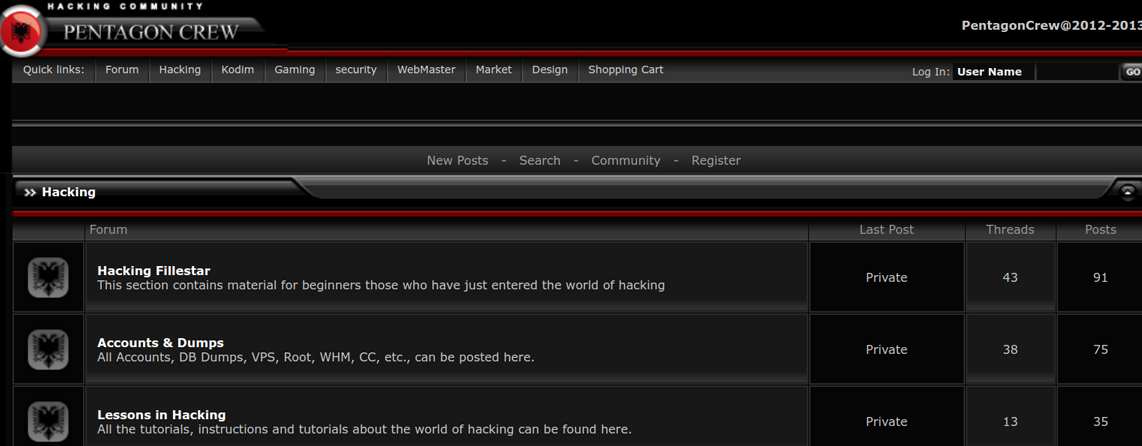
In the years leading up to his arrest, Ferizi was the administrator of a cybercrime forum called Pentagon Crew. He also served as the leader of an ethnic Albanian group of hackers from Kosovo known as Kosova Hacker’s Security (KHS), which focused on compromising government and private websites in Israel, Serbia, Greece, Ukraine and the United States.

The Pentagon Crew forum founded by Ferizi.

In December 2015, Ferizi was apprehended in Malaysia and extradited to the United States. In January 2016, Ferizi pleaded guilty to providing material support to a terrorist group and to unauthorized access. He admitted to hacking a U.S.-based e-commerce company, stealing personal and financial data on 1,300 government employees, and providing the data to an Islamic State hacking group.

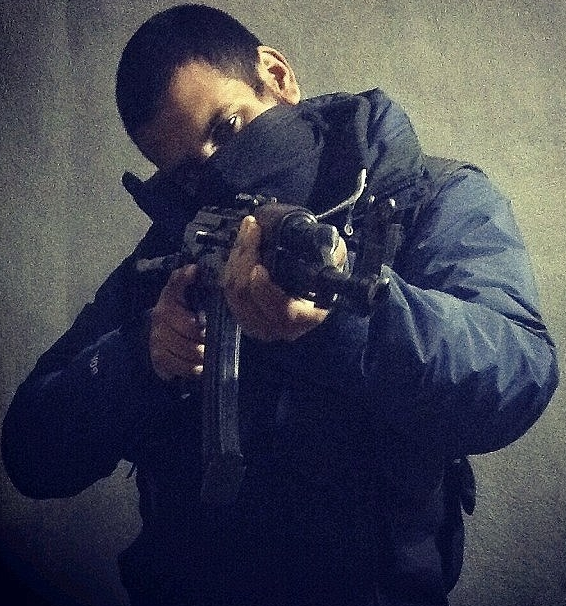
Ferizi gave the purloined data to Junaid “Trick” Hussain, a 21-year-old hacker and recruiter for ISIS who published it in August 2015 as part of a directive that ISIS supporters kill the named U.S. military members and government employees. Later that month, Hussain was reportedly killed by a drone strike in Syria.

The government says Ferizi and his associates made money by hacking PayPal and other financial accounts, and through pornography sites he allegedly set up mainly to steal personal and financial data from visitors.

Junaid Hussain’s Twitter profile photo.

Between 2015 and 2019, Ferizi was imprisoned at a facility in Illinois that housed several other notable convicts. For example, prosecutors allege that Ferizi was an associate of Mahmud “Red” Abouhalima, who was serving a 240 year sentence at the prison for his role in the 1993 World Trade Center bombing.

Another inmate incarcerated at the same facility was Shawn Bridges, a former U.S. Secret Service agent serving almost eight years for stealing $820,000 worth of bitcoin from online drug dealers while investigating the hidden underground website Silk Road. Prosecutors say Ferizi and Bridges discussed ways to hide their bitcoin.

The information about Ferizi’s inmate friends came via a tip from another convict, who told the FBI that Ferizi was allegedly using his access to the prison’s email system to share email and bitcoin account passwords with family members back home.

The Justice Department said subpoenas served on Ferizi’s email accounts and interviews with his associates show Ferizi’s brother in Kosovo used the information to “liquidate the proceeds of Ferizi’s previous criminal hacking activities.”

[Side note: It may be little more than a coincidence, but my PayPal account was hacked in Dec. 2015 by criminals who social engineered PayPal employees over the phone into changing my password and bypassing multi-factor authentication. The hackers attempted to send my balance to an account tied to Hussain, but the transfer never went through.]

Ferizi is being tried in California, but has not yet had an initial appearance in court. He’s charged with one count of aggravated identity theft and one count of wire fraud. If convicted of wire fraud, he faces a maximum penalty of 20 years in prison and a fine of $250,000. If convicted of aggravated identity theft, he faces a mandatory penalty of 2 years in prison in addition to the punishment imposed for a wire fraud conviction.

source https://krebsonsecurity.com/2021/01/new-charges-derail-covid-release-for-hacker-who-aided-isis/

Joker’s Stash Carding Market to Call it Quits

Joker’s Stash, by some accounts the largest underground shop for selling stolen credit card and identity data, says it’s closing up shop effective mid-February 2021. The announcement came on the heels of a turbulent year for the major cybercrime store, and just weeks after U.S. and European authorities seized a number of its servers.

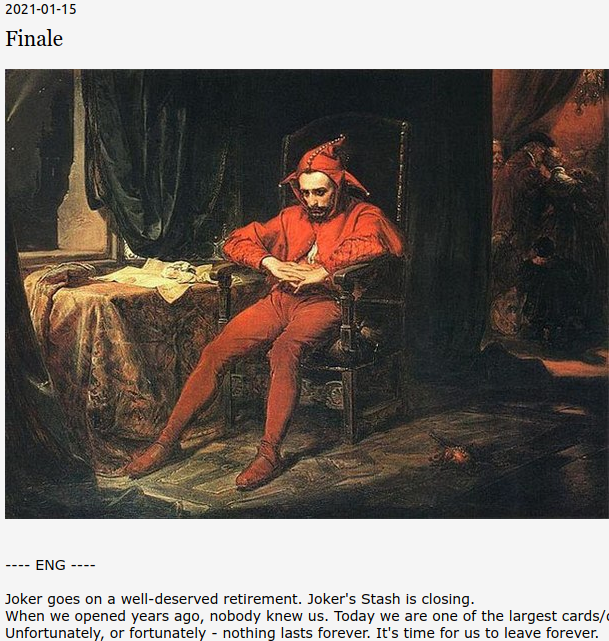
A farewell message posted by Joker’s Stash admin on Jan. 15, 2021.

The Russian and English language carding store first opened in October 2014, and quickly became a major source of “dumps” — information stolen from compromised payment cards that thieves can buy and use to create physical counterfeit copies of the cards.

But 2020 turned out to be a tough year for Joker’s Stash. As cyber intelligence firm Intel 471 notes, the curator of the store announced in October that he’d contracted COVID-19, spending a week in the hospital. Around that time, Intel 471 says many of Joker’s loyal customers started complaining that the shop’s payment card data quality was increasingly poor.

“The condition impacted the site’s forums, inventory replenishments and other operations,” Intel 471 said.

Image: Gemini Advisory

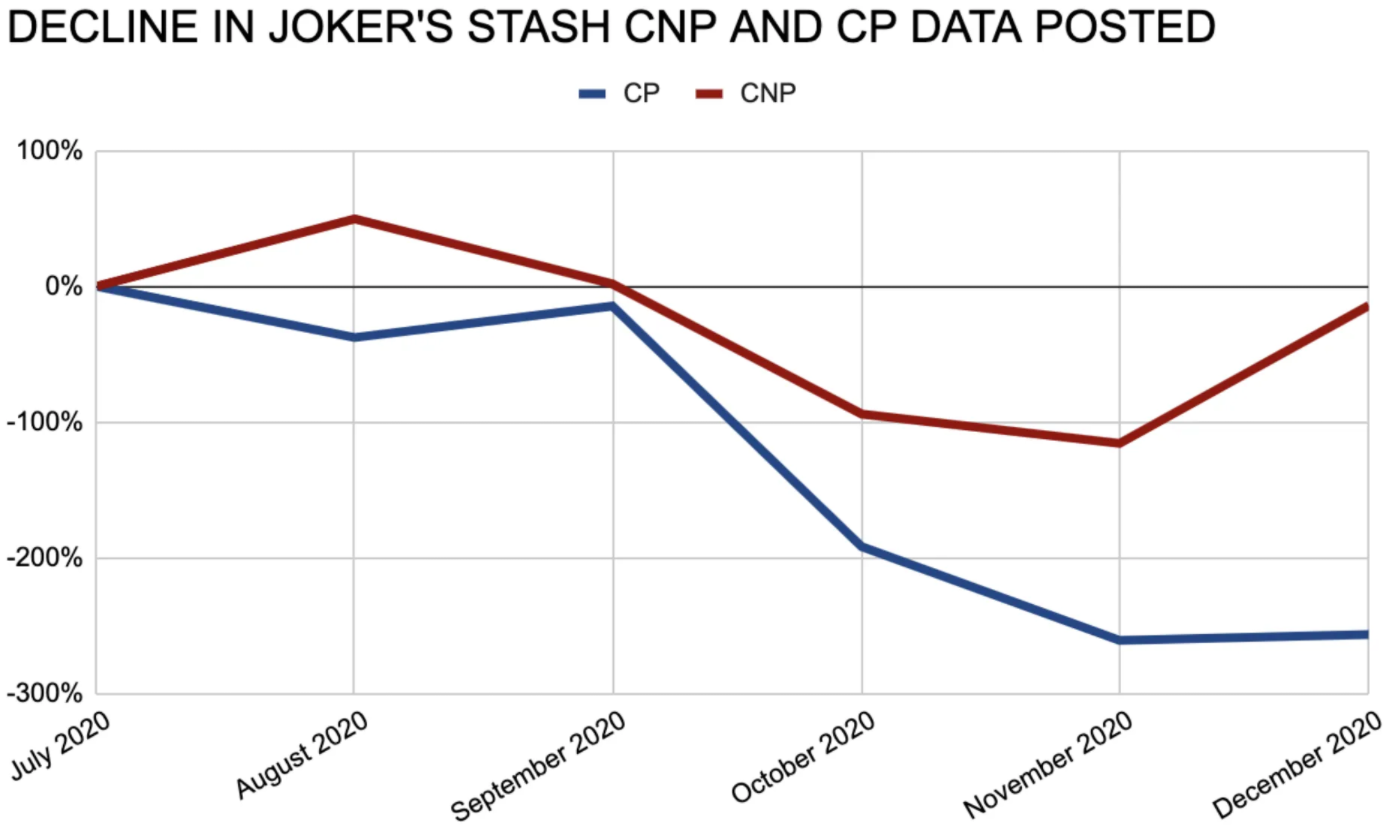
That COVID diagnosis may have affected the shop owner’s ability to maintain fresh and valid inventory on his site. Gemini Advisory, a New York City-based company that monitors underground carding shops, tracked a “severe decline” in the volume of compromised payment card accounts for sale on Joker’s Stash over the past six months.

“Joker’s Stash has received numerous user complaints alleging that card data validity is low, which even prompted the administrator to upload proof of validity through a card-testing service,” Gemini wrote in a blog post about the planned shutdown.

Image: Gemini Advisory

Then on Dec. 16, 2020, several of Joker’s long-held domains began displaying notices that the sites had been seized by the U.S. Department of Justice and Interpol. The crime shop quickly recovered, moving to new infrastructure and assuring the underground community that it would continue to operate normally.

Gemini estimates that Joker’s Stash generated more than a billion dollars in revenue over the past several years. Much of that revenue came from high-profile breaches, including tens of millions of payment card records stolen from major merchants including Saks Fifth Avenue, Lord and TaylorBebe StoresHilton HotelsJason’s DeliWhole FoodsChipotle, Wawa, Sonic Drive-In, the Hy-Vee supermarket chain, Buca Di Beppo, and Dickey’s BBQ.

Joker’s Stash routinely teased big breaches days or weeks in advance of selling payment card records stolen from those companies, and periodically linked to this site and other media outlets as proof of his shop’s prowess and authenticity.

Like many other top cybercrime bazaars, Joker’s Stash was a frequent target of phishers looking to rip off unwary or unsophisticated thieves. In 2018, KrebsOnSecurity detailed a vast network of fake Joker’s Stash sites set up to steal login credentials and bitcoin. The phony sites all traced back to the owners of a Pakistani web site design firm. Many of those fake sites are still active (e.g. jokersstash[.]su).

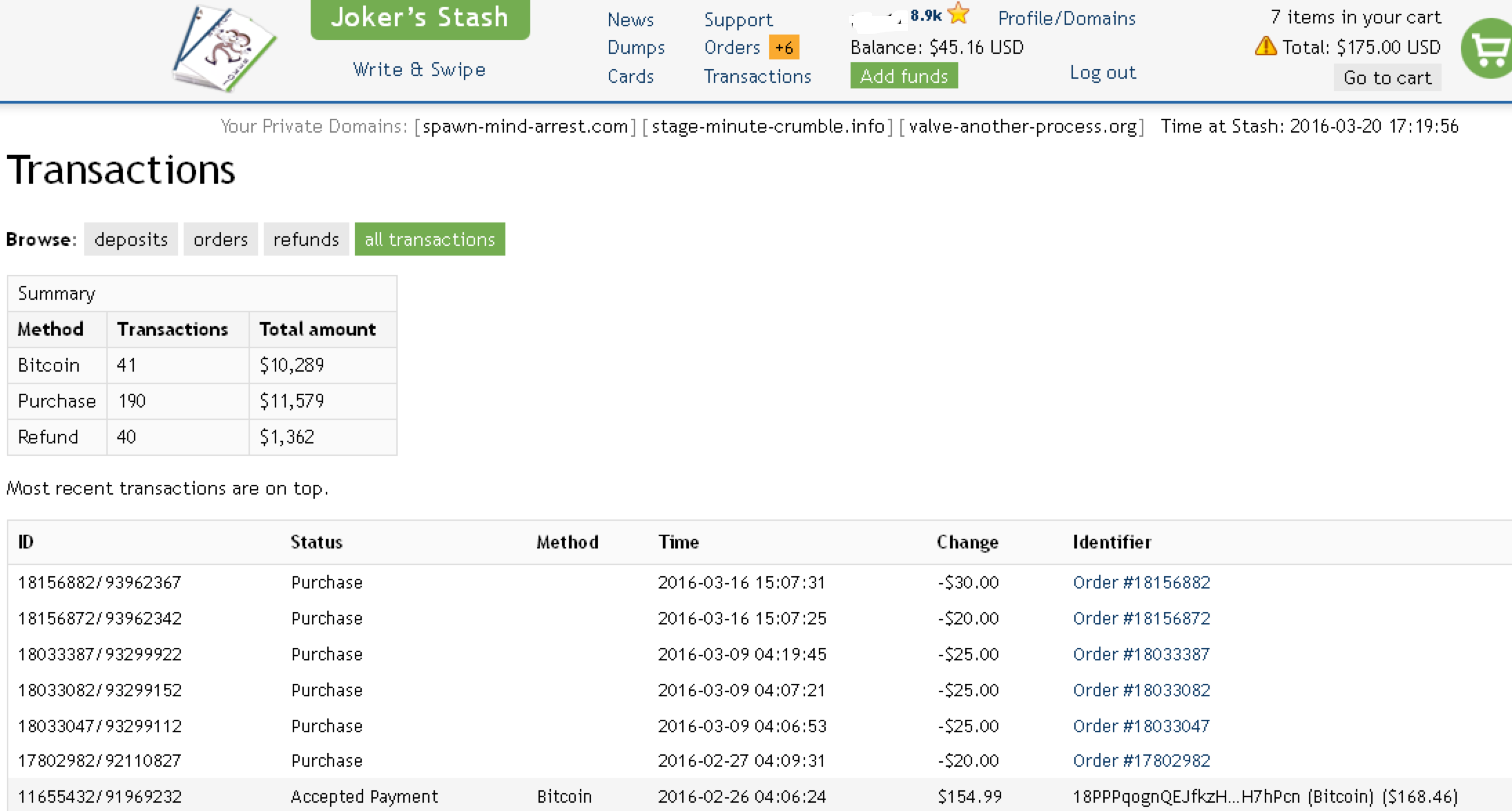
As noted here in 2016, Joker’s Stash attracted an impressive number of customers who kept five and six-digit balances at the shop, and who were granted early access to new breaches as well as steep discounts for bulk buys. Those “partner” customers will be given the opportunity to cash out their accounts. But the majority of Stash customers do not enjoy this status, and will have to spend their balances by Feb. 15 or forfeit those funds.

The dashboard for a Joker’s Stash customer who’s spent over $10,000 buying stolen credit cards from the site.

Gemini said another event that may have contributed to this threat actor shutting down their marketplace is the recent spike in the value of Bitcoin. A year ago, one bitcoin was worth about $9,000. Today a single bitcoin is valued at more than $35,000.

“JokerStash was an early advocate of Bitcoin and claims to keep all proceeds in this cryptocurrency,” Gemini observed in a blog post. “This actor was already likely to be among the wealthiest cybercriminals, and the spike may have multiplied their fortune, earning them enough money to retire. However, the true reason behind this shutdown remains unclear.”

If the bitcoin price theory holds, that would be fairly rich considering the parting lines in the closure notice posted to Joker’s Stash.

“We are also want to wish all young and mature ones cyber-gangsters not to lose themselves in the pursuit of easy money,” the site administrator(s) advised. “Remember, that even all the money in the world will never make you happy and that all the most truly valuable things in this life are free.”

Regardless, the impending shutdown is unlikely to have much of an impact on the overall underground carding industry, Gemini notes.

“Given Joker’s Stash’s high profile, it relied on a robust network of criminal vendors who offered their stolen records on this marketplace, among others,” the company wrote. “Gemini assesses with a high level of confidence that these vendors are very likely to fully transition to other large, top-tier dark web marketplaces.”

source https://krebsonsecurity.com/2021/01/jokers-stash-carding-market-to-call-it-quits/

Microsoft Patch Tuesday, January 2021 Edition

Microsoft today released updates to plug more than 80 security holes in its Windows operating systems and other software, including one that is actively being exploited and another which was disclosed prior to today. Ten of the flaws earned Microsoft’s most-dire “critical” rating, meaning they could be exploited by malware or miscreants to seize remote control over unpatched systems with little or no interaction from Windows users.

Most concerning of this month’s batch is probably a critical bug (CVE-2021-1647) in Microsoft’s default anti-malware suite — Windows Defender — that is seeing active exploitation. Microsoft recently stopped providing a great deal of detail in their vulnerability advisories, so it’s not entirely clear how this is being exploited.

But Kevin Breen, director of research at Immersive Labs, says depending on the vector the flaw could be trivial to exploit.

“It could be as simple as sending a file,” he said. “The user doesn’t need to interact with anything, as Defender will access it as soon as it is placed on the system.”

Fortunately, this bug is probably already patched by Microsoft on end-user systems, as the company continuously updates Defender outside of the normal monthly patch cycle.

Breen called attention to another critical vulnerability this month — CVE-2020-1660 — which is a remote code execution flaw in nearly every version of Windows that earned a CVSS score of 8.8 (10 is the most dangerous).

“They classify this vulnerability as ‘low’ in complexity, meaning an attack could be easy to reproduce,” Breen said. “However, they also note that it’s ‘less likely’ to be exploited, which seems counterintuitive. Without full context of this vulnerability, we have to rely on Microsoft to make the decision for us.”

CVE-2020-1660 is actually just one of five bugs in a core Microsoft service called Remote Procedure Call (RPC), which is responsible for a lot of heavy lifting in Windows. Some of the more memorable computer worms of the last decade spread automatically by exploiting RPC vulnerabilities.

Allan Liska, senior security architect at Recorded Future, said while it is concerning that so many vulnerabilities around the same component were released simultaneously, two previous vulnerabilities in RPC — CVE-2019-1409 and CVE-2018-8514 — were not widely exploited.

The remaining 70 or so flaws patched this month earned Microsoft’s less-dire “important” ratings, which is not to say they’re much less of a security concern. Case in point: CVE-2021-1709, which is an “elevation of privilege” flaw in Windows 8 through 10 and Windows Server 2008 through 2019.

“Unfortunately, this type of vulnerability is often quickly exploited by attackers,” Liska said. “For example, CVE-2019-1458 was announced on December 10th of 2019, and by December 19th an attacker was seen selling an exploit for the vulnerability on underground markets. So, while CVE-2021-1709 is only rated as [an information exposure flaw] by Microsoft it should be prioritized for patching.”

Trend Micro’s ZDI Initiative pointed out another flaw marked “important” — CVE-2021-1648, an elevation of privilege bug in Windows 8, 10 and some Windows Server 2012 and 2019 that was publicly disclosed by ZDI prior to today.

“It was also discovered by Google likely because this patch corrects a bug introduced by a previous patch,” ZDI’s Dustin Childs said. “The previous CVE was being exploited in the wild, so it’s within reason to think this CVE will be actively exploited as well.”

Separately, Adobe released security updates to tackle at least eight vulnerabilities across a range of products, including Adobe Photoshop and Illustrator. There are no Flash Player updates because Adobe retired the browser plugin in December (hallelujah!), and Microsoft’s update cycle from last month removed the program from Microsoft’s browsers.

Windows 10 users should be aware that the operating system will download updates and install them all at once on its own schedule, closing out active programs and rebooting the system. If you wish to ensure Windows has been set to pause updating so you have ample opportunity to back up your files and/or system, see this guide.

Please back up your system before applying any of these updates. Windows 10 even has some built-in tools to help you do that, either on a per-file/folder basis or by making a complete and bootable copy of your hard drive all at once. You never know when a patch roll-up will bork your system or possibly damage important files. For those seeking more flexible and full-featured backup options (including incremental backups), Acronis and Macrium are two that I’ve used previously and are worth a look.

That said, there don’t appear to be any major issues cropping up yet with this month’s update batch. But before you apply updates consider paying a visit to AskWoody.com, which usually has the skinny on any reports about problematic patches.

As always, if you experience glitches or issues installing any of these patches this month, please consider leaving a comment about it below; there’s a better-than-even chance other readers have experienced the same and may chime in here with some helpful tips.

source https://krebsonsecurity.com/2021/01/microsoft-patch-tuesday-january-2021-edition/

SolarWinds: What Hit Us Could Hit Others

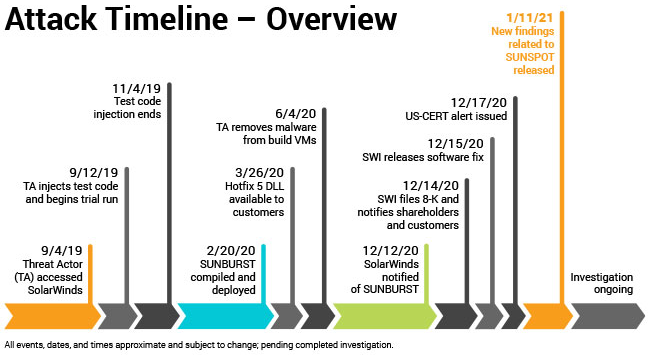
New research into the malware that set the stage for the megabreach at IT vendor SolarWinds shows the perpetrators spent months inside the company’s software development labs honing their attack before inserting malicious code into updates that SolarWinds then shipped to thousands of customers. More worrisome, the research suggests the insidious methods used by the intruders to subvert the company’s software development pipeline could be repurposed against many other major software providers.

In a blog post published Jan. 11, SolarWinds said the attackers first compromised its development environment on Sept. 4, 2019. Soon after, the attackers began testing code designed to surreptitiously inject backdoors into Orion, a suite of tools used by many Fortune 500 firms and a broad swath of the federal government to manage their internal networks.

Image: SolarWinds.

According to SolarWinds and a technical analysis from CrowdStrike, the intruders were trying to work out whether their “Sunspot” malware — designed specifically for use in undermining SolarWinds’ software development process — could successfully insert their malicious “Sunburst” backdoor into Orion products without tripping any alarms or alerting Orion developers.

In October 2019, SolarWinds pushed an update to their Orion customers that contained the modified test code. By February 2020, the intruders had used Sunspot to inject the Sunburst backdoor into the Orion source code, which was then digitally signed by the company and propagated to customers via SolarWinds’ software update process.

Crowdstrike said Sunspot was written to be able to detect when it was installed on a SolarWinds developer system, and to lie in wait until specific Orion source code files were accessed by developers. This allowed the intruders to “replace source code files during the build process, before compilation,” Crowdstrike wrote.

The attackers also included safeguards to prevent the backdoor code lines from appearing in Orion software build logs, and checks to ensure that such tampering wouldn’t cause build errors.

“The design of SUNSPOT suggests [the malware] developers invested a lot of effort to ensure the code was properly inserted and remained undetected, and prioritized operational security to avoid revealing their presence in the build environment to SolarWinds developers,” CrowdStrike wrote.

A third malware strain — dubbed “Teardrop” by FireEye, the company that first disclosed the SolarWinds attack in December — was installed via the backdoored Orion updates on networks that the SolarWinds attackers wanted to plunder more deeply.

So far, the Teardrop malware has been found on several government networks, including the Commerce, Energy and Treasury departments, the Department of Justice and the Administrative Office of the U.S. Courts.

SolarWinds emphasized that while the Sunspot code was specifically designed to compromise the integrity of its software development process, that same process is likely common across the software industry.

“Our concern is that right now similar processes may exist in software development environments at other companies throughout the world,” said SolarWinds CEO Sudhakar Ramakrishna. “The severity and complexity of this attack has taught us that more effectively combatting similar attacks in the future will require an industry-wide approach as well as public-private partnerships that leverage the skills, insight, knowledge, and resources of all constituents.”

source https://krebsonsecurity.com/2021/01/solarwinds-what-hit-us-could-hit-others/

Ubiquiti: Change Your Password, Enable 2FA

Ubiquiti, a major vendor of cloud-enabled Internet of Things (IoT) devices such as routers, network video recorders, security cameras and access control systems, is urging customers to change their passwords and enable multi-factor authentication. The company says an incident at a third-party cloud provider may have exposed customer account information and credentials used to remotely manage Ubiquiti gear.

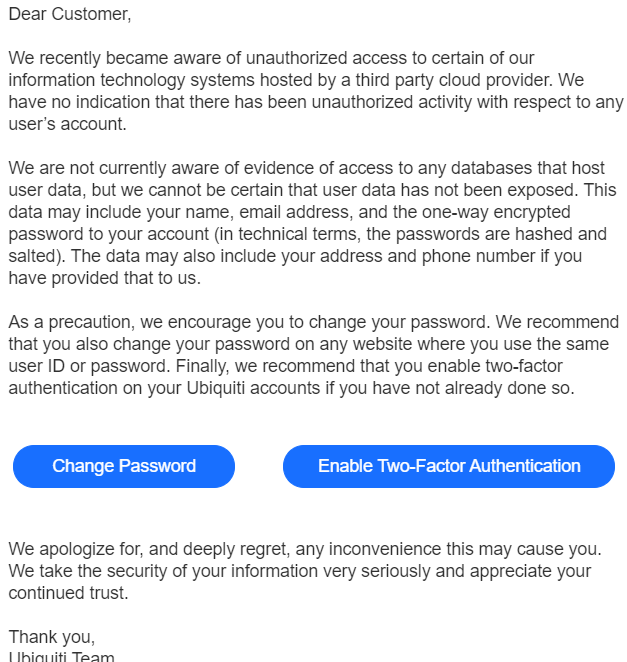
In an email sent to customers today, Ubiquiti Inc. [NYSE: UI] said it recently became aware of “unauthorized access to certain of our information technology systems hosted by a third party cloud provider,” although it declined to name that provider.

The statement continues:

“We are not currently aware of evidence of access to any databases that host user data, but we cannot be certain that user data has not been exposed. This data may include your name, email address, and the one-way encrypted password to your account (in technical terms, the passwords are hashed and salted). The data may also include your address and phone number if you have provided that to us.”

Ubiquiti has not yet responded to requests for more information, but the notice was confirmed as official in a post on the company’s user support forum.

The warning from Ubiquiti carries particular significance because the company has made it fairly difficult for customers using the latest Ubiquiti firmware to interact with their devices without first authenticating through the company’s cloud-based systems.

This has become a sticking point for many Ubiquiti customers, as evidenced by numerous threads on the topic in the company’s user support forums over the past few months.

“While I and others do appreciate the convenience and option of using hosted accounts, this incident clearly highlights the problem with relying on your infrastructure for authenticating access to our devices,” wrote one Ubiquiti customer today whose sentiment was immediately echoed by other users. “A lot us cannot take your process for granted and need to keep our devices offline during setup and make direct connections by IP/Hostname using our Mobile Apps.”

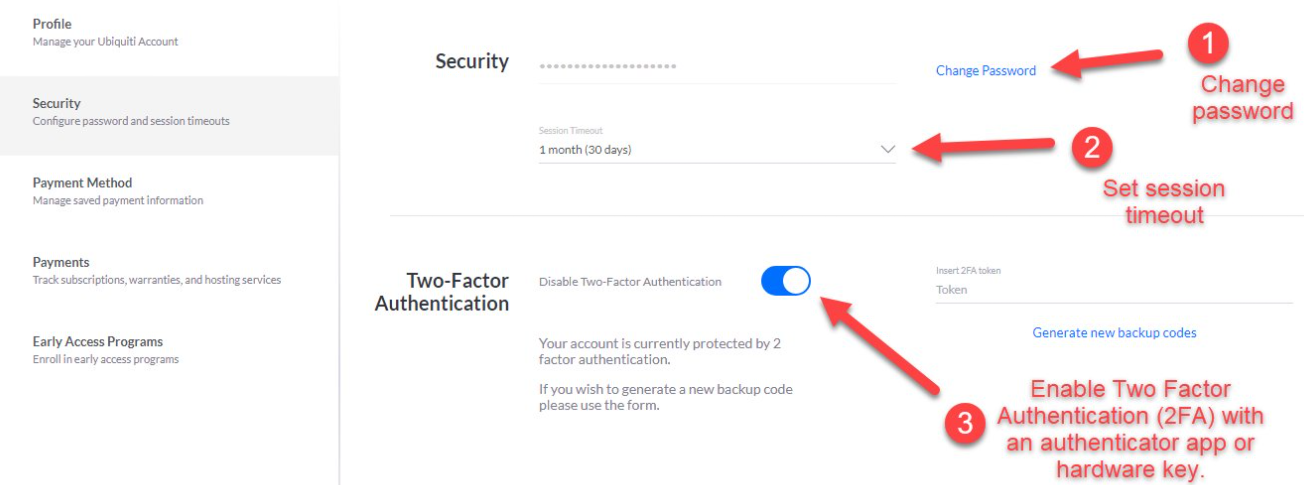
To manage your security settings on a Ubiquiti device, visit https://account.ui.com and log in. Click on ‘Security’ from the left-hand menu.

1. Change your password
2. Set a session timeout value
3. Enable 2FA

Image: twitter.com/crosstalksol/

According to Ubiquiti’s investment literature, the company has shipped more than 85 million devices that play a key role in networking infrastructure in over 200 countries and territories worldwide.

This is a developing story that may be updated throughout the day.

source https://krebsonsecurity.com/2021/01/ubiquiti-change-your-password-enable-2fa/