Investment Scammer John Davies Reinvents Himself?

John Bernard, a pseudonym used by a convicted thief and con artist named John Clifton Davies who’s fleeced dozens of technology startups out of an estimated $30 million, appears to have reinvented himself again after being exposed in a recent investigative series published here. Sources tell KrebsOnSecurity that Davies/Bernard is now posing as John Cavendish and head of a new “private office” called Hempton Business Management LLP.

John Davies is a U.K. man who absconded from justice before being convicted on multiple counts of fraud in 2015. Prior to his conviction, Davies served 16 months in jail before being cleared of murdering his wife on their honeymoon in India.

Davies’ fraud convictions stemmed from a series of U.K. companies he set up supposedly to help troubled companies reorganize their debt and turn things around. Davies ended up looting what little money his clients had left and spending it on lavish cars, home furnishings, vacations and luxury watches.

In a three-part series published last year, KrebsOnSecurity exposed how Davies — wanted by authorities in the U.K. — had fled the country, taken on the surname Bernard, remarried, and moved to his new (and fourth) wife’s hometown in Ukraine.
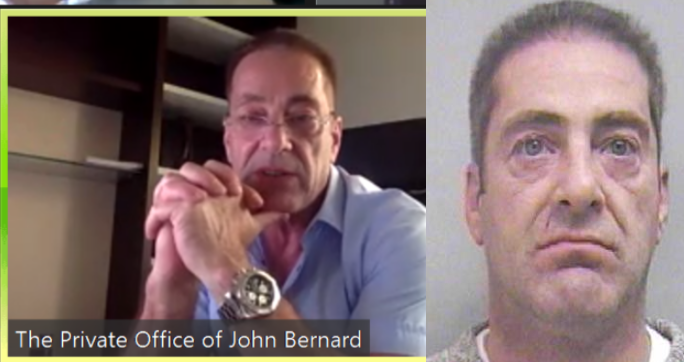
The scam artist John Bernard (left) in a recent Zoom call, and a photo of John Clifton Davies from 2015.

After eluding justice in the U.K., Davies reinvented himself as The Private Office of John Bernard, pretending to be a billionaire Swiss investor who made his fortunes in the dot-com boom 20 years ago and who was seeking private equity investment opportunities.

In case after case, Bernard would promise to invest millions in hi-tech startups, only to insist that companies pay tens of thousands of dollars worth of due diligence fees up front. However, the due diligence company he insisted on using — another Swiss firm called Inside Knowledge — also was secretly owned by Bernard, who would invariably pull out of the deal after receiving the due diligence money.

Bernard found a constant stream of new marks by offering extraordinarily generous finders fees to investment brokers who could introduce him to companies seeking an infusion of cash. Inside Knowledge and The Private Office both closed up shop not long after their exploits were detailed here late last year.

But it appears Davies has just assumed a new name. KrebsOnSecurity recently heard from an investment broker who previously represented multiple clients that got fleeced by Mr. Bernard/Davies over the years. That broker said he was blown away to hear Davies’ unique British accent on a recent call with a client that had been in investment talks with a Northern Ireland firm called Hempton Business Management.

This time, the source said, Davies was introduced by handlers on the call as John Cavendish.

“I just sat in on a call and John’s voice is unmistakable,” said the broker, who asked to remain anonymous. “He stumbled on the beginning of the call trying to remember which last name he was supposed to use. Immediately they go back to the standard script about the types of deals they are looking for. They want to be minority investors in private transactions and they are industry agnostic.  Their deal sizes are investments in the $5-20 million range, they prefer to not use big 4 firms for due diligence, and they have some smaller firms they use which are better suited for smaller investment deals.”
The source forwarded me some correspondence from Hempton Business Management, and I noticed it was sent from a Mariya Kulykova. This is interesting because Mr. Bernard’s personal assistant in Ukraine was a Mariya Kulikova (Ms. Kulikova deleted Bernard’s former companies from her LinkedIn profile shortly after last year’s series).

The company’s website says Hempton has been around since 2017, but the domain name was only registered in late November 2020. There is no information about who runs or owns the company on its site.

Hemptonllp[.]com was registered via Gandi, the same French registrar John Bernard/Davies has used over the years with his dozens of phantom companies.

Hempton Business Management’s only presence on LinkedIn appears to be a help wanted ad from a few weeks ago, for a marketing position at an office in Kyiv, Ukraine.

In response to an emailed request for comment on the apparent connections, Mr. Cavendish forwarded the message to a James Donohoe, who replied that he was the owner of Hempton. Donohoe said the domain was new because the company recently re-branded, although he declined to discuss the matter further.

“This sounds like an accusation of a big fraud?,” Donohoe wrote. “I have never had any dealings with a John Clifton Davies or John Bernard. You really are a cheeky little bugger aren’t you!”

Mr. Donohoe did not respond to further requests for comment.

Hempton appears to be part of a network of corporate facades designed to lead any investigators into a labyrinth of entities that exist only on paper. Hempton is what’s known as a “shelf corporation,” an aged or seasoned company that was formed but never used as a business. Shelf corporations are registered solely for the purposes of being resold to others at a later date. Simply put, their resale allows new enterprises to appear older, more established, and trusted.

“Perhaps the leading reason for acquiring an aged entity in general is credibility,” explains TBA & Associates, a company co-registered in the UK and New Zealand that has created hundreds of shelf companies for sale (PDF), including Hempton Business Management LLP in 2017.

“Business relationships are frequently influenced by the length of time a company has been in existence,” TBA continues. “This is often true when establishing financial and client/vendor relationships.”
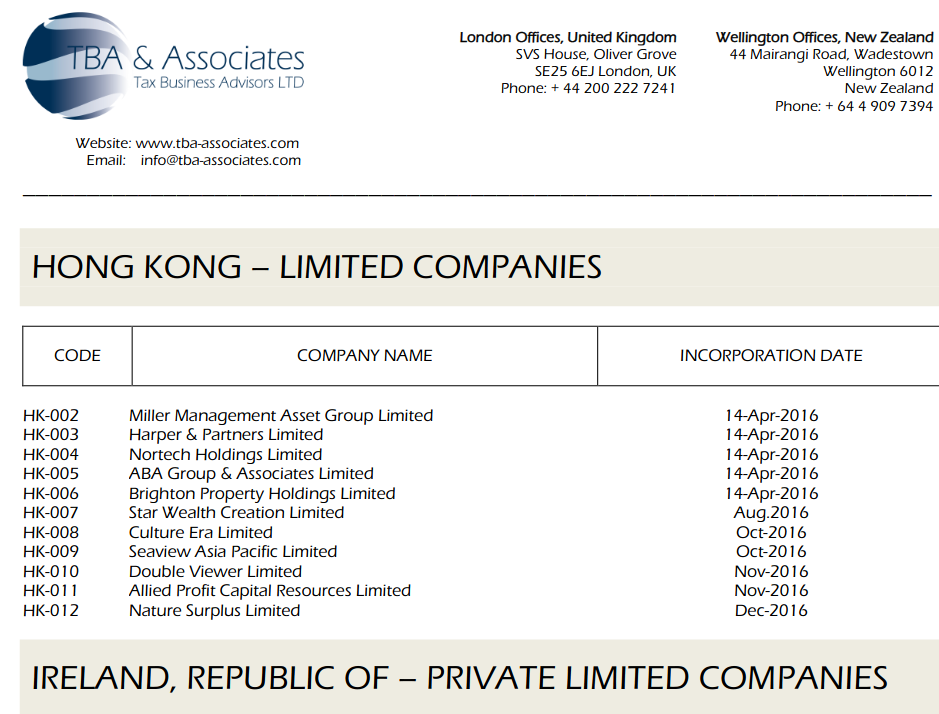
Some of the shelf companies created and sold by TBA & Associates.

Documents from the UK business record index Companies House show two entities as officers in Hempton: ABA Group & Associates LTD, and Harper & Partners Ltd. Both of these are shelf companies in Hong Kong that are listed for sale in the same TBA PDF advertisement linked for Hempton.

Searching Companies House for information on ABA Group and Harper & Partners leads to a dizzying number of other shelf companies in Hong Kong, Belize and the U.K. — all of which also were recently listed for sale by TBA.

The only person’s name attached to each of these companies is a Joaquim Magro de Almeida, a rather mysterious 72 year-old Portuguese business consultant. OpenCorporates says this same guy is an officer in 313 active companies. The U.K.’s Companies House lists Mr. Almeida as one of three officers in Euro Forex Investments Ltd., which Reuters says was a sprawling pyramid scheme that stole $1 billion from at least 3,700 victims in China, the United States and elsewhere.

This 2017 story from New Zealand financial news site interest.co.nz follows a trail of various other investment scams leading back to TBA shell companies, and to Mr. Almeida, too.

In my first report on John Davies, I noted that before becoming John Bernard he previously used the pseudonym “Jonathan Bibi” with an address in the offshore company haven of Seychelles. That identity was tied to a number of fraudulent cryptocurrency and binary options investment schemes.

Fraudsters are drawn to complexity, and they typically incorporate their shell or shelf companies in countries with little to no oversight or background checks tied to the creation and maintenance of corporate entities. As we’ve seen here, the U.K. is a favorite of fraudsters and money launderers worldwide. In a scathing 2017 report titled Hiding in Plain Sight (PDF), Transparency International found some 766 UK corporate vehicles were alleged to have been used in 52 large-scale corruption and money laundering cases approaching £80 billion.

source https://krebsonsecurity.com/2021/05/investment-scammer-john-davies-reinvents-himself/
Malicious Office 365 Apps Are the Ultimate Insiders

Phishers targeting Microsoft Office 365 users increasingly are turning to specialized links that take users to their organization’s own email login page. After a user logs in, the link prompts them to install a malicious but innocuously-named app that gives the attacker persistent, password-free access to any of the user’s emails and files, both of which are then plundered to launch malware and phishing scams against others.

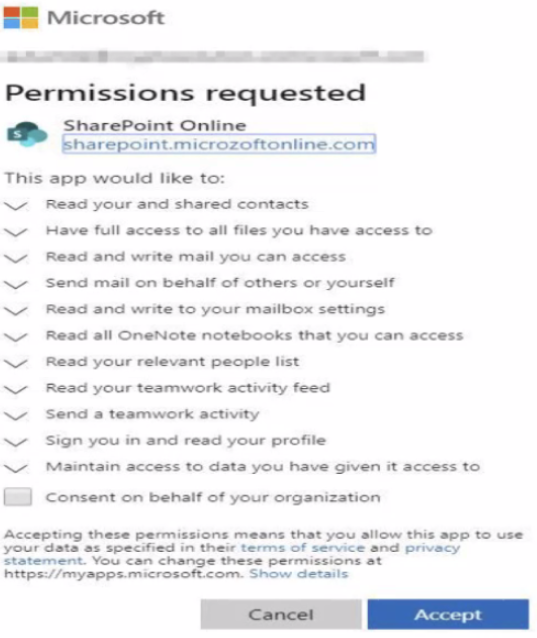
These attacks begin with an emailed link that when clicked loads not a phishing site but the user’s actual Office 365 login page — whether that be at microsoft.com or their employer’s domain. After logging in, the user might see a prompt that looks something like this:

These malicious apps allow attackers to bypass multi-factor authentication, because they are approved by the user after that user has already logged in. Also, the apps will persist in a user’s Office 365 account indefinitely until removed, and will survive even after an account password reset.

This week, messaging security vendor Proofpoint published some new data on the rise of these malicious Office 365 apps, noting that a high percentage of Office users will fall for this scheme [full disclosure: Proofpoint is an advertiser on this website].

Ryan Kalember, Proofpoint’s executive vice president of cybersecurity strategy, said 55 percent of the company’s customers have faced these malicious app attacks at one point or another.

“Of those who got attacked, about 22 percent — or one in five — were successfully compromised,” Kalember said.

Kalember said Microsoft last year sought to limit the spread of these malicious Office apps by creating an app publisher verification system, which requires the publisher to be a valid Microsoft Partner Network member.

That approval process is cumbersome for attackers, so they’ve devised a simple work around. “Now, they’re compromising accounts in credible tenants first,” Proofpoint explains. “Then, they’re creating, hosting and spreading cloud malware from within.”

The attackers responsible for deploying these malicious Office apps aren’t after passwords, and in this scenario they can’t even see them. Rather, they’re hoping that after logging in users will click yes to a approve the installation of a malicious but innocuously-named app into their Office365 account.

Kalember said the crooks behind these malicious apps typically use any compromised email accounts to conduct “business email compromise” or BEC fraud, which involves spoofing an email from someone in authority at an organization and requesting the payment of a fictitious invoice. Other uses have included the sending of malware-laced emails from the victim’s email account.

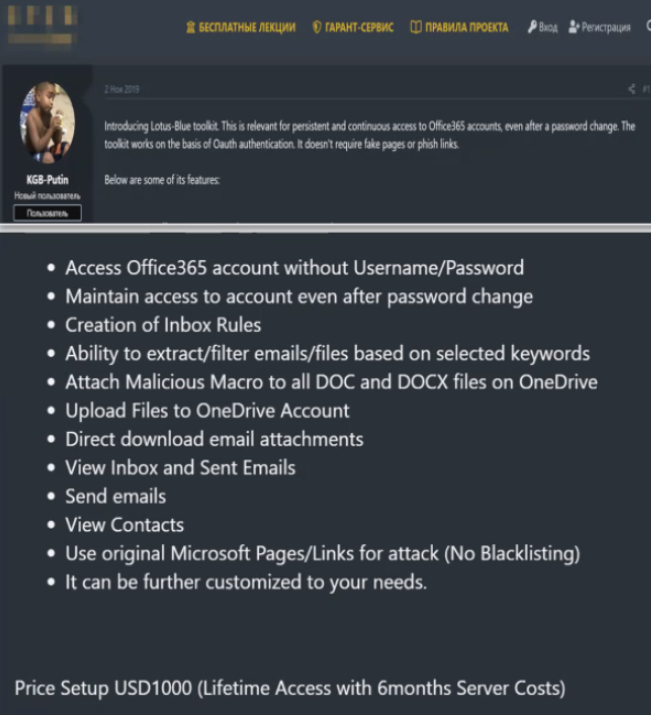
Last year, Proofpoint wrote about a service in the cybercriminal underground where customers could access various Office 365 accounts without a username or password. The service also advertised the ability to extract and filter emails and files based on selected keywords, as well as attach malicious macros to all documents in a user’s Microsoft OneDrive.

A cybercriminal service advertising the sale of access to hacked Office365 accounts. Image: Proofpoint.

“You don’t need a botnet if you have Office 365, and you don’t need malware if you have these [malicious] apps,” Kalember said. “It’s just easier, and it’s a good way to bypass multi-factor authentication.”

KrebsOnSecurity first warned about this trend in January 2020. That story cited Microsoft saying that while organizations running Office 365 could restrict users from installing apps, doing so was a “drastic step” that “severely impairs your users’ ability to be productive with third-party applications.”

Since then, Microsoft added a policy that allows Office 365 administrators to block users from consenting to an application from a non-verified publisher. Also, applications published after November 8, 2020, are coupled with a consent screen warning in case the publisher is not verified, and the tenant policy allows the consent.

Proofpoint says O365 administrators should limit or block which non-administrators can create applications, and enable Microsoft’s verified publisher policy — as a majority of cloud malware is still coming from Office 365 tenants that are not part of Microsoft’s partner network.

source https://krebsonsecurity.com/2021/05/malicious-office-365-apps-are-the-ultimate-insiders/

The Wages of Password Re-use: Your Money or Your Life

When normal computer users fall into the nasty habit of recycling passwords, the result is most often some type of financial loss. When cybercriminals develop the same habit, it can eventually cost them their freedom.

Our passwords can say a lot about us, and much of what they have to say is unflattering. In a world in which all databases — including hacker forums — are eventually compromised and leaked online, it can be tough for cybercriminals to maintain their anonymity if they’re in the habit of re-using the same unusual passwords across multiple accounts associated with different email addresses.

The long-running Breadcrumbs series here tracks how cybercriminals get caught, and it’s mostly through odd connections between their online and offline selves scattered across the Internet. Interestingly, one of the more common connections involves re-using or recycling passwords across multiple accounts.

And yes, hackers get their passwords compromised at the same rate as the rest of us. Which means when a cybercrime forum gets hacked and its user databases posted online, it is often possible to work backwards from some of the more unique passwords for each account and see where else that password was used.

SWATTING THE FLY

Of all the stories I’ve written here over the last 11 years, probably the piece I get asked most to recount is the one about Sergey “Fly” Vovnenko, a Ukrainian man who in 2013 hatched and executed a plan to buy heroin off the dark web, ship it to our house and then spoof a call to the police from one of our neighbors saying we were dealing drugs.

Fly was the administrator of a Russian-language identity theft forum at the time, and as a secret lurker on his forum KrebsOnSecurity watched his plan unfold in real time. As I described in a 2019 story about an interview Fly gave to a Russian publication upon his release from a U.S. prison, his propensity for password re-use ultimately landed him in Italy’s worst prison for more than a year before he was extradited to face charges in America.

Around the same time Fly was taking bitcoin donations for a fund to purchase heroin on my behalf, he was also engaged to be married to a young woman. But Fly apparently did not fully trust his bride-to-be, so he had malware installed on her system that forwarded him copies of all email that she sent and received.

But Fly would make at least two big operational security mistakes in this spying effort: First, he had his fiancée’s messages forwarded to an email account he’d used for plenty of cybercriminal stuff related to his various “Fly” identities.

Mistake number two was the password for his email account was the same as his cybercrime forum admin account. And unbeknownst to him at the time, that forum was hacked, with all email addresses and hashed passwords exposed.

Soon enough, investigators were reading Fly’s email, including the messages forwarded from his wife’s account that had details about their upcoming nuptials, such as shipping addresses for their wedding-related items and the full name of Fly’s fiancée. It didn’t take long to zero in on Fly’s location in Naples.

POOR PASSWORDS AS GOOD OPSEC?

While it may sound unlikely that a guy so enmeshed in the cybercrime space could make such rookie security mistakes, I have found that a great many cybercriminals actually have worse operational security than the average Internet user.

Countless times over the years I’ve encountered huge tranches of valuable, dangerous data — like a botnet control panel or admin credentials for cybercrime forums — that were full of bad passwords, like password1 or 123qweasd (an incredibly common keyboard pattern password).

I suspect this may be because the nature of illicit activity online requires cybercrooks to create vast numbers of single- or brief-use accounts, and as such they tend to re-use credentials across multiple sites, or else pick very poor passwords — even for critical resources.

Regardless of their reasons or lack thereof for choosing poor passwords, it is fascinating that in terms of maintaining one’s operational security it actually benefits cybercriminals to use poor passwords in many situations.

For example, it is often the denizens of the cybercrime underground who pick crappy passwords for their forum accounts who end up doing their future selves a favor when the forum eventually gets hacked and its user database is posted online.

SOME ADVICE FOR EVERYONE

It really stinks that it’s mid-2021 and we’re still so reliant on passwords. But as long as that’s the case, I hope it’s clear that the smartest choice for all Internet users is to pick unique passwords for every site. The major Web browsers will now auto-suggest long, complex and unique passwords when users go to set up a new account somewhere online, and this is obviously the simplest way to achieve that goal.

Password managers are ideal for people who can’t break the habit of re-using passwords, because you only have to remember one (strong) master password to access all of your stored credentials.

If you don’t trust password managers and have trouble remembering complex passwords, consider relying instead on password length, which is a far more important determiner of whether a given password can be cracked by available tools in any timeframe that might be reasonably useful to an attacker.

In that vein, it’s safer and wiser to focus on picking passphrases instead of passwords. Passphrases are collections of multiple (ideally unrelated) words mushed together. Passphrases are not only generally more secure, they also have the added benefit of being easier to remember. Their main limitation is that countless sites still force you to add

Finally, there’s absolutely nothing wrong with writing down your passwords, provided a) you do not store them in a file on your computer or taped to your laptop, and b) that your password notebook is stored somewhere relatively secure, i.e. not in your purse or car, but something like a locked drawer or safe.

Further reading: Who’s Behind the GandCrab Ransomware?

source https://krebsonsecurity.com/2021/05/the-wages-of-password-re-use-your-money-or-your-life/

Task Force Seeks to Disrupt Ransomware Payments

Some of the world’s top tech firms are backing a new industry task force focused on disrupting cybercriminal ransomware gangs by limiting their ability to get paid, and targeting the individuals and finances of the organized thieves behind these crimes.

In a 50-page report delivered to the Biden administration this week, top executives from Amazon, Cisco, FireEye, McAfee, Microsoft and dozens of other firms joined the U.S. Department of Justice (DOJ), Europol and the U.K. National Crime Agency in calling for an international coalition to combat ransomware criminals, and for a global network of ransomware investigation hubs.

The Ransomware Task Force urged the White House to make finding, frustrating and apprehending ransomware crooks a priority within the U.S. intelligence community, and to designate the current scourge of digital extortion as a national security threat.

The formation of the industry partnership comes just days after The Wall Street Journal broke the news that the DOJ was forming its own task force to deal with the “root causes” of ransomware. An internal DOJ memo reportedly “calls for developing a strategy that targets the entire criminal ecosystem around ransomware, including prosecutions, disruptions of ongoing attacks and curbs on services that support the attacks, such as online forums that advertise the sale of ransomware or hosting services that facilitate ransomware campaigns.”

According to security firm Emsisoft, almost 2,400 U.S.-based governments, healthcare facilities and schools were victims of ransomware in 2020.

“The costs of ransomware go far beyond the ransom payments themselves,” the task force report observes. “Cybercrime is typically seen as a white-collar crime, but while ransomware is profit-driven and ‘non-violent’ in the traditional sense, that has not stopped ransomware attackers from routinely imperiling lives.”

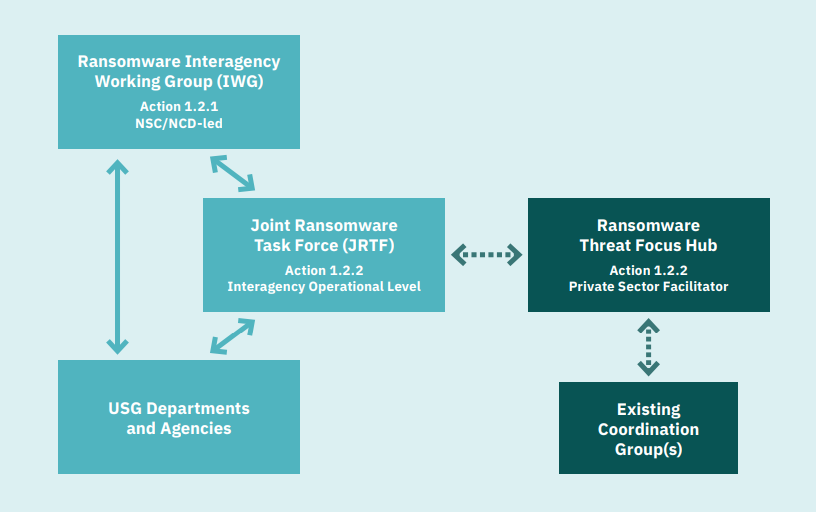
A proposed framework for a public-private operational ransomware campaign. Image: IST.

It is difficult to gauge the true cost and size of the ransomware problem because many victims never come forward to report the crimes. As such, a number of the task force’s recommendations focus on ways to encourage more victims to report the crimes to their national authorities, such as requiring victims and incident response firms who pay a ransomware demand to report the matter to law enforcement and possibly regulators at the U.S. Treasury Department.

Last year, Treasury issued a controversial memo warning that ransomware victims who end up sending digital payments to people already being sanctioned by the U.S. government for money laundering and other illegal activities could result in hefty fines.

Philip Reiner, executive director of the Institute for Security and Technology, said the reporting recommendations are one of several areas where federal agencies will likely need to dedicate more employees. For example, he said, expecting victims to clear ransomware payments with the Treasury Department first assumes the agency has the staff to respond in any kind of timeframe that might be useful for a victim undergoing a ransomware attack.

“That’s why we were so dead set in putting forward comprehensive framework,” Reiner said. “That way, Department of Homeland Security can do what they need to do, the State Department, Treasury gets involved, and it all needs to be synchronized for going after the bad guys with the same alacrity.”

Some have argued that making it illegal to pay a ransom is one way to decrease the number of victims who acquiesce to their tormentors’ demands. But the task force report says we’re nowhere near ready for that yet.

“Ransomware attackers require little risk or effort to launch attacks, so a prohibition on ransom payments would not necessarily lead them to move into other areas,” the report observes. “Rather, they would likely continue to mount attacks and test the resolve of both victim organizations and their regulatory authorities. To apply additional pressure, they would target organizations considered more essential to society, such as healthcare providers, local governments, and other custodians of critical infrastructure.”

“As such, any intent to prohibit payments must first consider how to build organizational cybersecurity maturity, and how to provide an appropriate backstop to enable organizations to weather the initial period of extreme testing,” the authors concluded in the report. “Ideally, such an approach would also be coordinated internationally to avoid giving ransomware attackers other avenues to pursue.”

The task force’s report comes as federal agencies have been under increased pressure to respond to a series of ransomware attacks that were mass-deployed as attackers began exploiting four zero-day vulnerabilities in Microsoft Exchange Server email products to install malicious backdoors. Earlier this month, the DOJ announced the FBI had conducted a first-of-its-kind operation to remove those backdoors from hundreds of Exchange servers at state and local government facilities.

Many of the recommendations in the Ransomware Task Force report are what you might expect, such as encouraging voluntary information sharing on ransomware attacks; launching public awareness campaigns on ransomware threats; exerting pressure on countries that operate as safe havens for ransomware operators; and incentivizing the adoption of security best practices through tax breaks.

A few of the more interesting recommendations (at least to me) included:

-Limit legal liability for ISPs that act in good faith trying to help clients secure their systems.

-Create a federal “cyber response and recovery fund” to help state and local governments or critical infrastructure companies respond to ransomware attacks.

-Require cryptocurrency exchanges to follow the same “know your customer” (KYC) and anti-money laundering rules as financial institutions, and aggressively targeting exchanges that do not.

-Have insurance companies measure and assert their aggregated ransomware losses and establish a common “war chest” subrogation fund “to evaluate and pursue strategies aimed at restitution, recovery, or civil asset seizures, on behalf of victims and in conjunction with law enforcement efforts.”

-Centralize expertise in cryptocurrency seizure, and scaling criminal seizure processes.

-Create a standard format for reporting ransomware incidents.

-Establish a ransomware incident response network.

source https://krebsonsecurity.com/2021/04/task-force-seeks-to-disrupt-ransomware-payments/

Experian API Exposed Credit Scores of Most Americans

Big-three consumer credit bureau Experian just fixed a weakness with a partner website that let anyone look up the credit score of tens of millions of Americans just by supplying their name and mailing address, KrebsOnSecurity has learned. Experian says it has plugged the data leak, but the researcher who reported the finding says he fears the same weakness may be present at countless other lending websites that work with the credit bureau.

Bill Demirkapi, an independent security researcher who’s currently a sophomore at the Rochester Institute of Technology, said he discovered the data exposure while shopping around for student loan vendors online.

Demirkapi encountered one lender’s site that offered to check his loan eligibility by entering his name, address and date of birth. Peering at the code behind this lookup page, he was able to see it invoked an Experian Application Programming Interface or API — a capability that allows lenders to automate queries for FICO credit scores from the credit bureau.

“No one should be able to perform an Experian credit check with only publicly available information,” Demirkapi said. “Experian should mandate non-public information for promotional inquiries, otherwise an attacker who found a single vulnerability in a vendor could easily abuse Experian’s system.”

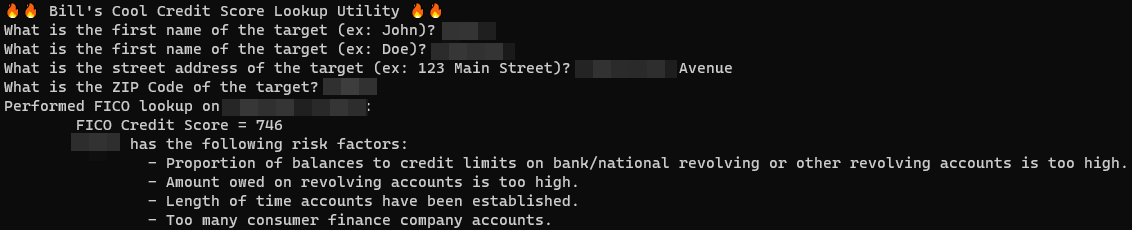
Demirkapi found the Experian API could be accessed directly without any sort of authentication, and that entering all zeros in the “date of birth” field let him then pull a person’s credit score. He even built a handy command-line tool to automate the lookups, which he dubbed “Bill’s Cool Credit Score Lookup Utility.”

Demirkapi’s Experian credit score lookup tool.

KrebsOnSecurity put that tool to the test, asking permission from a friend to have Demirkapi look up their credit score. The friend agreed and said he would pull his score from Experian (at this point I hadn’t told him that Experian was involved). The score he provided matched the score returned by Demirkapi’s lookup tool.

In addition to credit scores, the Experian API returns for each consumer up to four “risk factors,” indicators that might help explain why a person’s score is not higher.

For example, in my friend’s case Bill’s tool said his mid-700s score could be better if the proportion of balances to credit limits was lower, and if he didn’t owe so much on revolving credit accounts.

“Too many consumer finance company accounts,” the API concluded about my friend’s score.

The reason I could not test Demirkapi’s findings on my own credit score is that we have a security freeze on our files at the three major consumer credit reporting bureaus, and a freeze blocks this particular API from pulling the information.

Demirkapi declined to share with Experian the name of the lender or the website where the API was exposed. He refused because he said he suspects there may be hundreds or even thousands of companies using the same API, and that many of those lenders could be similarly leaking access to Experian’s consumer data.

“If we let them know about the specific endpoint, they can just ban/work with the loan vendor to block these requests on this one case, which doesn’t fix the systemic problem,” he explained.

Nevertheless, after being contacted by this reporter Experian figured out on its own which lender was exposing their API; Demirkapi said that vendor’s site now indicates the API access has been disabled.

“We have been able to confirm a single instance of where this situation has occurred and have taken steps to alert our partner and resolve the matter,” Experian said in a written statement. “While the situation did not implicate or compromise any of Experian’s systems, we take this matter very seriously. Data security has always been, and always will be, our highest priority.”

Demirkapi said he’s disappointed that Experian did exactly what he feared they would do.

“They found one endpoint I was using and sent it into maintenance mode,” he said. “But this doesn’t address the systemic issue at all.”

Leaky and poorly-secured APIs like the one Demirkapi found are the source of much mischief in the hands of identity thieves. Earlier this month, auto insurance giant Geico disclosed that fraudsters abused a bug in its site to steal drivers license numbers from Americans.

Geico said the data was used by thieves involved in fraudulently applying for unemployment insurance benefits. Many states now require drivers license numbers as a way of verifying an applicant’s identity.

In 2013, KrebsOnSecurity broke the news about an identity theft service in the underground that programmatically pulled sensitive consumer credit data directly from a subsidiary of Experian. That service was run by a Vietnamese hacker who’d told the Experian subsidiary he was a private investigator. The U.S. Secret Service later said the ID theft service “caused more material financial harm to more Americans than any other.”

Additional reading: Experian’s Credit Freeze Security is Still a Joke (Apr. 27, 2021)

source https://krebsonsecurity.com/2021/04/experian-api-exposed-credit-scores-of-most-americans/

Experian’s Credit Freeze Security is Still a Joke

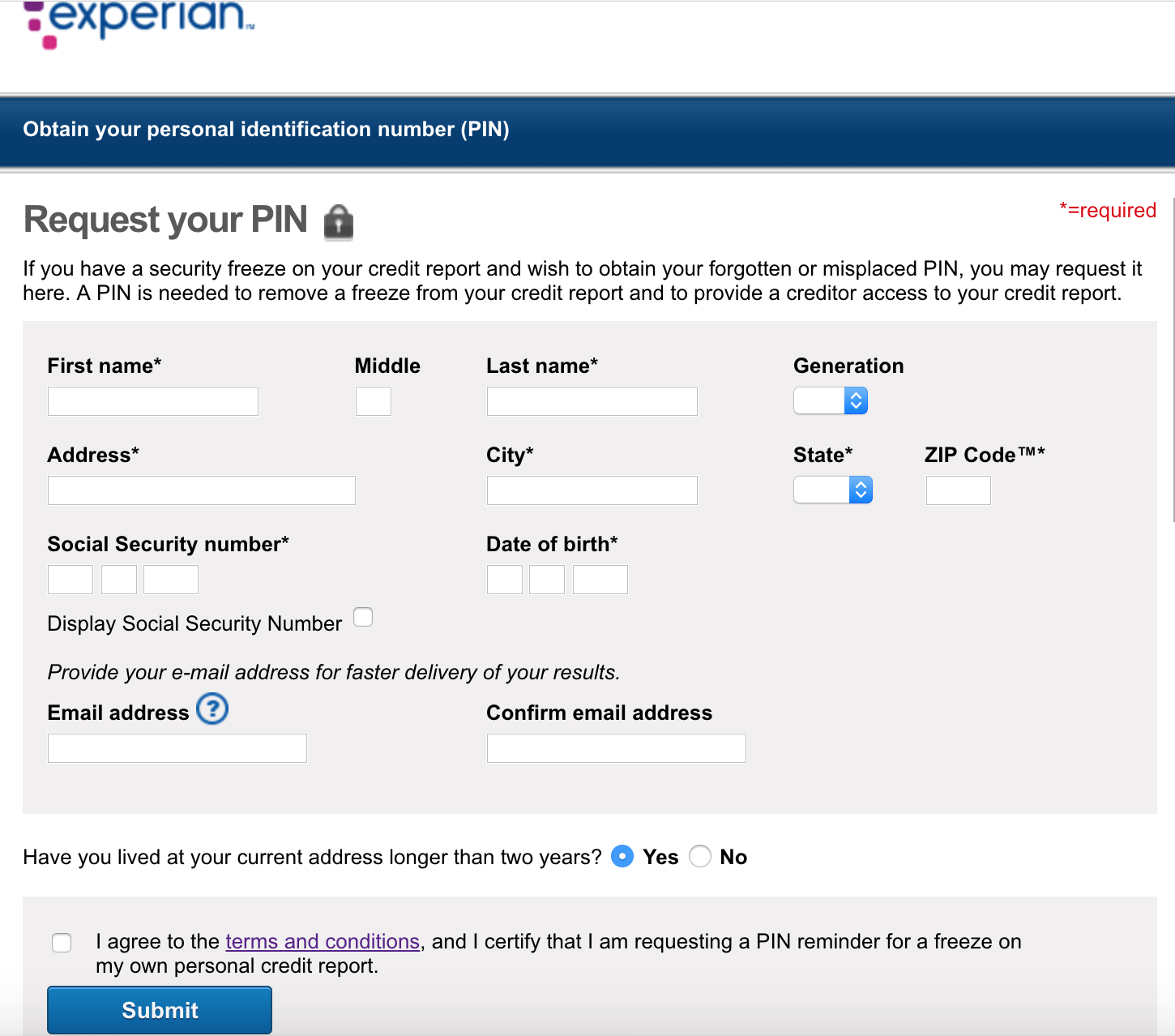
In 2017, KrebsOnSecurity showed how easy it is for identity thieves to undo a consumer’s request to freeze their credit file at Experian, one of the big three consumer credit bureaus in the United States.  Last week, KrebsOnSecurity heard from a reader who had his freeze thawed without authorization through Experian’s website, and it reminded me of how truly broken authentication and security remains in the credit bureau space.

Experian’s page for retrieving someone’s credit freeze PIN requires little more information than has already been leaked by big-three bureau Equifax and a myriad other breaches.

Dune Thomas is a software engineer from Sacramento, Calif. who put a freeze on his credit files last year at Experian, Equifax and TransUnion after thieves tried to open multiple new payment accounts in his name using an address in Washington state that was tied to a vacant home for sale.

But the crooks were persistent: Earlier this month, someone unfroze Thomas’ account at Experian and promptly applied for new lines of credit in his name, again using the same Washington street address. Thomas said he only learned about the activity because he’d taken advantage of a free credit monitoring service offered by his credit card company.

Thomas said after several days on the phone with Experian, a company representative acknowledged that someone had used the “request your PIN” feature on Experian’s site to obtain his PIN and then unfreeze his file.

Thomas said he and a friend both walked through the process of recovering their freeze PIN at Experian, and were surprised to find that just one of the five multiple-guess questions they were asked after entering their address, Social Security Number and date of birth had anything to do with information only the credit bureau might know.

KrebsOnSecurity stepped through the same process and found similar results. The first question asked about a new mortgage I supposedly took out in 2019 (I didn’t), and the answer was none of the above. The answer to the second question also was none of the above.

The next two questions were useless for authentication purposes because they’d already been asked and answered; one was “which of the following is the last four digits of your SSN,” and the other was “I was born within a year or on the year of the date below.” Only one question mattered and was relevant to my credit history (it concerned the last four digits of a checking account number).

The best part about this lax authentication process is that one can enter any email address to retrieve the PIN — it doesn’t need to be tied to an existing account at Equifax. Also, when the PIN is retrieved, Equifax doesn’t bother notifying any other email addresses already on file for that consumer.

Finally, your basic consumer (read: free) account at Experian does not give users the option to enable any sort of multi-factor authentication that might help stymie some of these PIN retrieval attacks on credit freezes.

Unless, that is, you subscribe to Experian’s heavily-marketed and confusingly-worded “CreditLock” service, which charges between $14.99 and $24.99 a month for the ability to “lock and unlock your file easily and quickly, without delaying the application process.” CreditLock users can both enable multifactor authentication and get alerts when someone tries to access their account.

Thomas said he’s furious that Experian only provides added account security for consumer who pay for monthly plans.

“Experian had the ability to give people way better protection through added authentication of some kind, but instead they don’t because they can charge $25 a month for it,” Thomas said. “They’re allowing this huge security gap so they can make a profit. And this has been going on for at least four years.”

Experian has not yet responded to requests for comment.

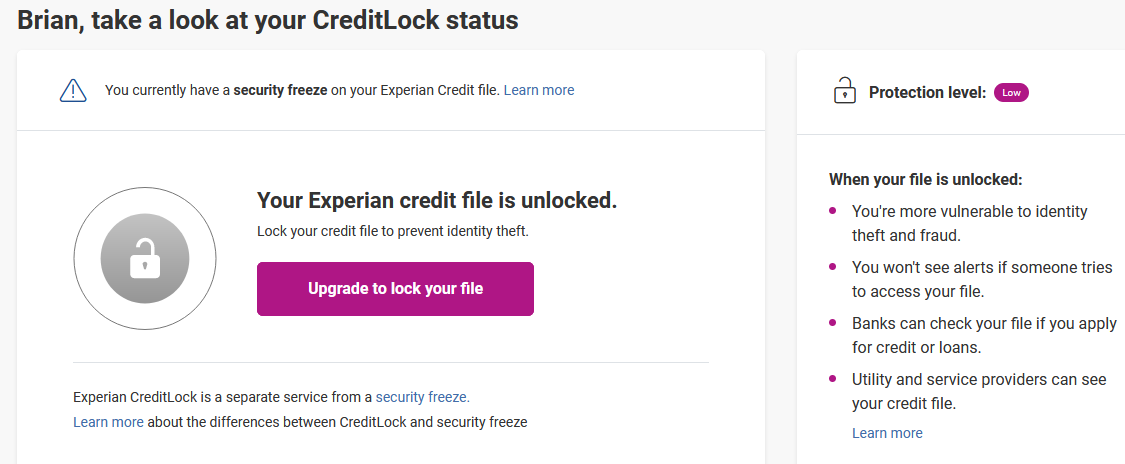
When a consumer with a freeze logs in to Experian’s site, they are immediately directed to a message for one of Experian’s paid services, such as its CreditLock service. The message I saw upon logging in confirmed that while I had a freeze in place with Experian, my current “protection level” was “low” because my credit file was unlocked.

“When your file is unlocked, you’re more vulnerable to identity theft and fraud,” Experian warns, untruthfully. “You won’t see alerts if someone tries to access your file. Banks can check your file if you apply for credit or loans. Utility and service providers can see your credit file.”

Experian says my security is low because while I have a freeze in place, I haven’t bought into their questionable “lock service.”

Sounds scary, right? The thing is — except for the part about not seeing alerts — none of the above statement is true if you already have a freeze on your file. A security freeze essentially blocks any potential creditors from being able to view your credit file, unless you affirmatively unfreeze or thaw your file beforehand.

With a freeze in place on your credit file, ID thieves can apply for credit in your name all they want, but they will not succeed in getting new lines of credit in your name because few if any creditors will extend that credit without first being able to gauge how risky it is to loan to you (i.e., view your credit file). It is now free to freeze your credit in all U.S. states and territories.

Experian, like the other consumer credit bureaus, uses their intentionally confusing “lock” terminology to frighten consumers into paying for monthly subscription services. A key selling point for these lock services is they can be a faster way to let creditors peek at your file when you wish to apply for new credit. That may or may not be true in practice, but consider why it’s so important for Experian to get consumers to sign up for their lock programs.

The real reason is that Experian makes money every time someone makes a credit inquiry in your name, and it does not want to do anything to hinder those inquiries. Signing up for a lock service lets Experian continue selling credit report information to a variety of third parties. According to Experian’s FAQ, when locked your Experian credit file remains accessible to a host of companies, including:

-Potential employers or insurance companies

-Collection agencies acting on behalf of companies you may owe

-Companies providing pre-screened credit card offers

-Companies that have an existing credit relationship with you (this is true for frozen files also)

-Personalized offers from Experian, if you choose to receive them

It is annoying that Experian can get away with offering additional account security only to people who pay the company a hefty sum each month to sell their information. It’s also amazing that this sloppy security I wrote about back in 2017 is still just as prevalent in 2021.

But Experian is hardly alone. In 2019, I wrote about how Equifax’s new MyEquifax site made it simple for thieves to lift an existing credit freeze at Equifax and bypass the PIN if they were armed with just your name, Social Security number and birthday.

Also in 2019, identity thieves were able to get a copy of my credit report from TransUnion after successfully guessing the answers to multiple-guess questions like the ones Experian asks. I only found out after hearing from a detective in Washington state, who informed me that a copy of the report was found on a removable drive seized from a local man who was arrested on suspicion of being part of an ID theft gang.

TransUnion investigated and found it was indeed at fault for giving my credit report to ID thieves, but that on the bright side its systems blocked another fraudulent attempt at getting my report in 2020.

“In our investigation, we determined that a similar attempt to fraudulently obtain your report occurred in April 2020, and was successfully blocked by enhanced controls TransUnion has implemented since last year,” the company said. “TransUnion deploys a multi-layered security program to combat the ongoing and increasing threat of fraud, cyber-attacks and malicious activity.  In today’s dynamic threat environment, TransUnion is constantly enhancing and refining our controls to address the latest security threats, while still allowing consumers access to their information.”

For more information on credit freezes (also called a “security freezes”), how to request one, and other tips on preventing identity fraud, check out this story.

If you haven’t done so lately, it might be a good time to order a free copy of your credit report from annualcreditreport.com. This service entitles each consumer one free copy of their credit report annually from each of the three credit bureaus — either all at once or spread out over the year.

source https://krebsonsecurity.com/2021/04/experians-credit-freeze-security-is-still-a-joke/

Note to Self: Create Non-Exhaustive List of Competitors

What was the best news you heard so far this month? Mine was learning that KrebsOnSecurity is listed as a restricted competitor by Gartner Inc. [NYSE:IT] — a $4 billion technology goliath whose analyst reports can move markets and shape the IT industry.

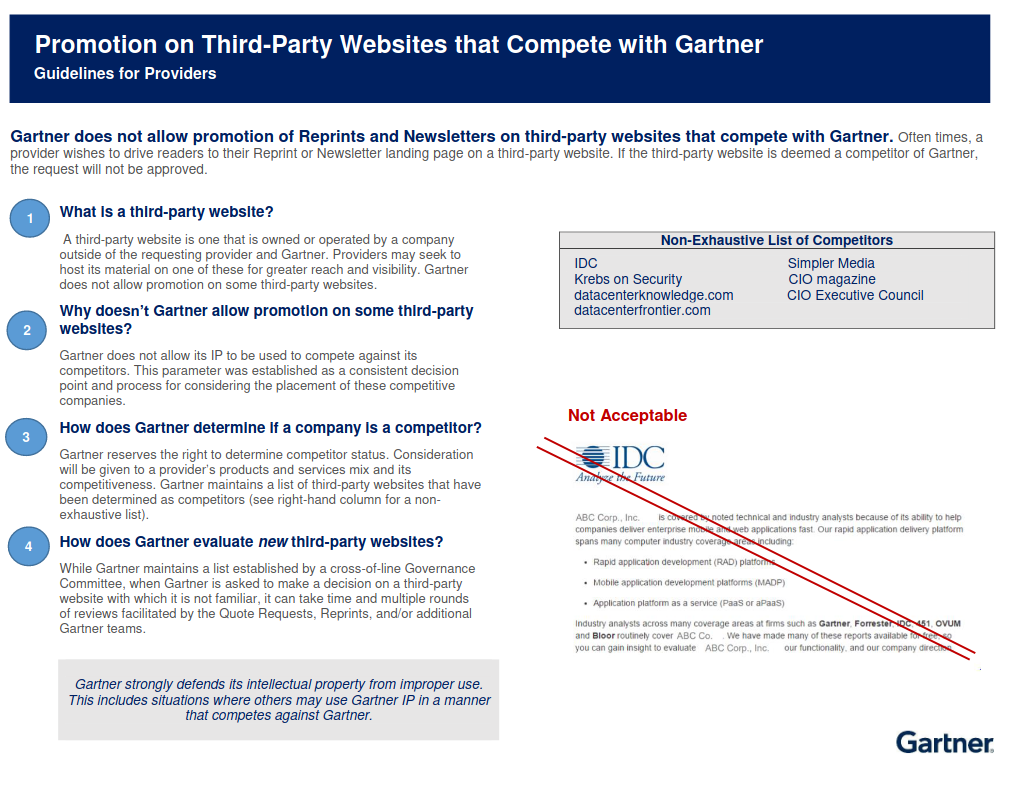
Earlier this month, a reader pointed my attention to the following notice from Gartner to clients who are seeking to promote Gartner reports about technology products and services:

What that notice says is that KrebsOnSecurity is somehow on Gartner’s “non exhaustive list of competitors,” i.e., online venues where technology companies are not allowed to promote Gartner reports about their products and services.

The bulk of Gartner’s revenue comes from subscription-based IT market research. As the largest organization dedicated to the analysis of software, Gartner’s network of analysts are well connected to the technology and software industries. Some have argued that Gartner is a kind of private social network, in that a significant portion of Gartner’s competitive position is based on its interaction with an extensive network of software vendors and buyers.

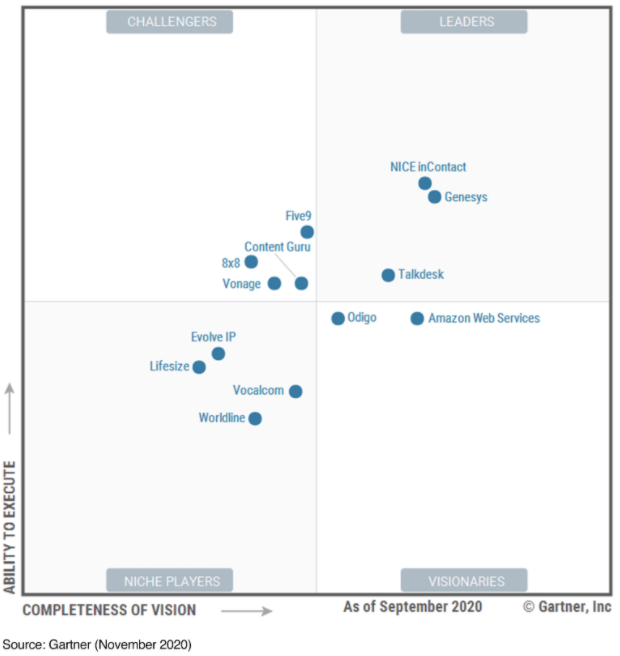
Either way, the company regularly serves as a virtual kingmaker with their trademark “Magic Quandrant” designations, which rate technology vendors and industries “based on proprietary qualitative data analysis methods to demonstrate market trends, such as direction, maturity and participants.”

The two main subjective criteria upon which Gartner bases those rankings are “the ability to execute” and “completeness of vision.” They also break companies out into categories such as “challengers,” “leaders,” “visionaries” and “niche players.”

Gartner’s 2020 “Magic Quadrant” for companies that provide “contact center as a service” offerings.

So when Gartner issues a public report forecasting that worldwide semiconductor revenue will fall, or that worldwide public cloud revenue will grow, those reports very often move markets.

Being listed by Gartner as a competitor has had no discernable financial impact on KrebsOnSecurity, or on its reporting. But I find this designation both flattering and remarkable given that this site seldom promotes technological solutions.

Nor have I ever offered paid consulting or custom market research (although I did give a paid keynote speech at Gartner’s 2015 conference in Orlando, which is still by far the largest crowd I’ve ever addressed).

Rather, KrebsOnSecurity has sought to spread cybersecurity awareness primarily by highlighting the “who” of cybercrime — stories told from the perspectives of both attackers and victims. What’s more, my research and content is available to everyone at the same time, and for free.

I rarely do market predictions (or prognostications of any kind), but in deference to Gartner allow me to posit a scenario in which major analyst firms start to become a less exclusive and perhaps less relevant voice as both an influencer and social network.

For years I have tried to corrupt more of my journalist colleagues into going it alone, noting that solo blogs and newsletters can not only provide a hefty boost from newsroom income, but they also can produce journalism that is just as timely, relevant and impactful.

Those enticements have mostly fallen on deaf ears. Recently, however, an increasing number of journalists from major publications have struck out on their own, some in reportorial roles, others as professional researchers and analysts in their own right.

If Gartner considers a one-man blogging operation as competition, I wonder what they’ll think of the coming collective output from an entire industry of newly emancipated reporters seeking more remuneration and freedom offered by independent publishing platforms like Substack, Patreon and Medium.

Oh, I doubt any group of independent journalists would seek to promulgate their own Non-Exclusive List of Competitors at Whom Thou Shalt Not Publish. But why should they? One’s ability to execute does not impair another’s completeness of vision, nor vice versa. According to Gartner, it takes all kinds, including visionaries, niche players, leaders and challengers.

source https://krebsonsecurity.com/2021/04/note-to-self-create-non-exhaustive-list-of-competitors/

Did Someone at the Commerce Dept. Find a SolarWinds Backdoor in Aug. 2020?

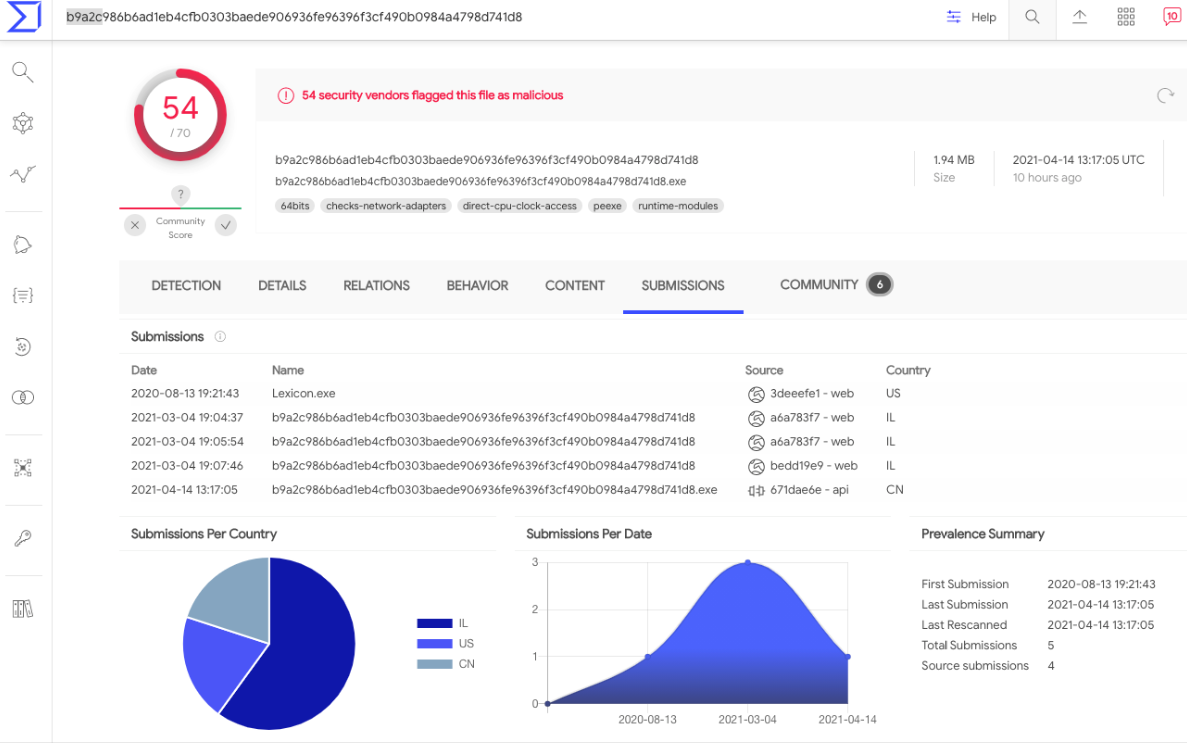
On Aug. 13, 2020, someone uploaded a suspected malicious file to VirusTotal, a service that scans submitted files against more than five dozen antivirus and security products. Last month, Microsoft and FireEye identified that file as a newly-discovered fourth malware backdoor used in the sprawling SolarWinds supply chain hack. An analysis of the malicious file and other submissions by the same VirusTotal user suggest the account that initially flagged the backdoor as suspicious belongs to IT personnel at the National Telecommunications and Information Administration (NTIA), a division of the U.S. Commerce Department that handles telecommunications and Internet policy.

Both Microsoft and FireEye published blog posts on Mar. 4 concerning a new backdoor found on high-value targets that were compromised by the SolarWinds attackers. FireEye refers to the backdoor as “Sunshuttle,” whereas Microsoft calls it “GoldMax.” FireEye says the Sunshuttle backdoor was named “Lexicon.exe,” and had the unique file signatures or “hashes” of “9466c865f7498a35e4e1a8f48ef1dffd” (MD5) and b9a2c986b6ad1eb4cfb0303baede906936fe96396f3cf490b0984a4798d741d8 (SHA-1).

“In August 2020, a U.S.-based entity uploaded a new backdoor that we have named SUNSHUTTLE to a public malware repository,” FireEye wrote.

The “Sunshuttle” or “GoldMax” backdoor, as identified by FireEye and Microsoft, respectively. Image: VirusTotal.com.

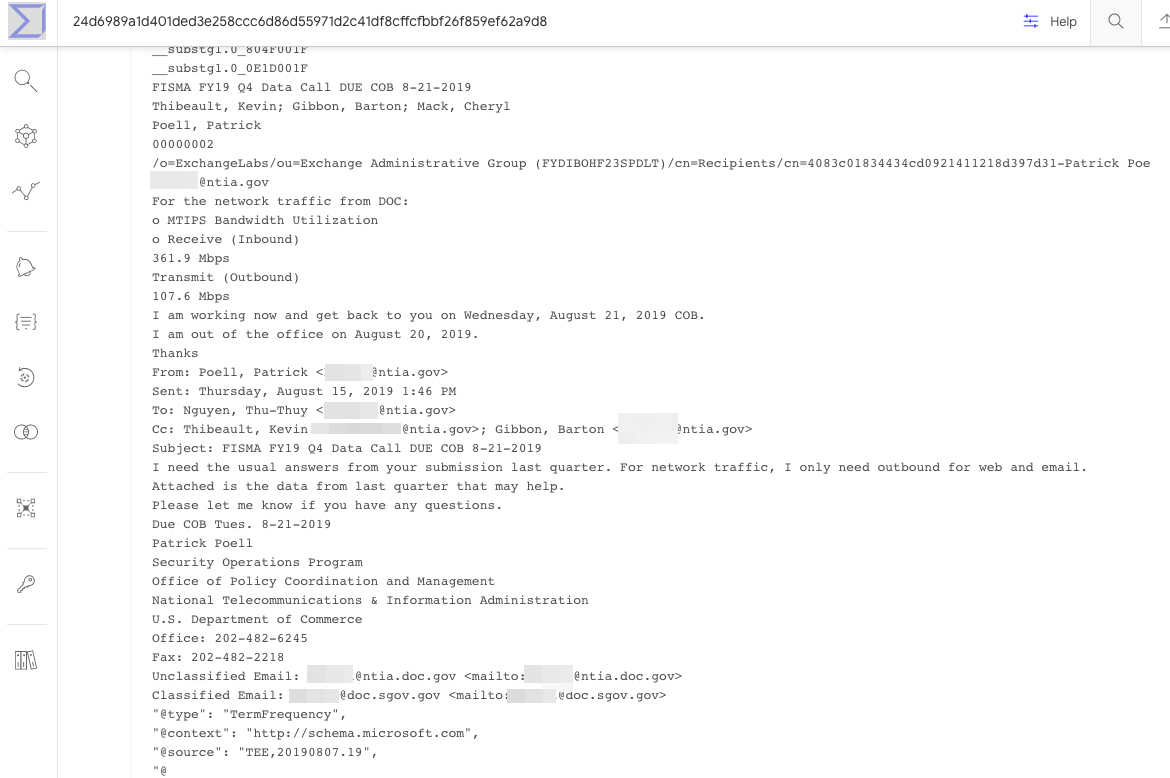
A search in VirusTotal’s malware repository shows that on Aug. 13, 2020 someone uploaded a file with that same name and file hashes. Premium VirusTotal users can see other files submitted by specific users, and several of those submitted by the same user over nearly two years include messages and files sent to email addresses for people currently working in NTIA’s information technology department.

An apparently internal email that got uploaded to VirusTotal in Feb. 2020 by the same account that uploaded the Sunshuttle backdoor malware to VirusTotal in August 2020.

The NTIA did not respond to requests for comment. But in December 2020, The Wall Street Journal reported that the NTIA was among multiple federal agencies that had email and files plundered by the SolarWinds attackers. “The hackers broke into about three dozen email accounts since June at the NTIA, including accounts belonging to the agency’s senior leadership, according to a U.S. official familiar with the matter,” The Journal wrote.

It’s unclear what, if anything, NTIA’s IT staff did in response to scanning the backdoor file back in Aug. 2020. But the world would not find out about the SolarWinds debacle until early December 2020, when FireEye first disclosed the extent of its own compromise from the SolarWinds malware and published details about the tools and techniques used by the perpetrators.

The SolarWinds attack involved malicious code being surreptitiously inserted into updates shipped by SolarWinds for some 18,000 users of its Orion network management software. Beginning in March 2020, the attackers then used the access afforded by the compromised SolarWinds software to push additional backdoors and tools to targets when they wanted deeper access to email and network communications.

U.S. intelligence agencies have attributed the SolarWinds hack to an arm of the Russian state intelligence known as the SVR, which also was determined to have been involved in the hacking of the Democratic National Committee six years ago. On Thursday, the White House issued long-expected sanctions against Russia in response to the SolarWinds attack and other malicious cyber activity, leveling economic sanctions against 32 entities and individuals for disinformation efforts and for carrying out the Russian government’s interference in the 2020 presidential election.

The U.S. Treasury Department (which also was hit with second-stage malware that let the SolarWinds attackers read Treasury email communications) has posted a full list of those targeted, including six Russian companies for providing support to the cyber activities of the Russian intelligence service.

Also on Thursday, the FBI, National Security Agency (NSA), and the Cybersecurity Infrastructure Security Administration (CISA) issued a joint advisory on several vulnerabilities in widely-used software products that the same Russian intelligence units have been attacking to further their exploits in the SolarWinds hack. Among those is CVE-2020-4006, a security hole in VMWare Workspace One Access that VMware patched in December 2020 after hearing about it from the NSA.

On December 18, VMWare saw its stock price dip 5.5 percent after KrebsOnSecurity published a report linking the flaw to NSA reports about the Russian cyberspies behind the SolarWinds attack. At the time, VMWare was saying it had received “no notification or indication that CVE-2020-4006 was used in conjunction with the SolarWinds supply chain compromise.” As a result, a number of readers responded that making this connection was tenuous, circumstantial and speculative.

But the joint advisory makes clear the VMWare flaw was in fact used by SolarWinds attackers to further their exploits.

“Recent Russian SVR activities include compromising SolarWinds Orion software updates, targeting COVID-19 research facilities through deploying WellMess malware, and leveraging a VMware vulnerability that was a zero-day at the time for follow-on Security Assertion Markup Language (SAML) authentication abuse,” the NSA’s advisory (PDF) reads. “SVR cyber actors also used authentication abuse tactics following SolarWinds-based breaches.”

Officials within the Biden administration have told media outlets that a portion of the United States’ response to the SolarWinds hack would not be discussed publicly. But some security experts are concerned that Russian intelligence officials may still have access to networks that ran the backdoored SolarWinds software, and that the Russians could use that access to affect a destructive or disruptive network response of their own, The New York Times reports.

“Inside American intelligence agencies, there have been warnings that the SolarWinds attack — which enabled the SVR to place ‘back doors’ in the computer networks — could give Russia a pathway for malicious activity against government agencies and corporations,” The Times observed.

source https://krebsonsecurity.com/2021/04/did-someone-at-the-commerce-dept-find-a-solarwinds-backdoor-in-aug-2020/

Microsoft Patch Tuesday, April 2021 Edition

Microsoft today released updates to plug at least 110 security holes in its Windows operating systems and other products. The patches include four security fixes for Microsoft Exchange Server — the same systems that have been besieged by attacks on four separate (and zero-day) bugs in the email software over the past month. Redmond also patched a Windows flaw that is actively being exploited in the wild.

Nineteen of the vulnerabilities fixed this month earned Microsoft’s most-dire “Critical” label, meaning they could be used by malware or malcontents to seize remote control over vulnerable Windows systems without any help from users.

Microsoft released updates to fix four more flaws in Exchange Server versions 2013-2019 (CVE-2021-28480, CVE-2021-28481, CVE-2021-28482, CVE-2021-28483). Interestingly, all four were reported by the U.S. National Security Agency, although Microsoft says it also found two of the bugs internally. A Microsoft blog post published along with today’s patches urges Exchange Server users to make patching their systems a top priority.

Satnam Narang, staff research engineer at Tenable, said these vulnerabilities have been rated ‘Exploitation More Likely’ using Microsoft’s Exploitability Index.

“Two of the four vulnerabilities (CVE-2021-28480, CVE-2021-28481) are pre-authentication, meaning an attacker does not need to authenticate to the vulnerable Exchange server to exploit the flaw,” Narang said. “With the intense interest in Exchange Server since last month, it is crucial that organizations apply these Exchange Server patches immediately.”

Also patched today was a vulnerability in Windows (CVE-2021-28310) that’s being exploited in active attacks already. The flaw allows an attacker to elevate their privileges on a target system.

“This does mean that they will either need to log on to a system or trick a legitimate user into running the code on their behalf,” said Dustin Childs of Trend Micro. “Considering who is listed as discovering this bug, it is probably being used in malware. Bugs of this nature are typically combined with other bugs, such as browser bug of PDF exploit, to take over a system.”

In a technical writeup on what they’ve observed since finding and reporting attacks on CVE-2021-28310, researchers at Kaspersky Lab noted the exploit they saw was likely used together with other browser exploits to escape “sandbox” protections of the browser.

“Unfortunately, we weren’t able to capture a full chain, so we don’t know if the exploit is used with another browser zero-day, or coupled with known, patched vulnerabilities,” Kaspersky’s researchers wrote.

Allan Laska, senior security architect at Recorded Future, notes that there are several remote code execution vulnerabilities in Microsoft Office products released this month as well. CVE-2021-28454 and CVE-2021-28451 involve Excel, while CVE-2021-28453 is in Microsoft Word and CVE-2021-28449 is in Microsoft Office. All four vulnerabilities are labeled by Microsoft as “Important” (not quite as bad as “Critical”). These vulnerabilities impact all versions of their respective products, including Office 365.

Other Microsoft products that got security updates this month include Edge (Chromium-based), Azure and Azure DevOps Server, SharePoint Server, Hyper-V, Team Foundation Server, and Visual Studio.

Separately, Adobe has released security updates for Photoshop, Digital Editions, RoboHelp, and Bridge.

It’s a good idea for Windows users to get in the habit of updating at least once a month, but for regular users (read: not enterprises) it’s usually safe to wait a few days until after the patches are released, so that Microsoft has time to iron out any kinks in the new armor.

But before you update, please make sure you have backed up your system and/or important files. It’s not uncommon for a Windows update package to hose one’s system or prevent it from booting properly, and some updates have been known to erase or corrupt files.

So do yourself a favor and backup before installing any patches. Windows 10 even has some built-in tools to help you do that, either on a per-file/folder basis or by making a complete and bootable copy of your hard drive all at once.

And if you wish to ensure Windows has been set to pause updating so you can back up your files and/or system before the operating system decides to reboot and install patches on its own schedule, see this guide.

As always, if you experience glitches or problems installing any of these patches this month, please consider leaving a comment about it below; there’s a better-than-even chance other readers have experienced the same and may chime in here with some helpful tips.

source https://krebsonsecurity.com/2021/04/microsoft-patch-tuesday-april-2021-edition/

ParkMobile Breach Exposes License Plate Data, Mobile Numbers of 21M Users

Someone is selling account information for 21 million customers of ParkMobile, a mobile parking app that’s popular in North America. The stolen data includes customer email addresses, dates of birth, phone numbers, license plate numbers, hashed passwords and mailing addresses.

KrebsOnSecurity first heard about the breach from Gemini Advisory, a New York City based threat intelligence firm that keeps a close eye on the cybercrime forums. Gemini shared a new sales thread on a Russian-language crime forum that included my ParkMobile account information in the accompanying screenshot of the stolen data.

Included in the data were my email address and phone number, as well as license plate numbers for four different vehicles we have used over the past decade.

Asked about the sales thread, Atlanta-based ParkMobile said the company published a notification on Mar. 26 about “a cybersecurity incident linked to a vulnerability in a third-party software that we use.”

“In response, we immediately launched an investigation with the assistance of a leading cybersecurity firm to address the incident,” the notice reads. “Out of an abundance of caution, we have also notified the appropriate law enforcement authorities. The investigation is ongoing, and we are limited in the details we can provide at this time.”

The statement continues: “Our investigation indicates that no sensitive data or Payment Card Information, which we encrypt, was affected. Meanwhile, we have taken additional precautionary steps since learning of the incident, including eliminating the third-party vulnerability, maintaining our security, and continuing to monitor our systems.”

Asked for clarification on what the attackers did access, ParkMobile confirmed it included basic account information – license plate numbers, and if provided, email addresses and/or phone numbers, and vehicle nickname.

“In a small percentage of cases, there may be mailing addresses,” spokesman Jeff Perkins said.

ParkMobile doesn’t store user passwords, but rather it stores the output of a fairly robust one-way password hashing algorithm called bcrypt, which is far more resource-intensive and expensive to crack than common alternatives like MD5. The database stolen from ParkMobile and put up for sale includes each user’s bcrypt hash.

“You are correct that bcrypt hashed and salted passwords were obtained,” Perkins said when asked about the screenshot in the database sales thread.

“Note, we do not keep the salt values in our system,” he said. “Additionally, the compromised data does not include parking history, location history, or any other sensitive information. We do not collect social security numbers or driver’s license numbers from our users.”

ParkMobile says it is finalizing an update to its support site confirming the conclusion of its investigation. But I wonder how many of its users were even aware of this security incident. The Mar. 26 security notice does not appear to be linked to other portions of the ParkMobile site, and it is absent from the company’s list of recent press releases.

It’s also curious that ParkMobile hasn’t asked or forced its users to change their passwords as a precautionary measure. I used the ParkMobile app to reset my password, but there was no messaging in the app that suggested this was a timely thing to do.

So if you’re a ParkMobile user, changing your account password might be a pro move. If it’s any consolation, whoever is selling this data is doing so for an insanely high starting price ($125,000) that is unlikely to be paid by any cybercriminal to a new user with no reputation on the forum.

More importantly, if you used your ParkMobile password at any other site tied to the same email address, it’s time to change those credentials as well (and stop re-using passwords).

The breach comes at a tricky time for ParkMobile. On March 9, the European parking group EasyPark announced its plans to acquire the company, which operates in more than 450 cities in North America.

source https://krebsonsecurity.com/2021/04/parkmobile-breach-exposes-license-plate-data-mobile-numbers-of-21m-users/