Intuit to Share Payroll Data from 1.4M Small Businesses With Equifax

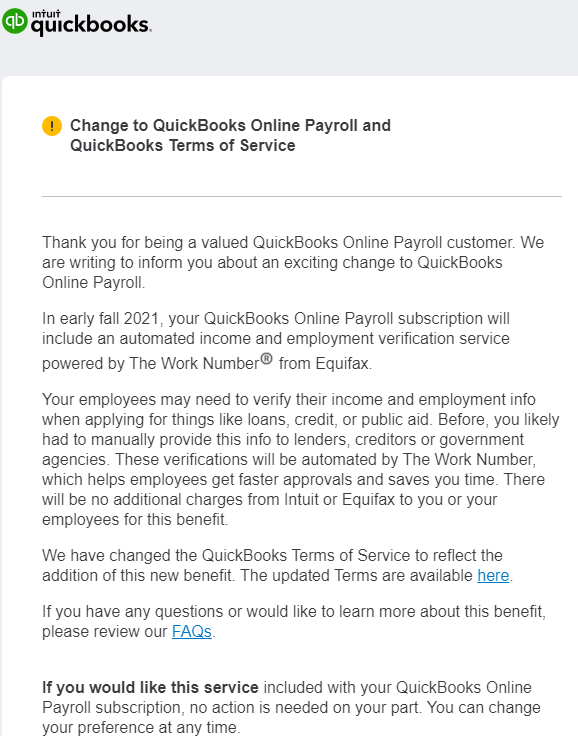
Financial services giant Intuit this week informed 1.4 million small businesses using its QuickBooks Online Payroll and Intuit Online Payroll products that their payroll information will be shared with big-three consumer credit bureau Equifax starting later this year unless customers opt out by the end of this month.

Intuit says the change is tied to an “exciting” and “free” new service that will let millions of small business employees get easy access to employment and income verification services when they wish to apply for a loan or line of credit.

“In early fall 2021, your QuickBooks Online Payroll subscription will include an automated income and employment verification service powered by The Work Number from Equifax,” reads the Intuit email, which includes a link to the new Terms of Service. “Your employees may need to verify their income and employment info when applying for things like loans, credit, or public aid. Before, you likely had to manually provide this info to lenders, creditors or government agencies. These verifications will be automated by The Work Number, which helps employees get faster approvals and saves you time.”

An Intuit spokesperson clarified that the new service is not available through QuickBooks Online or to QuickBooks Online users as a whole. Intuit’s FAQ on the changes is here.

Equifax’s 2017 megabreach that exposed the personal and financial details of 145.5 million Americans may have shocked the public, but it did little to stop more than a million employers from continuing to sell Equifax their employee payroll data, Bloomberg found in late 2017.

“The workforce-solutions unit is now among Equifax’s fastest-growing businesses, contributing more than a fifth of the firm’s $3.1 billion of revenue last year,” wrote Jennifer Surane. “Using payroll data from government agencies and thousands of employers — including a vast majority of Fortune 500 companies — Equifax has cultivated a database of 300 million current and historic employment records, according to regulatory filings.”

QuickBooks Online user Anthony Citrano posted on Twitter about receiving the notice, noting that the upcoming changes had yet to receive any attention in the financial or larger media space.

“The way I read the terms, Equifax gets to proactively collect all payroll data just in case they need to share it later — similar to how they already handle credit reporting,” said Citrano, who is founder and CEO of Acquicent, a company that issues non-fungible tokens (NFTs). “And that feels like a disaster waiting to happen, especially given Equifax’s history.”

In selling payroll data to Equifax, Intuit will be joining some of the world’s largest payroll providers. For example, ADP — the largest payroll software provider in the United States — has long shared payroll data with Equifax.

But Citrano said this move by Intuit will incorporate a large number of fairly small businesses.

“ADP participates in some way already, but QuickBooks Online jumping on the bandwagon means a lot of employees of small to mid-sized businesses are going to be affected,” he said.

Why might small businesses want to think twice before entrusting Equifax with their payroll data? The answer is the company doesn’t have a great track record of protecting that information.

In the days following the 2017 breach at Equifax, KrebsOnSecurity pointed out that The Work Number made it a little too easy for anyone to learn your salary history. At the time, all you needed to view someone’s entire work and salary history was their Social Security number and date of birth. It didn’t help that for roughly half the U.S. population, both of the pieces of information were known to be in the possession of criminals behind the breach.

Equifax responded by taking down its Work Number website until it was able to include additional authentication requirements, saying anyone could opt out of Equifax revealing their salary history.

Equifax’s security improvements included the addition of four multiple-guess questions whose answers were based on publicly-available data. But these requirements were easily bypassed, as evidenced by a previous breach at Equifax’s employment division.

The Work Number is a user-paid verification of employment database created by TALX Corp., a data broker acquired by Equifax in 2007. Four months before the epic 2017 breach became public, KrebsOnSecurity broke the news that fraudsters who specialize in tax refund fraud had been successfully guessing the answers to those secret questions to reset TALX account PINs, which then let them view past W-2 tax forms for employees at many Fortune 500 companies.

Intuit says affected customers that do not want this new service included must update their preferences and opt-out by July 31, 2021. Otherwise, they will be automatically will be opted in. According to Intuit, customers can opt out by following these steps:

1. Sign in to QuickBooks Online Payroll.

2. Go to Payroll Settings.

3. In the Shared data section, select the pencil and uncheck the box.

4. Select Save.

source https://krebsonsecurity.com/2021/07/intuit-to-share-payroll-data-from-1-4m-small-businesses-with-equifax/

We Infiltrated a Counterfeit Check Ring! Now What?

Imagine waking up each morning knowing the identities of thousands of people who are about to be mugged for thousands of dollars each. You know exactly when and where each of those muggings will take place, and you’ve shared this information in advance with the authorities each day for a year with no outward indication that they are doing anything about it. How frustrated would you be?

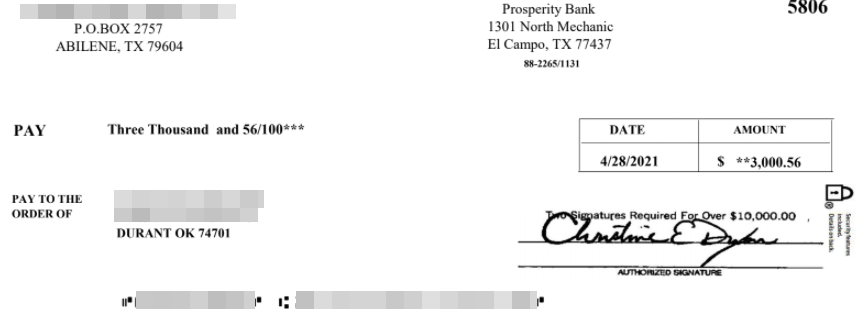
A counterfeit check image [redacted] that was intended for a person helping this fraud gang print and mail phony checks tied to a raft of email-based scams. One fraud-fighting group is intercepting hundreds to thousands of these per day.

Such is the curse of the fraud fighter known online by the handles “Brianna Ware” and “BWare” for short, a longtime member of a global group of volunteers who’ve infiltrated a cybercrime gang that disseminates counterfeit checks tied to a dizzying number of online scams.

For the past year, BWare has maintained contact with an insider from the criminal group that’s been sending daily lists of would-be victims who are to receive counterfeit checks printed using the real bank account information of legitimate companies.

“Some days we’re seeing thousands of counterfeit checks going out,” BWare said.

The scams used in connection with the fraudulent checks vary widely, from fake employment and “mystery shopper” schemes to those involving people who have been told they can get paid to cover their cars in advertisements (a.k.a. the “car wrap” scam).

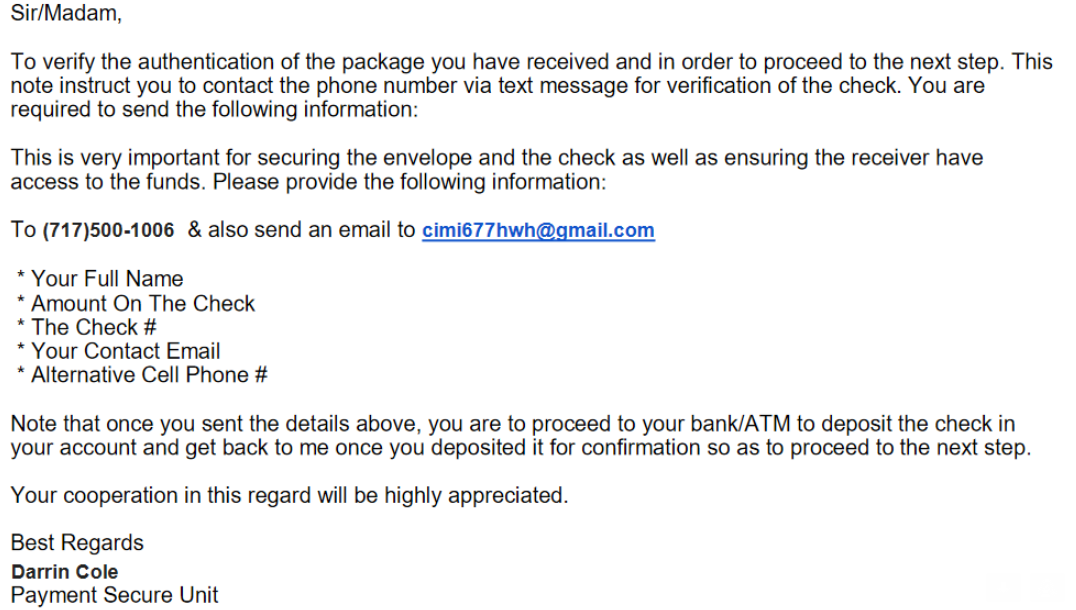
A form letter mailed out with a counterfeit check urges the recipient to text a phone number after the check has been deposited.

Most of the counterfeit checks being disseminated by this fraud group are in amounts ranging from $2,500 to $5,000. The crimes that the checks enable are known variously as “advanced fee” scams, in that they involve tricking people into making payments in anticipation of receiving something of greater value in return.

But in each scheme the goal is the same: Convince the recipient to deposit the check and then wire a portion of the amount somewhere else. A few days after the check is deposited, it gets invariably canceled by the organization whose bank account information was on the check. And then person who deposited the phony check is on the hook for the entire amount.

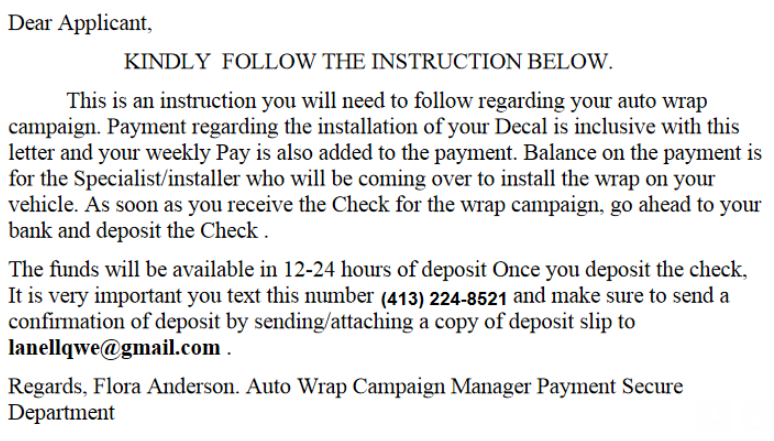
“Like the car wrap scam, where they send you a check for $5,000, and you agree to keep $1,000 for your first payment and send the rest back to them in exchange for the car wrap materials,” BWare said. “Usually the check includes a letter that says they want you to text a specific phone number to let them know you received the check. When you do that, they’ll start sending you instructions on how and where to send the money.”

A typical confirmation letter that accompanies a counterfeit check for a car wrap scam.

Traditionally, these groups have asked recipients to transit money via wire transfer. But these days, BWare said, the same crooks are now asking people to forward the money via mobile applications like CashApp and Venmo.

BWare and other volunteer fraud fighters believe the fake checks gang is using people looped into phony employment schemes and wooed through online romance scams to print the counterfeit checks, and that other recruits are responsible for mailing them out each day.

“More often than not, the scammers creating the shipping labels will provide those to an unwitting accomplice, or the accomplice is told to log in to an account and print the labels,” BWare explained.

Often the counterfeit checks and labels forwarded by BWare’s informant come with notes attached indicating the type of scam with which they are associated.

“Sometimes they’re mystery shopper scams, and other times it’s overpayment for an item sold on Craigslist,” BWare said. “We don’t know how the scammers are getting the account and routing numbers for these checks, but they are drawn on real companies and always scan fine through a bank’s systems initially. The recipients can deposit them at any bank, but we try to get the checks to the banks when we can so they have a heads up.”

SHRINKING FROM THE FIREHOSE?

Roughly a year ago, BWare’s group started sharing its intelligence with fraud investigators at FedEx and the U.S. Postal Service — the primary delivery mechanisms for these counterfeit checks.

Both the USPS and FedEx have an interest in investigating because the fraudsters in this case are using stolen shipping labels paid for by companies who have no idea their FedEx or USPS accounts are being used for such purposes.

“In most cases, the name of the sender will be completely unrelated to what’s being sent,” BWare said. “For example, you’ll see a label for a letter to go out with a counterfeit check for a car wrap scam, and the sender on the shipping label will be something like XYZ Biological Resources.”

But BWare says a year later, there is little sign that anyone is interested in acting on the shared intelligence.

“It’s so much information that they really don’t want it anymore and they’re not doing anything about it,” BWare said of FedEx and the USPS. “It’s almost like they’re turning a blind eye. There are so many of these checks going out each day that instead of trying to drink from the firehouse, they’re just turning their heads.”

FedEx did not respond to requests for comment. The U.S. Postal Inspection Service responded with a statement saying it “does not comment publicly on its investigative procedures and operational protocols.”

ANY METHOD THAT WORKS

Ronnie Tokazowski is a threat researcher at Agari, a security firm that has closely tracked many of the groups behind these advanced fee schemes [KrebsOnSecurity interviewed Tokazowski in 2018 after he received a security industry award for his work in this area].

Tokazowski said it’s likely the group BWare has infiltrated is involved in a myriad other email fraud schemes, including so-called “business email compromise” (BEC) or “CEO scams,” in which the fraudsters impersonate executives at a company in the hopes of convincing someone at the firm to wire money for payment of a non-existent invoice. According to the FBI, BEC scams netted thieves nearly $2 billion in 2020 — far more than any other type of cybercrime.

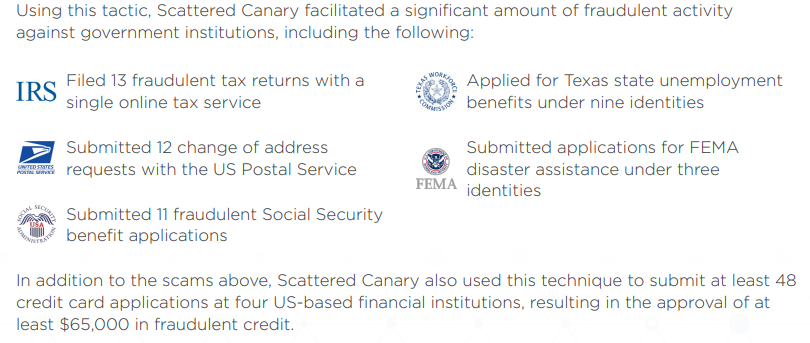
In a report released in 2019 (PDF), Agari profiled a group it dubbed “Scattered Canary” that is operating principally out of West Africa and dabbles in a dizzying array of schemes, including BEC and romance scams, FEMA and SBA loans, unemployment insurance fraud, counterfeit checks and of course money laundering.

Image: Agari.

Tokazowski said he doesn’t know if the group BWare is watching has any affiliation with Scattered Canary. But he said his experience with Scattered Canary shows these groups tend to make money via any and all methods that reliably produce results.

“One of the things that came out of the Scattered Canary report was that the actors we saw doing BEC scams were the same actors doing the car wrap and various Craigslist scams involving fake checks,” he said. “The people doing this type of crime will have tutorials on how to run the scam, how to wire money out for unemployment fraud, how to target people on Craigslist, and so on. It’s very different from the way a Russian hacking group might go after one industry vertical or piece of software or focus on one or two types of fraud. They will follow any method they can that works.”

Tokazowski said he’s taken his share of flack from people on social media who say his focus on West African nations as the primary source of these advanced fee and BEC scams is somehow racist [KrebsOnSecurity experienced a similar response to the 2013 stories, Spy Service Exposes Nigerian ‘Yahoo Boys’, and ‘Yahoo Boys’ Have 419 Facebook Friends].

But Tokazowski maintains he has been one of the more vocal proponents of the idea that trying to fight these problems by arresting those involved is something of a Sisyphean task, and that it makes way more sense to focus on changing the economic realities in places like Nigeria, which has been a hotbed of advanced fee activity for decades.

Nigeria has the world’s second-highest unemployment rate — rising from 27.1 percent in 2019 to 33 percent in 2020, according to the National Bureau of Statistics. The nation also is among the world’s most corrupt, according to 2020 findings from Transparency International.

“Education is definitely one piece, as raising awareness is hands down the best way to get ahead of this,” Tokazowski said. “But we also need to think about ways to create more business opportunities there so that people who are doing this to put food on the table have more legitimate opportunities. Unfortunately, thanks to the level of corruption of government officials, there are a lot of cultural reasons that fighting this type of crime at the source is going to be difficult.”

source https://krebsonsecurity.com/2021/06/we-infiltrated-a-counterfeit-check-ring-now-what/

MyBook Users Urged to Unplug Devices from Internet

Hard drive giant Western Digital is urging users of its MyBook Live brand of network storage drives to disconnect them from the Internet, warning that malicious hackers are remotely wiping the drives using a previously unknown critical flaw that can be triggered by anyone who knows the Internet address of an affected device.

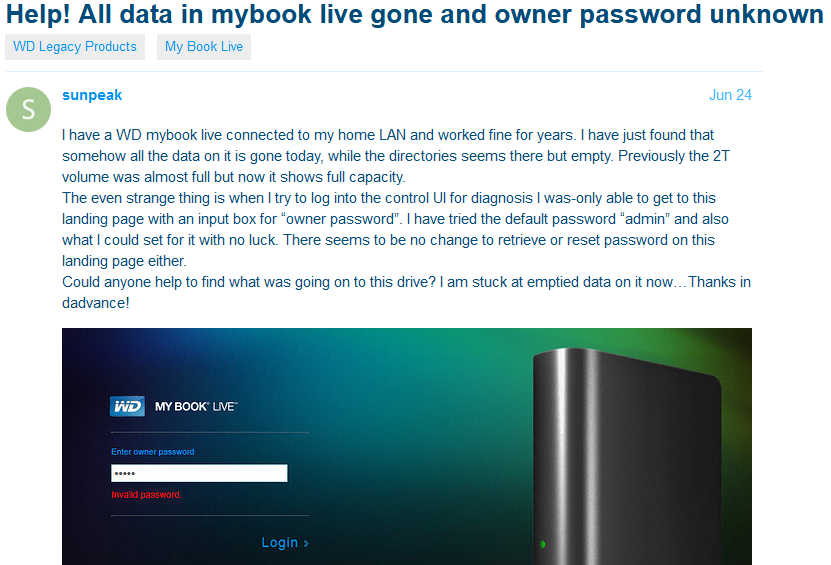
One of many similar complaints on Western Digital’s user forum.

Earlier this week, Bleeping Computer and Ars Technica pointed to a heated discussion thread on Western Digital’s user forum where many customers complained of finding their MyBook Live and MyBook Live Duo devices completely wiped of their data.

“Western Digital has determined that some My Book Live and My Book Live Duo devices are being compromised through exploitation of a remote command execution vulnerability,” the company said in a statement June 24. “In some cases, this compromise has led to a factory reset that appears to erase all data on the device. The My Book Live and My Book Live Duo devices received its final firmware update in 2015. We understand that our customers’ data is very important. We are actively investigating the issue and will provide an updated advisory when we have more information.”

Western Digital’s brief advisory includes a link to an entry in the National Vulnerability Database for CVE-2018-18472. The NVD writeup says Western Digital WD My Book Live and WD My Book Live Duo (all versions) have a root Remote Command Execution bug.

“It can be triggered by anyone who knows the IP address of the affected device, as exploited in the wild in June 2021 for factory reset commands,” NVD wrote.

Examine the CVE attached to this flaw and you’ll notice it was issued in 2018. The NVD’s advisory credits VPN reviewer Wizcase.com with reporting the bug to Western Digital three years ago, back in June 2018.

In some ways, it’s remarkable that it took this long for vulnerable MyBook devices to be attacked: The 2018 Wizcase writeup on the flaw includes proof-of-concept code that lets anyone run commands on the devices as the all-powerful “root” user.

Western Digital’s response at the time was that the affected devices were no longer supported and that customers should avoid connecting them to the Internet. That response also suggested this bug has been present in its devices for at least a decade.

“The vulnerability report CVE-2018-18472 affects My Book Live devices originally introduced to the market between 2010 and 2012,” reads a reply from Western Digital that Wizcase posted to its blog. “These products have been discontinued since 2014 and are no longer covered under our device software support lifecycle. We encourage users who wish to continue operating these legacy products to configure their firewall to prevent remote access to these devices, and to take measures to ensure that only trusted devices on the local network have access to the device.”

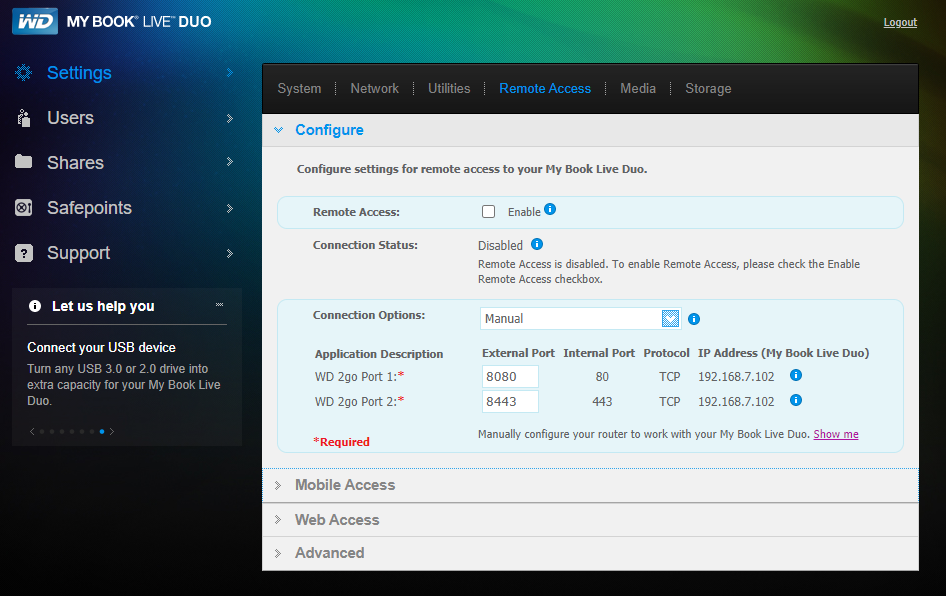
A local administration page for the MyBook Live Duo.

Wizcase said the flaw it found in MyBook devices also may be present in certain models of WD MyCloud network attached storage (NAS) devices, although Western Digital’s advisory makes no mention of its MyCloud line being affected.

The vulnerable MyBook devices are popular among home users and small businesses because they’re relatively feature-rich and inexpensive, and can be upgraded with additional storage quite easily. But these products also make it simple for users to access their files remotely over the Internet using a mobile app.

I’m guessing it is primarily users who’ve configured their MyBooks to be remotely accessible who are experiencing these unfortunate drive wipes. Regardless, it’s probably safest to observe Western Digital’s advice and disconnect any MyBooks you have from ethernet access.

If you’d still like to keep your MyBook connected to your local network (at least until you can find a suitable backup for your backups), please make double sure remote access is not enabled in your device settings (see screenshot above).

source https://krebsonsecurity.com/2021/06/mybook-users-urged-to-unplug-devices-from-internet/

How Cyber Sleuths Cracked an ATM Shimmer Gang

In 2015, police departments worldwide started finding ATMs compromised with advanced new “shimming” devices made to steal data from chip card transactions. Authorities in the United States and abroad had seized many of these shimmers, but for years couldn’t decrypt the data on the devices. This is a story of ingenuity and happenstance, and how one former Secret Service agent helped crack a code that revealed the contours of a global organized crime ring.

Jeffrey Dant was a special agent at the U.S. Secret Service for 12 years until 2015. After that, Dant served as the global lead for the fraud fusion center at Citi, one of the largest financial institutions in the United States.

Not long after joining Citi, Dant heard from industry colleagues at a bank in Mexico who reported finding one of these shimming devices inside the card acceptance slot of a local ATM. As it happens, KrebsOnSecurity wrote about that particular shimmer back in August 2015.
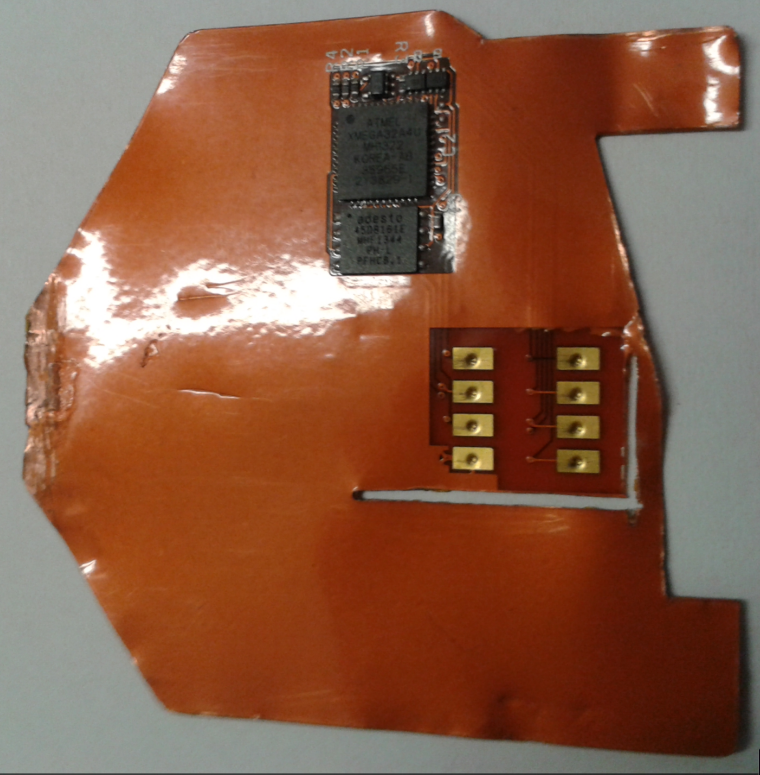
This card ‘shimming’ device is made to read chip-enabled cards and can be inserted directly into the ATM’s card acceptance slot.

The shimmers were an innovation that caused concern on multiple levels. For starters, chip-based payment cards were supposed to make it far more expensive and difficult for thieves to copy and clone. But these skimmers took advantage of weaknesses in the way many banks at the time implemented the new chip card standard.

Also, unlike traditional ATM skimmers that run on hidden cell phone batteries, the ATM shimmers found in Mexico did not require any external power source, and thus could remain in operation collecting card data until the device was removed.

When a chip card is inserted, a chip-capable ATM reads the data stored on the smart card by sending an electric current through the chip. Incredibly, these shimmers were able to siphon a small amount of that power (a few milliamps) to record any data transmitted by the card. When the ATM is no longer in use, the skimming device remains dormant, storing the stolen data in an encrypted format.

Dant and other investigators looking into the shimmers didn’t know at the time how the thieves who planted the devices went about gathering the stolen data. Traditional ATM skimmers are either retrieved manually, or they are programmed to transmit the stolen data wirelessly, such as via text message or Bluetooth.

But recall that these shimmers don’t have anywhere near the power needed to transmit data wirelessly, and the flexible shimmers themselves tend to rip apart when retrieved from the mouth of a compromised ATM. So how were the crooks collecting the loot?

“We didn’t know how they were getting the PINs at the time, either,” Dant recalled. “We found out later they were combining the skimmers with old school cameras hidden in fake overhead and side panels on the ATMs.”

Investigators wanted to look at the data stored on the shimmer, but it was encrypted. So they sent it to MasterCard’s forensics lab in the United Kingdom, and to the Secret Service.

“The Secret Service didn’t have any luck with it,” Dant said. “MasterCard in the U.K. was able to understand a little bit at a high level what it was doing, and they confirmed that it was powered by the chip. But the data dump from the shimmer was just encrypted gibberish.”

Organized crime gangs that specialize in deploying skimmers very often will encrypt stolen card data as a way to remove the possibility that any gang members might try to personally siphon and sell the card data in underground markets.

THE DOWNLOAD CARDS

Then in 2017, Dant got a lucky break: Investigators had found a shimming device inside an ATM in New York City, and that device appeared identical to the shimmers found in Mexico two years earlier.

“That was the first one that had showed up in the U.S. at that point,” Dant said.

The Citi team suspected that if they could work backwards from the card data that was known to have been recorded by the skimmers, they might be able to crack the encryption.

“We knew when the shimmer went into the ATM, thanks to closed-circuit television footage,” Dant said. “And we know when that shimmer was discovered. So between that time period of a couple of days, these are the cards that interacted with the skimmer, and so these card numbers are most likely on this device.”

Based off that hunch, MasterCard’s eggheads had success decoding the encrypted gibberish. But they already knew which payment cards had been compromised, so what did investigators stand to gain from breaking the encryption?

According to Dant, this is where things got interesting: They found that the same primary account number (unique 16 digits of the card) was present on the download card and on the shimmers from both New York City and Mexican ATMs.

Further research revealed that account number was tied to a payment card issued years prior by an Austrian bank to a customer who reported never receiving the card in the mail.

“So why is this Austrian bank card number on the download card and two different shimming devices in two different countries, years apart?” Dant said he wondered at the time.

He didn’t have to wait long for an answer. Soon enough, the NYPD brought a case against a group of Romanian men suspected of planting the same shimming devices in both the U.S. and Mexico. Search warrants served against the Romanian defendants turned up multiple copies of the shimmer they’d seized from the compromised ATMs.

“They found an entire ATM skimming lab that had different versions of that shimmer in untrimmed squares of sheet metal,” Dant said. “But but what stood out the most was this unique device — the download card.”
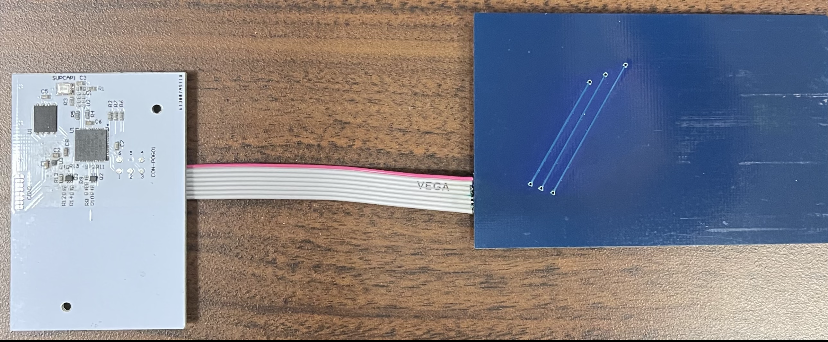
The download card (right, in blue) opens an encrypted session with the shimmer, and then transmits the stolen card data to the attached white plastic device. Image: KrebsOnSecurity.com.

The download card consisted of two pieces of plastic about the width of a debit card but a bit long longer. The blue plastic part — made to be inserted into a card reader — features the same contacts as a chip card. The blue plastic was attached via a ribbon cable to a white plastic card with a green LED and other electronic components.

Sticking the blue download card into a chip reader revealed the same Austrian card number seen on the shimming devices. It then became very clear what was happening.

“The download card was hard coded with chip card data on it, so that it could open up an encrypted session with the shimmer,” which also had the same card data, Dant said.
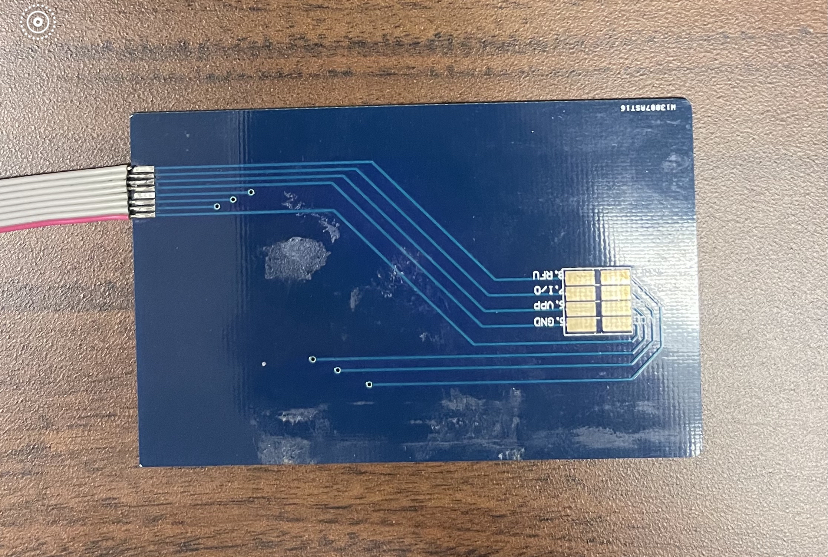
The download card, up close. Image: KrebsOnSecurity.com.

Once inserted into the mouth of ATM card acceptance slot that’s already been retrofitted with one of these shimmers, the download card causes an encrypted data exchange between it and the shimmer. Once that two-way handshake is confirmed, the white device lights up a green LED when the data transfer is complete.

THE MASTER KEY

Dant said when the Romanian crew mass-produced their shimming devices, they did so using the same stolen Austrian bank card number. What this meant was that now the Secret Service and Citi had a master key to discover the same shimming devices installed in other ATMs.

That’s because every time the gang compromised a new ATM, that Austrian account number would traverse the global payment card networks — telling them exactly which ATM had just been hacked.

“We gave that number to the card networks, and they were able to see all the places that card had been used on their networks before,” Dant said. “We also set things up so we got alerts anytime that card number popped up, and we started getting tons of alerts and finding these shimmers all over the world.”

For all their sleuthing, Dant and his colleagues never really saw shimming take off in the United States, at least nowhere near as prevalently as in Mexico, he said.

The problem was that many banks in Mexico and other parts of Latin America had not properly implemented the chip card standard, which meant thieves could use shimmed chip card data to make the equivalent of old magnetic stripe-based card transactions.

By the time the Romanian gang’s shimmers started showing up in New York City, the vast majority of U.S. banks had already properly implemented chip card processing in such a way that the same phony chip card transactions which sailed through Mexican banks would simply fail every time they were tried against U.S. institutions.

“It never took off in the U.S., but this kind of activity went on like wildfire for years in Mexico,” Dant said.

The other reason shimming never emerged as a major threat for U.S. financial institutions is that many ATMs have been upgraded over the past decade so that their card acceptance slots are far slimmer, Dant observed.

“That download card is thicker than a lot of debit cards, so a number of institutions were quick to replace the older card slots with newer hardware that reduced the height of a card slot so that you could maybe get a shimmer and a debit card, but definitely not a shimmer and one of these download cards,” he said.

Shortly after ATM shimmers started showing up at banks in Mexico, KrebsOnSecurity spent four days in Mexico tracing the activities of a Romanian organized crime gang that had very recently started its own ATM company there called Intacash.

Sources told KrebsOnSecurity that the Romanian gang also was paying technicians from competing ATM providers to retrofit cash machines with Bluetooth-based skimmers that hooked directly up to the electronics on the inside. Hooked up to the ATM’s internal power, those skimmers could collect card data indefinitely, and the data could be collected wirelessly with a smart phone.

Follow-up reporting last year by the Organized Crime and Corruption Reporting Project (OCCRP) found Intacash and its associates compromised more than 100 ATMs across Mexico using skimmers that were able to remain in place undetected for years. The OCCRP, which dubbed the Roomanian group “The Riviera Maya Gang,” estimates the crime syndicate used cloned card data and stolen PINs to steal more than $1.2 billion from bank accounts of tourists visiting the region.

Last month, Mexican authorities arrested Florian “The Shark” Tudor, Intacash’s boss and the reputed ringleader of the Romanian skimming syndicate. Authorities charged that Tudor’s group also specialized in human trafficking, which allowed them to send gang members to compromise ATMs across the border in the United States.

source https://krebsonsecurity.com/2021/06/how-cyber-sleuths-cracked-an-atm-shimmer-gang/
How Cyber Safe is Your Drinking Water Supply?

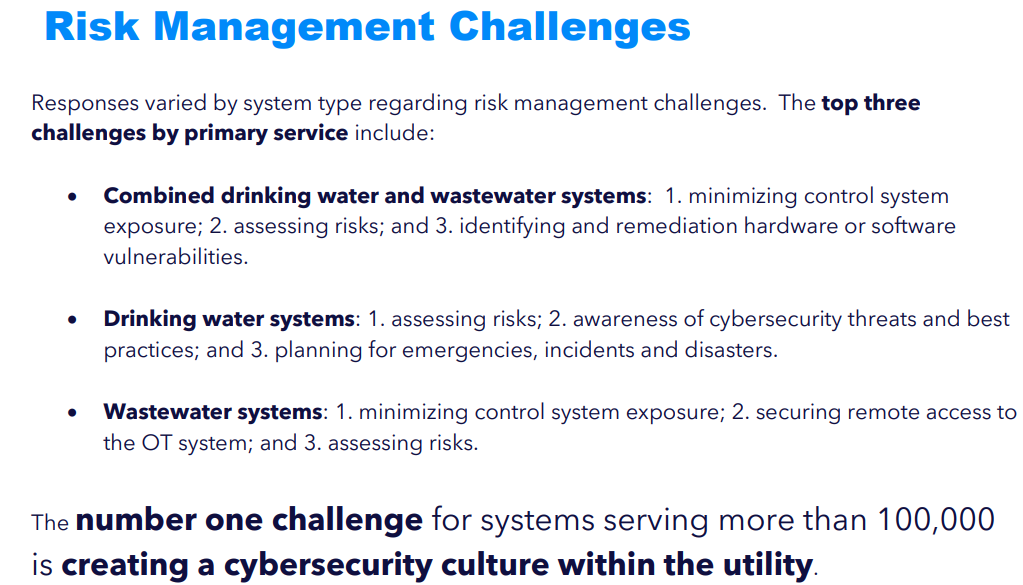
Amid multiple recent reports of hackers breaking into and tampering with drinking water treatment systems comes a new industry survey with some sobering findings: A majority of the 52,000 separate drinking water systems in the United States still haven’t inventoried some or any of their information technology systems — a basic first step in protecting networks from cyberattacks.

The Water Information Sharing and Analysis Center (WaterISAC) — an industry group that tries to facilitate information sharing and the adoption of best practices among utilities in the water sector — surveyed roughly 600 employees of water and wastewater treatment facilities nationwide, and found 37.9 percent of utilities have identified all IT-networked assets, with an additional 21.7 percent working toward that goal.

The ISAC found when it comes to IT systems tied to “operational technology” (OT) — systems responsible for monitoring and controlling the industrial operation of these utilities and their safety features — just 30.5 percent had identified all OT-networked assets, with an additional 22.5 percent working to do so.

“Identifying IT and OT assets is a critical first step in improving cybersecurity,” the report concluded. “An organization cannot protect what it cannot see.”

It’s also hard to see threats you’re not looking for: 67.9 percent of water systems reported no IT security incidents in the last 12 months, a somewhat unlikely scenario.

Michael Arceneaux, managing director of the WaterISAC, said the survey shows much room for improvement and a need for support and resources.

“Threats are increasing, and the sector, EPA, CISA and USDA need to collaborate to help utilities prevent and recover from compromises,” Arceneaux said on Twitter.

While documenting each device that needs protection is a necessary first step, a number of recent cyberattacks on water treatment systems have been blamed on a failure to properly secure water treatment employee accounts that can be used for remote access.

In April, federal prosecutors unsealed an indictment against a 22-year-old from Kansas who’s accused of hacking into a public water system in 2019. The defendant in that case is a former employee of the water district he allegedly hacked.

In February, we learned that someone hacked into the water treatment plan in Oldsmar, Fla. and briefly increased the amount of sodium hydroxide (a.k.a. lye used to control acidity in the water) to 100 times the normal level. That incident stemmed from stolen or leaked employee credentials for TeamViewer, a popular program that lets users remotely control their computers.

In January, a hacker tried to poison a water treatment plant that served parts of the San Francisco Bay Area, reports Kevin Collier for NBCNews. The hacker in that case also had the username and password for a former employee’s TeamViewer account.

Image: WaterISAC.

Andrew Hildick-Smith is a consultant who served more than 15 years managing remote access systems for the Massachusetts Water Resources Authority. He said the percentage of companies that reported already having inventoried all of their IT systems or being in the process of doing so is roughly equal to the number of larger water utilities (greater than 100,000 customers) that recently had to certify to the Environmental Protection Agency (EPA) that they are compliant with the Water Infrastructure Act of 2018.

The water act gives utilities serving between 3,300 and 50,000 residents until the end of this month to complete a cybersecurity risk and resiliency assessment.

But Hildick-Smith said the vast majority of the nation’s water utilities — tens of thousands of them — serve fewer than 3,300 residents, and those utilities currently do not have to report to the EPA about their cybersecurity practices (or the lack thereof).

“A large number of utilities — probably close to 40,000 of them — are small enough that they haven’t been asked to do anything,” he said. “But some of those utilities are kind of doing cybersecurity based on self motivation rather than any requirement.”

According to the WaterISAC, a great many of the nation’s water utilities are subject to economic disadvantages typical of rural and urban communities.

“Others do not have access to a cybersecurity workforce,” the report explains. “Operating in the background is that these utilities are struggling to maintain and replace infrastructure, maintain revenues while addressing issues of affordability, and comply with safe and clean water regulations.”

The report makes the case for federal funding of state and local systems to provide cybersecurity training, tools and services for those in charge of maintaining IT systems, noting that 38 percent of water systems allocate less than 1 percent of their annual budgets to cybersecurity.

As the recent hacking incidents above can attest, enabling some form of multi-factor authentication for remote access can blunt many of these attacks.

However, the sharing of remote access credentials among water sector employees may be a contributing factor in these recent incidents, since organizations that let multiple employees use the same account also are less likely to have any form of multi-factor enabled.

A copy of the Water ISAC report is available here (PDF).

source https://krebsonsecurity.com/2021/06/how-cyber-safe-is-your-drinking-water-supply/

First American Financial Pays Farcical $500K Fine

In May 2019, KrebsOnSecurity broke the news that the website of mortgage settlement giant First American Financial Corp. [NYSE:FAF] was leaking more than 800 million documents — many containing sensitive financial data — related to real estate transactions dating back 16 years. This week, the U.S. Securities and Exchange Commission settled its investigation into the matter after the Fortune 500 company agreed to pay a paltry penalty of less than $500,000.

First American Financial Corp.

If you bought or sold a property in the last two decades or so, chances are decent that you also gave loads of personal and financial documents to First American. According to data from the American Land Title Association, First American is the second largest mortgage title and settlement company in the United States, handling nearly a quarter of all closings each year.

The SEC says First American derives nearly 92 percent of its revenue from its title insurance segment, earning $7.1 billion last year.

Title insurance protects homebuyers from the prospect of someone contesting their legitimacy as the new homeowner. According to SimpleShowing.com, there are actually two title insurance policies in each transaction — one for the buyer and one for the lender (the latter also needs protection as they’re providing the mortgage to purchase the home).

Title insurance is not mandated by law, but most lenders require it as part of any mortgage transaction. In other words, if you wish to take out a mortgage on a home you will not be able to do so without giving companies like First American gobs of documents about your income, assets and liabilities — including quite a bit of sensitive financial data.

Aside from its core business competency — checking to make sure the property at issue in any real estate transaction is unencumbered by any liens or other legal claims against it — First American basically has one job: Protect the privacy and security of all these documents.

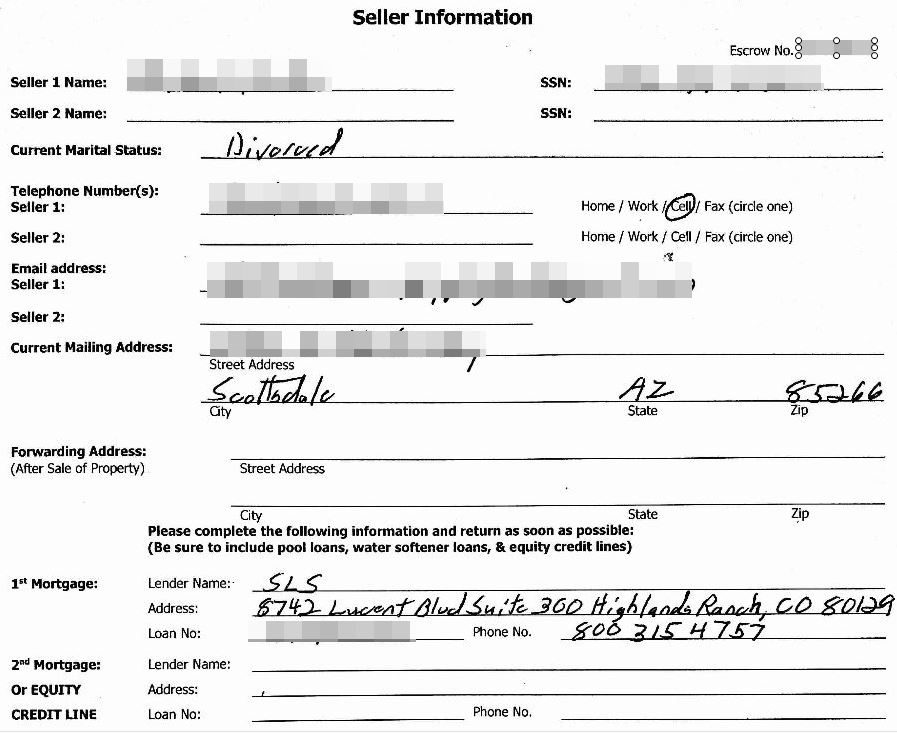
A redacted screenshot of one of many millions of sensitive records exposed by First American’s Web site.

It’s easy to see why companies like First American might not view protecting this data as sacrosanct, as the entire industry’s incentive for safeguarding all those sensitive documents is somewhat misaligned.

That is to say, in the title insurance industry the parties to a real estate transaction aren’t customers, but rather they are are the product. The actual customers of the title insurance companies are principally the banks which back these mortgage transactions.

We see a similar dynamic with social media platforms, where the “user” is not the customer at all but the product whose data is being bought and sold by these platforms.

Roughly five months before KrebsOnSecurity notified First American that anyone with a web browser could view sensitive document in its “Eagle Pro” database online just by changing some characters at the end of a link, an internal security audit at First American flagged the exact same vulnerability.

But the company never acted to fix it until the news media came calling.

The SEC’s administrative proceeding (PDF) explains how things slipped through the cracks. Under First American’s documented vulnerability remediation policies, the data leak was classified as a security weakness with a “level 3” severity, which placed it in the “medium risk” category and required remediation within 45 days.

But rather than recording the vulnerability as a level 3 severity, due to a clerical error the vulnerability was erroneously entered as a level 2 or “low risk” severity in First American’s automated tracking system. Level 2 issues required remediation within 90 days. Even so, First American missed that mark.

The SEC said that under First American’s remediation policies, if the person responsible for fixing the problem is unable to do so based on the timeframes listed above, that employee must have their management contact the company’s information security department to discuss their remediation plan and proposed time estimate.

“If it is not technically possible to remediate the vulnerability, or if remediation is cost prohibitive, the [employee] and their management must contact Information Security to obtain a waiver or risk acceptance approval from the CISO,” the SEC explained. “The [employee] did not request a waiver or risk acceptance from the CISO.”

So, someone within First American accepted the risk, but that person neglected to ensure the higher-ups within the company also were comfortable with that risk. It’s difficult not to hum a tune whenever the phrase “accepted the risk” comes up if you’ve ever seen this excellent infosec industry parody.

The SEC took aim at First American because a few days after our May 24, 2019 story ran, the company issued an 8-K filing with the agency stating First American had no prior indication of any vulnerability.

“That statement demonstrated that First American’s senior management was not properly informed of the prior report of a vulnerability and a failure to remediate the problem,” wrote Michael Volkov, a 30-year federal prosecutor who now runs The Volkov Law Group in Washington, D.C.

Reporting for Reuters Regulatory Intelligence, Richard Satran says the SEC charged First American with violating Rule 13a-15(a) of the Exchange Act.

“The rule broadly requires firms involved in securities issuance to have a compliance process in place to assure material information follows securities laws,” Satran wrote. “The SEC avoided getting into the specific details of the breach and instead focused on the way its disclosure was handled.”

Mark Rasch, also former federal prosecutor in Washington, said the SEC is signaling with this action that it intends to take on more cases in which companies flub security governance in some big way.

“It’s a win for the SEC, and for First America, but it’s hardly justice,” Rasch said. “It’s a paltry fine, and it involves no admission of guilt by First American.”

Rasch said First American’s first problem was labeling the weakness as a medium risk.

“This is lots of sensitive data you’re exposing to anyone with a web browser,” Rasch said. “That’s a high-risk vulnerability. It also means you probably don’t know whether or not anyone has accessed that data. There’s no way to tell unless you can go back through all your logs all those years.”

The SEC said the 800 million+ records had been publicly available on First American’s website since 2013. In August 2019, the company said a third-party investigation into the exposure identified just 32 consumers whose non-public personal information likely was accessed without authorization.

When KrebsOnSecurity asked how long it maintained access logs or how far back in time that review went, First American declined to be more specific, saying only that its logs covered a period that was typical for a company of its size and nature.

However, documents from New York financial regulators show First American was unable to determine whether records were accessed prior to Jun 2018 (one year prior to fixing the weakness).

The records exposed by First American would have been a virtual gold mine for phishers and scammers involved in Business Email Compromise (BEC) scams, which often impersonate real estate agents, closing agencies, title and escrow firms in a bid to trick property buyers into wiring funds to fraudsters. According to the FBI, BEC scams are the most costly form of cybercrime today.

First American is not out of the regulatory woods yet from this enormous data leak. In July 2020, the New York State Department of Financial Services announced the company was the target of their first ever cybersecurity enforcement action in connection with the incident, charges that could bring steep financial penalties. That inquiry is ongoing.

The DFS considers each instance of exposed personal information a separate violation, and the company faces penalties of up to $1,000 per violation. According to the SEC, First American’s EaglePro database contained tens of millions of document images that contained non-public personal information.

source https://krebsonsecurity.com/2021/06/first-american-financial-pays-farcical-500k-fine/

Ukrainian Police Nab Six Tied to CLOP Ransomware

Authorities in Ukraine this week charged six people alleged to be part of the CLOP ransomware group, a cybercriminal gang said to have extorted more than half a billion dollars from victims. Some of CLOP’s victims this year alone include Stanford University Medical School, the University of California, and University of Maryland.

A still shot from a video showing Ukrainian police seizing a Tesla, one of many high-end vehicles seized in this week’s raids on the Clop gang.

According to a statement and videos released today, the Ukrainian Cyber Police charged six defendants with various computer crimes linked to the CLOP gang, and conducted 21 searches throughout the Kyiv region.

First debuting in early 2019, CLOP is one of several ransomware groups that hack into organizations, launch ransomware that encrypts files and servers, and then demand an extortion payment in return for a digital key needed to unlock access.

/

CLOP has been especially busy over the past six months exploiting four different zero-day vulnerabilities in File Transfer Appliance (FTA), a file sharing product made by California-based Accellion.

The CLOP gang seized on those flaws to deploy ransomware to a significant number of Accellion’s FTA customers, including U.S. grocery chain Krogers, the law firm Jones Day, security firm Qualys, and the Singaporean telecom giant Singtel.

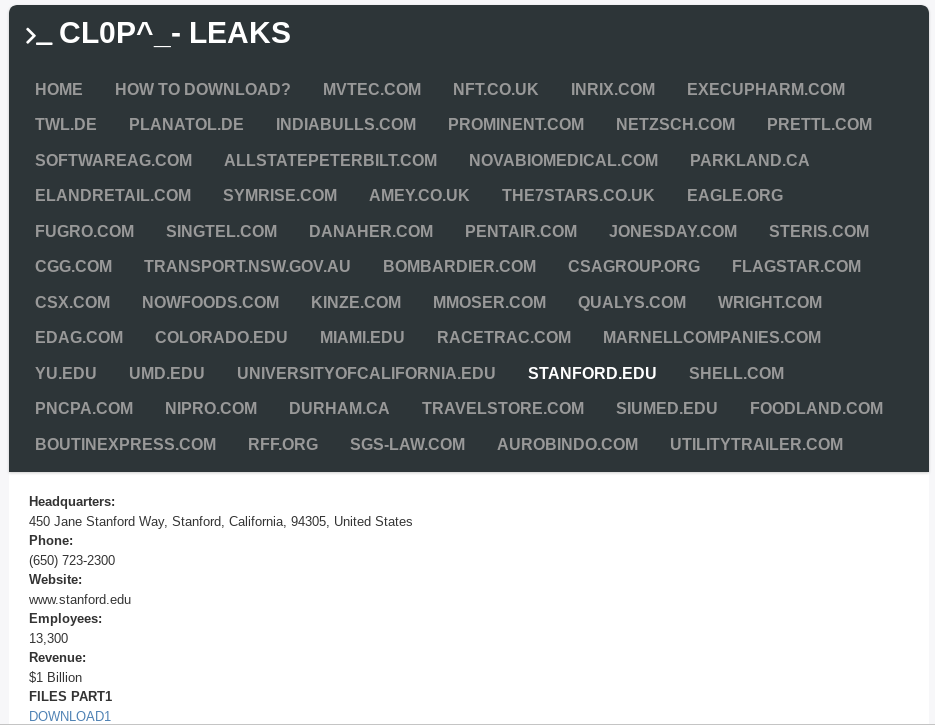
Last year, CLOP adopted the practice of attempting to extract a second ransom demand from victims in exchange for a promise not to publish or sell any stolen data. Terabytes of documents and files stolen from victim organizations that have not paid a data ransom are now available for download from CLOP’s deep web site, including Stanford, UCLA and the University of Maryland.

CLOP’s victim shaming blog on the deep web.

It’s not clear how much this law enforcement operation by Ukrainian authorities will affect the overall operations of the CLOP group. Cybersecurity intelligence firm Intel 471 says the law enforcement raids in Ukraine were limited to the cash-out and money laundering side of CLOP’s business only.

“We do not believe that any core actors behind CLOP were apprehended, due to the fact that they are probably living in Russia,” Intel 471 concluded. “The overall impact to CLOP is expected to be minor although this law enforcement attention may result in the CLOP brand getting abandoned as we’ve recently seen with other ransomware groups like DarkSide and Babuk” [links added].

While CLOP as a moneymaking collective is fairly young organization, security experts say CLOP members hail from a group of Threat Actors (TA) known as “TA505,” which MITRE‘s ATT&CK database says is a financially motivated cybercrime group that has been active since at least 2014. “This group is known for frequently changing malware and driving global trends in criminal malware distribution,” MITRE assessed.

source https://krebsonsecurity.com/2021/06/ukrainian-police-nab-six-tied-to-clop-ransomware/

How Does One Get Hired by a Top Cybercrime Gang?

The U.S. Department of Justice (DOJ) last week announced the arrest of a 55-year-old Latvian woman who’s alleged to have worked as a programmer for Trickbot, a malware-as-a-service platform responsible for infecting millions of computers and seeding many of those systems with ransomware.

Just how did a self-employed web site designer and mother of two come to work for one of the world’s most rapacious cybercriminal groups and then leave such an obvious trail of clues indicating her involvement with the gang? This post explores answers to those questions, as well as some of the ways Trickbot and other organized cybercrime gangs gradually recruit, groom and trust new programmers.

Alla Witte’s personal website — allawitte[.]nl — circa October 2018.

The indictment released by the DOJ (PDF) is heavily redacted, and only one of the defendants is named: Alla “Max” Witte, a 55-year-old Latvian national who was arrested Feb. 6 in Miami, Fla.

The DOJ alleges Witte was responsible for “overseeing the creation of code related to the monitoring and tracking of authorized users of the Trickbot malware, the control and deployment of ransomware, obtaining payments from ransomware victims, and developing tools and protocols for the storage of credentials stolen and exfiltrated from victims infected by Trickbot.”

The indictment also says Witte provided code to the Trickbot Group for a web panel used to access victim data stored in a database. According to the government, that database contained a large number of credit card numbers and stolen credentials from the Trickbot botnet, as well as information about infected machines available as bots.

“Witte provided code to this repository that showed an infected computer or ‘bot’ status in different colors based on the colors of a traffic light and allowed other Trickbot Group members to know when their co-conspirators were working on a particular infected machine,” the indictment alleges.

While any law enforcement action against a crime group that has targeted hospitals, schools, public utilities and governments is good news, Witte’s indictment and arrest were probably inevitable: It is hard to think of an accused cybercriminal who has made more stunningly poor and rookie operational security mistakes than this Latvian senior citizen.

For starters, it appears at one point in 2020 Witte actually hosted Trickbot malware on a vanity website registered in her nameallawitte[.]nl.

While it is generally a bad idea for cybercriminals to mix their personal life with work, Witte’s social media accounts mention a close family member (perhaps her son or husband) had the first name “Max,” which allegedly was her hacker handle.

Unlike many accused cybercriminals who hail from Russia or former Soviet countries, Witte did not feel obligated to avoid traveling to areas where she might be within reach of U.S. law enforcement agencies. According to her indictment, Witte was living in the South American nation of Suriname and she was arrested in Miami while flying from Suriname. It is not clear where her intended destination was.

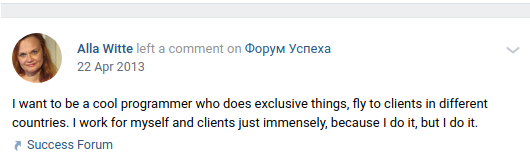
A Google-translated post Witte made to her Vkontakte page, five years before allegedly joining the Trickbot group.

Alex Holden, founder of the cybersecurity intelligence firm Hold Security, said Witte’s greatest lapse in judgment came around Christmas time in 2019, when she infected one of her own computers with the Trickbot malware — allowing it to steal and log her data within the botnet interface.

“On top of the password re-use, the data shows a great insight into her professional and personal Internet usage,” Holden wrote in a blog post on Witte’s arrest.

“Many in the gang not only knew her gender but her name too,” Holden wrote. “Several group members had AllaWitte folders with data. They refer to Alla almost like they would address their mothers.”

So how did this hacker mom with apparently zero sense of self-preservation come to work for one of the world’s most predatory cybercriminal gangs?

The government’s indictment dedicates several pages to describing the hiring processes of the Trickbot group, which continuously scoured fee-based Russian and Belarussian-based job websites for resumes of programmers looking for work. Those who responded were asked to create various programs designed to test the applicant’s problem-solving and coding skills.

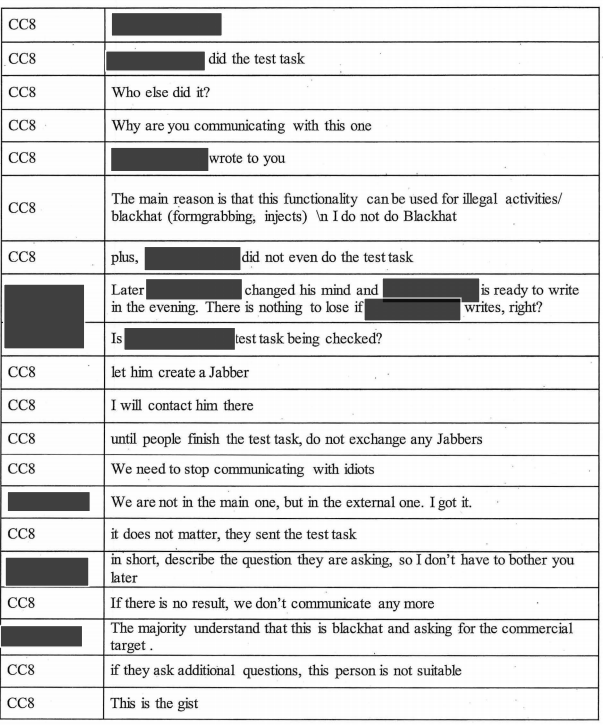
Here’s a snippet of translated instant message text between two of the unnamed Trickbot defendants, in which they discuss an applicant who understood immediately that he was being hired to help with cybercrime activity.

A conversation between two Trickbot group members concerning a potential new hire. Image: DOJ.

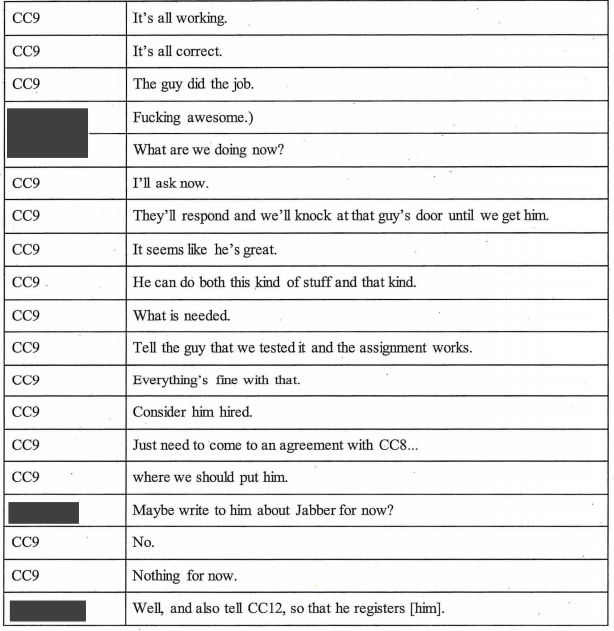
The following conversation, on or about June 1, 2016, concerned a potential new Trickbot hire who successfully completed a test task that involved altering a Firefox Web browser.

Other conversation snippets in the indictment suggest the majority of new recruits understand that what the projects and test tasks they are being asked to perform are related to cybercrime activity.

“The majority understand that this is blackhat and asking for the commercial target,” wrote the defendant identified only as Co-Conspirator 8 (CC8).

But what about new hires that aren’t hip to exactly how the programs they’re being asked to create get used? Another source in the threat intelligence industry who has had access to the inner workings of Trickbot provided some additional context on how developers are onboarded into the group.

“There’s a two-step hiring process where at first you may not understand who you’re working for,” said the source. “But that timeframe is typically pretty short, like less than a year.”

After that, if the candidate is talented and industrious enough, someone in the Trickbot group will “read in” the new recruit — i.e. explain in plain terms how their work is being used.

“If you’re good, at some point they’re going to read you in and you’ll know, but if you’re not good or you’re not okay with that, they will triage that pretty quickly and your services will no longer be required,” the source said. “But if you make it past that first year, the chances that you still don’t know what you’re doing are very slim.”

According to the DOJ, Witte had access to Trickbot for roughly two years between 2018 and 2020.

Investigators say prior to launching Trickbot, some members of the conspiracy previously were responsible for disseminating Dyre, a particularly stealthy password stealer that looked for passwords used at various banks. The government says Trickbot members — including Witte — routinely used bank account passwords stolen by their malware to drain victim bank accounts and send the money to networks of money mules.

The hiring model adopted by Trickbot allows the gang to recruit a steady stream of talented developers cheaply and covertly. But it also introduces the very real risk that new recruits may offer investigators a way to infiltrate the group’s operations, and possibly even identify co-conspirators.

Ransomware attacks are nearly all perpetrated these days by ransomware affiliate groups which constantly recruit new members to account for attrition, competition from other ransomware groups, and for the odd affiliate who gets busted by law enforcement.

Under the ransomware affiliate model, a cybercriminal can earn up to 85 percent of the total ransom paid by a victim company he or she is responsible for compromising and bringing to the group. But from time to time, poor operational security by an affiliate exposes the gang’s entire operation.

On June 7, the DOJ announced it had clawed back $2.3 million worth of Bitcoin that Colonial Pipeline paid to ransomware extortionists last month. The funds had been sent to DarkSide, a ransomware-as-a-service syndicate that disbanded after a May 14 farewell message to affiliates saying its Internet servers and cryptocurrency stash were seized by unknown law enforcement entities.

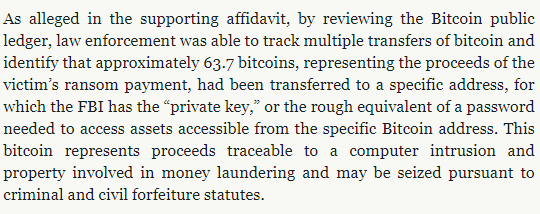
“The proceeds of the victim’s ransom payment…had been transferred to a specific address, for which the FBI has the ‘private key,’ or the rough equivalent of a password needed to access assets accessible from the specific Bitcoin address,” the DOJ explained, somewhat cryptically.

Multiple security experts quickly zeroed in on how investigators were able to retrieve the funds, which did not represent the total amount Colonial paid (~$4.4 million): The amount seized was roughly what a top DarkSide affiliate would have earned for scoring the initial malware infection that precipitated the ransomware incident.

source https://krebsonsecurity.com/2021/06/how-does-one-get-hired-by-a-top-cybercrime-gang/

Microsoft Patches Six Zero-Day Security Holes

Microsoft today released another round of security updates for Windows operating systems and supported software, including fixes for six zero-day bugs that malicious hackers already are exploiting in active attacks.

June’s Patch Tuesday addresses just 49 security holes — about half the normal number of vulnerabilities lately. But what this month lacks in volume it makes up for in urgency: Microsoft warns that bad guys are leveraging a half-dozen of those weaknesses to break into computers in targeted attacks.

Among the zero-days are:

CVE-2021-33742, a remote code execution bug in a Windows HTML component.
CVE-2021-31955, an information disclosure bug in the Windows Kernel
CVE-2021-31956, an elevation of privilege flaw in Windows NTFS
CVE-2021-33739, an elevation of privilege flaw in the Microsoft Desktop Window Manager
CVE-2021-31201, an elevation of privilege flaw in the Microsoft Enhanced Cryptographic Provider
CVE-2021-31199, an elevation of privilege flaw in the Microsoft Enhanced Cryptographic Provider

Kevin Breen, director of cyber threat research at Immersive Labs, said elevation of privilege flaws are just as valuable to attackers as remote code execution bugs: Once the attacker has gained an initial foothold, he can move laterally across the network and uncover further ways to escalate to system or domain-level access.

“This can be hugely damaging in the event of ransomware attacks, where high privileges can enable the attackers to stop or destroy backups and other security tools,” Breen said. “The ‘exploit detected’ tag means attackers are actively using them, so for me, it’s the most important piece of information we need to prioritize the patches.”

Microsoft also patched five critical bugs — flaws that can be remotely exploited to seize control over the targeted Windows computer without any help from users. CVE-2021-31959 affects everything from Windows 7 through Windows 10 and Server versions 2008, 2012, 2016 and 2019.

Sharepoint also got a critical update in CVE-2021-31963; Microsoft says this one is less likely to be exploited, but then critical Sharepoint flaws are a favorite target of ransomware criminals.

Interestingly, two of the Windows zero-day flaws — CVE-2021-31201 and CVE-2021-31199 — are related to a patch Adobe released today for CVE-2021-28550, a flaw in Adobe Acrobat and Reader that also is being actively exploited.

“Attackers have been seen exploiting these vulnerabilities by sending victims specially crafted PDFs, often attached in a phishing email, that when opened on the victim’s machine, the attacker is able to gain arbitrary code execution,” said Christopher Hass, director of information security and research at Automox. “There are no workarounds for these vulnerabilities, patching as soon as possible is highly recommended.”

In addition to updating Acrobat and Reader, Adobe patched flaws in a slew of other products today, including Adobe Connect, Photoshop, and Creative Cloud. The full list is here, with links to updates.

The usual disclaimer:

Before you update with this month’s patch batch, please make sure you have backed up your system and/or important files. It’s not uncommon for Windows updates to hose one’s system or prevent it from booting properly, and some updates even have been known to erase or corrupt files.

So do yourself a favor and backup before installing any patches. Windows 10 even has some built-in tools to help you do that, either on a per-file/folder basis or by making a complete and bootable copy of your hard drive all at once.

And if you wish to ensure Windows has been set to pause updating so you can back up your files and/or system before the operating system decides to reboot and install patches on its own schedule, see this guide.

As always, if you experience glitches or problems installing any of these patches this month, please consider leaving a comment about it below; there’s a better-than-even chance other readers have experienced the same and may chime in here with some helpful tips.

For a quick visual breakdown of each update released today and its severity level, check out the this Patch Tuesday post from the SANS Internet Storm Center.

source https://krebsonsecurity.com/2021/06/microsoft-patches-six-zero-day-security-holes/

Justice Dept. Claws Back $2.3M Paid by Colonial Pipeline to Ransomware Gang

The U.S. Department of Justice said today it has recovered $2.3 million worth of Bitcoin that Colonial Pipeline paid to ransomware extortionists last month. The funds had been sent to DarkSide, a ransomware-as-a-service syndicate that disbanded after a May 14 farewell message to affiliates saying its Internet servers and cryptocurrency stash were seized by unknown law enforcement entities.

On May 7, the DarkSide ransomware gang sprang its attack against Colonial, which ultimately paid 75 Bitcoin (~$4.4 million) to its tormentors. The company said the attackers only hit its business IT networks — not its pipeline security and safety systems — but that it shut the pipeline down anyway as a precaution [several publications noted Colonial shut down its pipeline because its billing system was impacted, and it had no way to get paid].

On or around May 14, the DarkSide representative on several Russian-language cybercrime forums posted a message saying the group was calling it quits.

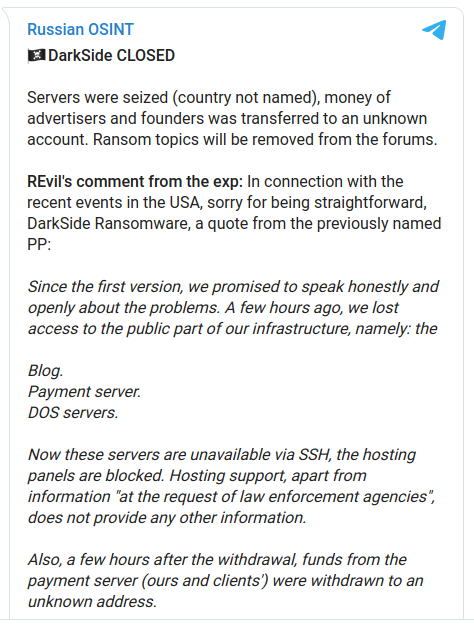
“Servers were seized, money of advertisers and founders was transferred to an unknown account,” read the farewell message. “Hosting support, apart from information ‘at the request of law enforcement agencies,’ does not provide any other information.”

A message from the DarkSide and REvil ransomware-as-a-service cybercrime affiliate programs.

Many security experts said they suspected DarkSide was just laying low for a while thanks to the heat from the Colonial attack, and that the group would re-emerge under a new banner in the coming months. And while that may be true, the seizure announced today by the DOJ certainly supports the DarkSide administrator’s claims that their closure was involuntary.

Security firms have suspected for months that the DarkSide gang shares some leadership with that of REvil, a.k.a. Sodinokibi, another ransomware-as-a-service platform that closed up shop in 2019 after bragging that it had extorted more than $2 billion from victims. That suspicion was solidified further when the REvil administrator added his comments to the announcement about DarkSide’s closure (see screenshot above).

First surfacing on Russian language hacking forums in August 2020, DarkSide is a ransomware-as-a-service platform that vetted cybercriminals can use to infect companies with ransomware and carry out negotiations and payments with victims. DarkSide says it targets only big companies, and forbids affiliates from dropping ransomware on organizations in several industries, including healthcare, funeral services, education, public sector and non-profits.

According to an analysis published May 18 by cryptocurrency security firm Elliptic, 47 cybercrime victims paid DarkSide a total of $90 million in Bitcoin, putting the average ransom payment of DarkSide victims at just shy of $2 million.

HOW DID THEY DO IT?

The DoJ’s announcement left open the question of how exactly it was able to recover a portion of the payment made by Colonial, which shut down its Houston to New England fuel pipeline for a week and prompted long lines, price hikes and gas shortages at filling stations across the nation.

The DOJ said law enforcement was able to track multiple transfers of bitcoin and identify that approximately 63.7 bitcoins (~$3.77 million on May 8), “representing the proceeds of the victim’s ransom payment, had been transferred to a specific address, for which the FBI has the ‘private key,’ or the rough equivalent of a password needed to access assets accessible from the specific Bitcoin address.”

A passage from the DOJ’s press release today.

How it came to have that private key is the key question. Nicholas Weaver, a lecturer at the computer science department at University of California, Berkeley, said the most likely explanation is that law enforcements agent seized money from a specific DarkSide affiliate responsible for bringing the crime gang the initial access to Colonial’s systems.

“The ‘obtained the private key’ part of their statement is doing a lot of work,” Weaver said, point out that the amount the FBI recovered was less than the full amount Colonial paid.

“It is ONLY the Colonial Pipeline ransom, and it looks to be only the affiliate’s take.”

Experts at Elliptic came to the same conclusion.

“Any ransom payment made by a victim is then split between the affiliate and the developer,” writes Elliptic’s co-founder Tom Robinson. “In the case of the Colonial Pipeline ransom payment, 85% (63.75 BTC) went to the affiliate and 15% went to the DarkSide developer.”

The Biden administration is under increasing pressure to do something about the epidemic of ransomware attacks. In conjunction with today’s action, the DOJ called attention to the wins of its Ransomware and Digital Extortion Task Force, which have included successful prosecutions of crooks behind such threats as the Netwalker and SamSam ransomware strains.

The DOJ also released a June 3 memo from Deputy Attorney General Lisa O. Monaco instructing all federal prosecutors to adhere to new guidelines that seek centralize reporting about ransomware victims.

Having a central place for law enforcement and intelligence agencies to gather and act on ransomware threats was one of the key recommendations of a ransomware task force being led by some of the world’s top tech firms. In an 81-page report, the industry led task force called for an international coalition to combat ransomware criminals, and for a global network of investigation hubs. Their recommendations focus mainly on disrupting cybercriminal ransomware gangs by limiting their ability to get paid, and targeting the individuals and finances of the organized thieves behind these crimes.

source https://krebsonsecurity.com/2021/06/justice-dept-claws-back-2-3m-paid-by-colonial-pipeline-to-ransomware-gang/