Who Is the Network Access Broker ‘Babam’?

Rarely do cybercriminal gangs that deploy ransomware gain the initial access to the target themselves. More commonly, that access is purchased from a cybercriminal broker who specializes in acquiring remote access credentials — such as usernames and passwords needed to remotely connect to the target’s network. In this post we’ll look at the clues left behind by “Babam,” the handle chosen by a cybercriminal who has sold such access to ransomware groups on many occasions over the past few years.
Since the beginning of 2020, Babam has set up numerous auctions on the Russian-language cybercrime forum Exploit, mainly selling virtual private networking (VPN) credentials stolen from various companies. Babam has authored more than 270 posts since joining Exploit in 2015, including dozens of sales threads. However, none of Babam posts on Exploit include any personal information or clues about his identity.

But in February 2016, Babam joined Verified, another Russian-language crime forum. Verified was hacked at least twice in the past five years, and its user database posted online. That information shows that Babam joined Verified using the email address “operns@gmail.com.” The latest Verified leak also exposed private messages exchanged by forum members, including more than 800 private messages that Babam sent or received on the forum over the years.

In early 2017, Babam confided to another Verified user via private message that he is from Lithuania. In virtually all of his forum posts and private messages, Babam can be seen communicating in transliterated Russian rather than by using the Cyrillic alphabet. This is common among cybercriminal actors for whom Russian is not their native tongue.

Cyber intelligence platform Constella Intelligence told KrebsOnSecurity that the operns@gmail.com address was used in 2016 to register an account at filmai.in, which is a movie streaming service catering to Lithuanian speakers. The username associated with that account was “bo3dom.”

A reverse WHOIS search via DomainTools.com says operns@gmail.com was used to register two domain names: bonnjoeder[.]com back in 2011, and sanjulianhotels[.]com (2017). It’s unclear whether these domains ever were online, but the street address on both records was “24 Brondeg St.” in the United Kingdom. [Full disclosure: DomainTools is a frequent advertiser on this website.]

A reverse search at DomainTools on “24 Brondeg St.” reveals one other domain: wwwecardone[.]com. The use of domains that begin with “www” is fairly common among phishers, and by passive “typosquatting” sites that seek to siphon credentials from legitimate websites when people mistype a domain, such as accidentally omitting the “.” after typing “www”.

A banner from the homepage of the Russian language cybercrime forum Verified.

Searching DomainTools for the phone number in the WHOIS records for wwwecardone[.]com  — +44.0774829141 — leads to a handful of similar typosquatting domains, including wwwebuygold[.]com and wwwpexpay[.]com. A different UK phone number in a more recent record for the wwwebuygold[.]com domain — 44.0472882112 — is tied to two more domains – howtounlockiphonefree[.]com, and portalsagepay[.]com. All of these domains date back to between 2012 and 2013.

The original registration records for the iPhone, Sagepay and Gold domains share an email address: devrian26@gmail.com. A search on the username “bo3dom” using Constella’s service reveals an account at ipmart-forum.com, a now-defunct forum concerned with IT products, such as mobile devices, computers and online gaming. That search shows the user bo3dom registered at ipmart-forum.com with the email address devrian27@gmail.com, and from an Internet address in Vilnius, Lithuania.

Devrian27@gmail.com was used to register multiple domains, including wwwsuperchange.ru back in 2008 (notice again the suspect “www” as part of the domain name). Gmail’s password recovery function says the backup email address for devrian27@gmail.com is bo3*******@gmail.com. Gmail accepts the address bo3domster@gmail.com as the recovery email for that devrian27 account.

According to Constella, the bo3domster@gmail.com address was exposed in multiple data breaches over the years, and in each case it used one of two passwords: “lebeda1” and “a123456“.

Searching in Constella for accounts using those passwords reveals a slew of additional “bo3dom” email addresses, including bo3dom@gmail.com.  Pivoting on that address in Constella reveals that someone with the name Vytautas Mockus used it to register an account at mindjolt.com, a site featuring dozens of simple puzzle games that visitors can play online.

At some point, mindjolt.com apparently also was hacked, because a copy of its database at Constella says the bo3dom@gmail.com used two passwords at that site: lebeda1 and a123456.

A reverse WHOIS search on “Vytautas Mockus” at DomainTools shows the email address devrian25@gmail.com was used in 2010 to register the domain name perfectmoney[.]co. This is one character off of perfectmoney[.]com, which is an early virtual currency that was quite popular with cybercriminals at the time. The phone number tied to that domain registration was “86.7273687“.

A Google search for “Vytautas Mockus” says there’s a person by that name who runs a mobile food service company in Lithuania called “Palvisa.” A report on Palvisa (PDF) purchased from Rekvizitai.vz — an official online directory of Lithuanian companies — says Palvisa was established in 2011 by a Vytautaus Mockus, using the phone number 86.7273687, and the email address bo3dom@gmail.com. The report states that Palvisa is active, but has had no employees other than its founder.

Reached via the bo3dom@gmail.com address, the 36-year-old Mr. Mockus expressed mystification as to how his personal information wound up in so many records. “I am not involved in any crime,” Mockus wrote in reply.
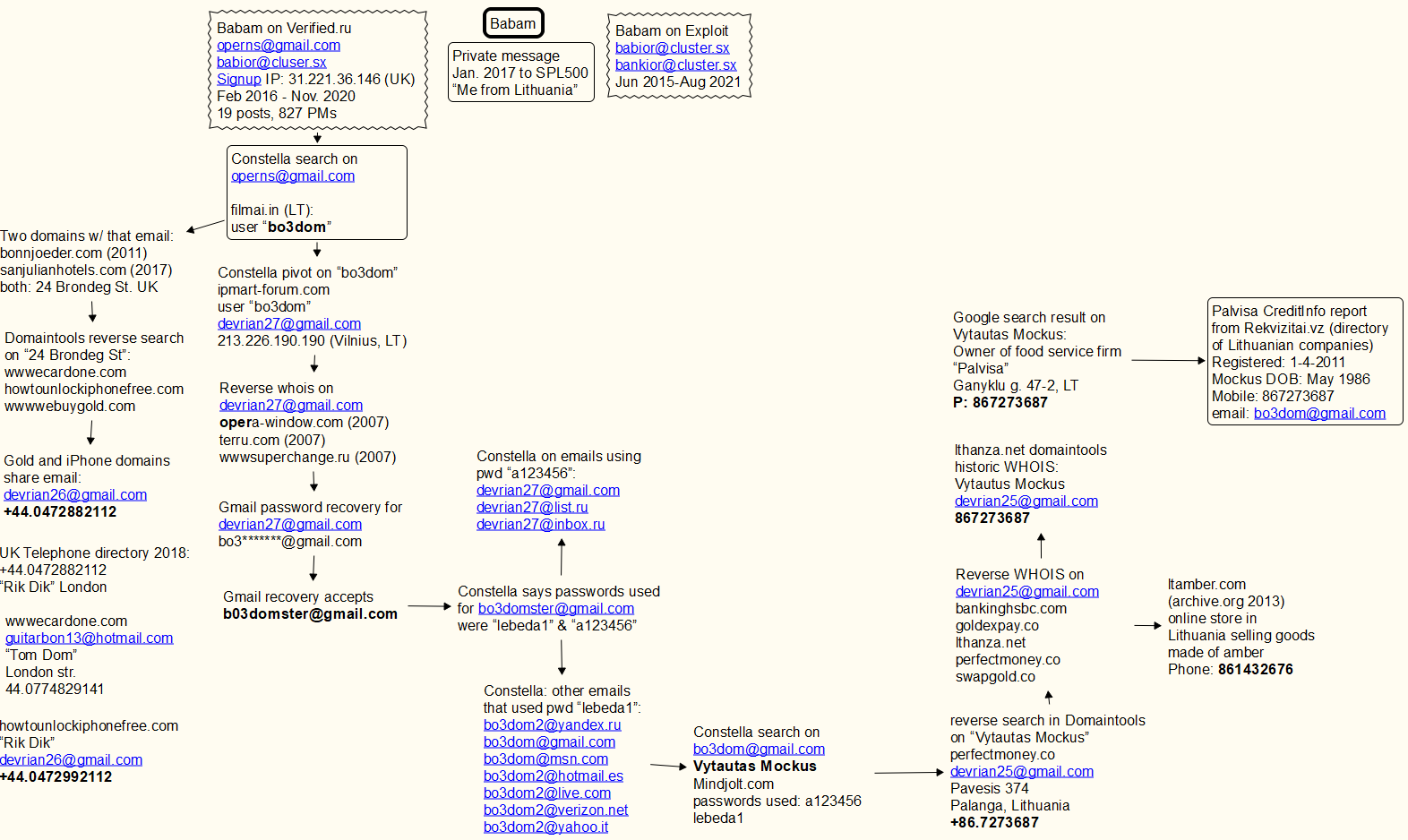
A rough mind map of the connections mentioned in this story.

The domains apparently registered by Babam over nearly 10 years suggest he started off mainly stealing from other cybercrooks. By 2015, Babam was heavily into “carding,” the sale and use of stolen payment card data. By 2020, he’d shifted his focus almost entirely to selling access to companies.

A profile produced by threat intelligence firm Flashpoint says Babam has received at least four positive feedback reviews on the Exploit cybercrime forum from crooks associated with the LockBit ransomware gang.
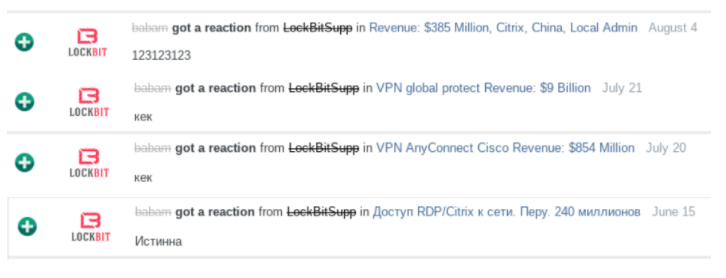
The ransomware collective LockBit giving Babam positive feedback for selling access to different victim organizations. Image: Flashpoint

According to Flashpoint, in April 2021 Babam advertised the sale of Citrix credentials for an international company that is active in the field of laboratory testing, inspection and certification, and that has more than $5 billion in annual revenues and more than 78,000 employees.

Flashpoint says Babam initially announced he’d sold the access, but later reopened the auction because the prospective buyer backed out of the deal. Several days later, Babam reposted the auction, adding more information about the depth of the illicit access and lowering his asking price. The access sold less than 24 hours later.

“Based on the provided statistics and sensitive source reporting, Flashpoint analysts assess with high confidence that the compromised organization was likely Bureau Veritas, an organization headquartered in France that operates in a variety of sectors,” the company concluded.

In November, Bureau Veritas acknowledged that it shut down its network in response to a cyber attack. The company hasn’t said whether the incident involved ransomware and if so what strain of ransomware, but its response to the incident is straight out of the playbook for responding to ransomware attacks. Bureau Veritas has not yet responded to requests for comment; its latest public statement on Dec. 2 provides no additional details about the cause of the incident.

Flashpoint notes that Babam’s use of transliterated Russian persists on both Exploit and Verified until around March 2020, when he switches over to using mostly Cyrillc in his forum comments and sales threads. Flashpoint said this could be an indication that a different person started using the Babam account since then, or more likely that Babam had only a tenuous grasp of Russian to begin with and that his language skills and confidence improved over time.

Lending credence to the latter theory is that Babam still makes linguistic errors in his postings that suggest Russian is not his original language, Flashpoint found.

“The use of double “n” in such words as “проданно” (correct – продано) and “сделанны” (correct – сделаны) by the threat actor proves that this style of writing is not possible when using machine translation since this would not be the correct spelling of the word,” Flashpoint analysts wrote.

“These types of grammatical errors are often found among people who did not receive sufficient education at school or if Russian is their second language,” the analysis continues. “In such cases, when someone tries to spell a word correctly, then by accident or unknowingly, they overdo the spelling and make these types of mistakes. At the same time, colloquial speech can be fluent or even native. This is often typical for a person who comes from the former Soviet Union states.”

source https://krebsonsecurity.com/2021/12/who-is-the-network-access-broker-babam/

Ubiquiti Developer Charged With Extortion, Causing 2020 “Breach”

In January 2021, technology vendor Ubiquiti Inc. [NYSE:UI] disclosed that a breach at a third party cloud provider had exposed customer account credentials. In March, a Ubiquiti employee warned that the company had drastically understated the scope of the incident, and that the third-party cloud provider claim was a fabrication. On Wednesday, a former Ubiquiti developer was arrested and charged with stealing data and trying to extort his employer while pretending to be a whistleblower.

Federal prosecutors say Nickolas Sharp, a senior developer at Ubiquiti, actually caused the “breach” that forced Ubiquiti to disclose a cybersecurity incident in January. They allege that in late December 2020, Sharp applied for a job at another technology company, and then abused his privileged access to Ubiquiti’s systems at Amazon’s AWS cloud service and the company’s GitHub accounts to download large amounts of proprietary data.

Sharp’s indictment doesn’t specify how much data he allegedly downloaded, but it says some of the downloads took hours, and that he cloned approximately 155 Ubiquiti data repositories via multiple downloads over nearly two weeks.

On Dec. 28, other Ubiquiti employees spotted the unusual downloads, which had leveraged internal company credentials and a Surfshark VPN connection to hide the downloader’s true Internet address. Assuming an external attacker had breached its security, Ubiquiti quickly launched an investigation.

But Sharp was a member of the team doing the forensic investigation, the indictment alleges.

“At the time the defendant was part of a team working to assess the scope and damage caused by the incident and remediate its effects, all while concealing his role in committing the incident,” wrote prosecutors with the Southern District of New York.

According to the indictment, on January 7 a senior Ubiquiti employee received a ransom email. The message was sent through an IP address associated with the same Surfshark VPN. The ransom message warned that internal Ubiquiti data had been stolen, and that the information would not be used or published online as long as Ubiquiti agreed to pay 25 Bitcoin.

The ransom email also offered to identify a purportedly still unblocked “backdoor” used by the attacker for the sum of another 25 Bitcoin (the total amount requested was equivalent to approximately $1.9 million at the time). Ubiquiti did not pay the ransom demands.

Investigators say they were able to tie the downloads to Sharp and his work-issued laptop because his Internet connection briefly failed on several occasions while he was downloading the Ubiquiti data. Those outages were enough to prevent Sharp’s Surfshark VPN connection from functioning properly — thus exposing his Internet address as the source of the downloads.

When FBI agents raided Sharp’s residence on Mar. 24, he reportedly maintained his innocence and told agents someone else must have used his Paypal account to purchase the Surfshark VPN subscription.

Several days after the FBI executed its search warrant, Sharp “caused false or misleading news stories to be published about the incident,” prosecutors say. Among the claims made in those news stories was that Ubiquiti had neglected to keep access logs that would allow the company to understand the full scope of the intrusion. In reality, the indictment alleges, Sharp had shortened to one day the amount of time Ubiquiti’s systems kept certain logs of user activity in AWS.

“Following the publication of these articles, between Tuesday, March 30, 2021 and Wednesday March 31, [Ubiquiti’s] stock price fell approximately 20 percent, losing over four billion dollars in market capitalization,” the indictment states.

Sharp faces four criminal counts, including wire fraud, intentionally damaging protected computers, transmission of interstate communications with intent to extort, and making false statements to the FBI.

News of Sharp’s arrest was first reported by BleepingComputer, which wrote that while the Justice Department didn’t name Sharp’s employer in its press release or indictment, all of the details align with previous reporting on the Ubiquiti incident and information presented in Sharp’s LinkedIn account. A link to the indictment is here (PDF).

source https://krebsonsecurity.com/2021/12/ubiquiti-developer-charged-with-extortion-causing-2020-breach/

The Internet is Held Together With Spit & Baling Wire

A visualization of the Internet made using network routing data. Image: Barrett Lyon, opte.org.

Imagine being able to disconnect or redirect Internet traffic destined for some of the world’s biggest companies — just by spoofing an email. This is the nature of a threat vector recently removed by a Fortune 500 firm that operates one of the largest Internet backbones.

Based in Monroe, La., Lumen Technologies Inc. [NYSE: LUMN] (formerly CenturyLink) is one of more than two dozen entities that operate what’s known as an Internet Routing Registry (IRR). These IRRs maintain routing databases used by network operators to register their assigned network resources — i.e., the Internet addresses that have been allocated to their organization.

The data maintained by the IRRs help keep track of which organizations have the right to access what Internet address space in the global routing system. Collectively, the information voluntarily submitted to the IRRs forms a distributed database of Internet routing instructions that helps connect a vast array of individual networks.

There are about 70,000 distinct networks on the Internet today, ranging from huge broadband providers like AT&T, Comcast and Verizon to many thousands of enterprises that connect to the edge of the Internet for access. Each of these so-called “Autonomous Systems” (ASes) make their own decisions about how and with whom they will connect to the larger Internet.

Regardless of how they get online, each AS uses the same language to specify which Internet IP address ranges they control: It’s called the Border Gateway Protocol, or BGP. Using BGP, an AS tells its directly connected neighbor AS(es) the addresses that it can reach. That neighbor in turn passes the information on to its neighbors, and so on, until the information has propagated everywhere [1].

A key function of the BGP data maintained by IRRs is preventing rogue network operators from claiming another network’s addresses and hijacking their traffic. In essence, an organization can use IRRs to declare to the rest of the Internet, “These specific Internet address ranges are ours, should only originate from our network, and you should ignore any other networks trying to lay claim to these address ranges.”

In the early days of the Internet, when organizations wanted to update their records with an IRR, the changes usually involved some amount of human interaction — often someone manually editing the new coordinates into an Internet backbone router. But over the years the various IRRs made it easier to automate this process via email.

For a long time, any changes to an organization’s routing information with an IRR could be processed via email as long as one of the following authentication methods was successfully used:

-CRYPT-PW: A password is added to the text of an email to the IRR containing the record they wish to add, change or delete (the IRR then compares that password to a hash of the password);

-PGPKEY: The requestor signs the email containing the update with an encryption key the IRR recognizes;

-MAIL-FROM: The requestor sends the record changes in an email to the IRR, and the authentication is based solely on the “From:” header of the email.

Of these, MAIL-FROM has long been considered insecure, for the simple reason that it’s not difficult to spoof the return address of an email. And virtually all IRRs have disallowed its use since at least 2012, said Adam Korab, a network engineer and security researcher based in Houston.

All except Level3, a major Internet backbone provider acquired by Lumen/CenturyLink.

“LEVEL3 is the last IRR operator which allows the use of this method, although they have discouraged its use since at least 2012,” Korab told KrebsOnSecurity. “Other IRR operators have fully deprecated MAIL-FROM.”

Importantly, the name and email address of each Autonomous System’s official contact for making updates with the IRRs is public information.

Korab filed a vulnerability report with Lumen demonstrating how a simple spoofed email could be used to disrupt Internet service for banks, telecommunications firms and even government entities.

“If such an attack were successful, it would result in customer IP address blocks being filtered and dropped, making them unreachable from some or all of the global Internet,” Korab said, noting that he found more than 2,000 Lumen customers were potentially affected. “This would effectively cut off Internet access for the impacted IP address blocks.”

The recent outage that took Facebook, Instagram and WhatsApp offline for the better part of a day was caused by an erroneous BGP update submitted by Facebook. That update took away the map telling the world’s computers how to find its various online properties.

Now consider the mayhem that would ensue if someone spoofed IRR updates to remove or alter routing entries for multiple e-commerce providers, banks and telecommunications companies at the same time.

“Depending on the scope of an attack, this could impact individual customers, geographic market areas, or potentially the [Lumen] backbone,” Korab continued. “This attack is trivial to exploit, and has a difficult recovery. Our conjecture is that any impacted Lumen or customer IP address blocks would be offline for 24-48 hours. In the worst-case scenario, this could extend much longer.”

Lumen told KrebsOnSecurity that it continued offering MAIL-FROM: authentication because many of its customers still relied on it due to legacy systems. Nevertheless, after receiving Korab’s report the company decided the wisest course of action was to disable MAIL-FROM: authentication altogether.

“We recently received notice of a known insecure configuration with our Route Registry,” reads a statement Lumen shared with KrebsOnSecurity. “We already had mitigating controls in place and to date we have not identified any additional issues. As part of our normal cybersecurity protocol, we carefully considered this notice and took steps to further mitigate any potential risks the vulnerability may have created for our customers or systems.”

Level3, now part of Lumen, has long urged customers to avoid using “Mail From” for authentication, but until very recently they still allowed it.

KC Claffy is the founder and director of the Center for Applied Internet Data Analysis (CAIDA), and a resident research scientist of the San Diego Supercomputer Center at the University of California, San Diego. Claffy said there is scant public evidence of a threat actor using the weakness now fixed by Lumen to hijack Internet routes.

“People often don’t notice, and a malicious actor certainly works to achieve this,” Claffy said in an email to KrebsOnSecurity. “But also, if a victim does notice, they generally aren’t going to release details that they’ve been hijacked. This is why we need mandatory reporting of such breaches, as Dan Geer has been saying for years.”

But there are plenty of examples of cybercriminals hijacking IP address blocks after a domain name associated with an email address in an IRR record has expired. In those cases, the thieves simply register the expired domain and then send email from it to an IRR specifying any route changes.

While it’s nice that Lumen is no longer the weakest link in the IRR chain, the remaining authentication mechanisms aren’t great. Claffy said after years of debate over approaches to improving routing security, the operator community deployed an alternative known as the Resource Public Key Infrastructure (RPKI).

“The RPKI includes cryptographic attestation of records, including expiration dates, with each Regional Internet Registry (RIR) operating as a ‘root’ of trust,” wrote Claffy and two other UC San Diego researchers in a paper that is still undergoing peer review. “Similar to the IRR, operators can use the RPKI to discard routing messages that do not pass origin validation checks.”

However, the additional integrity RPKI brings also comes with a fair amount of added complexity and cost, the researchers found.

“Operational and legal implications of potential malfunctions have limited registration in and use of the RPKI,” the study observed (link added). “In response, some networks have redoubled their efforts to improve the accuracy of IRR registration data. These two technologies are now operating in parallel, along with the option of doing nothing at all to validate routes.”

[1]: I borrowed some descriptive text in the 5th and 6th paragraphs from a CAIDA/UCSD draft paper — IRR Hygiene in the RPKI Era (PDF).

Further reading:

Trust Zones: A Path to a More Secure Internet Infrastructure (PDF).

Reviewing a historical Internet vulnerability: Why isn’t BGP more secure and what can we do about it? (PDF)

source https://krebsonsecurity.com/2021/11/the-internet-is-held-together-with-spit-baling-wire/

Arrest in ‘Ransom Your Employer’ Email Scheme

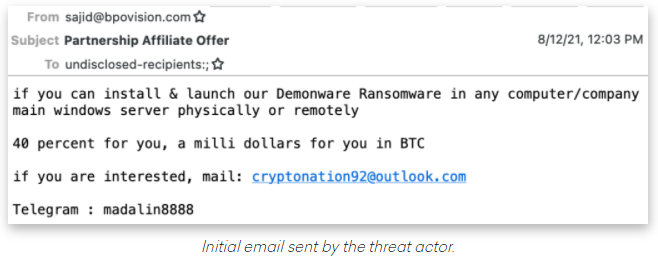
In August, KrebsOnSecurity warned that scammers were contacting people and asking them to unleash ransomware inside their employer’s network, in exchange for a percentage of any ransom amount paid by the victim company. This week, authorities in Nigeria arrested a suspect in connection with the scheme — a young man who said he was trying to save up money to help fund a new social network.

Image: Abnormal Security.

The brazen approach targeting disgruntled employees was first spotted by threat intelligence firm Abnormal Security, which described what happened after they adopted a fake persona and responded to the proposal in the screenshot above.

“According to this actor, he had originally intended to send his targets—all senior-level executives—phishing emails to compromise their accounts, but after that was unsuccessful, he pivoted to this ransomware pretext,” Abnormal’s Crane Hassold wrote.

Abnormal Security documented how it tied the email back to a Nigerian man who acknowledged he was trying to save up money to help fund a new social network he is building called Sociogram. In June 2021, the Nigerian government officially placed an indefinite ban on Twitter, restricting it from operating in Nigeria after the social media platform deleted tweets by the Nigerian president.

Reached via LinkedIn, Sociogram founder Oluwaseun Medayedupin asked to have his startup’s name removed from the story, although he did not respond to questions about whether there were any inaccuracies in Hassold’s report.

“Please don’t harm Sociogram’s reputation,” Medayedupin pleaded. “I beg you as a promising young man.”

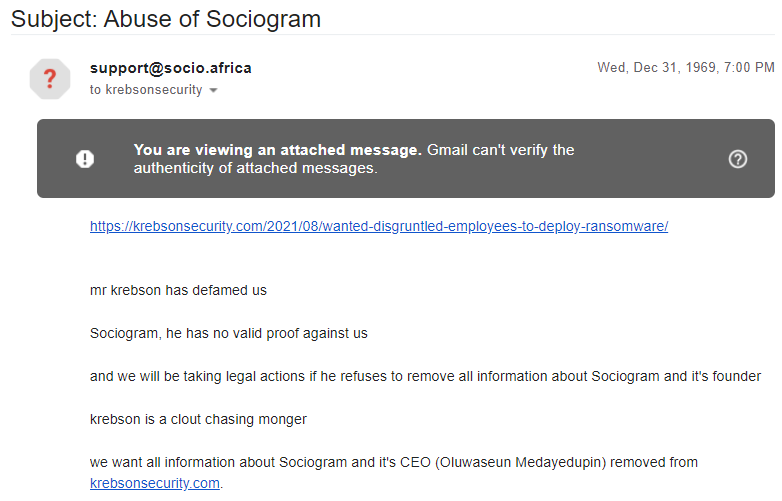
After he deleted his LinkedIn profile, I received the following message through the “contact this domain holder” link at KrebsOnSecurity’s domain registrar [curiously, the date of that missive reads “Dec. 31, 1969.”]. Apparently, Mr. Krebson is a clout-chasing monger.

A love letter from the founder of the ill-fated Sociogram.

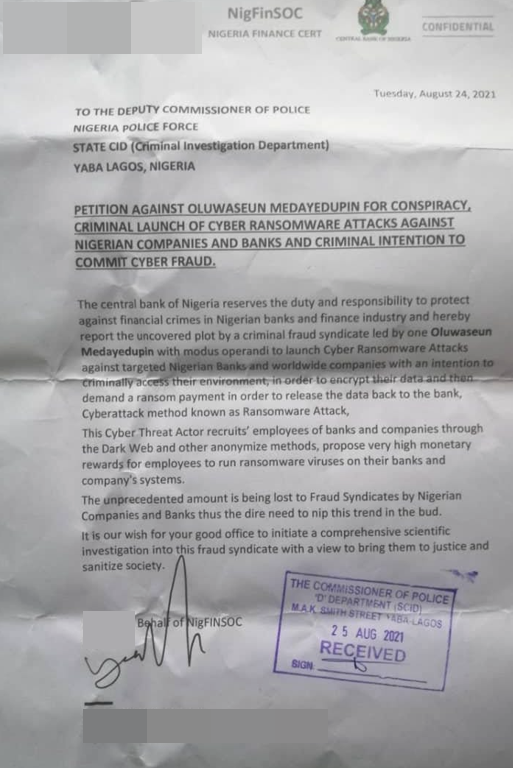
Mr. Krebson also heard from an investigator representing the Nigeria Finance CERT on behalf of the Central Bank Of Nigeria. While the Sociogram founder’s approach might seem amateurish to some, the financial community in Nigeria did not consider it a laughing matter.

On Friday, police in Lagos arrested Medayedupin. The investigator says formal charges will be levied against the defendant sometime this week.


KrebsOnSecurity spoke with a fraud investigator who is performing the forensic analysis of the devices seized from Medayedupin’s home. The investigator spoke on condition of anonymity out of concern for his physical safety.

The investigator — we’ll call him “George” — said the 23-year-old Medayedupin lives with his extended family in an extremely impoverished home, and that the young man told investigators he’d just graduated from college but turned to cybercrime at first with ambitions of merely scamming the scammers.

George’s team confirmed that Medayedupin had around USD $2,000 to his name, which he’d recently stolen from a group of Nigerian fraudsters who were scamming people for gift cards. Apparently, he admitted to creating a phishing website that tricked a member of this group into providing access to the money they’d made from their scams.

Medayedupin reportedly told investigators that for almost a week after he started emailing his ransom-your-employer scheme, nobody took him up on the offer. But after his name appeared in the news media, he received thousands of inquiries from people interested in his idea.

George described Medayedupin as smart, a quick learner, and fairly dedicated to his work.

“He seems like he could be a fantastic [employee] for a company,” George said. “But there is no employment here, so he chose to do this.”

What’s interesting about this case — and indeed likely why anyone thought this guy worthy of arrest — is that the Nigerian authorities were fairly swift to take action when a domestic cybercriminal raised the specter of causing financial losses for its own banks.

After all, the majority of the cybercrime that originates from Africa — think romance scams, BEC fraud, and unemployment/pandemic loan fraud — does not target Nigerian citizens, nor does it harm African banks. On the contrary: This activity pumps a great deal of Western money into Nigeria.

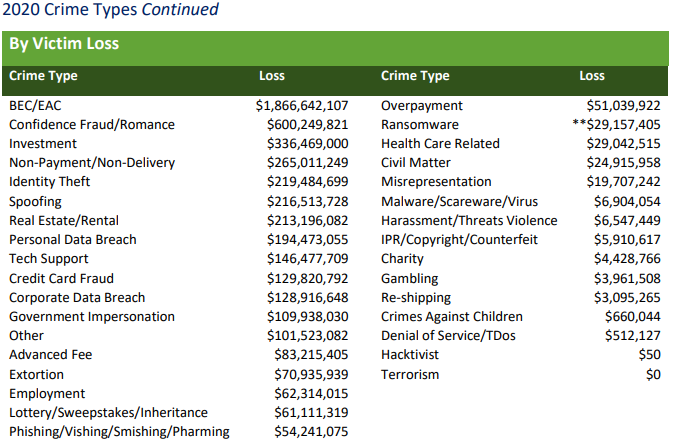
How much money are we talking about? The financial losses from these scams dwarf other fraud categories — such as identity theft or credit card fraud. According to the FBI’s Internet Crime Complaint Center (IC3), consumers and businesses reported more than $4.2 billion in losses tied to cybercrime in 2020, and BEC fraud and romance scams alone accounted for nearly 60 percent of those losses.

Source: FBI/IC3 2020 Internet Crime Report.

If the influx of a few billion US dollars into the Nigerian economy each year from cybercrime seems somehow insignificant, consider that (according to George) the average police officer in the country makes the equivalent of less than USD $100 a month.

Ronnie Tokazowski is a threat researcher at Agari, a security firm that has closely tracked many of the groups behind BEC scams. Tokazowski maintains he has been one of the more vocal proponents of the idea that trying to fight these problems by arresting those involved is something of a Sisyphean task, and that it makes way more sense to focus on changing the economic realities in places like Nigeria.

Nigeria has the world’s second-highest unemployment rate — rising from 27.1 percent in 2019 to 33 percent in 2020, according to the National Bureau of Statistics. The nation also is among the world’s most corrupt, according to 2020 findings from Transparency International.

“Education is definitely one piece, as raising awareness is hands down the best way to get ahead of this,” Tokazowski said, in a June 2021 interview. “But we also need to think about ways to create more business opportunities there so that people who are doing this to put food on the table have more legitimate opportunities. Unfortunately, thanks to the level of corruption of government officials, there are a lot of cultural reasons that fighting this type of crime at the source is going to be difficult.”

source https://krebsonsecurity.com/2021/11/arrest-in-ransom-your-employer-email-scheme/

The ‘Zelle Fraud’ Scam: How it Works, How to Fight Back

One of the more common ways cybercriminals cash out access to bank accounts involves draining the victim’s funds via Zelle, a “peer-to-peer” (P2P) payment service used by many financial institutions that allows customers to quickly send cash to friends and family. Naturally, a great deal of phishing schemes that precede these bank account takeovers begin with a spoofed text message from the target’s bank warning about a suspicious Zelle transfer. What follows is a deep dive into how this increasingly clever Zelle fraud scam typically works, and what victims can do about it.

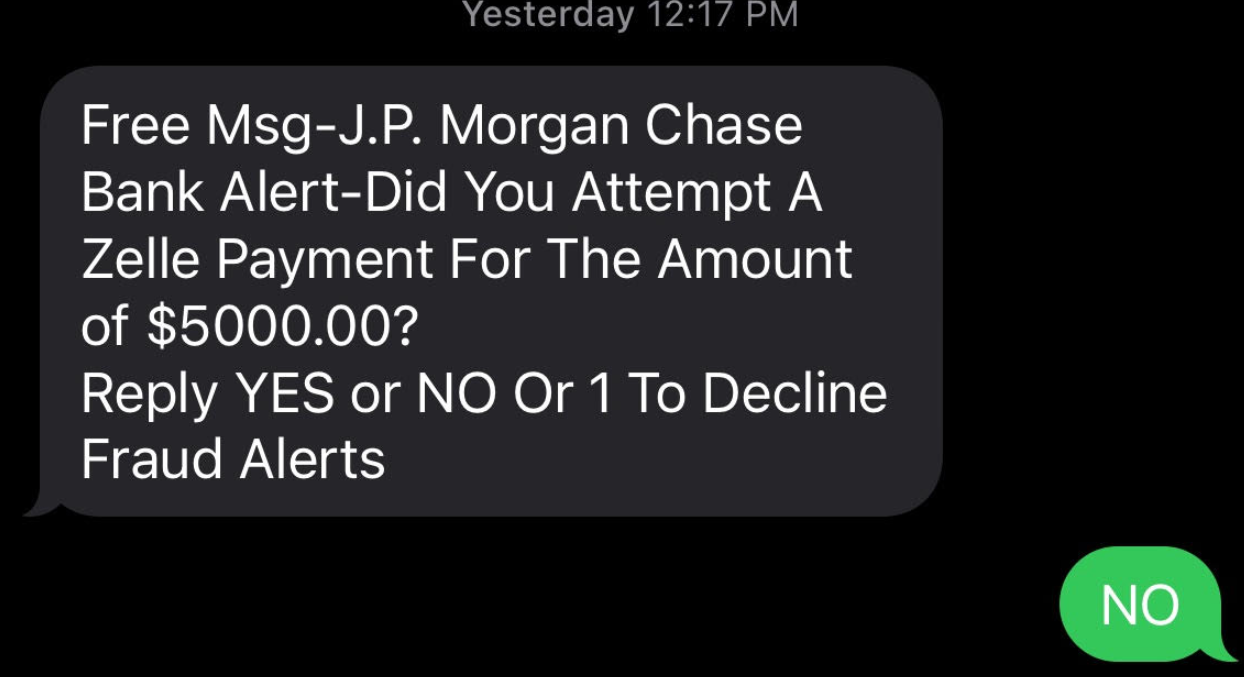
Last week’s story warned that scammers are blasting out text messages about suspicious bank transfers as a pretext for immediately calling and scamming anyone who responds via text. Here’s what one of those scam messages looks like:

Anyone who responds “yes,” “no” or at all will very soon after receive a phone call from a scammer pretending to be from the financial institution’s fraud department. The caller’s number will be spoofed so that it appears to be coming from the victim’s bank.

To verify the identity of the customer, the fraudster asks for their online banking username, and then tells the customer to read back a passcode sent via text or email. In reality, the fraudster initiates a transaction — such as the “forgot password” feature on the financial institution’s site — which is what generates the 2-step authentication passcode delivered to the member.

Ken Otsuka is a senior risk consultant at CUNA Mutual Group, an insurance company that provides financial services to credit unions. Otsuka said a phone fraudster typically will say something like, “Before I get into the details, I need to verify that I’m speaking to the right person. What’s your username?”

“In the background, they’re using the username with the forgot password feature, and that’s going to generate one of these two-factor authentication passcodes,” Otsuka said. “Then the fraudster will say, ‘I’m going to send you the password and you’re going to read it back to me over the phone.’”

The fraudster then uses the code to complete the password reset process, and then changes the victim’s online banking password. The fraudster then uses Zelle to transfer the victim’s funds to others.


An important aspect of this scam is that the fraudsters never even need to know or phish the victim’s password. By sharing their username and reading back the one-time code sent to them via email, the victim is allowing the fraudster to reset their online banking password.

Otsuka said in far too many account takeover cases, the victim has never even heard of Zelle, nor did they realize they could move money that way.

“The thing is, many credit unions offer it by default as part of online banking,” Otsuka said. “Members don’t have to request to use Zelle. It’s just there, and with a lot of members targeted in these scams, although they’d legitimately enrolled in online banking, they’d never used Zelle before.” [Curious if your financial institution uses Zelle? Check out their partner list here].

Otsuka said credit unions offering other peer-to-peer banking products have also been targeted, but that fraudsters prefer to target Zelle due to the speed of the payments.

“The fraud losses can escalate quickly due to the sheer number of members that can be targeted on a single day over the course of consecutive days,” Otsuka said.

To combat this scam Zelle introduced out-of-band authentication with transaction details. This involves sending the member a text containing the details of a Zelle transfer – payee and dollar amount – that is initiated by the member. The member must authorize the transfer by replying to the text.

Unfortunately, Otsuka said, the scammers are defeating this layered security control as well.

“The fraudsters follow the same tactics except they may keep the members on the phone after getting their username and 2-step authentication passcode to login to the accounts,” he said. “The fraudster tells the member they will receive a text containing details of a Zelle transfer and the member must authorize the transaction under the guise that it is for reversing the fraudulent debit card transaction(s).”

In this scenario, the fraudster actually enters a Zelle transfer that triggers the following text to the member, which the member is asked to authorize: For example:

“Send $200 Zelle payment to Boris Badenov? Reply YES to send, NO to cancel. ABC Credit Union . STOP to end all messages.”

“My team has consulted with several credit unions that rolled Zelle out or our planning to introduce Zelle,” Otsuka said. “We found that several credit unions were hit with the scam the same month they rolled it out.”

The upshot of all this is that many financial institutions will claim they’re not required to reimburse the customer for financial losses related to these voice phishing schemes. Bob Sullivan, a veteran journalist who writes about fraud and consumer issues, says in many cases banks are giving customers incorrect and self-serving opinions after the thefts.

“Consumers — many who never ever realized they had a Zelle account – then call their banks, expecting they’ll be covered by credit-card-like protections, only to face disappointment and in some cases, financial ruin,” Sullivan wrote in a recent Substack post. “Consumers who suffer unauthorized transactions are entitled to Regulation E protection, and banks are required to refund the stolen money. This isn’t a controversial opinion, and it was recently affirmed by the CFPB here. If you are reading this story and fighting with your bank, start by providing that link to the financial institution.”

“If a criminal initiates a Zelle transfer — even if the criminal manipulates a victim into sharing login credentials — that fraud is covered by Regulation E, and banks should restore the stolen funds,” Sullivan said. “If a consumer initiates the transfer under false pretenses, the case for redress is more weak.”

Sullivan notes that the Consumer Financial Protection Bureau (CFPB) recently announced it was conducting a probe into companies operating payments systems in the United States, with a special focus on platforms that offer fast, person-to-person payments.

“Consumers expect certain assurances when dealing with companies that move their money,” the CFPB said in its Oct. 21 notice. “They expect to be protected from fraud and payments made in error, for their data and privacy to be protected and not shared without their consent, to have responsive customer service, and to be treated equally under relevant law. The orders seek to understand the robustness with which payment platforms prioritize consumer protection under law.”

Anyone interested in letting the CFPB know about a fraud scam that abused a P2P payment platform like Zelle, Cashapp, or Venmo, for example, should send an email describing the incident to BigTechPaymentsInquiry@cfpb.gov. Be sure to include Docket No. CFPB-2021-0017 in the subject line of the message.

In the meantime, remember the mantra: Hang up, Look Up, and Call Back. If you receive a call from someone warning about fraud, hang up. If you believe the call might be legitimate, look up the number of the organization supposedly calling you, and call them back.

source https://krebsonsecurity.com/2021/11/the-zelle-fraud-scam-how-it-works-how-to-fight-back/

Tech CEO Pleads to Wire Fraud in IP Address Scheme

The CEO of a South Carolina technology firm has pleaded guilty to 20 counts of wire fraud in connection with an elaborate network of phony companies set up to obtain more than 735,000 Internet Protocol (IP) addresses from the nonprofit organization that leases the digital real estate to entities in North America.

In 2018, the American Registry for Internet Numbers (ARIN), which oversees IP addresses assigned to entities in the U.S., Canada, and parts of the Caribbean, notified Charleston, S.C. based Micfo LLC that it intended to revoke 735,000 addresses.

ARIN said they wanted the addresses back because the company and its owner — 38-year-old Amir Golestan — had obtained them under false pretenses. A global shortage of IPv4 addresses has massively driven up the price of these resources over the years: At the time of this dispute, a single IP address could fetch between $15 and $25 on the open market.

Micfo responded by suing ARIN to try to stop the IP address seizure. Ultimately, ARIN and Micfo settled the dispute in arbitration, with Micfo returning most of the addresses that it hadn’t already sold.

But the legal tussle caught the attention of South Carolina U.S. Attorney Sherri Lydon, who in May 2019 filed criminal wire fraud charges against Golestan, alleging he’d orchestrated a network of shell companies and fake identities to prevent ARIN from knowing the addresses were all going to the same buyer.

Each of those shell companies involved the production of notarized affidavits in the names of people who didn’t exist. As a result, Lydon was able to charge Golestan with 20 counts of wire fraud — one for each payment made by the phony companies that bought the IP addresses from ARIN.

Amir Golestan, CEO of Micfo.

On Nov. 16, just two days into his trial, Golestan changed his “not guilty” plea, agreeing to plead guilty to all 20 wire fraud charges. KrebsOnSecurity interviewed Golestan at length earlier this year, but he has not responded to requests for comment on his plea change.

By 2013, a number of Micfo’s customers had landed on the radar of Spamhaus, a group that many network operators rely upon to help block junk email. But shortly after Spamhaus began blocking many of Micfo’s IP address ranges, Micfo shifted gears and began reselling IP addresses mainly to companies marketing “virtual private networking” or VPN services that help customers hide their real IP addresses online.

In a 2020 interview, Golestan told KrebsOnSecurity that Micfo was at one point responsible for brokering roughly 40 percent of the IP addresses used by the world’s largest VPN providers. Throughout that conversation, Golestan maintained his innocence, even as he explained that the creation of the phony companies was necessary to prevent entities like Spamhaus from interfering with its business going forward.

Stephen Ryan, an attorney representing ARIN, said Golestan changed his plea after the court heard from a former Micfo employee and public notary who described being instructed by Golestan to knowingly certify false documents.

“Her testimony made him appear bullying and unsavory,” Ryan said. “Because it turned out he had also sued her to try to prevent her from disclosing the actions he’d directed.”

Golestan’s rather sparse plea agreement (first reported by The Wall Street Journal) does not specify any sort of leniency he might gain from prosecutors for agreeing to end the trial prematurely. But it’s worth noting that a conviction on a single act of wire fraud can result in fines and up to 20 years in prison.

The courtroom drama comes as ARIN’s counterpart in Africa is embroiled in a similar, albeit much larger dispute over millions of wayward African IP addresses. In July 2021, the African Network Information Centre (AFRINIC) confiscated more than six million IP addresses from Cloud Innovation, a company incorporated in the African offshore entity haven of Seychelles (pronounced, quite aptly — “say shells”).

AFRINIC revoked the addresses — valued at around USD $120 million — after an internal review found that most of them were being used outside of Africa by various entities in China and Hong Kong. Like ARIN, AFRINIC’s policies require those who are leasing IP addresses to demonstrate that the addresses are being used by entities within their geographic region.

But just weeks later, Cloud Innovation convinced a judge in AFRINIC’s home country of Mauritius to freeze $50 million in AFRINIC bank accounts, arguing that AFRINIC had “acted in bad faith and upon frivolous grounds to tarnish the reputation of Cloud Innovation,” and that it was obligated to protect its customers from disruption of service.

That financial freeze has since been partially lifted, but the legal and financial wrangling between AFRINIC and Cloud Innovation continues. The company’s CEO is also suing the CEO and board chair of AFRINIC in an $80 million defamation case.

Ron Guilmette is a security researcher who spent several years tracing how tens of millions of dollars worth of AFRINIC IP addresses were privately sold to address brokers by a former AFRINIC executive. Guilmette said Golestan’s guilty plea is a positive sign for AFRINIC, ARIN and the three other Regional Internet Registries (RIRs).

“It’s good news for the rule of law,” Guilmette said. “It has implications for the AFRINIC case because it reaffirms the authority of all RIRs, including AFRINIC and ARIN.”

source https://krebsonsecurity.com/2021/11/tech-ceo-pleads-to-wire-fraud-in-ip-address-scheme/

Hoax Email Blast Abused Poor Coding in FBI Website

The Federal Bureau of Investigation (FBI) confirmed today that its fbi.gov domain name and Internet address were used to blast out thousands of fake emails about a cybercrime investigation. According to an interview with the person who claimed responsibility for the hoax, the spam messages were sent by abusing insecure code in an FBI online portal designed to share information with state and local law enforcement authorities.

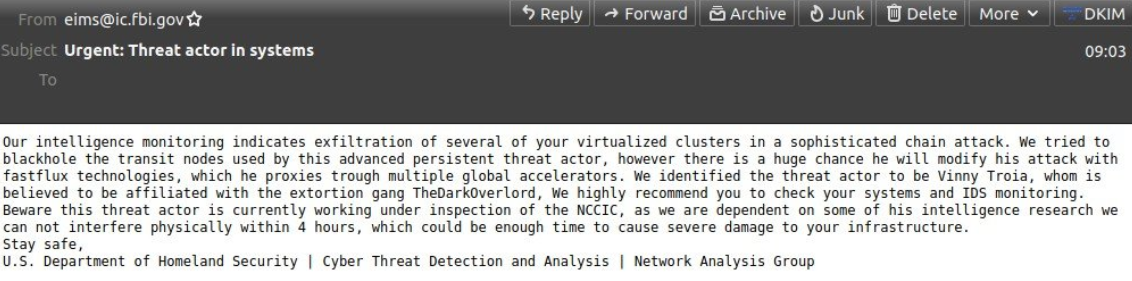
The phony message sent late Thursday evening via the FBI’s email system. Image: Spamhaus.org

Late in the evening of Nov. 12 ET, tens of thousands of emails began flooding out from the FBI address eims@ic.fbi.gov, warning about fake cyberattacks. Around that time, KrebsOnSecurity received an email from the same email address.

“Hi its pompompurin,” read the message. “Check headers of this email it’s actually coming from FBI server. I am contacting you today because we located a botnet being hosted on your forehead, please take immediate action thanks.”

A review of the email’s message headers indicated it had indeed been sent by the FBI, and from the agency’s own Internet address. The domain in the “from:” portion of the email I received — eims@ic.fbi.gov — corresponds to the FBI’s Criminal Justice Information Services division (CJIS).

According to the Department of Justice, “CJIS manages and operates several national crime information systems used by the public safety community for both criminal and civil purposes. CJIS systems are available to the criminal justice community, including law enforcement, jails, prosecutors, courts, as well as probation and pretrial services.”

In response to a request for comment, the FBI confirmed the unauthorized messages, but declined to offer further information.

“The FBI and CISA [the Cybersecurity and Infrastructure Security Agency] are aware of the incident this morning involving fake emails from an @ic.fbi.gov email account,” reads the FBI statement. “This is an ongoing situation and we are not able to provide any additional information at this time. The impacted hardware was taken offline quickly upon discovery of the issue. We continue to encourage the public to be cautious of unknown senders and urge you to report suspicious activity to http://www.ic3.gov or http://www.cisa.gov.”

In an interview with KrebsOnSecurity, Pompompurin said the hack was done to point out a glaring vulnerability in the FBI’s system.

“I could’ve 1000% used this to send more legit looking emails, trick companies into handing over data etc.,” Pompompurin said. “And this would’ve never been found by anyone who would responsibly disclose, due to the notice the feds have on their website.”

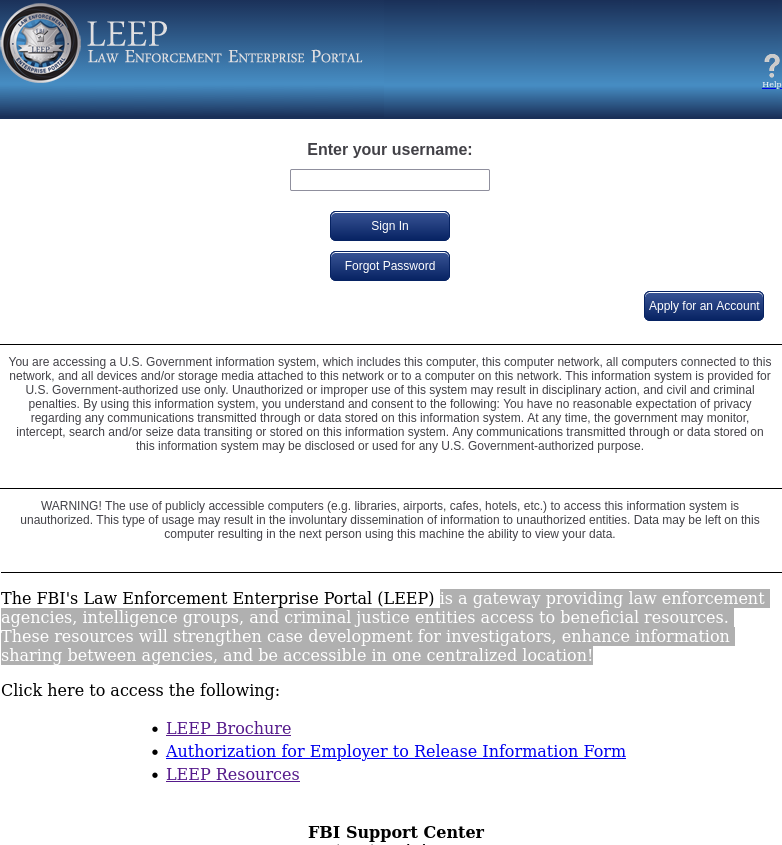
Pompompurin says the illicit access to the FBI’s email system began with an exploration of its Law Enforcement Enterprise Portal (LEEP), which the agency describes as “a gateway providing law enforcement agencies, intelligence groups, and criminal justice entities access to beneficial resources.”

The FBI’s Law Enforcement Enterprise Portal (LEEP).

“These resources will strengthen case development for investigators, enhance information sharing between agencies, and be accessible in one centralized location!,” the FBI’s site enthuses.

Until sometime this morning, the LEEP portal allowed anyone to apply for an account. Helpfully, step-by-step instructions for registering a new account on the LEEP portal also are available from the DOJ’s website. [It should be noted that “Step 1” in those instructions is to visit the site in Microsoft’s Internet Explorer, an outdated web browser that even Microsoft no longer encourages people to use for security reasons.]

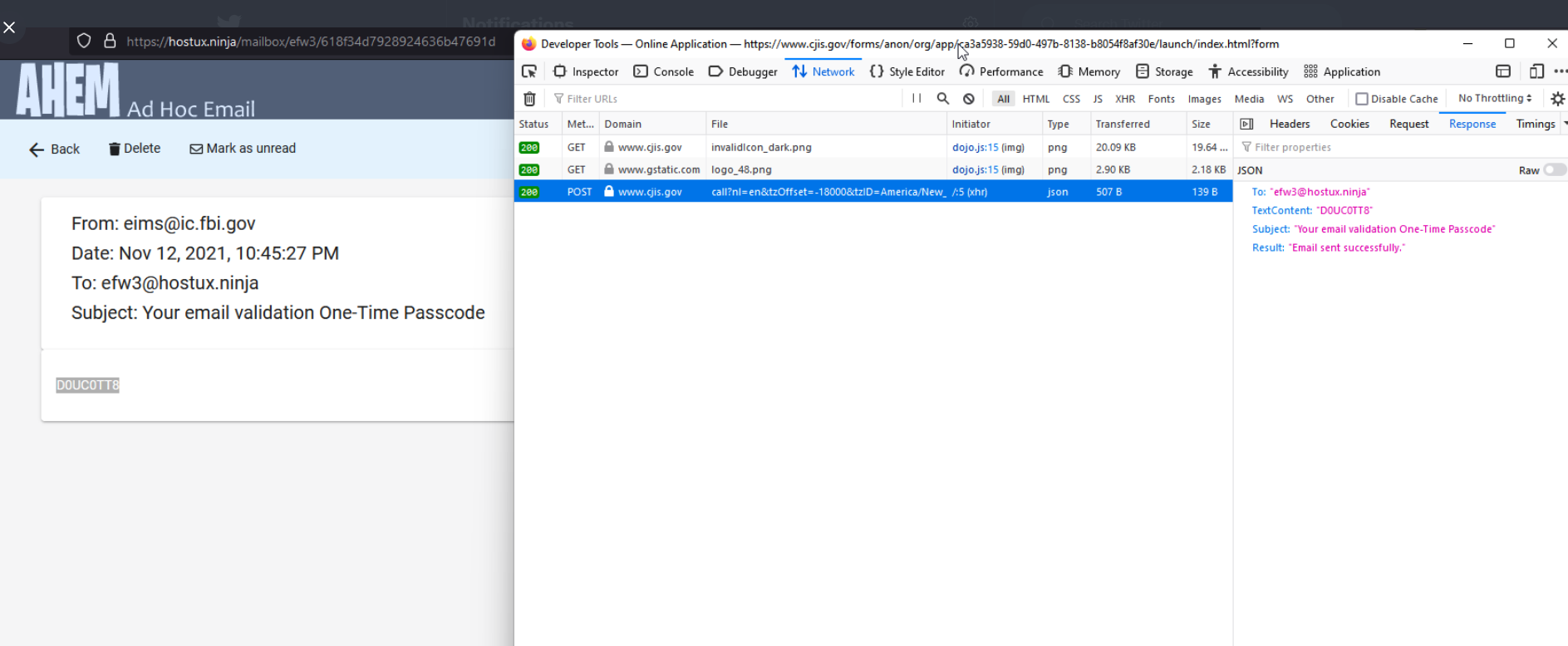
Much of that process involves filling out forms with the applicant’s personal and contact information, and that of their organization. A critical step in that process says applicants will receive an email confirmation from eims@ic.fbi.gov with a one-time passcode — ostensibly to validate that the applicant can receive email at the domain in question.

But according to Pompompurin, the FBI’s own website leaked that one-time passcode in the HTML code of the web page.

A screenshot shared by Pompompurin. Image: KrebOnSecurity.com

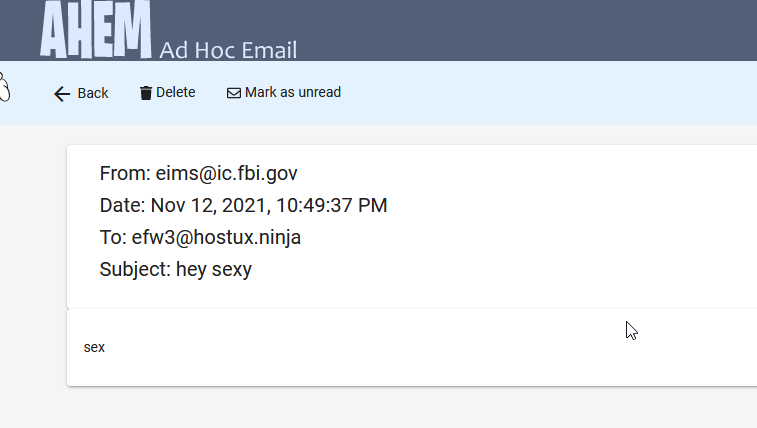
Pompompurin said they were able to send themselves an email from eims@ic.fbi.gov by editing the request sent to their browser and changing the text in the message’s “Subject” field and “Text Content” fields.

A test email using the FBI’s communications system that Pompompurin said they sent to a disposable address.

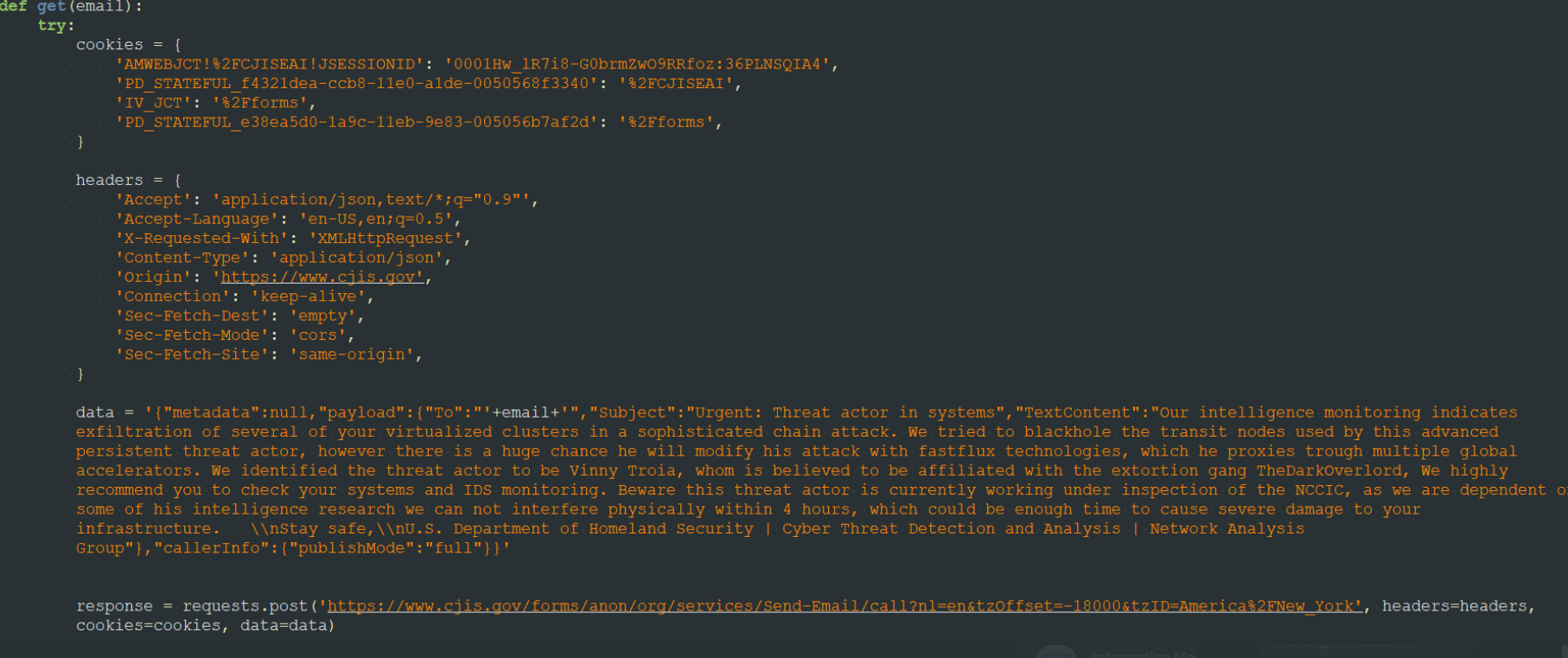
“Basically, when you requested the confirmation code [it] was generated client-side, then sent to you via a POST Request,” Pompompurin said. “This post request includes the parameters for the email subject and body content.”

Pompompurin said a simple script replaced those parameters with his own message subject and body, and automated the sending of the hoax message to thousands of email addresses.

A screenshot shared by Pompompurin, who says it shows how he was able to abuse the FBI’s email system to send a hoax message.

“Needless to say, this is a horrible thing to be seeing on any website,” Pompompurin said. “I’ve seen it a few times before, but never on a government website, let alone one managed by the FBI.”

As we can see from the first screenshot at the top of this story, Pompompurin’s hoax message is an attempt to smear the name of Vinny Troia, the founder of the dark web intelligence companies NightLion and Shadowbyte.

“Members of the RaidForums hacking community have a long standing feud with Troia, and commonly deface websites and perform minor hacks where they blame it on the security researcher,” Ionut Illascu wrote for BleepingComputer. “Tweeting about this spam campaign, Vinny Troia hinted at someone known as ‘pompompurin,’ as the likely author of the attack. Troia says the individual has been associated in the past with incidents aimed at damaging the security researcher’s reputation.”

Troia’s work as a security researcher was the subject of a 2018 article here titled, “When Security Researchers Pose as Cybercrooks, Who Can Tell the Difference?” No doubt this hoax was another effort at blurring that distinction.

source https://krebsonsecurity.com/2021/11/hoax-email-blast-abused-poor-coding-in-fbi-website/

SMS About Bank Fraud as a Pretext for Voice Phishing

Most of us have probably heard the term “smishing” — which is a portmanteau for traditional phishing scams sent through SMS text messages. Smishing messages usually include a link to a site that spoofs a popular bank and tries to siphon personal information. But increasingly, phishers are turning to a hybrid form of smishing — blasting out linkless text messages about suspicious bank transfers as a pretext for immediately calling and scamming anyone who responds via text.

KrebsOnSecurity recently heard from a reader who said his daughter received an SMS that said it was from her bank, and inquired whether she’d authorized a $5,000 payment from her account. The message said she should reply “Yes” or “No,” or 1 to decline future fraud alerts.

Since this seemed like a reasonable and simple request — and she indeed had an account at the bank in question — she responded, “NO.”

Seconds later, her mobile phone rang.

“When she replied ‘no,’ someone called immediately, and the caller ID said ‘JP Morgan Chase’,” reader Kris Stevens told KrebsOnSecurity. “The person on the phone said they were from the fraud department and they needed to help her secure her account but needed information from her to make sure they were talking to the account owner and not the scammer.”

Thankfully, Stevens said his daughter had honored the gold rule regarding incoming phone calls about fraud: When In Doubt, Hang up, Look up, and Call Back.

“She knows the drill so she hung up and called Chase, who confirmed they had not called her,” he said. “What was different about this was it was all very smooth. No foreign accents, the pairing of the call with the text message, and the fact that she does have a Chase account.”

The remarkable aspect of these phone-based phishing scams is typically the attackers never even try to log in to the victim’s bank account. The entirety of the scam takes place over the phone.

We don’t know what the fraudsters behind this clever hybrid SMS/voice phishing scam intended to do with the information they might have coaxed from Stevens’ daughter. But in previous stories and reporting on voice phishing schemes, the fraudsters used the phished information to set up new financial accounts in the victim’s name, which they then used to receive and forward large wire transfers of stolen funds.

Even many security-conscious people tend to focus on protecting their online selves, while perhaps discounting the threat from less technically sophisticated phone-based scams. In 2020 I told the story of “Mitch” — the tech-savvy Silicon Valley executive who got voice phished after he thought he’d turned the tables on the scammers.

Unlike Stevens’ daughter, Mitch didn’t hang up with the suspected scammers. Rather, he put them on hold. Then Mitch called his bank on the other line and asked if their customer support people were in fact engaged in a separate conversation with him over the phone.

The bank replied that they were indeed speaking to the same customer on a different line at that very moment. Feeling better, Mitch got back on the line with the scammers. What Mitch couldn’t have known at that point was that a member of the fraudster’s team simultaneously was impersonating him on the phone with the bank’s customer service people.

So don’t be Mitch. Don’t try to outsmart the crooks. Just remember this anti-fraud mantra, and maybe repeat it a few times in front of your friends and family: When in doubt, hang up, look up, and call back. If you believe the call might be legitimate, look up the number of the organization supposedly calling you, and call them back.

And I suppose the same time-honored advice about not replying to spam email goes doubly for unsolicited text messages: When in doubt, it’s best not to respond.

source https://krebsonsecurity.com/2021/11/sms-about-bank-fraud-as-a-pretext-for-voice-phishing/

Microsoft Patch Tuesday, November 2021 Edition

Microsoft Corp. today released updates to quash at least 55 security bugs in its Windows operating systems and other software. Two of the patches address vulnerabilities that are already being used in active attacks online, and four of the flaws were disclosed publicly before today — potentially giving adversaries a head start in figuring out how to exploit them.

Among the zero-day bugs is CVE-2021-42292, a “security feature bypass” problem with Microsoft Excel versions 2013-2021 that could allow attackers to install malicious code just by convincing someone to open a booby-trapped Excel file (Microsoft says Mac versions of Office are also affected, but several places are reporting that Office for Mac security updates aren’t available yet).

Microsoft’s revised, more sparse security advisories don’t offer much detail on what exactly is being bypassed in Excel with this flaw. But Dustin Childs over at Trend Micro’s Zero Day Initiative says the vulnerability is likely due to loading code that should be limited by a user prompt — such as a warning about external content or scripts — but for whatever reason that prompt does not appear, thus bypassing the security feature.

The other critical flaw patched today that’s already being exploited in the wild is CVE-2021-42321, yet another zero-day in Microsoft Exchange Server. You may recall that earlier this year a majority of the world’s organizations running Microsoft Exchange Servers were hit with four zero-day attacks that let thieves install backdoors and siphon email.

As Exchange zero-days go, CVE-2021-42321 appears somewhat mild by comparison. Unlike the four zero-days involved in the mass compromise of Exchange Server systems earlier this year, CVE-2021-42321 requires the attacker to be already authenticated to the target’s system. Microsoft has published a blog post/FAQ about the Exchange zero-day here.

Two of the vulnerabilities that were disclosed prior to today’s patches are CVE-2021-38631 and CVE-2021-41371. Both involve weaknesses in Microsoft’s Remote Desktop Protocol (RDP, Windows’ built-in remote administration tool) running on Windows 7 through Windows 11 systems, and on Windows Server 2008-2019 systems. The flaws let an attacker view the RDP password for the vulnerable system.

“Given the interest that cybercriminals — especially ransomware initial access brokers — have in RDP, it is likely that it will be exploited at some point,” said Allan Liska, senior security architect at Recorded Future.

Liska notes this month’s patch batch also brings us CVE-2021-38666, which is a Remote Code Execution vulnerability in the Windows RDP Client.

“This is a serious vulnerability, labeled critical by Microsoft,” Liska added. “In its Exploitability Assessment section Microsoft has labelled this vulnerability ‘Exploitation More Likely.’ This vulnerability affects Windows 7 – 11 and Windows Server 2008 – 2019 and should be a high priority for patching.”

For most Windows home users, applying security updates is not a big deal. By default, Windows checks for available updates and is fairly persistent in asking you to install them and reboot, etc. It’s a good idea to get in the habit of patching on a monthly basis, ideally within a few days of patches being released.

But please do not neglect to backup your important files — before patching if possible. Windows 10 has some built-in tools to help you do that, either on a per-file/folder basis or by making a complete and bootable copy of your hard drive all at once. There are also a number of excellent third-party products that make it easy to duplicate your entire hard drive on a regular basis, so that a recent, working image of the system is always available for restore.

And if you wish to ensure Windows has been set to pause updating so you can back up your files and/or system before the operating system decides to reboot and install patches on its own schedule, see this guide.

If you experience any glitches or problems installing patches this month, please consider leaving a comment about it below; there’s a better-than-even  chance other readers have experienced the same and may offer useful tips or suggestions.

Further reading:

SANS Internet Storm Center rundown on each of the 55 patches released today, indexed by exploitability and severity, with links to each advisory.

source https://krebsonsecurity.com/2021/11/microsoft-patch-tuesday-november-2021-edition/

REvil Ransom Arrest, $6M Seizure, and $10M Reward

The U.S. Department of Justice today announced the arrest of Ukrainian man accused of deploying ransomware on behalf of the REvil ransomware gang, a Russian-speaking cybercriminal collective that has extorted hundreds of millions from victim organizations. The DOJ also said it had seized $6.1 million in cryptocurrency sent to another REvil affiliate, and that the U.S. Department of State is now offering up to $10 million for the name or location any key REvil leaders, and up to $5 million for information on REvil affiliates.

If it sounds unlikely that a normal Internet user could make millions of dollars unmasking the identities of REvil gang members, take heart and consider that the two men indicted as part this law enforcement action do not appear to have done much to separate their cybercriminal identities from their real-life selves.

Exhibit #1: Yaroslav Vasinskyi, the 22-year-old Ukrainian national accused of being REvil Affiliate #22. Vasinskyi was arrested Oct. 8 in Poland, which maintains an extradition treaty with the United States. Prosecutors say Vasinskyi was involved in a number of REvil ransomware attacks, including the July 2021 attack against Kaseya, Miami-based company whose products help system administrators manage large networks remotely.

Yaroslav Vasinksyi’s Vkontakte profile reads “If they tell you nasty things about me, believe every word.”

According to his indictment (PDF), Vasinskyi used a variety of hacker handles, including “Profcomserv” — the nickname behind an online service that floods phone numbers with junk calls for a fee. Prosecutors say Vasinskyi also used the monikers  “Yarik45,” and “Yaroslav2468.”

These last two nicknames correspond to accounts on several top cybercrime forums way back in 2013, where a user named “Yaroslav2468” registered using the email address yarik45@gmail.com.

That email address was used to register an account at Vkontakte (the Russian version of Facebook/Meta) under the profile name of “Yaroslav ‘sell the blood of css’ Vasinskyi.” Vasinskyi’s Vkontakte profile says his current city as of Oct. 3 was Lublin, Poland. Perhaps tauntingly, Vasinskyi’s profile page also lists the FBI’s 1-800 tip line as his contact phone number. He’s now in custody in Poland, awaiting extradition to the United States.

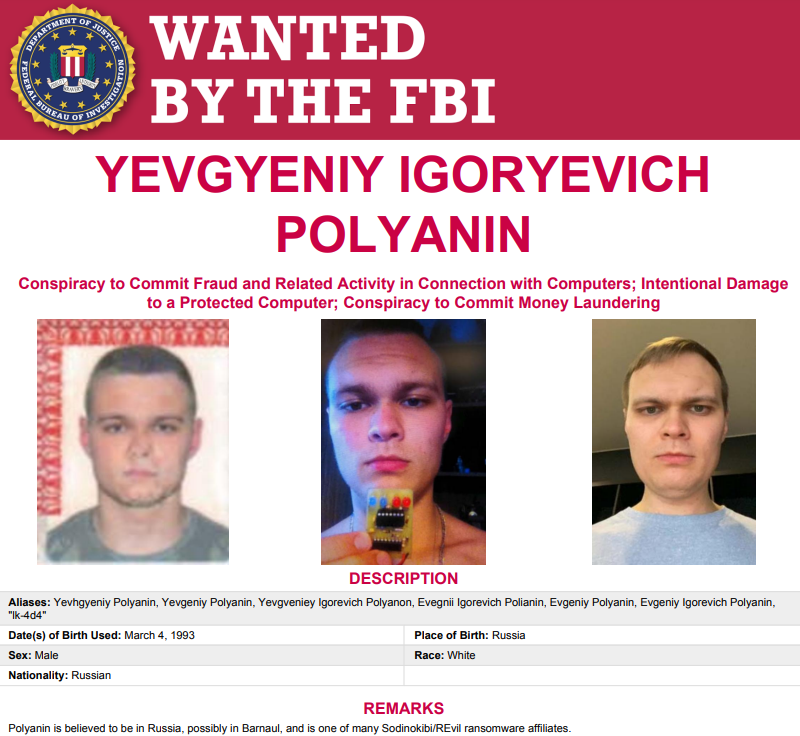
Exhibit #2: Yevgeniy Igorevich Polyanin, the 28-year-old Russian national who is alleged to be REvil Affiliate #23. The DOJ said it seized $6.1 million in funds traceable to alleged ransom payments received by Polyanin, and that the defendant had been involved in REvil ransomware attacks on multiple U.S. victim organizations.

The FBI’s wanted poster for Polyanin.

Polyanin’s indictment (PDF) says he also favored numerous hacker handles, including LK4D4, Damnating, Damn2life, Noolleds, and Antunpitre. Some of these nicknames go back more than a decade on Russian cybercrime forums, many of which have been hacked and relieved of their user databases over the years.

Among those was carder[.]su, and that forum’s database says a user by the name “Damnating” registered with the forum in 2008 using the email address damnating@yandex.ru. Sure enough, there is a Vkontakte profile tied to that email address under the name “Yevgeniy ‘damn’ Polyanin” from Barnaul, a city in the southern Siberian region of Russia.

The apparent lack of any real operational security by either of the accused here is so common that it is hardly remarkable. As exhibited by countless investigations in my Breadcrumbs story series, I have found that if a cybercriminal is active on multiple forums over more than 10 years, it is extremely likely that person has made multiple mistakes that make it relatively easy to connect his forum persona to his real-life identity.

As I explained earlier this year in The Wages of Password Re-use: Your Money or Your Life, it’s possible in many cases to make that connection thanks to two factors. The biggest is password re-use by cybercriminals (yes, crooks are lazy, too). The other is that cybercriminal forums, services, etc. get hacked just about as much as everyone else on the Internet, and when they do their user databases can reveal some very valuable secrets and connections.

In conjunction with today’s REvil action, the U.S. Department of State said it was offering a reward of up to $10 million for information leading to the identification or location of any individual holding a key leadership position in the REvil ransomware group. The department said it was also offering a reward of up to $5 million for information leading to the arrest and/or conviction in any country of any individual conspiring to participate in or attempting to participate in a REvil ransomware incident.

I really like this bounty offer and I hope we see more just like it for other ransomware groups. Because as we can see from the prosecutions of both Polyanin and Vasinskyi a lot of these guys simply aren’t too hard to find. Let the games begin.

source https://krebsonsecurity.com/2021/11/revil-ransom-arrest-6m-seizure-and-10m-reward/