Microsoft Patch Tuesday, March 2022 Edition

Microsoft on Tuesday released software updates to plug at least 70 security holes in its Windows operating systems and related software. For the second month running, there are no scary zero-day threats looming for Windows users, and relatively few “critical” fixes. And yet we know from experience that attackers are already trying to work out how to turn these patches into a roadmap for exploiting the flaws they fix. Here’s a look at the security weaknesses Microsoft says are most likely to be targeted first.

Greg Wiseman, product manager at Rapid7, notes that three vulnerabilities fixed this month have been previously disclosed, potentially giving attackers a head start in working out how to exploit them. Those include remote code execution bugs CVE-2022-24512, affecting .NET and Visual Studio, and CVE-2022-21990, affecting Remote Desktop Client. CVE-2022-24459 is a vulnerability in the Windows Fax and Scan service. All three publicly disclosed vulnerabilities are rated “Important” by Microsoft.

Just three of the fixes this month earned Microsoft’s most-dire “Critical” rating, which Redmond assigns to bugs that can be exploited to remotely compromise a Windows PC with little to no help from users. Two of those critical flaws involve Windows video codecs. Perhaps the most concerning critical bug quashed this month is CVE-2022-23277, a  remote code execution flaw affecting Microsoft Exchange Server.

“Thankfully, this is a post-authentication vulnerability, meaning attackers need credentials to exploit it,” Wiseman said. “Although passwords can be obtained via phishing and other means, this one shouldn’t be as rampantly exploited as the deluge of Exchange vulnerabilities we saw throughout 2021. Exchange administrators should still patch as soon as reasonably possible.”

CVE-2022-24508 is a remote code execution bug affecting Windows SMBv3, the technology that handles file sharing in Windows environments.

“This has potential for widespread exploitation, assuming an attacker can put together a suitable exploit,” Wiseman said. “Luckily, like this month’s Exchange vulnerabilities, this, too, requires authentication.”

Kevin Breen, director of cyber threat research at Immersive Labs, called attention to a trio of bugs fixed this month in the Windows Remote Desktop Protocol (RDP), which is a favorite target of ransomware groups.

CVE-2022-23285, CVE-2022-21990 and CVE-2022-24503 are a potential concern especially as this infection vector is commonly used by ransomware actors,” Breen said. “While exploitation is not trivial, requiring an attacker to set up bespoke infrastructure, it still presents enough of a risk to be a priority.”

March’s Patch Tuesday also brings an unusual update (CVE-2022-21967) that might just be the first security patch involving Microsoft’s Xbox device.

“This appears to be the first security patch impacting Xbox specifically,” said Dustin Childs from Trend Micro’s Zero Day Initiative. “There was an advisory for an inadvertently disclosed Xbox Live certificate back in 2015, but this seems to be the first security-specific update for the device itself.”

Also on Tuesday, Adobe released updates addressing six vulnerabilities in Adobe Photoshop, Illustrator and After Effects.

For a complete rundown of all patches released by Microsoft today and indexed by severity and other metrics, check out the always-useful Patch Tuesday roundup from the SANS Internet Storm Center. And it’s not a bad idea to hold off updating for a few days until Microsoft works out any kinks in the updates: AskWoody.com usually has the lowdown on any patches that may be causing problems for Windows users.

As always, please consider backing up your system or at least your important documents and data before applying system updates. And if you run into any problems with these patches, please drop a note about it here in the comments.

source https://krebsonsecurity.com/2022/03/microsoft-patch-tuesday-march-2022-edition/

Internet Backbone Giant Lumen Shuns .RU

Lumen Technologies, an American company that operates one of the largest Internet backbones and carries a significant percentage of the world’s Internet traffic, said today it will stop routing traffic for organizations based in Russia. Lumen’s decision comes just days after a similar exit by backbone provider Cogent, and amid a news media crackdown in Russia that has already left millions of Russians in the dark about what is really going on with their president’s war in Ukraine.

Monroe, La. based Lumen [NYSE: LUMN] (formerly CenturyLink) initially said it would halt all new business with organizations based in Russia, leaving open the possibility of continuing to serve existing clients there. But on Tuesday the company said it could no longer justify that stance.

“Life has taken a turn in Russia and Lumen is unable to continue to operate in this market,” Lumen said in a published statement. “The business services we provide are extremely small and very limited as is our physical presence. However, we are taking steps to immediately stop business in the region.”

“We decided to disconnect the network due to increased security risk inside Russia,” the statement continues. “We have not yet experienced network disruptions but given the increasingly uncertain environment and the heightened risk of state action, we took this move to ensure the security of our and our customers’ networks, as well as the ongoing integrity of the global Internet.”

According to Internet infrastructure monitoring firm Kentik, Lumen is the top international transit provider to Russia, with customers including Russian telecom giants Rostelecom and TTK, as well as all three major mobile operators (MTS, Megafon and VEON).

“A backbone carrier disconnecting its customers in a country the size of Russia is without precedent in the history of the internet and reflects the intense global reaction that the world has had over the invasion of Ukraine,” wrote Doug Madory, Kentik’s director of Internet analysis.

It’s not clear whether any other Internet backbone providers — some of which are based outside of the United States — will follow the lead of Lumen and Cogent. But Madory notes that as economic sanctions continue to exact a toll on Russia’s economy, its own telecommunications firms may have difficulty paying foreign transit providers for service.

Ukrainian leaders petitioned the Internet Corporation for Assigned Names and Numbers (ICANN) — the nonprofit organization charged with overseeing the global domain name system — to disconnect Russia’s top-level domain (.ru) from the Internet. ICANN respectfully declined that request, but many technology giants, including Amazon, Apple and Microsoft, have moved on their own to suspend new business in the country.

Meanwhile, Russia recently cracked down on the last remaining vestiges of a free press within its borders, passing a new law that threatens up to 15 years in jail for anyone who publishes content that refers to the conflict in Ukraine as a “war” or “invasion.”

As Neil MacFarquhar writes for The New York Times, what little coverage there is on Russian television networks about the invasion does not include any footage of the devastation wrought by Russian troops on the Ukrainian citizenry. At the same time, the Russian government has blocked Facebook and partly blocked Twitter, while other platforms like TikTok have suspended services in the country.

“To spend several days watching news broadcasts on the main state channels, as well as surveying state-controlled newspapers, is to witness the extent of the Kremlin’s efforts to sanitize its war with the Orwellian term ‘special military operation’ — and to make all news coverage align with that message,” MacFarquhar wrote.

The Washington Post, which was the first to report on Cogent’s decision last week, wrote that these independent actions by private tech companies collectively “will leave Russians more dependent than ever on government propaganda that already dominates the nation’s newspapers and broadcast stations, leaving few ways to access independent sources of news at a time when the country has entered a severe political crisis.”

In a blog post titled “Why the World Must Resist Calls to Undermine the Internet,” Internet Society President Andrew Sullivan said cutting a whole population off the Internet will stop disinformation coming from that population — but it also stops the flow of truth.

“Without the Internet, the rest of the world would not know of atrocities happening in other places,” Sullivan wrote. “And without the Internet, ordinary citizens of many countries wouldn’t know what was being carried out in their name. Our best hope, however dim, is that those supporting an aggressive regime will change their support. More information can help, even as disinformation circulates. We need a better understanding of what is and is not disinformation.”

There is another — perhaps less popular — camp, which holds that isolating Russia from the rest of the Internet might be THE thing that encourages more Russians to protest the war in Ukraine, and ultimately to take back control of their own country from its autocratic and kleptocratic leaders.

Not long after Russia invaded Ukraine, I heard from an old pen-pal in Ukraine: Sergey Vovnenko, a.k.a. “Flycracker,” a.k.a the convicted Ukrainian cybercriminal who once executed a plot to have me framed for heroin possession. Vovnenko did his time in a U.S. prison, left Fly behind, and we have since buried the hatchet. He’s now hunkered down in Lviv, Ukraine, which is serving as a major artery for refugees seeking shelter outside Ukraine’s borders.

These days, Vovnenko says he is working with many sympathetic hackers to fight the Russians online. Asked what he thought about the idea of Russia being isolated from the rest of the Internet, Vovnenko said it couldn’t happen soon enough given the Russian government’s new media blitz to cast the war in a patriotic light.

“I think they should be disconnected, maybe Russian people will rebel against Putin after that,” he said.

source https://krebsonsecurity.com/2022/03/internet-backbone-giant-lumen-shuns-ru/

Conti Ransomware Group Diaries, Part IV: Cryptocrime

Three stories here last week pored over several years’ worth of internal chat records stolen from the Conti ransomware group, the most profitable ransomware gang in operation today. The candid messages revealed how Conti evaded law enforcement and intelligence agencies, what it was like on a typical day at the Conti office, and how Conti secured the digital weaponry used in their attacks. This final post on the Conti conversations explores different schemes that Conti pursued to invest in and steal cryptocurrencies.

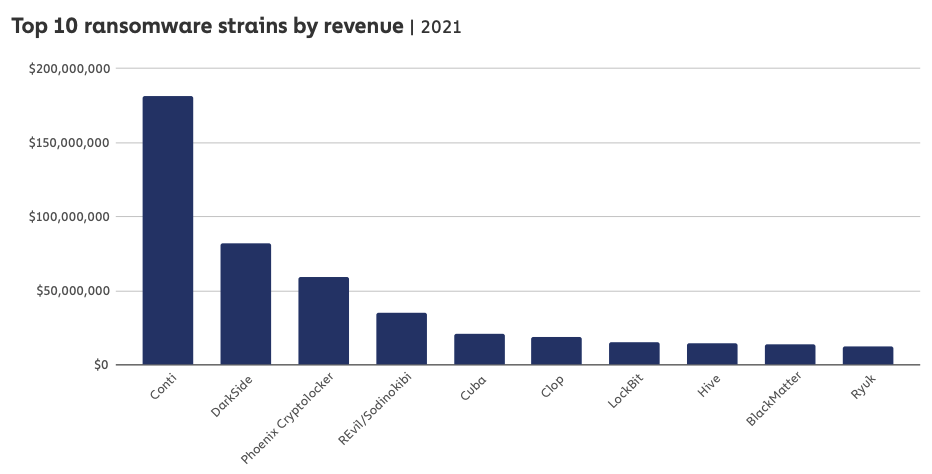
When you’re perhaps the most successful ransomware group around — Conti made $180 million last year in extortion payments, well more than any other crime group, according to Chainalysis — you tend to have a lot digital currency like Bitcoin.

This wealth allowed Conti to do things that regular investors couldn’t — such as moving the price of cryptocurrencies in one direction or the other. Or building a cryptocurrency platform and seeding it with loads of ill-gotten crypto from phantom investors.

One Conti top manager — aptly-named “Stern” because he incessantly needled Conti underlings to complete their assigned tasks — was obsessed with the idea of creating his own crypto scheme for cross-platform blockchain applications.

“I’m addicted right now, I’m interested in trading, defi, blockchain, new projects,” Stern told “Bloodrush” on Nov. 3, 2021. “Big companies have too many secrets that they hold on to, thinking that this is their main value, these patents and data.”

In a discussion thread that spanned many months in Conti’s internal chat room, Stern said the plan was to create their own crypto universe.

“Like Netherium, Polkadot and Binance smart chain, etc.,” Stern wrote. “Does anyone know more about this? Study the above systems, code, principles of work. To build our own, where it will already be possible to plug in NFT, DEFI, DEX and all the new trends that are and will be. For others to create their own coins, exchanges and projects on our system.”

It appears that Stern has been paying multiple developers to pursue the notion of building a peer-to-peer (P2P) based system for “smart contracts” — programs stored on a blockchain that run whenever predetermined conditions are met.

It’s unclear under what context the Conti gang was interested in smart contracts, but the idea of a ransomware group insisting on payments via smart contracts is not entirely new. In 2020, researchers from Athens University School of Information Sciences and Technology in Greece showed (PDF) how ransomware-as-a-service offerings might one day be executed through smart contracts.

Before that, Jeffrey Ladish, an information security consultant based in Oakland, Calif., penned a two-part analysis on why smart contracts will make ransomware more profitable.

“By using a smart contract, an operator can trustlessly sell their victims a decryption key for money,” Ladish wrote. “That is, a victim can send some money to a smart contract with a guarantee that they will either receive the decryption key to their data or get their money back. The victim does not have to trust the person who hacked their computer because they can verify that the smart contract will fairly handle the exchange.”

The Conti employee “Van” appears to have taken the lead on the P2P crypto platform, which he said was being developed using the Rust programming language.

“I am trying to make a p2p network in Rust,” Van told a co-worker “Demon” on Feb. 19, 2022. “I’m sorting it out and have already started writing code.”

“It’s cool you like Rust,” Demon replied. “I think it will help us with smart contracts.”

Stern apparently believed in his crypto dreams so much that he sponsored a $100,000 article writing contest on the Russian language cybercrime forum Exploit, asking interested applicants to put forth various ideas for crypto platforms. Such contests are an easy way to buy intellectual property for ongoing projects, and they’re also effective recruiting tools for cybercriminal organizations.

“Cryptocurrency article contest! [100.000$],” wrote mid-level Conti manager “Mango,” to boss Stern, copying the title of the post on the Exploit forum. “What the hell are you doing there…”

A few days later Mango reports to Stern that he has “prepared everything for both the social network and articles for crypto contests.”

DISTRIBUTED DENIAL OF DISCORD?

On June 6, 2021, Conti underling “Begemot” pitched Stern on a scheme to rip off a bunch of people mining virtual currencies, by launching distributed denial-of-service (DDoS) attacks against a cryptocurrency mining pool.

“We find young forks on exchanges (those that can be mined), analyze their infrastructure,” Begemot wrote.

Begemot continues:

“Where are the servers, nodes, capitalization, etc. Find a place where crypto holders communicate (discord, etc. ). Let’s find out the IP of the node. Most likely it will be IPv6. We start ddosing. We fly into the chat that we found earlier and write that there are problems, the crypt is not displayed, operations are not carried out (because the crypt depends on mining, there will really be problems ). Holders start to get nervous and withdraw the main balance. Crypto falls in price. We buy at a low price. We release ddos. Crypto grows again. We gain. Or a variant of a letter to the creators about the possibility of a ransom if they want the ddos ​​to end. From the main problem points, this is the implementation of Ipv6 DDoS.”

Stern replies that this is an excellent idea, and asks Begemet to explain how to identify the IP address of the target.

SQUID GAMES

It appears Conti was involved in “SQUID,” a new cryptocurrency which turned out to be a giant social media scam that netted the fraudsters millions of dollars. On Oct. 31, 2021, Conti member “Ghost” sent a message to his colleagues that a big “pump” moneymaking scheme would be kicking off in 24 hours. In crypto-based pump-and-dump scams, the conspirators use misleading information to inflate the price of a currency, after which they sell it at a profit.

“The big day has arrived,” Ghost wrote. “24 hours remaining until the biggest pump signal of all time! The target this time will be around 400% gains possibly even more. We will be targeting 100 million $ volume. With the bull market being in full effect and volumes being high, the odds of reaching 400% profit will be very high once again. We will do everything in our power to make sure we reach this target, if you have missed our previous big successful pumps, this is also the one you will not want to miss. A massive pump is about to begin in only 24 hours, be prepared.”

Ghost’s message doesn’t mention which crypto platform would be targeted by the scam. But the timing aligns with a pump-and-dump executed against the SQUID cryptocurrency (supposedly inspired by the popular South Korean Netflix series). SQUID was first offered to investors on Oct. 20, 2021.

The now-defunct website for the cryptocurrency scam SQUID.

As Gizmodo first reported on Nov. 1, 2021, just prior to the scam SQUID was trading at just one cent, but in less than a week its price had jumped to over $2,856.

Gizmodo referred to the scam as a “rug pull,” which happens when the promoter of a digital token draws in buyers, stops trading activity and makes off with the money raised from sales. SQUID’s developers made off with an estimated $3.38 million (£2.48m).

“The SQUID crypto coin was launched just last week and included plenty of red flags, including a three-week old website filled with bizarre spelling and grammatical errors,” Gizmodo’s Matt Novak wrote. “The website, hosted at SquidGame.cash, has disappeared, along with every other social media presence set up by the scammers.”

source https://krebsonsecurity.com/2022/03/conti-ransomware-group-diaries-part-iv-cryptocrime/

Conti Ransomware Group Diaries, Part III: Weaponry

Part I of this series examined newly-leaked internal chats from the Conti ransomware group, and how the crime gang dealt with its own internal breaches. Part II explored what it’s like to be an employee of Conti’s sprawling organization. Today’s Part III looks at how Conti abused a panoply of popular commercial security services to undermine the security of their targets, as well as how the team’s leaders strategized for the upper hand in ransom negotiations with victims.

Conti is by far the most aggressive and profitable ransomware group in operation today. Image: Chainalysis

Conti is by far the most successful ransomware group in operation today, routinely pulling in multi-million dollar payments from victim organizations. That’s because more than perhaps any other ransomware outfit, Conti has chosen to focus its considerable staff and talents on targeting companies with more than $100 million in annual revenues.

As it happens, Conti itself recently joined the $100 million club. According to the latest Crypto Crime Report (PDF) published by virtual currency tracking firm Chainalysis, Conti generated at least $180 million in revenue last year.

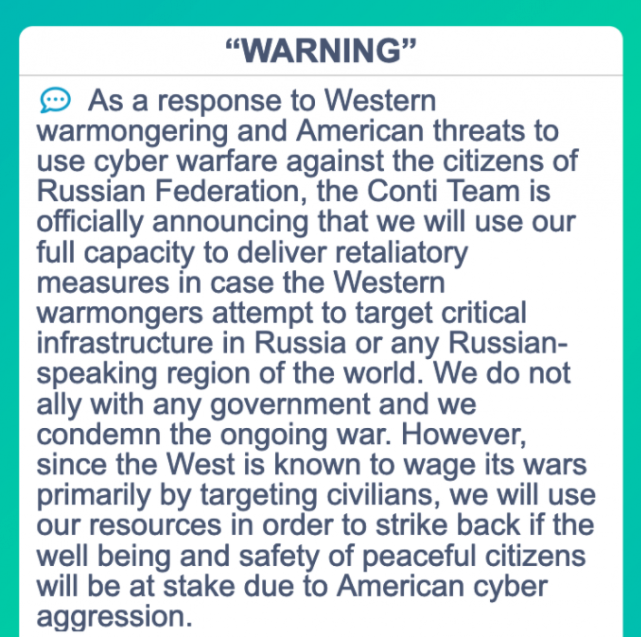
On Feb. 27, a Ukrainian cybersecurity researcher who is currently in Ukraine leaked almost two years’ worth of internal chat records from Conti, which had just posted a press release to its victim shaming blog saying it fully supported Russia’s invasion of his country. Conti warned it would use its cyber prowess to strike back at anyone who interfered in the conflict.

The leaked chats show that the Conti group — which fluctuated in size from 65 to more than 100 employees — budgeted several thousand dollars each month to pay for a slew of security and antivirus tools. Conti sought out these tools both for continuous testing (to see how many products detected their malware as bad), but also for their own internal security.

A chat between Conti upper manager “Reshaev” and subordinate “Pin” on Aug. 8, 2021 shows Reshaev ordering Pin to quietly check on the activity of the Conti network administrators once a week — to ensure they’re not doing anything to undermine the integrity or security of the group’s operation. Reshaev tells Pin to install endpoint detection and response (EDR) tools on every administrator’s computer.

“Check admins’ activity on servers each week,” Reshaev said. “Install EDR on every computer (for example, Sentinel, Cylance, CrowdStrike); set up more complex storage system; protect LSAS dump on all computers; have only 1 active accounts; install latest security updates; install firewall on all network.”

Conti managers were hyper aware that their employees handled incredibly sensitive and invaluable data stolen from companies, information that would sell like hotcakes on the underground cybercrime forums. But in a company run by crooks, trust doesn’t come easily.

“You check on me all the time, don’t you trust me?,” asked mid-level Conti member “Bio” of “Tramp” (a.k.a. “Trump“), a top Conti overlord. Bio was handling a large bitcoin transfer from a victim ransom payment, and Bio detected that Trump was monitoring him.

“When that kind of money and people from the street come in who have never seen that kind of money, how can you trust them 1,000%?” Trump replied. “I’ve been working here for more than 15 years and haven’t seen anything else.”

OSINT

Conti also budgeted heavily for what it called “OSINT,” or open-source intelligence tools. For example, it subscribed to numerous services that can help determine who or what is behind a specific Internet Protocol (IP) address, or whether a given IP is tied to a known virtual private networking (VPN) service. On an average day, Conti had access to tens of thousands of hacked PCs, and these services helped the gang focus solely on infected systems thought to be situated within large corporate networks.

Conti’s OSINT activities also involved abusing commercial services that could help the group gain the upper hand in ransom negotiations with victims. Conti often set its ransom demands as a percentage of a victim’s annual revenues, and the gang was known to harass board members of and investors in companies that refused to engage or negotiate.

In October 2021, Conti underling “Bloodrush” told his manager “Bentley” that the group urgently needed to purchase subscriptions to Crunchbase Pro and Zoominfo, noting that the services provide detailed information on millions of companies, such as how much insurance a company maintains; their latest earnings estimates; and contact information of executive officers and board members.

In a months-long project last year, Conti invested $60,000 in acquiring a valid license to Cobalt Strike, a commercial network penetration testing and reconnaissance tool that is sold only to vetted partners. But stolen or ill-gotten “Coba” licenses are frequently abused by cybercriminal gangs to help lay the groundwork for the installation of ransomware on a victim network. It appears $30,000 of that investment went to cover the actual cost of a Cobalt Strike license, while the other half was paid to a legitimate company that secretly purchased the license on Conti’s behalf.

Likewise, Conti’s Human Resources Department budgeted thousands of dollars each month toward employer subscriptions to numerous job-hunting websites, where Conti HR employees would sift through resumes for potential hires. In a note to Conti taskmaster “Stern” explaining the group’s paid access on one employment platform, Conti HR employee “Salamandra” says their workers have already viewed 25-30 percent of all relevant CVs available on the platform.

“About 25% of resumes will be free for you, as they are already opened by other managers of our company some CVs are already open for you, over time their number will be 30-35%,” Salamandra wrote. “Out of 10 CVs, approximately 3 will already be available.”

Another organizational unit within Conti with its own budget allocations — called the “Reversers” — was responsible for finding and exploiting new security vulnerabilities in widely used hardware, software and cloud-based services. On July 7, 2021, Stern ordered reverser “Kaktus” to start focusing the department’s attention on Windows 11, Microsoft’s newest operating system.

“Win11 is coming out soon, we should be ready for this and start studying it,” Stern said. “The beta is already online, you can officially download and work.”

BY HOOK OR BY CROOK

The chats from the Conti organization include numerous internal deliberations over how much different ransomware victims should be made to pay. And on this front, Conti appears to have sought assistance from multiple third parties.

Milwaukee-based cyber intelligence firm Hold Security this week posted a screenshot on Twitter of a conversation in which one Conti member claims to have a journalist on their payroll who can be hired to write articles that put pressure on victim companies to pay a ransom demand.

“There is a journalist who will help intimidate them for 5 percent of the payout,” wrote Conti member “Alarm,” on March 30, 2021.

The Conti team also had decent working relationships with multiple people who worked at companies that helped ransomware victims navigate paying an extortion demand in virtual currency. One friendly negotiator even had his own nickname within the group — “The Spaniard” — who according to Conti mid-level manager Mango is a Romanian man who works for a large ransomware recovery firm in Canada.

“We have a partner here in the same panel who has been working with this negotiator for a long time, like you can quickly negotiate,” Trump says to Bio on Dec. 12, 2021, in regards to their ransomware negotiations with LeMans Corp., a large Wisconsin-based distributor of powersports equipment [LeMans declined to comment for this story].

Trump soon after posts a response from their negotiator friend:

“They are willing to pay $1KK [$1 million] quickly. Need decryptors. The board is willing to go to a maximum of $1KK, which is what I provided to you. Hopefully, they will understand. The company revenue is under $100KK [$100 million]. This is not a large organization. Let me know what you can do. But if you have information about their cyber insurance and maybe they have a lot of money in their account, I need a bank payout, then I can bargain. I’ll be online by 21-00 Moscow time. For now, take a look at the documents and see if there is insurance and bank statements.”

In a different ransom discussion, the negotiator urges Conti to reconsider such a hefty demand.

“My client only has a max of $200,000 to pay and only wants the data,” the negotiator wrote on Oct. 7, 2021. “See what you can do or this deal will not happen.”

Many organizations now hold cyber insurance to cover the losses associated with a ransomware attack. The logs indicate Conti was ambivalent about working with these victims. For one thing, the insurers seemed to limit their ability to demand astronomical ransom amounts. On the other hand, insured victims usually paid out, with a minimum of hassle or protracted back-and-forth negotiations.

“They are insured for cyber risks, so what are we waiting for?” asks Conti upper manager “Revers,” in a conversation on Sept. 14, 2021.

“There will be trades with the insurance company?” asks Conti employee “Grant.”

“That’s not how it works,” Revers replied. “They have a coverage budget. We just take it and that’s it.”

Conti was an early adopter of the ransomware best practice of “double extortion,” which involves charging the victim two separate ransom demands: One in exchange for a digital key needed to unlock infected systems, and another to secure a promise that any stolen data will not be published or sold, and will be destroyed. Indeed, some variation of the message “need decryptors, deletion logs” can be seen throughout the chats following the gang’s receipt of payment from a victim.

Conti victims were directed to a page on the dark web that included a countdown timer. Victims who failed to negotiate a payment before the timer expired could expect to see their internal data automatically published on Conti’s victim shaming blog.

The beauty of the double extortion approach is that even when victims refuse to pay for a decryption key — perhaps because they’re confident they can restore systems from backups — they might still pay to keep the breach quiet.

“Hello [victim company redacted],” the gang wrote in January 2022. “We are Conti Group. We want to inform that your company local network have been hacked and encrypted. We downloaded from your network more than 180GB of sensitive data. – Shared HR – Shared_Accounting – Corporate Debt – Departments. You can see your page in the our blog here [dark web link]. Your page is hidden. But it will be published if you do not go to the negotiations.”

“We came to an agreement before the New Year,” Conti member “Skippy” wrote later in a message to the victim company. “You got a lot of time, more than enough to find any sum and fulfill your part of this agreement. However, you now ask for additional time, additional proofs, etc. Seems like you are preparing to break the agreement and flee, or just to decrease the sum. Moreover, it is a very strange request and explanation. A lot of companies pay such amounts without any problems. So, our answer: We are waiting for the above mentioned sum until 5 February. We keep our words. If we see no payment and you continue to add any conditions, we begin to upload data. That is all.”

And a reputation for keeping their word is what makes groups like Conti so feared. But some may come to question the group’s competence, and whether it may now be too risky to work with them.

On Mar. 3, a new Twitter account called “Trickbotleaks” began posting the names, photos and personal information of what the account claimed were top Trickbot administrators, including information on many of the Conti nicknames mentioned throughout this story. The Trickbotleaks Twitter account was suspended less than 24 hours later.

On Mar. 2, the Twitter account that originally leaked the Conti chat (a.k.a. “jabber”) records posted fresh logs from the Conti chat room, proving the infiltrator still had access and that Conti hadn’t figured out how they’d been had.

“Ukraine will rise!,” the account tweeted. “Fresh jabber logs.”

source https://krebsonsecurity.com/2022/03/conti-ransomware-group-diaries-part-iii-weaponry/

Conti Ransomware Group Diaries, Part II: The Office

Earlier this week, a Ukrainian security researcher leaked almost two years’ worth of internal chat logs from Conti, one of the more rapacious and ruthless ransomware gangs in operation today. Tuesday’s story examined how Conti dealt with its own internal breaches and attacks from private security firms and governments. In Part II of this series we’ll explore what it’s like to work for Conti, as described by the Conti employees themselves.

The Conti group’s chats reveal a great deal about the internal structure and hierarchy of the ransomware organization. Conti maintains many of the same business units as a legitimate, small- to medium-sized enterprise, including a Human Resources department that is in charge of constantly interviewing potential new hires.

Other Conti departments with their own distinct budgets, staff schedules, and senior leadership include:

Coders: Programmers hired to write malicious code, integrate disparate technologies
Testers: Workers in charge of testing Conti malware against security tools and obfuscating it
Administrators: Workers tasked with setting up, tearing down servers, other attack infrastructure
Reverse Engineers: Those who can disassemble computer code, study it, find vulnerabilities or weaknesses
Penetration Testers/Hackers: Those on the front lines battling against corporate security teams to steal data, and plant ransomware.

Conti appears to have contracted out much of its spamming operations, or at least there was no mention of “Spammers” as direct employees. Conti’s leaders seem to have set strict budgets for each of its organizational units, although it occasionally borrowed funds allocated for one department to address the pressing cashflow needs of another.

A great many of the more revealing chats concerning Conti’s structure are between “Mango” — a mid-level Conti manager to whom many other Conti employees report each day — and “Stern,” a sort of cantankerous taskmaster who can be seen constantly needling the staff for reports on their work.

In July 2021, Mango told Stern that the group was placing ads on several Russian-language cybercrime forums to hire more workers. “The salary is $2k in the announcement, but there are a lot of comments that we are recruiting galley slaves,” Mango wrote. “Of course, we dispute that and say those who work and bring results can earn more, but there are examples of coders who work normally and earn $5-$10k salary.”

The Conti chats show the gang primarily kept tabs on the victim bots infected with their malware via both the Trickbot and Emotet crimeware-as-a-service platforms, and that it employed dozens of people to continuously test, maintain and expand this infrastructure 24 hours a day, 7 days a week.

Conti members referred to Emotet as “Booz” or “Buza,” and it is evident from reading these chat logs that Buza had its own stable of more than 50 coders, and likely much of the same organizational structure as Conti.

According to Mango, as of July 18, 2021 the Conti gang employed 62 people, mostly low-level malware coders and software testers. However, Conti’s employee roster appears to have fluctuated wildly from one month to the next. For example, on multiple occasions the organization was forced to fire many employees as a security precaution in the wake of its own internal security breaches.

In May 2021, Stern told Mango he wanted his underlings to hire 100 more “encoders” to work with the group’s malware before the bulk of the gang returns from their summer vacations in Crimea. Most of these new hires, Stern says, will join the penetration testing/hacking teams headed by Conti leaders “Hof” and “Reverse.” Both Hof and Reverse appear to have direct access to the Emotet crimeware platform.

Trying to accurately gauge the size of the Conti organization is problematic, in part because cybersecurity experts have long held that Conti is merely a rebrand of another ransomware strain and affiliate program known as Ryuk. First spotted in 2018, Ryuk was just as ruthless and mercenary as Conti, and the FBI says that in first year of its operation Ryuk earned more than $61 million in ransom payouts.

“Conti is a Targeted version of Ryuk, which comes from Trickbot and Emotet which we’ve been monitoring for some time,” researchers at Palo Alto Networks wrote about Ryuk last year. “A heavy focus was put on hospital systems, likely due to the necessity for uptime, as these systems were overwhelmed with handling the ongoing COVID-19 pandemic. We observed initial Ryuk ransom requests ranging from US$600,000 to $10 million across multiple industries.”

On May 14, 2021, Ireland’s Health Service Executive (HSE) suffered a major ransomware attack at the hands of Conti. The attack would disrupt services at several Irish hospitals, and resulted in the near complete shutdown of the HSE’s national and local networks, forcing the cancellation of many outpatient clinics and healthcare services. It took the HSE until Sept. 21, 2021 to fully restore all of its systems from the attack, at at estimated cost of more than $600 million.

It remains unclear from reading these chats how many of Conti’s staff understood how much of the organization’s operations overlapped with that of Conti. Lawrence Abrams at Bleeping Computer pointed to an October 2020 Conti chat in which the Emotet representative “Buza” posts a link to a security firm’s analysis of Ryuk’s return.
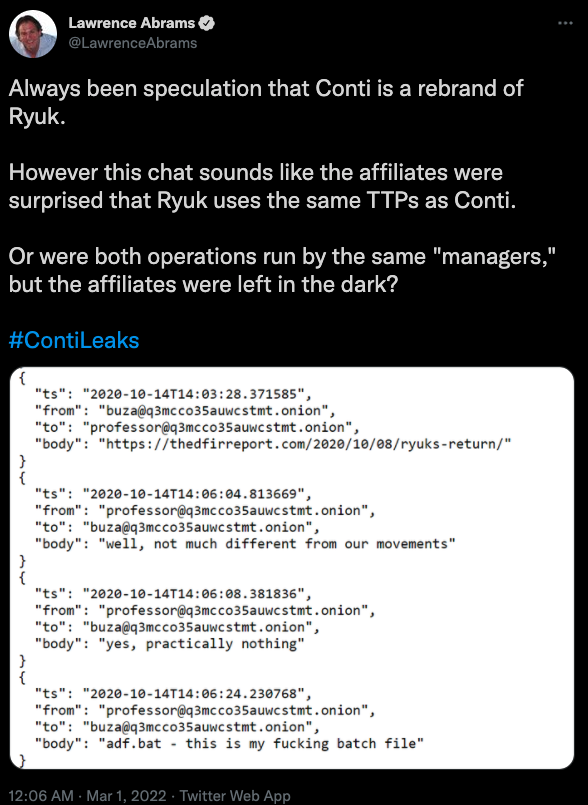
Professor,” the nickname chosen by one of Conti’s most senior generals, replies that indeed Ryuk’s tools, techniques and procedures are nearly identical to Conti’s.

“adf.bat — this is my fucking batch file,” Professor writes, evidently surprised at having read the analysis and spotting his own code being re-used in high-profile ransomware attacks by Ryuk.

“Feels like [the] same managers were running both Ryuk and Conti, with a slow migration to Conti in June 2020,” Abrams wrote on Twitter. “However, based on chats, some affiliates didn’t know that Ryuk and Conti were run by the same people.”

ATTRITION

Each Conti employee was assigned a specific 5-day workweek, and employee schedules were staggered so that some number of staff was always on hand 24/7 to address technical problems with the botnet, or to respond to ransom negotiations initiated by a victim organization.

Like countless other organizations, Conti made its payroll on the 1st and 15th of each month, albeit in the form of Bitcoin deposits. Most employees were paid $1,000 to $2,000 monthly.

However, many employees used the Conti chat room to vent about working days on end without sleep or breaks, while upper managers ignored their repeated requests for time off.

Indeed, the logs indicate that Conti struggled to maintain a steady number of programmers, testers and administrators in the face of mostly grueling and repetitive work that didn’t pay very well (particularly in relation to the earnings of the group’s top leadership). What’s more, some of the group’s top members were openly being approached to work for competing ransomware organizations, and the overall morale of the group seemed to fluctuate between paydays.

Perhaps unsurprisingly, the turnover, attrition and burnout rate was quite high for low-level Conti employees, meaning the group was forced to constantly recruit new talent.

“Our work is generally not difficult, but monotonous, doing the same thing every day,” wrote “Bentley,” the nickname chosen by the key Conti employee apparently in charge of “crypting” the group’s malware — ensuring that it goes undetected by all or at least most antivirus products on the market.

Bentley was addressing a new Conti hire — “Idgo” — telling him about his daily duties.

“Basically, this involves launching files and checking them according to the algorithm,” Bentley explains to Idgo. “Poll communication with the encoder to receive files and send reports to him. Also communication with the cryptor to send the tested assembly to the crypt. Then testing the crypt. If jambs appear at this stage , then sending reports to the cryptor and working with him. And as a result – the issuance of the finished crypt to the partner.”

Bentley cautioned that this testing of their malware had to be repeated approximately every four hours to ensure that any new malware detection capability added to Windows Defender — the built-in antivirus and security service in Windows — won’t interfere with their code.

“Approximately every 4 hours, a new update of Defender databases is released,” Bentley told Igdo. “You need to work for 8 hours before 20-21 Moscow time. And career advancement is possible.” Igdo agrees, noting that he’d started working for Conti a year earlier, as a code tester.

OBSERVATIONS

The logs show the Conti gang is exceedingly good at quickly finding many potential new ransomware victims, and the records include many internal debates within Conti leadership over how much certain victim companies should be forced to pay. They also show with terrifying precision how adeptly a large, organized cybercrime group can pivot from a single compromised PC to completely owning a Fortune 500 company.

As a well-staffed “big game” killing machine, Conti is perhaps unparalleled among ransomware groups. But the internal chat logs show this group is in serious need of some workflow management and tracking tools. That’s because time and time again, the Conti gang lost control over countless bots — all potential sources of ransom revenue that will help pay employee salaries for months — because of a simple oversight or mistake.

Peppered throughout the leaked Conti chats — roughly several times each week — are pleadings from various personnel in charge of maintaining the sprawling and constantly changing digital assets that support the group’s ransomware operation. These messages invariably relate to past-due invoices for multiple virtual servers, domain registrations and other cloud-based resources.

On Mar. 1, 2021, a low-level Conti employee named “Carter” says the bitcoin fund used to pay for VPN subscriptions, antivirus product licenses, new servers and domain registrations is short $1,240 in Bitcoin.

“Hello, we’re out of bitcoins, four new servers, three vpn subscriptions and 22 renewals are out,” Carter wrote on Nov. 24, 2021. “Two weeks ahead of renewals for $960 in bitcoin 0.017. Please send some bitcoins to this wallet, thanks.”

As part of the research for this series, KrebsOnSecurity spent many hours reading each day of Conti’s chat logs going back to September 2020. I wish I could get many of those hours back: Much of the conversations are mind-numbingly boring chit-chat and shop talk. But overall, I came away with the impression that Conti is a highly effective — if also remarkably inefficient — cybercriminal organization.

Some of Conti’s disorganized nature is probably endemic in the cybercrime industry, which is of course made up of criminals who are likely accustomed to a less regimented lifestyle. But make no mistake: As ransomware collectives like Conti continue to increase payouts from victim organizations, there will be increasing pressure on these groups to tighten up their operations and work more efficiently, professionally and profitably.

Stay tuned for Part III in this series, which will look at how Conti secured access to the cyber weaponry needed to subvert the security of their targets, as well as how the team’s leaders approached ransom negotiations with their victims.

source https://krebsonsecurity.com/2022/03/conti-ransomware-group-diaries-part-ii-the-office/
Conti Ransomware Group Diaries, Part I: Evasion

A Ukrainian security researcher this week leaked several years of internal chat logs and other sensitive data tied to Conti, an aggressive and ruthless Russian cybercrime group that focuses on deploying its ransomware to companies with more than $100 million in annual revenue. The chat logs offer a fascinating glimpse into the challenges of running a sprawling criminal enterprise with more than 100 salaried employees. The records also provide insight into how Conti has dealt with its own internal breaches and attacks from private security firms and foreign governments.

Conti’s threatening message this week regarding international interference in Ukraine.

Conti makes international news headlines each week when it publishes to its dark web blog new information stolen from ransomware victims who refuse to pay an extortion demand. In response to Russia’s invasion of Ukraine, Conti published a statement announcing its “full support.”

“If anybody will decide to organize a cyberattack or any war activities against Russia, we are going to use all our possible resources to strike back at the critical infrastructures of an enemy,” the Conti blog post read.

On Sunday, Feb. 27, a new Twitter account “Contileaks” posted links to an archive of chat messages taken from Conti’s private communications infrastructure, dating from January 29, 2021 to the present day. Shouting “Glory for Ukraine,” the Contileaks account has since published additional Conti employee conversations from June 22, 2020 to Nov. 16, 2020.

The Contileaks account did not respond to requests for comment. But Alex Holden, the Ukrainian-born founder of the Milwaukee-based cyber intelligence firm Hold Security, said the person who leaked the information is not a former Conti affiliate — as many on Twitter have assumed. Rather, he said, the leaker is a Ukrainian security researcher who has chosen to stay in his country and fight.

“The person releasing this is a Ukrainian and a patriot,” Holden said. “He’s seeing that Conti is supporting Russia in its invasion of Ukraine, and this is his way to stop them in his mind at least.”

GAP #1

The temporal gaps in these chat records roughly correspond to times when Conti’s IT infrastructure was dismantled and/or infiltrated by security researchers, private companies, law enforcement, and national intelligence agencies. The holes in the chat logs also match up with periods of relative quiescence from the group, as it sought to re-establish its network of infected systems and dismiss its low-level staff as a security precaution.

On Sept. 22, 2020, the U.S. National Security Agency (NSA) began a weeks-long operation in which it seized control over the Trickbot botnet, a malware crime machine that has infected millions of computers and is often used to spread ransomware. Conti is one of several cybercrime groups that has regularly used Trickbot to deploy malware.

Once in control over Trickbot, the NSA’s hackers sent all infected systems a command telling them to disconnect themselves from the Internet servers the Trickbot overlords used to control compromised Microsoft Windows computers. On top of that, the NSA stuffed millions of bogus records about new victims into the Trickbot database.

News of the Trickbot compromise was first published here on Oct. 2, 2020, but the leaked Conti chats show that the group’s core leadership detected something was seriously wrong with their crime machine just a few hours after the initial compromise of Trickbot’s infrastructure on Sept. 22.

“The one who made this garbage did it very well,” wrote “Hof,” the handle chosen by a top Conti leader, commenting on the Trickbot malware implant that was supplied by the NSA and quickly spread to the rest of the botnet. “He knew how the bot works, i.e. he probably saw the source code, or reversed it. Plus, he somehow encrypted the config, i.e. he had an encoder and a private key, plus uploaded it all to the admin panel. It’s just some kind of sabotage.”

“Moreover, the bots have been flooded with such a config that they will simply work idle,” Hof explained to his team on Sept. 23, 2020. Hof noted that the intruder even kneecapped Trickbot’s built-in failsafe recovery mechanism. Trickbot was configured so that if none of the botnet’s control servers were reachable, they could still be recaptured and controlled by registering a pre-computed domain name on EmerDNS, a decentralized domain name system based on the Emercoin virtual currency.

“After a while they will download a new config via emercoin, but they will not be able to apply this config, because this saboteur has uploaded the config with the maximum number, and the bot is checking that the new config should be larger than the old one,” Hof wrote. “Sorry, but this is fucked up. I don’t know how to get them back.”

It would take the Conti gang several weeks to rebuild its malware infrastructure, and infect tens of thousands of new Microsoft Windows systems. By late October 2021, Conti’s network of infected systems had grown to include 428 medical facilities throughout the United States, and the gang’s leaders saw an opportunity to create widespread panic — if not also chaos — by deploying their ransomware simultaneously to hundreds of American healthcare organizations already struggling amid a worldwide pandemic.

“Fuck the clinics in the USA this week,” wrote Conti manager “Target” on Oct. 26, 2020. “There will be panic. 428 hospitals.”

On October 28, the FBI and the U.S. Department of Homeland Security hastily assembled a conference call with healthcare industry executives warning about an “imminent cybercrime threat to U.S. hospitals and healthcare providers.”

Follow-up reporting confirmed that at least a dozen healthcare organizations were hit with ransomware that week, but the carnage apparently was not much worse than a typical week in the healthcare sector. One information security leader in the healthcare industry told KrebsOnSecurity at the time that it wasn’t uncommon for the industry to see at least one hospital or health care facility hit with ransomware each day.

GAP #2

The more recent gap in the Conti chat logs corresponds to a Jan. 26, 2021 international law enforcement operation to seize control of Emotet, a prolific malware strain and cybercrime-as-a-service platform that was used heavily by Conti. Following the Emotet takedown, the Conti group once again reorganized, with everyone forced to pick new nicknames and passwords.

The logs show Conti made a special effort to help one of its older members — All Witte — a 55-year-old Latvian woman arrested last year on suspicion of working as a programmer for the Trickbot group. The chat records indicate Witte became something of a maternal figure for many of Conti’s younger personnel, and after her arrest Conti’s leadership began scheming a way to pay for her legal defense.

Alla Witte’s personal website — allawitte[.]nl — circa October 2018.

“They gave me a lawyer, they said the best one, plus excellent connections, he knows the investigator, he knows the judge, he is a federal lawyer there, licensed, etc., etc.,” wrote Mango” — a mid-level manager within Conti — to “Stern,” a much higher-up Conti manager and taskmaster who frequently asked various units of the gang for updates on their daily assignments.

Stern agreed that this was the best course of action, but it’s unclear if it was successfully carried out. Also, the entire scheme may not have been as altruistic as it seemed: Mango suggested that paying Witte’s attorney fees might also give the group inside access to information about the government’s ongoing investigation of Trickbot.

“Let’s try to find a way to her lawyer right now and offer him to directly sell the data bypassing her,” Mango suggests to Stern on June 23, 2021.

The FBI has been investigating Trickbot for years, and it is clear that at some point the U.S. government shared information with the Russians about the hackers they suspected were behind Trickbot. It is also clear from reading these logs that the Russians did little with this information until October 2021, when Conti’s top generals began receiving tips from their Russian law enforcement sources that the investigation was being rekindled.

“Our old case was resumed,” wrote the Conti member “Kagas” in a message to Stern on Oct. 6, 2021. “The investigator said why it was resumed: The Americans officially requested information about Russian hackers, not only about us, but in general who was caught around the country. Actually, they are interested in the Trickbot, and some other viruses. Next Tuesday, the investigator called us for a conversation, but for now, it’s like [we’re being called on as] witnesses. That way if the case is suspended, they can’t interrogate us in any way, and, in fact, because of this, they resumed it. We have already contacted our lawyers.”

Incredibly, another Conti member pipes into the discussion and says the group has been assured that the investigation will go nowhere from the Russian side, and that the entire inquiry from local investigators would be closed by mid-November 2021.

It appears Russian investigators were more interested in going after a top Conti competitor — REvil, an equally ruthless Russian ransomware group that likewise mainly targeted large organizations that could pay large ransom demands.

On Jan. 14, 2022, the Russian government announced the arrest of 14 people accused of working for REvil. The Russian Federal Security Service (FSB) said the actions were taken in response to a request from U.S. officials, but many experts believe the crackdown was part of a cynical ploy to assuage (or distract) public concerns over Russian President Vladimir Putin’s bellicose actions in the weeks before his invasion of Ukraine.

The leaked Conti messages show that TrickBot was effectively shut down earlier this month. As Catalin Cimpanu at The Record points out, the messages also contain copious ransom negotiations and payments from companies that had not disclosed a breach or ransomware incident (and indeed had paid Conti to ensure their silence). In addition, there are hundreds of bitcoin addresses in these chats that will no doubt prove useful to law enforcement organizations seeking to track the group’s profits.

This is the first of several stories about the inner workings of Conti, based on the leaked chat records. Part II will be told through the private messages exchanged by Conti employees working in different operational units, and it explores some of the more unique and persistent challenges facing large-scale cybercriminal organizations today.

source https://krebsonsecurity.com/2022/03/conti-ransomware-group-diaries-part-i-evasion/

Russia Sanctions May Spark Escalating Cyber Conflict

President Biden joined European leaders this week in enacting economic sanctions against Russia in response to its invasion of Ukraine. The West has promised tougher sanctions are coming, but experts warn these will almost certainly trigger a Russian retaliation against America and its allies, which could escalate into cyber attacks on Western financial institutions and energy infrastructure.

Michael Daniel is a former cybersecurity advisor to the White House during the Obama administration who now heads the Cyber Threat Alliance, an industry group focused on sharing threat intelligence among members. Daniel said there are two primary types of cyber threats the group is concerned about potentially coming in response to sanctions on Russia.

The first involves what Daniel called “spillover and collateral damage” — a global malware contagion akin to a NotPeyta event — basically some type of cyber weapon that has self-propagating capabilities and may even leverage a previously unknown security flaw in a widely-used piece of hardware or software.

Russia has been suspected of releasing NotPetya, a large-scale cyberattack in 2017 initially aimed at Ukrainian businesses that mushroomed into an extremely disruptive and expensive global malware outbreak.

“The second level [is that] in retaliation for sanctions or perceived interference, Russia steps up more direct attacks on Western organizations,” Daniel said. “The Russians have shown themselves to be incredibly ingenious and creative in terms of how they come up with targets that seem to catch us by surprise. If the situation escalates in cyberspace, there could be some unanticipated organizations that end up in the crosshairs.”

What kinds of attacks are experts most concerned about? In part because the Russian economy is so dependent on energy exports, Russia has invested heavily in probing for weaknesses in the cyber systems that support bulk power production and distribution.

Ukraine has long been used as the testing grounds for Russian offensive hacking capabilities targeting power infrastructure. State-backed Russian hackers have been blamed for the Dec. 23, 2015 cyberattack on Ukraine’s power grid that left 230,000 customers shivering in the dark.

Experts warn that Russia could just as easily use its arsenal of sneaky cyber exploits against energy systems that support U.S. and European nations. In 2014, then National Security Agency Director Mike Rogers told lawmakers that hackers had been breaking into U.S. power utilities to probe for weaknesses, and that Russia had been caught planting malware in the same kind of industrial computers used by power utilities.

“All of that leads me to believe it is only a matter of when, not if, we are going to see something dramatic,” Rogers said at the time.

That haunting prophecy is ringing anew as European leaders work on hammering out additional sanctions, which the European Commission president says will restrict the Russian economy’s ability to function by starving it of important technology and access to finance.

A draft of the new penalties obtained by The New York Times would see the European Union ban the export of aircraft and spare parts that are necessary for the maintenance of Russian fleets.

“The bloc will also ban the export of specialized oil-refining technology as well as semiconductors, and it will penalize more banks — although it will stop short of targeting VTB, Russia’s second-largest bank, which is already crippled by American and British sanctions,” The Times wrote.

Dmitri Alperovitch is co-founder and former chief technology officer at the security firm CrowdStrike. Writing for The Economist, Alperovitch said America must tailor its response carefully to avoid initiating a pattern of escalation that could result in a potentially devastating hot war with Russia.

“The proposed combination of sanctions on top Russian banks and implementation of export controls on semiconductors would be likely to severely debilitate the Russian economy,” Alperovitch wrote. “And although many in the West may initially cheer this outcome as righteous punishment for Russia’s blatant violation of Ukrainian sovereignty, these measures will probably trigger significant Russian retaliation against America. That prospect all but guarantees that the conflict will not come to an end with an invasion of Ukraine.”

Faced with a potentially existential threat to its economic well-being — and seeing itself as having nothing more to lose — Russia will have several tools at its disposal with which to respond, he said: One of those will be carrying out cyber-attacks against American and European financial institutions and energy infrastructure.

“Having already exhausted the power of economic sanctions, America and its European allies would have few choices other than to respond to these attacks with offensive cyber-strikes of their own,” Alperovitch wrote. “This pattern of tit-for-tat cyber retaliation could place Russia and the West on a worrying path. It could end with the conflict spilling out of cyberspace and into the realm of a hot conflict. This outcome—a hot conflict between two nuclear powers with extensive cyber capabilities—is one that everyone in the world should be anxious to avoid.”

In May 2021, Russian cybercriminals unleashed a ransomware attack against Colonial Pipeline, a major fuel distributor in the United States. The resulting outage caused fuel shortages and price spikes across the nation. Alperovitch says a retaliation from Russia in response to sanctions could make the Colonial Pipeline attack seem paltry by comparison.

“The colonial pipeline is going to be like child’s play if the Russians truly unleash all their capability,” Alperovitch told CNBC this week.

For example, having your organization’s computers and servers locked by ransomware may seem like a day at the park compared to getting hit with “wiper” malware that simply overwrites or corrupts data on infected systems.

Kim Zetter, a veteran Wired reporter who now runs her own cybersecurity-focused Substack newsletter, has painstakingly documented two separate wiper attacks launched in the lead-up to the Russian invasion that targeted Ukrainian government and contractor networks, as well as systems in Latvia and Lithuania.

One contractor interviewed by Zetter said the wiper attacks appeared to be extremely targeted, going after organizations that support the Ukrainian government — regardless of where those organizations are physically located.

“The wiper, dubbed HermeticaWiper, appears to have been in the works for months but was only released on computers today,” Zetter wrote. “It follows on a previous wiper attack that struck Ukrainian systems in January called WhisperGate. Like that previous infection, HermeticaWiper is designed to overwrite files on systems to render them inoperable.”

A joint advisory last week by the FBI, National Security Agency (NSA) and the Cybersecurity and Infrastructure Security Agency (CISA) warned that Russian cyber actors have been targeting cleared defense contractors, and that since January 2020 and continuing through this month, the cyber actors had maintained a persistent presence on those contractor networks. The advisory said the attackers exfiltrated email and data, and were able to “acquire sensitive, unclassified information, as well as proprietary and export-controlled technology.”

A report Thursday by NBC News suggested President Biden had been presented with options for massive cyberattacks against Russia, including the disruption of Internet access across Russia, shutting off the power, and stopping trains in their tracks.

But White House National Security Council spokesperson Emily Home told Reuters the NBC News report was “wildly off base and does not reflect what is actually being discussed in any shape or form.”

That’s good news, according to Jim Lewis, director of the public policy program at the Center for Strategic and International Studies. Lewis said the United States and its allies have far more to lose if the West gets embroiled in an escalation of cyber attacks with Russia over sanctions.

“The asymmetry in pressure points makes the idea of us doing something probably not a good idea,” Lewis told KrebsOnSecurity. “If Putin hasn’t gone completely nuts, he’ll be cautious of doing anything that might be construed under international law as the use of force through cyber means.”

Lewis said a more likely response from Russia would include enlisting cybercriminals throughout Russia and the Commonwealth of Independent States to step up ransomware and other disruptive attacks against high-impact targets in specific industries.

“The pressure points for Putin are his political support — the oligarchs and security services,” Lewis said. “If we want to squeeze him, that’s where we have to squeeze, things like seizing all their real estate in Miami Beach, or putting them on no-fly lists. If you want to hurt Putin, a cyberattack probably wouldn’t do it. Unless it was against his bank account.”

In a call to action issued earlier this week dubbed “Shields Up,” CISA warned that Russia could escalate its destabilizing actions in ways that may impact others outside of Ukraine. CISA also published a new catalog of free public and private sector cybersecurity services.

source https://krebsonsecurity.com/2022/02/russia-sanctions-may-spark-escalating-cyber-conflict/

IRS: Selfies Now Optional, Biometric Data to Be Deleted

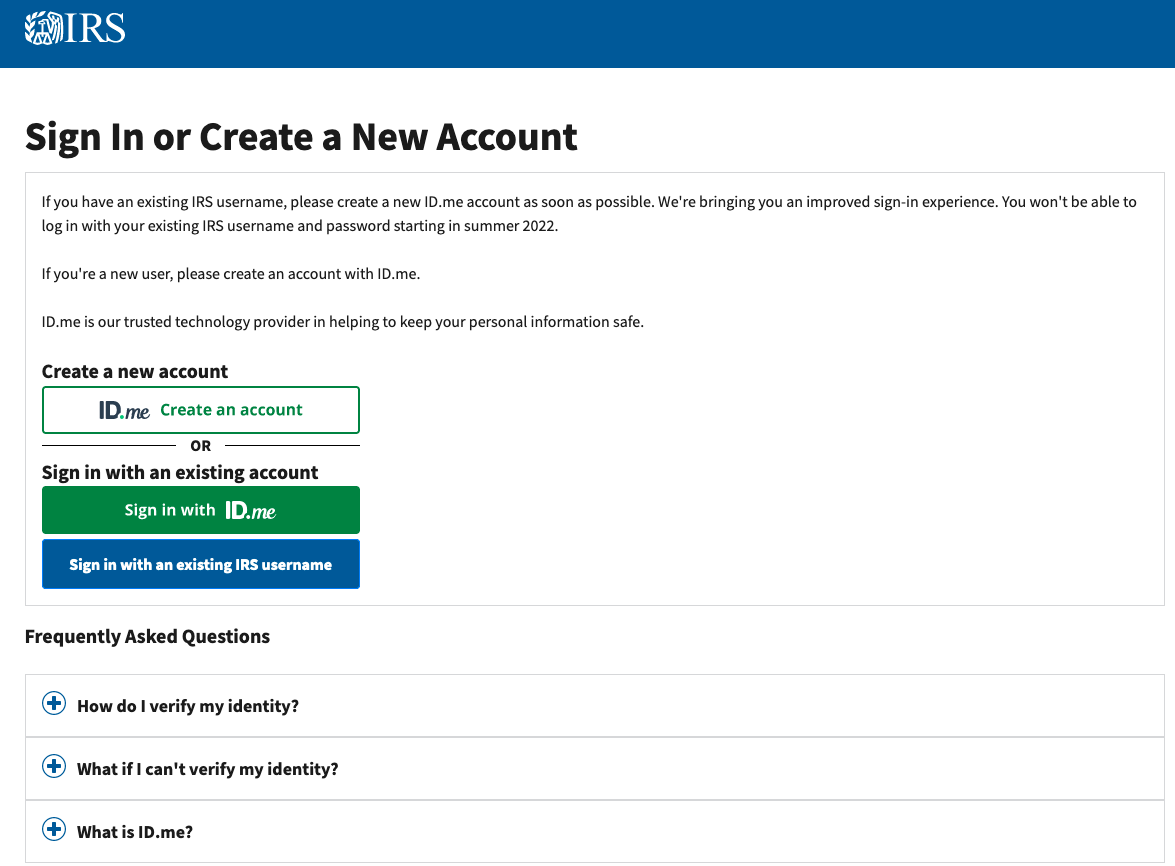
The U.S. Internal Revenue Service (IRS) said Monday that taxpayers are no longer required to provide facial scans to create an account online at irs.gov. In lieu of providing biometric data, taxpayers can now opt for a live video interview with ID.me, the privately-held Virginia company that runs the agency’s identity proofing system. The IRS also said any biometric data already shared with ID.me would be permanently deleted over the next few weeks, and any biometric data provided for new signups will be destroyed after an account is created.

“Taxpayers will have the option of verifying their identity during a live, virtual interview with agents; no biometric data – including facial recognition – will be required if taxpayers choose to authenticate their identity through a virtual interview,” the IRS said in a Feb. 21 statement.

“Taxpayers will still have the option to verify their identity automatically through the use of biometric verification through ID.me’s self-assistance tool if they choose,” the IRS explained. “For taxpayers who select this option, new requirements are in place to ensure images provided by taxpayers are deleted for the account being created. Any existing biometric data from taxpayers who previously created an IRS Online Account that has already been collected will also be permanently deleted over the course of the next few weeks.”

In addition, the IRS said it planned to roll out Login.gov as an authentication tool for those seeking access to their tax records online. Login.gov is a single sign-on solution already used to access 200 websites run by 28 federal agencies.

“The General Services Administration is currently working with the IRS to achieve the security standards and scale required of Login.Gov, with the goal of moving toward introducing this option after the 2022 filing deadline,” the agency wrote.

The IRS first announced its partnership with ID.me in November, but the press release received little public attention. On Jan. 19, KrebsOnSecurity published the story IRS Will Soon Require Selfies for Online Access, detailing a rocky experience signing up for IRS access via ID.me.

The IRS says it will require ID.me for all logins later this summer.

That story went viral, and the ensuing media coverage forced the IRS to answer questions about why it was incentivizing the collection and storage of biometric data by a private company. On Feb. 7, the IRS announced its intention to transition away from requiring biometric data from taxpayers who wish to access their records at the agency’s website, but it left unanswered the question of what would happen with the facial recognition data already collected by ID.me on behalf of the IRS.

In a letter to the IRS this month, Senate Finance Committee Chairman Ron Wyden (D-Ore.) challenged the Treasury Department and IRS to reconsider the biometric requirements, saying login.gov is perfectly up to the task if given all of the resources and funding it deserves.

“Unfortunately, login.gov has not yet reached its full potential, in part because many agencies have flouted the Congressional mandate that they use it, and because successive Administrations have failed to prioritize digital identity,” Wyden wrote. “The cost of this inaction has been billions of dollars in fraud, which has in turn fueled a black market for stolen personal data, and enabled companies like ID.me to commercialize what should be a core government service.”

source https://krebsonsecurity.com/2022/02/irs-selfies-now-optional-biometric-data-to-be-deleted/

Report: Missouri Governor’s Office Responsible for Teacher Data Leak

Missouri Governor Mike Parson made headlines last year when he vowed to criminally prosecute a journalist for reporting a security flaw in a state website that exposed personal information of more than 100,000 teachers. But Missouri prosecutors now say they will not pursue charges following revelations that the data had been exposed since 2011 — two years after responsibility for securing the state’s IT systems was centralized within Parson’s own Office of Administration.

Missouri Gov. Mike Parson (R), vowing to prosecute the St. Louis Post-Dispatch for reporting a security vulnerability that exposed teacher SSNs.

In October 2021, St. Louis Post-Dispatch reporter Josh Renaud alerted Missouri education department officials that their website was exposing the Social Security numbers of more than 100,000 primary and secondary teachers in the state. Renaud found teachers’ SSNs were accessible in the HTML source code of some Missouri education department webpages.

After confirming that state IT officials had secured the exposed teacher data, the Post-Dispatch ran a story about their findings. Gov. Parson responded by holding a press conference in which he vowed his administration would seek to prosecute and investigate “the hackers” and anyone who aided the publication in its “attempt to embarrass the state and sell headlines for their news outlet.”

“The state is committed to bringing to justice anyone who hacked our systems or anyone who aided them to do so,” Parson said in October. “A hacker is someone who gains unauthorized access to information or content. This individual did not have permission to do what they did. They had no authorization to convert or decode, so this was clearly a hack.”

Parson tasked the Missouri Highway Patrol to produce a report on their investigation into “the hackers.”  On Monday, Feb. 21, The Post-Dispatch published the 158-page report (PDF), which concluded after 175 hours of investigation that Renaud did nothing wrong and only accessed information that was publicly available.

Emails later obtained by the Post-Dispatch showed that the FBI told state cybersecurity officials that there was “not an actual network intrusion” and the state database was “misconfigured.” The emails also revealed the proposed message when education department leaders initially prepared to respond in October:

“We are grateful to the member of the media who brought this to the state’s attention,” was the proposed quote attributed to the state’s education commissioner before Parson began shooting the messenger.

The Missouri Highway Patrol report includes an interview with Mallory McGowin, the chief communications officer for the state’s Department of Elementary and Secondary Education (DESE). McGowin told police the website weakness actually exposed 576,000 teacher Social Security numbers, and the data would have been publicly exposed for a decade.

McGowin also said the DESE’s website was developed and maintained by the Office of Administration’s Information Technology Services Division (ITSD) — which the governor’s office controls directly.

“I asked Mrs. McGowin if I was correct in saying the website was for DESE but it was maintained by ITSD, and she indicated that was correct,” the Highway Patrol investigator wrote. “I asked her if the ITSD was within the Office of Administration, or if DESE had their on-information technology section, and she indicated it was within the Office of Administration. She stated in 2009, policy was changed to move all information technology services to the Office of Administration.”

The report was a vindication for Renaud and for University of Missouri-St. Louis professor Shaji Khan, who helped the Post-Dispatch verify that the security flaw existed. Khan was also a target of Parson’s vow to prosecute “the hackers.” Khan’s attorney Elad Gross told the publication his client was not being charged, and that “state officials committed all of the wrongdoing here.”

“They failed to follow basic security procedures for years, failed to protect teachers’ Social Security numbers, and failed to take responsibility, instead choosing to instigate a baseless investigation into two Missourians who did the right thing and reported the problem,” Gross told The Post-Dispatch. “We thank the Missouri State Highway Patrol and the Cole County Prosecutor’s Office for their diligent work on a case that never should have been sent to them.”

source https://krebsonsecurity.com/2022/02/report-missouri-governors-office-responsible-for-teacher-data-leak/

Red Cross Hack Linked to Iranian Influence Operation?

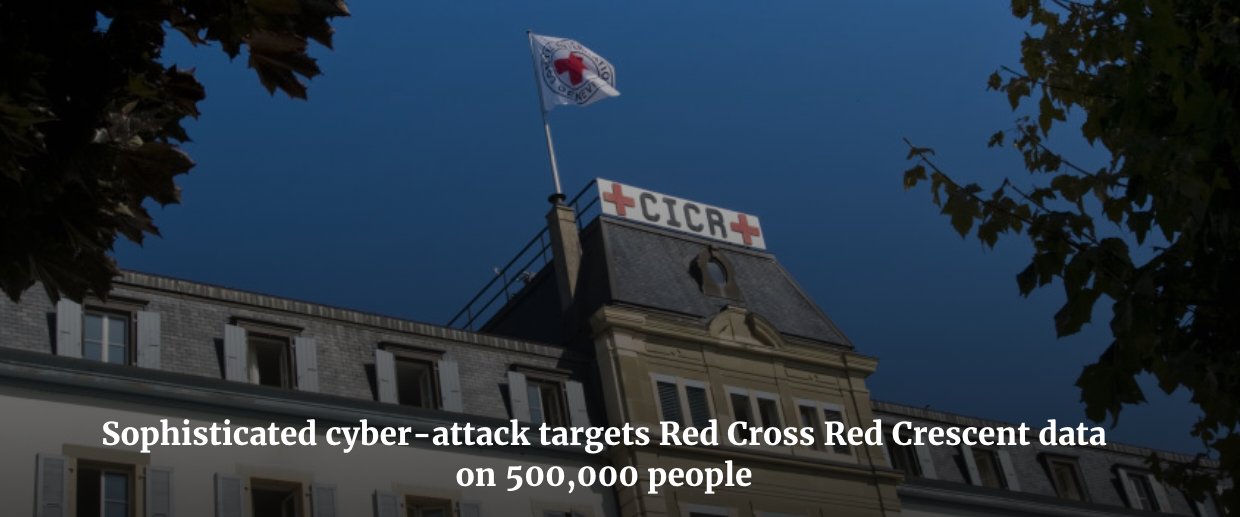
A network intrusion at the International Committee for the Red Cross (ICRC) in January led to the theft of personal information on more than 500,000 people receiving assistance from the group. KrebsOnSecurity has learned that the email address used by a cybercriminal actor who offered to sell the stolen ICRC data also was used to register multiple domain names the FBI says are tied to a sprawling media influence operation originating from Iran.

On Jan. 19, the ICRC disclosed the compromise of servers hosting the personal information of more than 500,000 people receiving services from the Red Cross and Red Crescent Movement. The ICRC said the hacked servers contained data relating to the organization’s Restoring Family Links services, which works to reconnect people separated by war, violence, migration and other causes.

The same day the ICRC went public with its breach, someone using the nickname “Sheriff” on the English-language cybercrime forum RaidForums advertised the sale of data from the Red Cross and Red Crescent Movement. Sheriff’s sales thread suggests the ICRC was asked to pay a ransom to guarantee the data wouldn’t be leaked or sold online.

“Mr. Mardini, your words have been heard,” Sheriff wrote, posting a link to the Twitter profile of ICRC General Director Robert Mardini and urging forum members to tell him to check his email. “Check your email and send a figure you can pay.”

RaidForums member “unindicted” aka Sheriff selling access to the International Red Cross and Red Crescent Movement data. Image: Ke-la.com

In their online statement about the hack (updated on Feb. 7) the ICRC said it had not had any contact with the hackers, and no ransom demand had been made.

“In line with our standing practice to engage with any actor who can facilitate or impede our humanitarian work, we are willing to communicate directly and confidentially with whoever may be responsible for this operation to impress upon them the need to respect our humanitarian action,” the ICRC statement reads.

Asked to comment on Sheriff’s claims, the ICRC issued the following statement:

“Right now, we do not have any conclusive evidence that this information from the data breach has been published or is being traded. Our cybersecurity team has looked into any reported allegation of data being available on the dark web.”

The email address that Sheriff used to register at RaidForums — kelvinmiddelkoop@hotmail.com — appears in an affidavit for a search warrant filed by the FBI roughly a year ago. That FBI warrant came on the heels of an investigation published by security firm FireEye, which examined an Iranian-based network of inauthentic news sites and social media accounts aimed at the United States., U.K. and other western audiences.

“This operation is leveraging a network of inauthentic news sites and clusters of associated accounts across multiple social media platforms to promote political narratives in line with Iranian interests,” FireEye researchers wrote. “These narratives include anti-Saudi, anti-Israeli, and pro-Palestinian themes, as well as support for specific U.S. policies favorable to Iran.”

The FBI says the domains registered by the email address tied to Sheriff’s RaidForums account were used in service of the Liberty Front Press, a network of phony news sites thought to originate from Iran.

According to the FBI affidavit, the address kelvinmiddelkoop@hotmail.com was used to register at least three different domains for phony news sites, including awdnews[.]com, sachtimes[.]com, and whatsupic[.]com. A reverse WHOIS search on that email address at DomainTools.com (an advertiser on this site) shows it was used to register 17 domains between 2012 and 2021, including moslimyouthmedia[.]com, moslempress[.]com, and realneinovosti[.]net.

A review of Sheriff’s postings to RaidForum reveals he has used two other nicknames since registering on the forum in December 2021: “Unindicted,” and “threat_actor.” In several posts, Sheriff taunts one FireEye employee by name.

In a Jan. 3, 2022 post, Sheriff says their “team” is seeking licenses for the Cobalt Strike penetration testing tool, and that they’re prepared to pay $3,000 – $4,000 per license. Cobalt Strike is a legitimate security product that is sold only to vetted partners, but compromised or ill-gotten Cobalt Strike licenses frequently are used in the run-up to ransomware attacks.

“We will buy constantly, make contact,” Sheriff advised. “Do not ask if we still need)) the team is interested in licenses indefinitely.”

On Jan. 4, 2022, Sheriff tells RaidForums that their team is in need of access to a specific data broker platform, and offers to pay as much as $35,000 for that access. Sheriff says they will only accept offers that are guaranteed through the forum’s escrow account.

The demand for escrow in a sales thread is almost universally a sign that someone means business and they are ready to transact on whatever was advertised or requested. That’s because escrow transactions necessarily force the buyer to make a deposit with the forum’s administrators before proceeding on any transaction.

Sheriff appears to have been part of a group on RaidForums that offered to buy access to organizations that could be extorted with ransomware or threatened with the publication of stolen data (PDF screenshot from threat intelligence firm KELA). In a “scam report” filed against Sheriff by another RaidForums member on Dec. 31, 2021, the claimant says Sheriff bought access from them and agreed to pay 70 percent of any ransom paid by the victim organization.

Instead, the claimant maintains, Sheriff only paid them roughly 25 percent. “The company pay $1.35 million ransom and only payment was made of $350k to me, so i ask for $600k to fix this dispute,” the affiliate wrote.

In another post on RaidForums, a user aptly named “FBI Agent” advised other denizens to steer clear of Sheriff’s ransomware affiliate program, noting that transacting with this person could run afoul of sanctions from the U.S. Department of the Treasury’s Office of Foreign Assets Control (OFAC) that restrict commerce with people residing in Iran.

“To make it clear, we don’t work with individuals under the OFAC sanctions list, which @Sheriff is under,” the ransomware affiliate program administrator wrote in reply.

RaidForums says Sheriff was referred to the forum by Pompompurin, the same hacker who used a security hole in the FBI’s website last year to blast a phony alert about a cybercrime investigation to state and local authorities. Pompompurin has been quite active on RaidForums for the past few years, frequently posting databases from newly-hacked organizations, and selling access to stolen information.

Reach via Twitter, Pompompurin said they had no idea who might have offered money and information on Sheriff, and that they would never “snitch” on Sheriff.

“I know who he is but I’m not saying anything,” Pompompurin replied.

The information about Sheriff was brought to my attention by an anonymous person who initially contacted KrebsOnSecurity saying they wanted to make a donation to the publication. When the person offering the gift asked if it was okay that the money came from a ransomware transaction, I naturally declined the offer.

That person then proceeded to share the information about the connection between Sheriff’s email address and the FBI search warrant, as well as the account’s credentials.

The same identity approached several other security researchers and journalists, one of whom was able to validate that the kelvinmiddelkoop@hotmail.com address actually belonged to Sheriff’s account. Those researchers were likewise offered tainted donations, except the individual offering the donation seemed to use a different story with each person about who they were or why they were offering money. Others contacted by the same anonymous user said they also received unsolicited details about Sheriff.

It seems clear that whoever offered that money and information has their own agenda, which may also involve attempts to make members of the news media appear untrustworthy for agreeing to accept stolen funds. However, the information they shared checks out, and since there is precious little public reporting on the source of the ICRC intrusion, the potential connection to hacker groups based in Iran seems worth noting.

source https://krebsonsecurity.com/2022/02/red-cross-hack-linked-to-iranian-influence-operation/