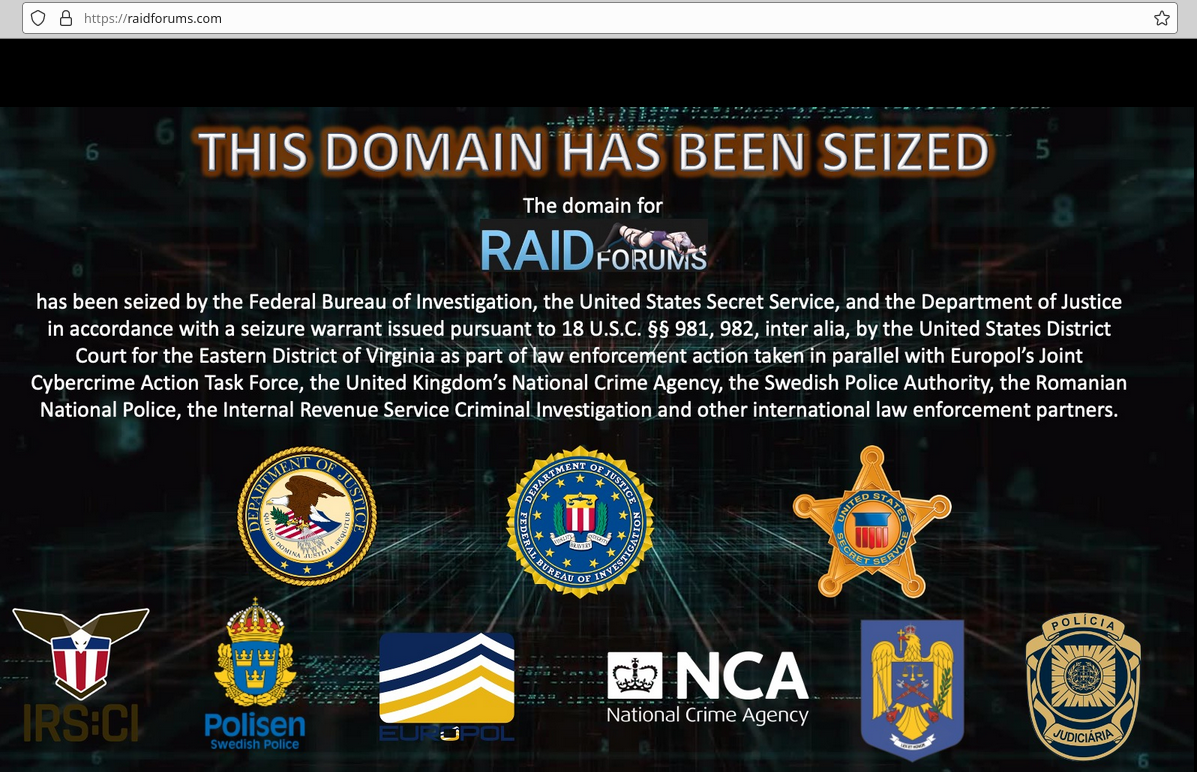
The U.S. Department of Justice (DOJ) said today it seized the website and user database for RaidForums, an extremely popular English-language cybercrime forum that sold access to more than 10 billion consumer records stolen in some of the world’s largest data breaches since 2015. The DOJ also charged the alleged administrator of RaidForums — 21-year-old Diogo Santos Coelho, of Portugal — with six criminal counts, including conspiracy, access device fraud and aggravated identity theft.
The “raid” in RaidForums is a nod to the community’s humble beginnings in 2015, when it was primarily an online venue for organizing and supporting various forms of electronic harassment. According to the DOJ, that early activity included ‘raiding‘ — posting or sending an overwhelming volume of contact to a victim’s online communications medium — and ‘swatting,’ the practice of making false reports to public safety agencies of situations that would necessitate a significant, and immediate armed law enforcement response.”
But over the years as trading in hacked databases became big business, RaidForums emerged as the go-to place for English-speaking hackers to peddle their wares. Perhaps the most bustling marketplace within RaidForums was its “Leaks Market,” which described itself as a place to buy, sell, and trade hacked databases and leaks.
The government alleges Coelho and his forum administrator identity “Omnipotent” profited from the illicit activity on the platform by charging “escalating prices for membership tiers that offered greater access and features, including a top-tier ‘God’ membership status.”
“RaidForums also sold ‘credits’ that provided members access to privileged areas of the website and enabled members to ‘unlock’ and download stolen financial information, means of identification, and data from compromised databases, among other items,” the DOJ said in a written statement. “Members could also earn credits through other means, such as by posting instructions on how to commit certain illegal acts.”
Prosecutors say Coelho also personally sold stolen data on the platform, and that Omnipotent directly facilitated illicit transactions by operating a fee-based “Official Middleman” service, a kind of escrow or insurance service that denizens of RaidForums were encouraged to use when transacting with other criminals.
Investigators described multiple instances wherein undercover federal agents or confidential informants used Omnipotent’s escrow service to purchase huge tranches of data from one of Coelho’s alternate user identities — meaning Coelho not only sold data he’d personally hacked but also further profited by insisting the transactions were handled through his own middleman service.
Not all of those undercover buys went as planned. One incident described in an affidavit by prosecutors (PDF) appears related to the sale of tens of millions of consumer records stolen last year from T-Mobile, although the government refers to the victim only as a major telecommunications company and wireless network operator in the United States.
On Aug. 11, 2021, an individual using the moniker “SubVirt” posted on RaidForums an offer to sell Social Security numbers, dates of birth and other records on more than 120 million people in the United States (SubVirt would later edit the sales thread to say 30 million records). Just days later, T-Mobile would acknowledge a data breach affecting 40 million current, former or prospective customers who applied for credit with the company.
The government says the victim firm hired a third-party to purchase the database and prevent it from being sold to cybercriminals. That third-party ultimately paid approximately $200,000 worth of bitcoin to the seller, with the agreement that the data would be destroyed after sale. “However, it appears the co-conspirators continued to attempt to sell the databases after the third-party’s purchase,” the affidavit alleges.
The FBI’s seizure of RaidForums was first reported by KrebsOnSecurity on Mar. 23, after a federal investigator confirmed rumors that the FBI had been secretly operating the RaidForums website for weeks.
Coelho landed on the radar of U.S. authorities in June 2018, when he tried to enter the United States at the Hartsfield-Jackson International Airport in Atlanta. The government obtained a warrant to search the electronic devices Coelho had in his luggage and found text messages, files and emails showing he was the RaidForums administrator Omnipotent.
“In an attempt to retrieve his items, Coelho called the lead FBI case agent on or around August 2, 2018, and used the email address unrivalled@pm.me to email the agent,” the government’s affidavit states. Investigators found this same address was used to register rf.ws and raid.lol, which Omnipotent announced on the forum would serve as alternative domain names for RaidForums in case the site’s primary domain was seized.
The DOJ said Coelho was arrested in the United Kingdom on January 31, at the United States’ request, and remains in custody pending the resolution of his extradition hearing. A statement from the U.K.’s National Crime Agency (NCA) said the RaidForum’s takedown was the result of “Operation Tourniquet,” which was carried out by the NCA in cooperation with the United Staes, Europol and four other countries, and resulted in “a number of linked arrests.”
A copy of the indictment against Coelho is available here (PDF).
Online scams that try to separate the unwary from their cryptocurrency are a dime a dozen, but a great many seemingly disparate crypto scam websites tend to rely on the same dodgy infrastructure providers to remain online in the face of massive fraud and abuse complaints from their erstwhile customers. Here’s a closer look at hundreds of phony crypto investment schemes that are all connected through a hosting provider which caters to people running crypto scams.
A security researcher recently shared with KrebsOnSecurity an email he received from someone who said they foolishly invested an entire bitcoin (currently worth ~USD $43,000) at a website called ark-x2[.]org, which promised to double any cryptocurrency investment made with the site.
The ark-x2[.]org site pretended to be a crypto giveaway website run by Cathie Wood, the founder and CEO of ARKinvest, an established Florida company that manages several exchange-traded investment funds. This is hardly the first time scammers have impersonated Wood or ARKinvest; a tweet from Wood in 2020 warned that the company would never use YouTube, Twitter, Instagram or any social media to solicit money.
At the crux of these scams are well-orchestrated video productions published on YouTube and Facebook that claim to be a “live event” featuring famous billionaires. In reality, these videos just rehash older footage while peppering viewers with prompts to sign up at a scam investment site — one they claim has been endorsed by the celebrities.
“I was watching a live video at YouTube where Elon Musk, Cathy Wood, and Jack Dorsey were talking about Crypto,” the victim told my security researcher friend. “An overlay on the video pointed to subscribing to the event at their website. I’ve been following Cathy Wood in her analysis on financial markets, so I was in a comfortable and trusted environment. The three of them are bitcoin maximalists in a sense, so it made perfect sense they were organizing a giveaway.”
“Without any doubt (other than whether the transfer would go through), I sent them 1 BTC (~$42,800), and they were supposed to return 2 BTC back,” the victim continued. “In hindsight, this was an obvious scam. But the live video and the ARK Invest website is what produced the trusted environment to me. I realized a few minutes later, when the live video looped. It wasn’t actually live, but a replay of a video from 6 months ago.”
Ark-x2[.]org is no longer online. But a look at the Internet address historically tied to this domain (186.2.171.79) shows the same address is used to host or park hundreds of other newly-minted crypto scam domains, including coinbase-x2[.]net (pictured below).
The crypto scam site coinbase-x2[.]net, which snares unwary investors with promises of free money.
Typical of crypto scam sites, Coinbase-x2 promises a chance to win 50,000 ETH (Ethereum virtual currency), plus a “welcome bonus” wherein they promise to double any crypto investment made with the platform. But everyone who falls for this greed trap soon discovers they won’t be getting anything in return, and that their “investment” is gone forever.
However, several dozen of the domains are in the .us domain space, which is technically supposed to be reserved for entities physically based in the United States. Those Dot-us domains all contain the registrant name Sergei Orlovets from Moscow, the email address ulaninkirill52@gmail.com, and the phone number +7.9914500893. Unfortunately, each of these clues lead to a dead end, meaning they were likely picked and used solely for these scam sites.
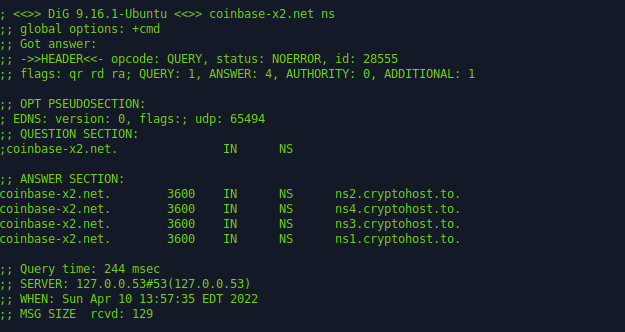
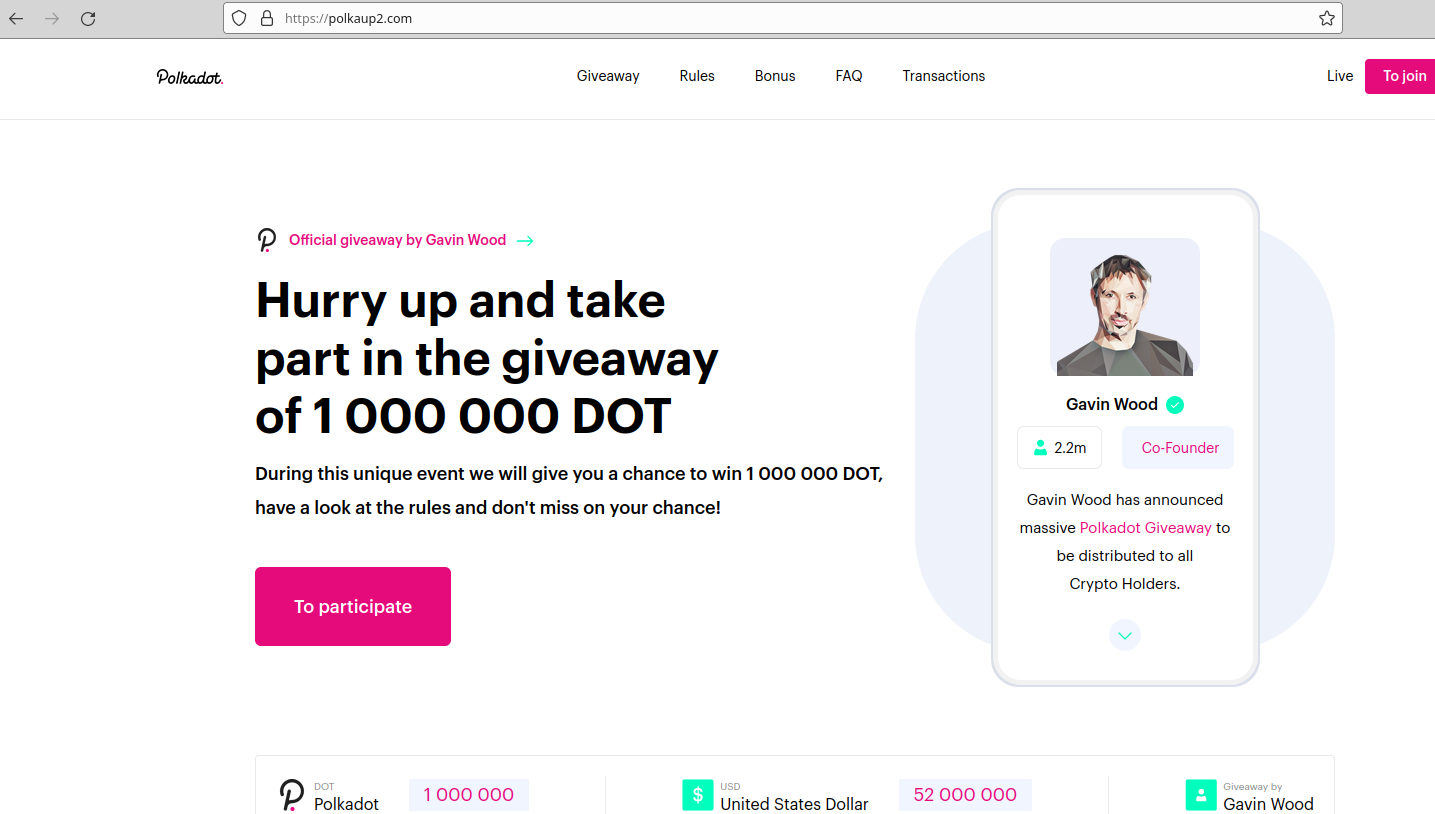
A dig into the Domain Name Server (DNS) records for Coinbase-x2[.]net shows it is hosted at a service called Cryptohost[.]to. Cryptohost also controls several other address ranges, including 194.31.98.X, which is currently home to even more crypto scam websites, many targeting lesser-known cryptocurrencies like Polkadot.
An ad posted to the Russian-language hacking forum BHF last month touted Cryptohost as a “bulletproof hosting provider for all your projects,” i.e., it can be relied upon to ignore abuse complaints about its customers.
“Why choose us? We don’t keep your logs!,” someone claiming to represent Cryptohost wrote to denizens of BHF.
Cryptohost says its service is backstopped by DDoS-Guard, a Russian company that has featured here recently for providing services to the sanctioned terrorist group Hamas and to the conspiracy theory groups QAnon/8chan.
A scam site at Cryptohost targeting Polkadot cryptocurrency holders.
Cryptohost did not respond to requests for comment.
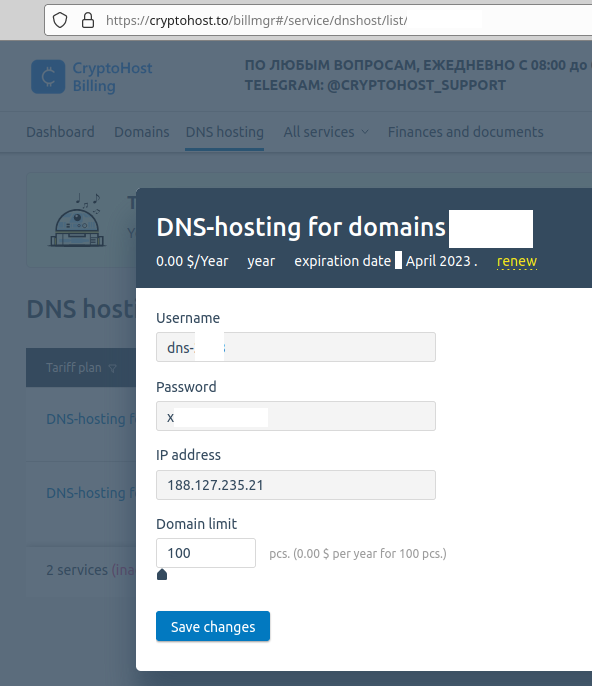
Signing up as a customer at Cryptohost presents a control panel that includes the IP address 188.127.235.21, which belongs to a hosting provider in Moscow called SmartApe. SmartApe says its main advantage is unlimited disk space, “which allows you to host an unlimited number of sites for little money.”
SmartApe CEO Mark Tepterev declined to comment on the allegations from FinTelegram, but said the company has thousands of clients, some of whom have their own clients.
Cryptohost’s customer panel, which points to an IP address at Russian hosting provider SmartApe.
“Also we host other hostings that have their own thousands of customers,” Tepterev said. “Of course, there are clients who use our services in their dubious interests. We immediately block such clients upon receipt of justified complaints.”
Much of the text used in these scam sites has been invoked verbatim in similar schemes dating back at least two years, and it’s likely that scam website templates are re-used so long as they continue to reel in new investors. Searching online for the phrase “During this unique event we will give you a chance to win” reveals many current and former sites tied to this scam.
While it may seem incredible that people will fall for stuff like this, such scams reliably generate decent profits. When Twitter got hacked in July 2020 and some of the most-followed celebrity accounts on Twitter started tweeting double-your-crypto offers, 383 people sent more than $100,000 in a few hours.
In Sept. 2021, the Bitcoin Foundation (bitcoin.org) was hacked, with the intruders placing a pop-up message on the site asking visitors to send money. The message said any sent funds would be doubled and returned, claiming that the Bitcoin Foundation had set up the program as a way of “giving back to the community.” The brief scam netted more than $17,000.
According to the U.S. Federal Trade Commission, nearly 7,000 people lost more than $80 million in crypto scams from October 2020 through March 2021 based on consumer fraud reports. That’s a significant jump from the year prior, when the FTC tracked just 570 cryptocurrency investment scam complaints totaling $7.5 million.
A recent report from blockchain analysis firm Chainalysis found that scammers stole approximately $14 billion worth of cryptocurrency in 2021 — nearly twice the $7.8 billion stolen by scammers in 2020, the report found.
In March, Australia’s competition watchdog filed a lawsuit against Facebook owner Meta Platforms, alleging the social media giant failed to prevent scammers using its platform to promote fake ads featuring well-known people. The complaint alleges the advertisements, which endorsed investment in cryptocurrency or money-making schemes, could have misled Facebook users into believing they were promoted by famous Australians.
In many ways, the crypto giveaway scam is a natural extension of perhaps the oldest cyber fraud in the book: Advanced-fee fraud. Most commonly associated with Nigerian Letter or “419” fraud and lottery/sweepstakes schemes, advanced fee scams promise a financial windfall if only the intended recipient will step up and claim what is rightfully theirs — and oh by the way just pay this small administrative fee and we’ll send the money.
What makes these double-your-crypto sites successful is not just ignorance and avarice, but the idea held by many novice investors that cryptocurrencies are somehow magical money-minting machines, or perhaps virtual slot machines that will eventually pay off if one simply deposits enough coinage.
Many organizations are already struggling to combat cybersecurity threats from ransomware purveyors and state-sponsored hacking groups, both of which tend to take days or weeks to pivot from an opportunistic malware infection to a full blown data breach. But few organizations have a playbook for responding to the kinds of virtual “smash and grab” attacks we’ve seen recently from LAPSUS$, a juvenile data extortion group whose short-lived, low-tech and remarkably effective tactics have put some of the world’s biggest corporations on edge.
Since surfacing in late 2021, LAPSUS$ has gained access to the networks or contractors for some of the world’s largest technology companies, including Microsoft, NVIDIA, Okta and Samsung. LAPSUS$ typically threatens to release sensitive data unless paid a ransom, but with most victims the hackers ended up publishing any information they stole (mainly computer source code).
Microsoft blogged about its attack at the hands of LAPSUS$, and about the group targeting its customers. It found LAPSUS$ used a variety of old-fashioned techniques that seldom show up in any corporate breach post-mortems, such as:
-targeting employees at their personal email addresses and phone numbers;
-offering to pay $20,000 a week to employees who give up remote access credentials;
-social engineering help desk and customer support employees at targeted companies;
-bribing/tricking employees at mobile phone stores to hijack a target’s phone number;
-intruding on their victims’ crisis communications calls post-breach.
If these tactics sound like something you might sooner expect from spooky, state-sponsored “Advanced Persistent Threat” or APT groups, consider that the core LAPSUS$ members are thought to range in age from 15 to 21. Also, LAPSUS$ operates on a shoestring budget and is anything but stealthy: According to Microsoft, LAPSUS$ doesn’t seem to cover its tracks or hide its activity. In fact, the group often announces its hacks on social media.
ADVANCED PERSISTENT TEENAGERS
This unusual combination makes LAPSUS$ something of an aberration that is probably more aptly referred to as “Advanced Persistent Teenagers,” said one CXO at a large organization that recently had a run-in with LAPSUS$.
“There is a lot of speculation about how good they are, tactics et cetera, but I think it’s more than that,” said the CXO, who spoke about the incident on condition of anonymity. “They put together an approach that industry thought suboptimal and unlikely. So it’s their golden hour.”
LAPSUS$ seems to have conjured some worst-case scenarios in the minds of many security experts, who worry what will happen when more organized cybercriminal groups start adopting these techniques.
“LAPSUS$ has shown that with only $25,000, a group of teenagers could get into organizations with mature cybersecurity practices,” said Amit Yoran, CEO of security firm Tenable and a former federal cybersecurity czar, testifying last week before the House Homeland Security Committee. “With much deeper pockets, focus, and mission, targeting critical infrastructure. That should be a sobering, if not terrifying, call to action.”
My CXO source said LAPSUS$ succeeds because they simply refuse to give up, and just keep trying until someone lets them in.
“They would just keep jamming a few individuals to get [remote] access, read some onboarding documents, enroll a new 2FA [two-factor authentication method] and exfiltrate code or secrets, like a smash-and-grab,” the CXO said. “These guys were not leet, just damn persistent.”
HOW DID WE GET HERE?
The smash-and-grab attacks by LAPSUS$ obscure some of the group’s less public activities, which according to Microsoft include targeting individual user accounts at cryptocurrency exchanges to drain crypto holdings.
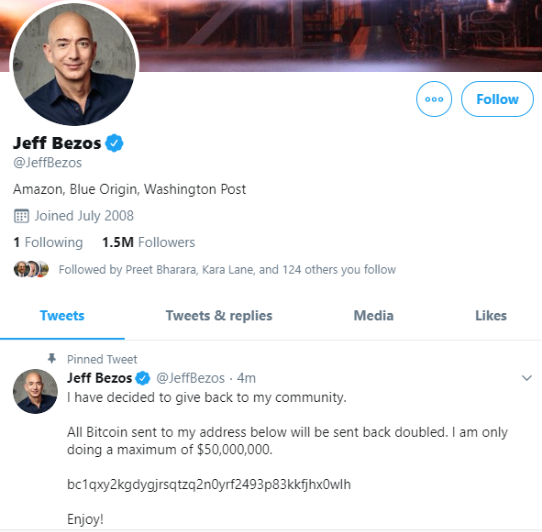
In some ways, the attacks from LAPSUS$ recall the July 2020 intrusion at Twitter, wherein the accounts for Apple, Bill Gates, Jeff Bezos, Kanye West, Uber and others were made to tweet messages inviting the world to participate in a cryptocurrency scam that promised to double any amount sent to specific wallets. The flash scam netted the perpetrators more than $100,000 in the ensuing hours.
The group of teenagers who hacked Twitter hailed from a community that traded in hacked social media accounts. This community places a special premium on accounts with short “OG” usernames, and some of its most successful and notorious members were known to use all of the methods Microsoft attributed to LAPSUS$ in the service of hijacking prized OG accounts.
The Twitter hackers largely pulled it off by brute force, writes Wired on the July 15, 2020 hack.
“Someone was trying to phish employee credentials, and they were good at it,” Wired reported. “They were calling up consumer service and tech support personnel, instructing them to reset their passwords. Many employees passed the messages onto the security team and went back to business. But a few gullible ones—maybe four, maybe six, maybe eight—were more accommodating. They went to a dummy site controlled by the hackers and entered their credentials in a way that served up their usernames and passwords as well as multifactor authentication codes.”
Twitter revealed that a key tactic of the group was “phone spear phishing” (a.k.a. “voice phishing” a.k.a. “vishing”). This involved calling up Twitter staffers using false identities, and tricking them into giving up credentials for an internal company tool that let the hackers reset passwords and multi-factor authentication setups for targeted users.
In August 2020, KrebsOnSecurity warned that crooks were using voice phishing to target new hires at major companies, impersonating IT employees and asking them to update their VPN client or log in at a phishing website that mimicked their employer’s VPN login page.
Two days after that story ran, the FBI and the Cybersecurity & Infrastructure Security Agency (CISA) issued their own warning on vishing, saying the attackers typically compiled dossiers on employees at specific companies by mass-scraping public profiles on social media platforms, recruiter and marketing tools, publicly available background check services, and open-source research. The joint FBI/CISA alert continued:
“Actors first began using unattributed Voice over Internet Protocol (VoIP) numbers to call targeted employees on their personal cellphones, and later began incorporating spoofed numbers of other offices and employees in the victim company. The actors used social engineering techniques and, in some cases, posed as members of the victim company’s IT help desk, using their knowledge of the employee’s personally identifiable information—including name, position, duration at company, and home address—to gain the trust of the targeted employee.”
“The actors then convinced the targeted employee that a new VPN link would be sent and required their login, including any 2FA [2-factor authentication] or OTP [one-time passwords]. The actor logged the information provided by the employee and used it in real-time to gain access to corporate tools using the employee’s account.”
Like LAPSUS$, these vishers just kept up their social engineering attacks until they succeeded. As KrebsOnSecurity wrote about the vishers back in 2020:
“It matters little to the attackers if the first few social engineering attempts fail. Most targeted employees are working from home or can be reached on a mobile device. If at first the attackers don’t succeed, they simply try again with a different employee.”
“And with each passing attempt, the phishers can glean important details from employees about the target’s operations, such as company-specific lingo used to describe its various online assets, or its corporate hierarchy.”
“Thus, each unsuccessful attempt actually teaches the fraudsters how to refine their social engineering approach with the next mark within the targeted organization.”
SMASH & GRAB
The primary danger with smash-and-grab groups like LAPSUS$ is not just their persistence but their ability to extract the maximum amount of sensitive information from their victims using compromised user accounts that typically have a short lifespan. After all, in many attacks, the stolen credentials are useful only so long as the impersonated employee isn’t also trying to use them.
This dynamic puts tremendous pressure on cyber incident response teams, which suddenly are faced with insiders who are trying frantically to steal everything of perceived value within a short window of time. On top of that, LAPSUS$ has a habit of posting screenshots on social media touting its access to internal corporate tools. These images and claims quickly go viral and create a public relations nightmare for the victim organization.
Single sign-on provider Okta experienced this firsthand last month, when LAPSUS$ posted screenshots that appeared to show Okta’s Slack channels and another with a Cloudflare interface. Cloudflare responded by resetting its employees’ Okta credentials.
Okta quickly came under fire for posting only a brief statement that said the screenshots LAPSUS$ shared were connected to a January 2022 incident involving the compromise of “a third-party customer support engineer working for one of our subprocessors,” and that “the matter was investigated and contained by the subprocessor.”
This assurance apparently did not sit well with many Okta customers, especially after LAPSUS$ began posting statements that disputed some of Okta’s claims. On March 25, Okta issued an apology for its handling of the January breach at a third-party support provider, which ultimately affected hundreds of its customers.
My CXO source said the lesson from LAPSUS$ is that even short-lived intrusions can have a long-term negative impact on victim organizations — especially when victims are not immediately forthcoming about the details of a security incident that affects customers.
“It does force us to think about insider access differently,” the CXO told KrebsOnSecurity. “Nation states have typically wanted longer, more strategic access; ransomware groups want large lateral movement. LAPSUS$ doesn’t care, it’s more about, ‘What can these 2-3 accounts get me in the next 6 hours?’ We haven’t optimized to defend that.”
Any organizations wondering what they can do to harden their systems against attacks from groups like LAPSUS$ should consult Microsoft’s recent blog post on the group’s activities, tactics and tools. Microsoft’s guidance includes recommendations that can help prevent account takeovers or at least mitigate the impact from stolen employee credentials.
On Tuesday, KrebsOnSecurity warned that hackers increasingly are using compromised government and police department email accounts to obtain sensitive customer data from mobile providers, ISPs and social media companies. Today, one of the U.S. Senate’s most tech-savvy lawmakers said he was troubled by the report and is now asking technology companies and federal agencies for information about the frequency of such schemes.
At issue are forged “emergency data requests,” (EDRs) sent through hacked police or government agency email accounts. Tech companies usually require a search warrant or subpoena before providing customer or user data, but any police jurisdiction can use an EDR to request immediate access to data without a warrant, provided the law enforcement entity attests that the request is related to an urgent matter of life and death.
As Tuesday’s story showed, hackers have figured out there is no quick and easy way for a company that receives one of these EDRs to know whether it is legitimate. After all, there are roughly 18,000 distinct police organizations in the United States alone, and many thousands of government and police agencies worldwide.
Criminal hackers exploiting that ambiguity are enjoying remarkable success rates gaining access to the data they’re after, and some are now selling EDRs as a service to other crooks online.
This week’s piece included confirmation from social media platform Discord about a fraudulent EDR they recently processed. On Wednesday, Bloombergpublished a story confirming that both Apple and Meta/Facebook have recently complied with fake EDRs.
Today, KrebsOnSecurity heard from Sen. Ron Wyden (D-Ore.), who said he was moved to action after reading this week’s coverage.
“Recent news reports have revealed an enormous threat to Americans’ safety and national security,” Wyden said in a statement provided to KrebsOnSecurity. “I’m particularly troubled by the prospect that forged emergency orders may be coming from compromised foreign law enforcement agencies, and then used to target vulnerable individuals.”
“I’m requesting information from tech companies and multiple federal agencies to learn more about how emergency data requests are being abused by hackers,” Wyden’s statement continues. “No one wants tech companies to refuse legitimate emergency requests when someone’s safety is at stake, but the current system has clear weaknesses that need to be addressed. Fraudulent government requests are a significant concern, which is why I’ve already authored legislation to stamp out forged warrants and subpoenas.”
Tuesday’s story showed how fraudulently obtained EDRs were a tool used by members of LAPSUS$, the data extortion group that recently hacked Microsoft, NVIDIA, Okta and Samsung. And it tracked the activities of a teenage hacker from the United Kingdom who was reportedly arrested multiple times for sending fake EDRs.
That was in March 2021, but there are similar fake EDR services on offer today. One example can be found on Telegram, wherein a member who favors the handle “Bug” has for the past month been selling access to various police and government email accounts.
All of the access Bug is currently offering was allegedly stolen from non-U.S. police and government email accounts, including a police department in India; a government ministry of the United Arab Emirates; the Brazilian Secretariat of Education; and Saudi Arabia’s Ministry of Education.
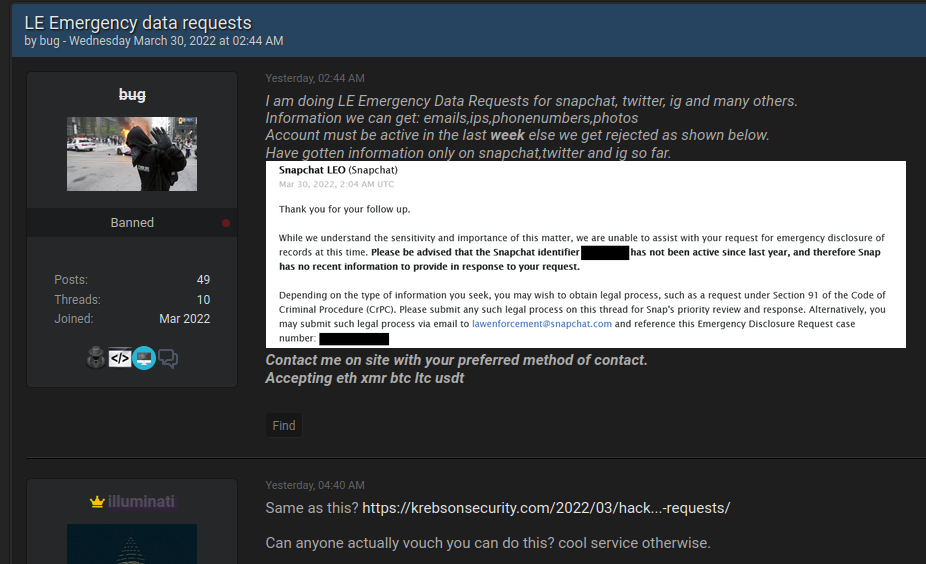
On Mar. 30, Bug posted a sales thread to the cybercrime forum Breached[.]co saying he could be hired to perform fake EDRs on targets at will, provided the account was recently active.
“I am doing LE Emergency Data Requests for snapchat, twitter, ig [Instagram] and many others,” Bug wrote. “Information we can get: emails, IPs, phone numbers, photos. Account must be active in the last week else we get rejected as shown below. Have gotten information only on Snapchat, Twitter and IG so far.”
An individual using the nickname “Bug” has been selling access to government and police email accounts for more than a month. Bug posted this sales thread on Wednesday.
KrebsOnSecurity sought comment from Instagram, Snapchat, and Twitter. This post will be updated in the event they respond.
The current scourge of fraudulent EDRs illustrates the dangers of relying solely on email to process legal requests for privileged subscriber data. In July 2021, Sen. Wyden and others introduced new legislation to combat the growing use of counterfeit court orders by scammers and criminals. The bill calls for funding for state and tribal courts to adopt widely available digital signature technology that meets standards developed by the National Institute of Standards and Technology.
“Forged court orders, usually involving copy-and-pasted signatures of judges, have been used to authorize illegal wiretaps and fraudulently take down legitimate reviews and websites by those seeking to conceal negative information and past crimes,” the lawmakers said in a statement introducing their bill.
The Digital Authenticity for Court Orders Act would require federal, state and tribal courts to use a digital signature for orders authorizing surveillance, domain seizures and removal of online content.
There is a terrifying and highly effective “method” that criminal hackers are now using to harvest sensitive customer data from Internet service providers, phone companies and social media firms. It involves compromising email accounts and websites tied to police departments and government agencies, and then sending unauthorized demands for subscriber data while claiming the information being requested can’t wait for a court order because it relates to an urgent matter of life and death.
In the United States, when federal, state or local law enforcement agencies wish to obtain information about who owns an account at a social media firm, or what Internet addresses a specific cell phone account has used in the past, they must submit an official court-ordered warrant or subpoena.
Virtually all major technology companies serving large numbers of users online have departments that routinely review and process such requests, which are typically granted as long as the proper documents are provided and the request appears to come from an email address connected to an actual police department domain name.
But in certain circumstances — such as a case involving imminent harm or death — an investigating authority may make what’s known as an Emergency Data Request (EDR), which largely bypasses any official review and does not require the requestor to supply any court-approved documents.
It is now clear that some hackers have figured out there is no quick and easy way for a company that receives one of these EDRs to know whether it is legitimate. Using their illicit access to police email systems, the hackers will send a fake EDR along with an attestation that innocent people will likely suffer greatly or die unless the requested data is provided immediately.
In this scenario, the receiving company finds itself caught between two unsavory outcomes: Failing to immediately comply with an EDR — and potentially having someone’s blood on their hands — or possibly leaking a customer record to the wrong person.
“We have a legal process to compel production of documents, and we have a streamlined legal process for police to get information from ISPs and other providers,” said Mark Rasch, a former prosecutor with the U.S. Department of Justice.
“And then we have this emergency process, almost like you see on [the television series] Law & Order, where they say they need certain information immediately,” Rasch continued. “Providers have a streamlined process where they publish the fax or contact information for police to get emergency access to data. But there’s no real mechanism defined by most Internet service providers or tech companies to test the validity of a search warrant or subpoena. And so as long as it looks right, they’ll comply.”
To make matters more complicated, there are tens of thousands of police jurisdictions around the world — including roughly 18,000 in the United States alone — and all it takes for hackers to succeed is illicit access to a single police email account.
THE LAPSUS$ CONNECTION
The reality that teenagers are now impersonating law enforcement agencies to subpoena privileged data on their targets at whim is evident in the dramatic backstory behind LAPSUS$, the data extortion group that recently hacked into some of the world’s most valuable technology companies, including Microsoft, Okta, NVIDIA and Vodafone.
In a blog post about their recent hack, Microsoft said LAPSUS$ succeeded against its targets through a combination of low-tech attacks, mostly involving old-fashioned social engineering — such as bribing employees at or contractors for the target organization.
“Other tactics include phone-based social engineering; SIM-swapping to facilitate account takeover; accessing personal email accounts of employees at target organizations; paying employees, suppliers, or business partners of target organizations for access to credentials and multi-factor authentication (MFA) approval; and intruding in the ongoing crisis-communication calls of their targets,” Microsoft wrote of LAPSUS$.
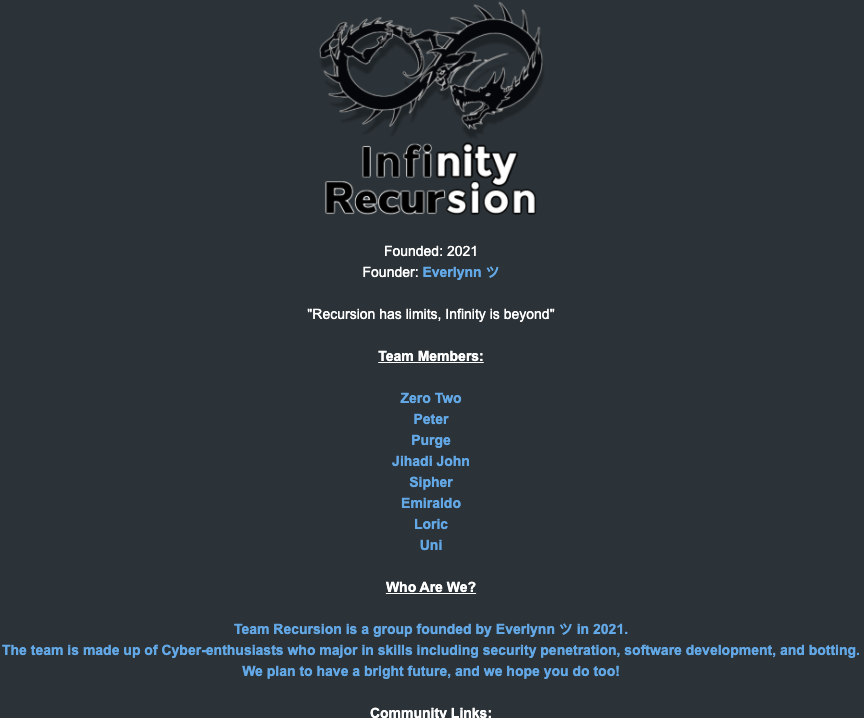
The roster of the now-defunct “Infinity Recursion” hacking team, from which some members of LAPSUS$ allegedly hail.
Researchers from security firms Unit 221B and Palo Alto Networks say that prior to launching LAPSUS$, the group’s leader “White” (a.k.a. “WhiteDoxbin,” “Oklaqq”) was a founding member of a cybercriminal group calling itself the “Recursion Team.” This group specialized in SIM swapping targets of interest and participating in “swatting” attacks, wherein fake bomb threats, hostage situations and other violent scenarios are phoned in to police as part of a scheme to trick them into visiting potentially deadly force on a target’s address.
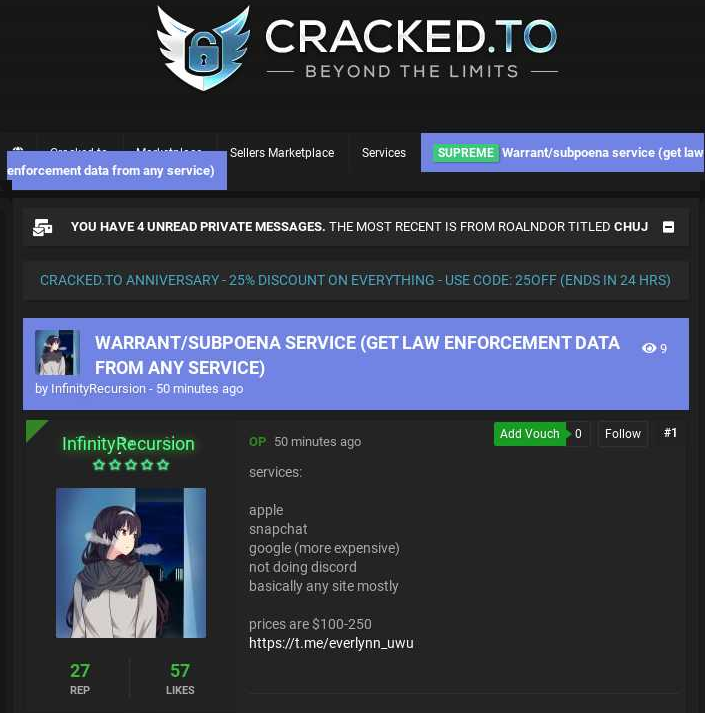
The founder of the Recursion Team was a then 14-year-old from the United Kingdom who used the handle “Everlynn.” On April 5, 2021, Everlynn posted a new sales thread to the cybercrime forum cracked[.]to titled, “Warrant/subpoena service (get law enforcement data from any service).” The price: $100 to $250 per request.
Everlynn advertising a warrant/subpoena service based on fake EDRs. Image: Ke-la.com.
“Services [include] Apple, Snapchat, Google (more expensive), not doing Discord, basically any site mostly,” read Everlynn’s ad, which was posted by the user account “InfinityRecursion.”
A month prior on Cracked, Everlynn posted a sales thread, “1x Government Email Account || BECOME A FED!,” which advertised the ability to send email from a federal agency within the government of Argentina.
“I would like to sell a government email that can be used for subpoena for many companies such as Apple, Uber, Instagram, etc.,” Everlynn’s sales thread explained, setting the price at $150. “You can breach users and get private images from people on SnapChat like nudes, go hack your girlfriend or something haha. You won’t get the login for the account, but you’ll basically obtain everything in the account if you play your cards right. I am not legally responsible if you mishandle this. This is very illegal and you will get raided if you don’t use a vpn. You can also breach into the government systems for this, and find LOTS of more private data and sell it for way, way more.”
It remains unclear whether White or Everlynn were among those detained; U.K. police declined to name the suspects. But White’s real-life identity became public recently after he crossed the wrong people.
The de-anonymization of the LAPSUS$ leader began late last year after he purchased a website called Doxbin, a long-running and highly toxic online community that is used to “dox” or post deeply personal information on people.
Based on the feedback posted by Doxbin members, White was not a particularly attentive administrator. Longtime members soon took to harassing him about various components of the site falling into disrepair. That pestering eventually prompted White to sell Doxbin back to its previous owner at a considerable loss. But before doing so, White leaked the Doxbin user database.
White’s leak triggered a swift counterpunch from Doxbin’s staff, which naturally responded by posting on White perhaps the most thorough dox the forum had ever produced.
KrebsOnSecurity recently interviewed the past and current owner of the Doxbin — an established hacker who goes by the handle “KT.” According to KT, it is becoming more common for hackers to use EDRs for stalking, hacking, harassing and publicly humiliating others.
KT shared several recent examples of fraudulent EDRs obtained by hackers who bragged about their success with the method.
“Terroristic threats with a valid reason to believe somebody’s life is in danger is usually the go-to,” KT said, referring to the most common attestation that accompanies a fake EDR.
One of the phony EDRs shared by KT targeted an 18-year-old from Indiana, and was sent to the social media platform Discord earlier this year. The document requested the Internet address history of Discord accounts tied to a specific phone number used by the target. Discord complied with the request.
“Discord replies to EDRs in 30 minutes to one hour with the provided information,” KT claimed.
Asked about the validity of the unauthorized EDR shared by KT, Discord said the request came from a legitimate law enforcement account that was later determined to have been compromised.
“We can confirm that Discord received requests from a legitimate law enforcement domain and complied with the requests in accordance with our policies,” Discord said in a written statement. “We verify these requests by checking that they come from a genuine source, and did so in this instance. While our verification process confirmed that the law enforcement account itself was legitimate, we later learned that it had been compromised by a malicious actor. We have since conducted an investigation into this illegal activity and notified law enforcement about the compromised email account.”
KT said fake EDRs don’t have to come from police departments based in the United States, and that some people in the community of those sending fake EDRs are hacking into police department emails by first compromising the agency’s website. From there, they can drop a backdoor “shell” on the server to secure permanent access, and then create new email accounts within the hacked organization.
In other cases, KT said, hackers will try to guess the passwords of police department email systems. In these attacks, the hackers will identify email addresses associated with law enforcement personnel, and then attempt to authenticate using passwords those individuals have used at other websites that have been breached previously.
“A lot of governments overseas are using WordPress, and I know a kid on Telegram who has multiple shells on gov sites,” KT said. “It’s near impossible to get U.S. dot-govs nowadays, although I’ve seen a few people with it. Most govs use [Microsoft] Outlook, so it’s more difficult because theres usually some sort of multi-factor authentication. But not all have it.”
According to KT, Everlynn and White recently had a falling out, with White paying KT to publish a dox on Everlynn and to keep it pinned to the site’s home page. That dox states that Everlynn is a 15-year-old from the United Kingdom who has used a variety of monikers over the past year alone, including “Miku” and “Anitsu.”
KT said Everlynn’s dox is accurate, and that the youth has been arrested multiple times for issuing fake EDRs. But KT said each time Everlynn gets released from police custody, he goes right back to committing the same cybercrimes.
“Anitsu (Miku, Everlynn), an old staff member of Doxbin, was arrested probably 4-5 months ago for jacking government emails used for EDR’ing,” KT said. “White and him are not friends anymore though. White paid me a few weeks ago to pin his dox on Doxbin. Also, White had planned to use EDRs against me, due to a bet we had planned; dox for dox, winner gets 1 coin.”
A FUNDAMENTALLY UNFIXABLE PROBLEM?
Nicholas Weaver, a security specialist and lecturer at the University of California, Berkeley, said one big challenge to combating fraudulent EDRs is that there is fundamentally no notion of global online identity.
“The only way to clean it up would be to have the FBI act as the sole identity provider for all state and local law enforcement,” Weaver said. “But even that won’t necessarily work because how does the FBI vet in real time that some request is really from some podunk police department?”
It’s not clear that the FBI would be willing or able to take on such a task. In November 2021, KrebsOnSecurity broke the news that hackers sent a fake email alert to thousands of state and local law enforcement entities through the FBI’s Law Enforcement Enterprise Portal (LEEP). In that attack, the intruders abused a fairly basic and dangerous coding error on the website, and the fake emails all came from a real fbi.gov address.
The phony message sent in November 2021 via the FBI’s email system.
The particulars of how the FBI’s LEEP portal got hacked were provided by Pompompurin, the handle chosen by an individual who’s been involved in countless data breaches at major companies. But Doxbin’s KT told KrebsOnSecurity this week that White was the one who initially discovered the LEEP portal security weakness.
“White originally found that,” KT said. “Pom just took credit.”
KrebsOnSecurity asked the FBI whether it had any indication that its own systems were used for unauthorized EDRs. The FBI declined to answer that question, but confirmed it was aware of different schemes involving phony EDRs targeting both the public and the agency’s private sector partners.
“We take these reports seriously and vigorously pursue them,” reads a written statement shared by the FBI. “Visit this page for tips and resources to verify the information you are receiving. If you believe you are a victim of an emergency data request scheme, please report to www.ic3.gov or contact your local FBI field office.”
Rasch said while service providers need more rigorous vetting mechanisms for all types of legal requests, getting better at spotting unauthorized EDRs would require these companies to somehow know and validate the names of every police officer in the United States.
“One of the problems you have is there’s no validated master list of people who are authorized to make that demand,” Rasch said. “And that list is going to change all the time. But even then, the entire system is only as secure as the least secure individual police officer email account.”
Weaver said what probably keeps fraudulent EDRs from being more common is that most people in the criminal hacking community perceive it as too risky. This is supported by the responses in discussion threads across multiple hacking forums where members sought out someone to perform an EDR on their behalf.
“It’s highly risky if you get caught,” Weaver said. “But doing this is not a matter of skill. It’s one of will. It’s a fundamentally unfixable problem without completely redoing how we think about identity on the Internet on a national scale.”
The current situation with fraudulent EDRs illustrates the dangers of relying solely on email to process legal requests for highly sensitive subscriber data. In July 2021, a bipartisan group of U.S. senators introduced new legislation to combat the growing use of counterfeit court orders by scammers and criminals. The bill calls for funding for state and tribal courts to adopt widely available digital signature technology that meets standards developed by the National Institute of Standards and Technology.
“Forged court orders, usually involving copy-and-pasted signatures of judges, have been used to authorize illegal wiretaps and fraudulently take down legitimate reviews and websites by those seeking to conceal negative information and past crimes,” the lawmakers said in a statement introducing their bill.
The Digital Authenticity for Court Orders Act would require federal, state and tribal courts to use a digital signature for orders authorizing surveillance, domain seizures and removal of online content.
An Estonian man was sentenced today to more than five years in a U.S. prison for his role in at least 13 ransomware attacks that caused losses of approximately $53 million. Prosecutors say the accused also enjoyed a lengthy career of “cashing out” access to hacked bank accounts worldwide.
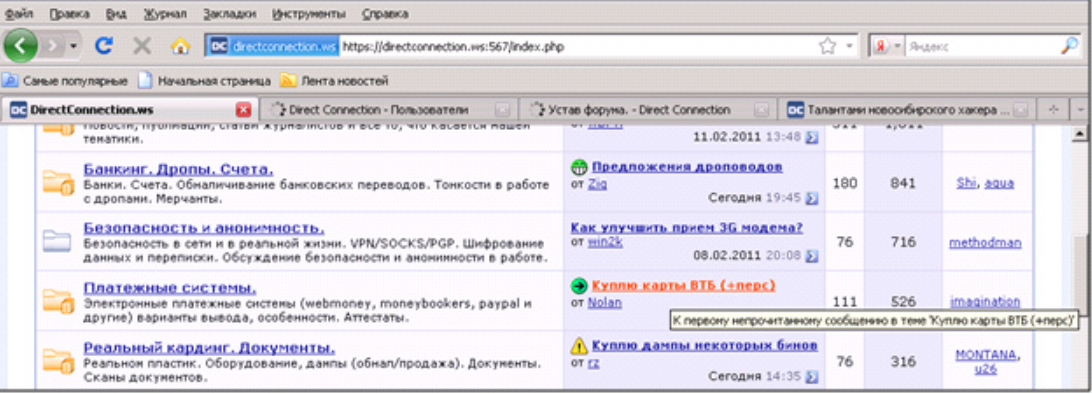
Maksim Berezan, 37, is an Estonian national who was arrested nearly two years ago in Latvia. U.S. authorities alleged Berezan was a longtime member of DirectConnection, a closely-guarded Russian cybercriminal forum that existed until 2015. Berezan’s indictment (PDF) says he used his status at DirectConnection to secure cashout jobs from other vetted crooks on the exclusive crime forum.
Berezan specialized in cashouts and “drops.” Cashouts refer to using stolen payment card data to make fraudulent purchases or to withdraw money from bank accounts without authorization. A drop is a location or individual able to securely receive and forward funds or goods obtained through cashouts or other types of fraud. Drops typically are used to make it harder for law enforcement to trace fraudulent transactions and to circumvent fraud detection measures used by banks and credit card companies.
Acting on information from U.S. authorities, in November 2020 Latvian police searched Berezan’s residence there and found a red Porsche Carrera 911, a black Porsche Cayenne, a Ducati motorcycle, and an assortment of jewelry. They also seized $200,000 in currency, and $1.7 million in bitcoin.
After Berezan was extradited to the United States in December 2020, investigators searching his electronic devices said they found “significant evidence of his involvement in ransomware activity.”
“The post-extradition investigation determined that Berezan had participated in at least 13 ransomware attacks, 7 of which were against U.S. victims, and that approximately $11 million in ransom payments flowed into cryptocurrency wallets that he controlled,” reads a statement from the U.S. Department of Justice.
Berezan pleaded guilty in April 2021 to conspiracy to commit wire fraud.
The DirectConnection cybercrime forum, circa 2011.
For many years on DirectConnection and other crime forums, Berezan went by the hacker alias “Albanec.” Investigators close to the case told KrebsOnSecurity that Albanec was involved in multiple so-called “unlimited” cashouts, a highly choreographed, global fraud scheme in which crooks hack a bank or payment card processor and used cloned payment cards at cash machines around the world to fraudulently withdraw millions of dollars in just a few hours.
Berezan joins a growing list of top cybercriminals from DirectConnection who’ve been arrested and convicted of cybercrimes since the forum disappeared years ago. One of Albanec’s business partners on the forum was Sergey “Flycracker” Vovnenko, a Ukrainian man who once ran his own cybercrime forum and who in 2013 executed a plot to have heroin delivered to our home in a bid to get Yours Truly arrested for drug possession. Vovnenko was later arrested, extradited to the United States, pleaded guilty and spent more than three years in prison on botnet-related charges (Vovnenko is now back in Ukraine, trying to fight the Russian invasion with his hacking abilities).
Perhaps the most famous DirectConnection member was its administrator Aleksei Burkov, a Russian hacker thought to be so connected to the Russian cybercriminal scene that he was described as an “asset of extreme importance to Moscow.” Burkov was arrested in Israel in 2015, and the Kremlin arrested an Israeli woman on trumped-up drug charges to force a prisoner swap.
Other notable cybercrooks from DirectConnection who’ve been arrested, extradited to the U.S. and sentenced to prison include convicted credit card fraudsters Vladislav “Badb” Horohorin and Sergey “zo0mer” Kozerev, as well as the infamous spammer and botnet master Peter “Severa” Levashov.
At his sentencing today, Berezan was sentenced to 66 months in prison and ordered to pay $36 million in restitution to his victims. A source close to the investigation said Berezan’s sentence likely would have been far more severe had he not entered into a cooperation agreement to share useful information with U.S. authorities.
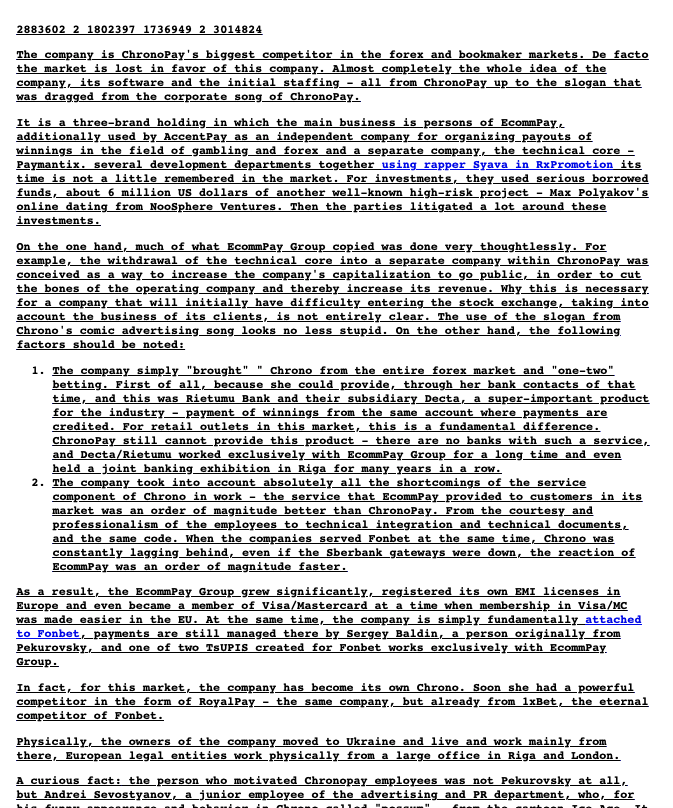
Pavel Vrublevsky, founder of the Russian payment technology firm ChronoPay and the antagonist in my 2014 book “Spam Nation,” was arrested in Moscow this month and charged with fraud. Russian authorities allege Vrublevsky operated several fraudulent SMS-based payment schemes, and facilitated money laundering for Hydra, the largest Russian darknet market. But according to information obtained by KrebsOnSecurity, it is equally likely Vrublevsky was arrested thanks to his propensity for carefully documenting the links between Russia’s state security services and the cybercriminal underground.
An undated photo of Vrublevsky at his ChronoPay office in Moscow.
ChronoPay specializes in providing access to the global credit card networks for “high risk” merchants — businesses involved in selling services online that tend to generate an unusually large number of chargebacks and reports of fraud, and hence have a higher risk of failure.
Using the hacker alias “RedEye,” the ChronoPay CEO oversaw a burgeoning pharmacy spam affiliate program called Rx-Promotion, which paid some of Russia’s most talented spammers and virus writers to bombard the world with junk email promoting Rx-Promotion’s pill shops. RedEye also was the administrator of Crutop, a Russian language forum and affiliate program that catered to thousands of adult webmasters.
In 2013, Vrublevsky was sentenced to 2.5 years in a Russian penal colony for convincing one of his top affiliates to launch a distributed denial-of-service (DDoS) attack against a competitor that shut down the ticketing system for the state-owned Aeroflot airline.
Following his release from jail, Vrublevsky began working on a new digital payments platform based in Hong Kong called HPay Ltd (a.k.a. Hong Kong Processing Corporation). HPay appears to have had a great number of clients that were running schemes which bamboozled people with fake lotteries and prize contests.
According to Russian prosecutors, the scam went like this: Consumers would receive an SMS with links to sites that falsely claimed a number of well-known companies were sponsoring drawings and lotteries for people who enrolled or agreed to answer surveys. All who responded were told they were winners, but also that they had to pay a commission to pick up the prize. That scheme allegedly stole 500 million rubles (~ USD $4.5 million) from over 100,000 consumers.
There are scant public records that show a connection between ChronoPay and HPay, apart from the fact that the latter’s website — hpay[.]io — was originally hosted on the same server (185.111.218.63) along with a handful of other domains, including Vrublevsky’s personal website rnp[.]com.
But then earlier this month, KrebsOnSecurity received a large amount of information that was stolen from ChronoPay recently when hackers managed to compromise the company’s Confluence server. Confluence is a web-based corporate wiki platform, and ChronoPay used their Confluence installation to document in exquisite detail how it creatively distributes the risk associated with high-risk processing by routing transactions through a myriad of shell companies and third-party processors.
A Google-translated snippet of the hacked ChronoPay Confluence installation. Click to enlarge.
Incredibly, Vrublevsky himself appears to have used ChronoPay’s Confluence wiki to document his entire 20+ years of personal and professional history in the high-risk payments space, including the company’s most recent forays with HPay. The latest document in the hacked archive is dated April 2021.
These diary entries, interspersed between highly technical how-tos, are all written in Russian and in the third person. But they are unmistakably Vrublevsky’s words: Some of the elaborate stories in the wiki were identical to theories that Vrublevsky himself espoused to me throughout hundreds of hours of phone interviews. Also, in some of the entries the narrator switches from “he” to “I” when describing the actions of Vrublevsky.
Vrublevsky’s memoire/wiki invokes the nicknames and real names of Russian hackers who worked with the protection of corrupt officials in the Russian Federal Security Service (FSB), the successor agency to the Soviet KGB. In several diary entries, Vrublevsky writes about various cybercriminals and Russian law enforcement officials involved in processing credit card payments tied to online gambling sites.
Russian banks are prohibited from processing payments for online gambling, and as a result many online gaming sites catering to Russian speakers have chosen to process credit card payments through Ukrainian financial institutions.
That’s according to Vladislav “BadB” Horohorin, the convicted cybercriminal who shared the ChronoPay Confluence data with KrebsOnSecurity. In February 2017, Horohorin was released after serving four years in a U.S. prison for his role in the 2009 theft of more than $9 million from RBS Worldpay.
Horohorin said Vrublevsky has been using his knowledge of the card processing networks to extort people in the online gambling industry who may run afoul of Russian laws.
“Russia has strict regulations against processing for the gambling business,” Horohorin said. “While Russian banks can’t do it, Ukrainian ones can, so we have Ukrainian banks processing gambling and casinos, which mostly Russian gamblers use. What Pavel does is he blackmails those Ukrainian banks using his connections and knowledge. Some pay, some don’t. But some people are not very tolerant of that kind of abuse.”
A native of Donetsk, Ukraine, Horohorin told KrebsOnSecurity he hacked and shared the ChronoPay Confluence installation because Vrublevsky had threatened a family member. Horohorin believes Vrublevsky secretly operated the “bad bank” channel on Telegram, which calls attention to online gambling operations that are violating Visa and MasterCard regulations (violations that can bring the violator hundreds of thousands of dollars in fines).
“Pavel scrupulously wrote his diary for a long time, and there is a lot of information on the people he knows,” Horohorin told KrebsOnSecurity. “My understanding is he wrote this in order to blackmail people later. There is a lot of interesting stuff, a lot of names and a lot of very intimate info about Russian card processing market, as well as Pavel’s own escapades.”
ChronoPay’s hacked Confluence server contains many diary entries about major players in the Russian online gambling and bookmaking industries.
Among the escapades recounted in the ChronoPay founder’s diaries are multiple stories involving the self-proclaimed “King of Fraud!” Aleksandr “Nastra” Zhukov, a Russian national who ran an advertising fraud network dubbed “Methbot” that stole $7 million from publishers through bots made to look like humans watching videos online.
The journal explains that Zhukov lived with a ChronoPay employee and had a great deal of interaction with ChronoPay’s high-risk department, so much so that Zhukov at one point gave Vrublevsky a $100,000 jeweled watch as a gift. Zukhov was arrested in Bulgaria in 2018 and extradited to the United States. Following a jury trial in New York that ended last year, Zhukov was sentenced to 10 years in prison.
According to the Russian news outlet Kommersant, Vrublevsky and company operated “Inferno Pay,” a payments portal that worked with Hydra, the largest Russian darknet market for illicit goods, including drug trafficking, malware, and counterfeit money and documents.
Inferno Pay, a cryptocurrency and payment API allegedly operated by the ChronoPay CEO.
“The services of Inferno Pay, whose commission came to 30% of the transaction, were actively used by online casinos,” Kommersant wrote on Mar. 12.
Kommersant said Russian authorities also searched the dwelling of Dmitry Artimovich, a former ChronoPay director who along with his brother Igor was responsible for running the Festi botnet, the same spam botnet that was used for years to pump out junk emails promoting Vrublevsky’s pharmacy affiliate websites. Festi also was the botnet used in the DDoS attack that sent Vrubelvsky to prison for two years in 2013.
Artimovich says he had a falling out with Vrublevsky roughly five years ago, and he’s been suing the company ever since. In a message to KrebsOnSecurity, Artimovich said while Vrublevsky was involved in a lot of shady activities, he doubts Vrublevksy’s arrest was really about SMS payment scams as the government claims.
“I do not think that it was a reason for his arrest,” Artimovich said. “Our law enforcement usually don’t give a shit about sites like this. And I don’t think that Vrublevsky made much money there. I believe he angered some high-ranking person. Because the scale of the case is much larger than Aeroflot. Police made search of 22 people. Illegal seizure of money, computers.”
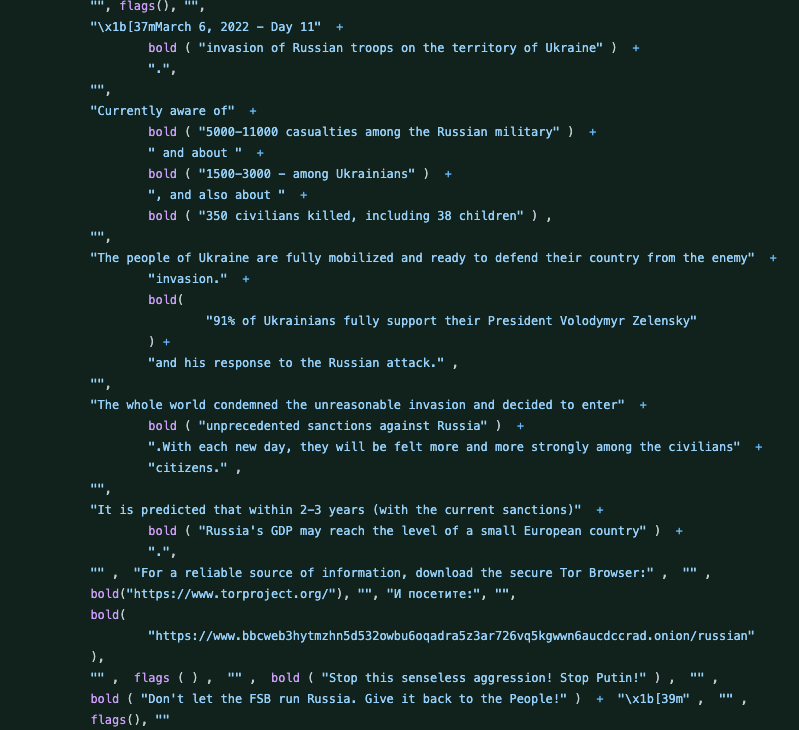
Researchers are tracking a number of open-source “protestware” projects on GitHub that have recently altered their code to display “Stand with Ukraine” messages for users, or basic facts about the carnage in Ukraine. The group also is tracking several code packages that were recently modified to erase files on computers that appear to be coming from Russian or Belarusian Internet addresses.
The upstart tracking effort is being crowdsourced via Telegram, but the output of the Russian research group is centralized in a Google Spreadsheet that is open to the public. Most of the GitHub code repositories tracked by this group include relatively harmless components that will either display a simple message in support of Ukraine, or show statistics about the war in Ukraine — such as casualty numbers — and links to more information on the Deep Web.
For example, the popular library ES5-ext hadn’t updated its code in nearly two years. But on March 7, the code project added a component “postinstall.js,” which checks to see if the user’s computer is tied to a Russian Internet address. If so, the code broadcasts a “Call for peace:”
A message that appears for Russian users of the popular es5-ext code library on GitHub. The message has been Google-Translated from Russian to English.
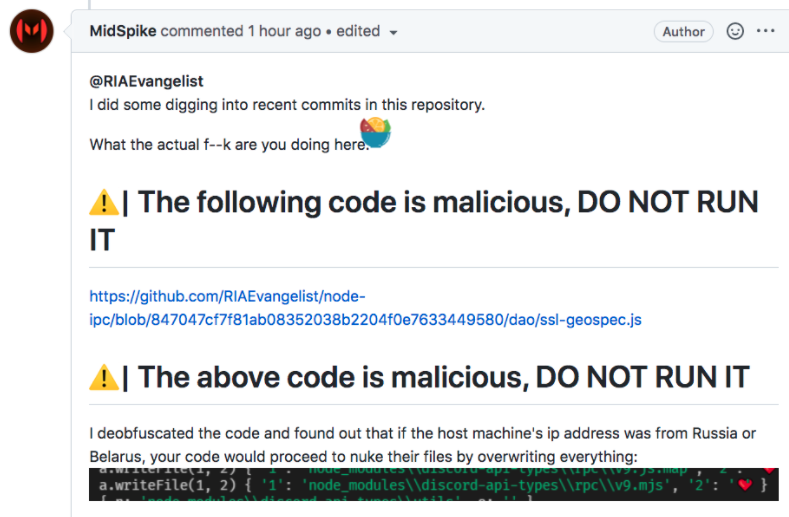
A more concerning example can be found at the GitHub page for “vue-cli,” a popular Javascript framework for building web-based user interfaces. On March 15, users discovered a new component had been added that was designed to wipe all files from any systems visiting from a Russian or Belarusian Internet address (the malicious code has since been removed):
Readers complaining that an update to the popular Vue-Cli package sought to wipe files if the user was coming from a Russian IP address.
“Man, I love politics in my APIs,” GitHub user “MSchleckser” commented wryly on Mar. 15.
The crowdsourced effort also blacklisted a code library called “PeaceNotWar” maintained by GitHub user RIAEvangelist.
“This code serves as a non-destructive example of why controlling your node modules is important,” RIAEvangelist wrote. “It also serves as a non-violent protest against Russia’s aggression that threatens the world right now. This module will add a message of peace on your users’ desktops, and it will only do it if it does not already exist just to be polite. To include this module in your code, just run npm i peacenotwar in your code’s directory or module root.”
Alex Holden is a native Ukrainian who runs the Minneapolis-based cyber intelligence firm Hold Security. Holden said the real trouble starts when protestware is included in code packages that get automatically fetched by a myriad of third-party software products. Holden said some of the code projects tracked by the Russian research group are maintained by Ukrainian software developers.
“Ukrainian and sadly non-Ukrainian developers are modifying their public software to trigger malware or pro-Ukraine ads when deployed on Russian computers,” Holden said. “And we see this effort, which is the Russians trying to defend against that.”
Commenting on the malicious code added to the “Vue-cli” application, GitHub user “nm17” said a continued expansion of protestware would erode public trust in open-source software.
“The Pandora’s box is now opened, and from this point on, people who use opensource will experience xenophobia more than ever before, EVERYONE included,” NM17 wrote. “The trust factor of open source, which was based on good will of the developers is now practically gone, and now, more and more people are realizing that one day, their library/application can possibly be exploited to do/say whatever some random dev on the internet thought ‘was the right thing they to do.’ Not a single good came out of this ‘protest.’”
Aleksei Burkov, seated second from right, attends a hearing in Jerusalem in 2015. Image: Andrei Shirokov / Tass via Getty Images.
Aleksei Burkov, a cybercriminal who long operated two of Russia’s most exclusive underground hacking forums, was arrested in 2015 by Israeli authorities. The Russian government fought Burkov’s extradition to the U.S. for four years — even arresting and jailing an Israeli woman to force a prisoner swap. That effort failed: Burkov was sent to America, pleaded guilty, and was sentenced to nine years in prison. But a little more than a year later, he was quietly released and deported back to Russia. Now some Republican lawmakers are asking why a Russian hacker once described as “an asset of supreme importance” was allowed to shorten his stay.
A native of St. Petersburg, Russia, Burkov admitted to running CardPlanet, a site that sold more than 150,000 stolen credit card accounts, and to being a founder of DirectConnection — a closely guarded online community that attracted some of the world’s most-wanted Russian hackers.
But Burkov’s cybercriminal activities spanned far beyond mere credit card fraud. A 2019 deep dive into Burkov’s hacker alias “K0pa” revealed he also was co-administrator of the secretive Russian cybercrime forum “Mazafaka.” Like DirectConnection, Mazafaka’s member roster was a veritable “Who’s Who?” of the Russian hacker underground, and K0pa played a key role in vetting new members and settling disputes for both communities.
K0pa’s elevated status in the Russian cybercrime community made him one of the most connected malicious hackers ever apprehended by U.S. authorities. As I wrote at the time of Burkov’s extradition, the Kremlin was probably concerned that he simply knew too much about Russia’s propensity to outsource certain activities to its criminal hacker community.
“To my knowledge, no one has accused Burkov of being some kind of cybercrime fixer or virtual badguy Rolodex for the Russian government,” KrebsOnSecurity wrote in 2019. “On the other hand, from his onetime lofty perch atop some of the most exclusive Russian cybercrime forums, K0pa certainly would have fit that role nicely.”
Burkov was arrested in December 2015 on an international warrant while visiting Israel, and over the ensuing four years the Russian government aggressively sought to keep him from being extradited to the United States.
When Israeli authorities turned down requests to send him back to Russia — supposedly to face separate hacking charges there — the Russians imprisoned Israeli citizen Naama Issachar on trumped-up drug charges in a bid to trade prisoners. Nevertheless, Burkov was extradited to the United States in November 2019.
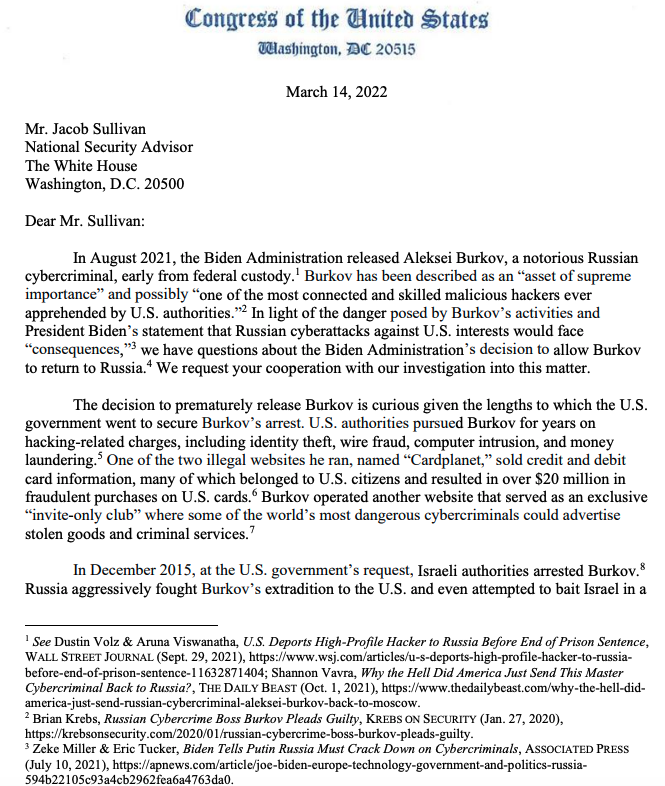
In June 2020, Burkov was sentenced to nine years in prison. But a little more than a year later — Aug. 25, 2021 — Burkov was released and deported back to Russia. According to a letter (PDF) sent Monday by four Republican House lawmakers to White House National Security Advisor Jake Sullivan, U.S. Immigration and Customs Enforcement (ICE) officials escorted Burkov onto a plane destined for Moscow shortly after his release.
“An ICE spokesperson stated that Burkov is wanted by Russian authorities, and a DOJ spokesperson denied that a prisoner exchange took place,” the letter reads. “The decision to prematurely release Burkov is curious given the lengths to which the U.S. government went to secure Burkov’s arrest.”
The letter, signed by the ranking members of the House Judiciary, Homeland Security, Intelligence and Foreign Affairs committees, demanded to know why Burkov was released prematurely, and whether the U.S. received anything in return. The lawmakers also asked for a list of all Russian nationals convicted of crimes in the U.S. who were released early since President Biden took office.
Records show Burkov was in the custody of either Israeli or U.S. authorities for almost five years prior to his sentencing in 2020. At the time of his release, Burkov had already been incarcerated for nearly six years. So where did the other years of his sentence go?
That remains unclear, but it is possible he cut some sort of deal to lessen his sentence. On June 16, 2021, a “sealed pleading” was added to Burkov’s court record, followed by a sealed document entered on Aug. 18 — a week before Burkov’s deportation.
The motion to seal these and other documents related to the pleading was made by U.S. federal prosecutors, and those documents remain hidden from public viewing.
As their cities suffered more intense bombardment by Russian military forces this week, Ukrainian Internet users came under renewed cyberattacks, with one Internet company providing service there saying they blocked ten times the normal number of phishing and malware attacks targeting Ukrainians.
John Todd is general manager of Quad9, a free “anycast” DNS platform. DNS stands for Domain Name System, which is like a globally distributed phone book for the Internet that maps human-friendly website names (example.com) to numeric Internet addresses (8.8.4.4.) that are easier for computers to manage. Your computer or mobile device generates DNS lookups each time you send or receive an email, or browse to a webpage.
With anycast, one Internet address can apply to many servers, meaning that any one of a number of DNS servers can respond to DNS queries, and usually the one that is geographically closest to the customer making the request will provide the response.
Quad9 insulates its users from a range of cyberattacks by blocking DNS requests for known-bad domain names, i.e., those confirmed to be hosting malicious software, phishing websites, stalkerware and other threats. And normally, the ratio of DNS queries coming from Ukraine that are allowed versus blocked by Quad9 is fairly constant.
But Todd says that on March 9, Quad9’s systems blocked 10 times the normal number of DNS requests coming from Ukraine, and to a lesser extent Poland.
Todd said Quad9 saw a significant drop in traffic reaching its Kyiv POP [point of presence] during the hostilities, presumably due to fiber cuts or power outages. Some of that traffic then shifted to Warsaw, which for much of Ukraine’s networking is the next closest significant interconnect site.
Quad9’s view of a spike in malicious traffic targeting Ukrainian users this week. Click to enlarge.
“While our overall traffic dropped in Kyiv — and slightly increased in Warsaw due to infrastructure outages inside of .ua — the ratio of (good queries):(blocked queries) has spiked in both cities,” he continued. “The spike in that blocking ratio [Wednesday] afternoon in Kyiv was around 10x the normal level when comparing against other cities in Europe (Amsterdam, Frankfurt.) While Ukraine always is slightly higher (20%-ish) than Western Europe, this order-of-magnitude jump is unprecedented.”
Quad9 declined to further quantify the data that informed the Y axis in the chart above, but said there are some numbers the company is prepared to share as absolutes.
“Looking three weeks ago on the same day of the week as yesterday, we had 118 million total block events, and of that 1.4 million were in Ukraine and Poland,” Todd said. “Our entire network saw yesterday on March 9th 121 million blocking events, worldwide. Of those 121 million events, 4.6 million were in Ukraine and Poland.”
Bill Woodcock is executive director at Packet Clearing House, a nonprofit based in San Francisco that is one of several sponsors of Quad9. Woodcock said the spike in blocked DNS queries coming out of Ukraine clearly shows an increase in phishing and malware attacks against Ukrainians.
“They’re being targeted by a huge amount of phishing, and a lot of malware that is getting onto machines is trying to contact malicious command-and-control infrastructure,” Woodcock said.
Both Todd and Woodcock said the smaller spike in blocked DNS requests originating from Poland is likely the result of so many Ukrainians fleeing their country: Of the two million people who have fled Ukraine since the beginning of the Russian invasion, more than 1.4 million have made their way to Poland, according to the latest figures from the United Nations.
The increase in malicious activity detected by Quad9 is the latest chapter in an ongoing series of cyberattacks against Ukrainian government and civilian systems since the outset of the war in the last week of February.
As Russian military tanks and personnel began crossing the border into Ukraine last month, security experts tracked a series of destructive data “wiper” attacks aimed at Ukrainian government agencies and contractor networks. Security firms also attributed to Russia’s intelligence services a volley of distributed denial-of-service (DDoS) attacks against Ukrainian banks just prior to the invasion.
Thus far, the much-feared large scale cyberattacks and retaliation from Russia haven’t materialized. But the data collected by Quad9 suggest that a great deal of low-level cyberattacks targeting Ukrainians remain ongoing.
It is unclear to what extent — if any — Russia’s vaunted cyber prowess may be stymied by mounting economic sanctions enacted by both private companies and governments. In the past week, two major backbone Internet providers said they would stop routing traffic for Russia.
Earlier today, the London Internet Exchange (LINX), one of the largest peering points where networks around the world exchange traffic, said it would stop routing for Russian Internet service providers Rostelecom and MegaFon. Rostelecom is Russia’s largest ISP, while MegaFon is Russia’s second-largest mobile phone operator and third largest ISP.
Doug Madory, director of research for Internet infrastructure monitoring firm Kentik, said LINX’s actions will further erode the connectivity of these large Russia providers to the larger Internet.
“If the other major EU exchanges followed suit, it could be really problematic for Russian connectivity,” Madory said.












 Daniel Quinn Flint (not related to Daniel RAY Flint who is a different person entirely)